


What Is a Furnace Heat Exchanger? Cracks & Safety
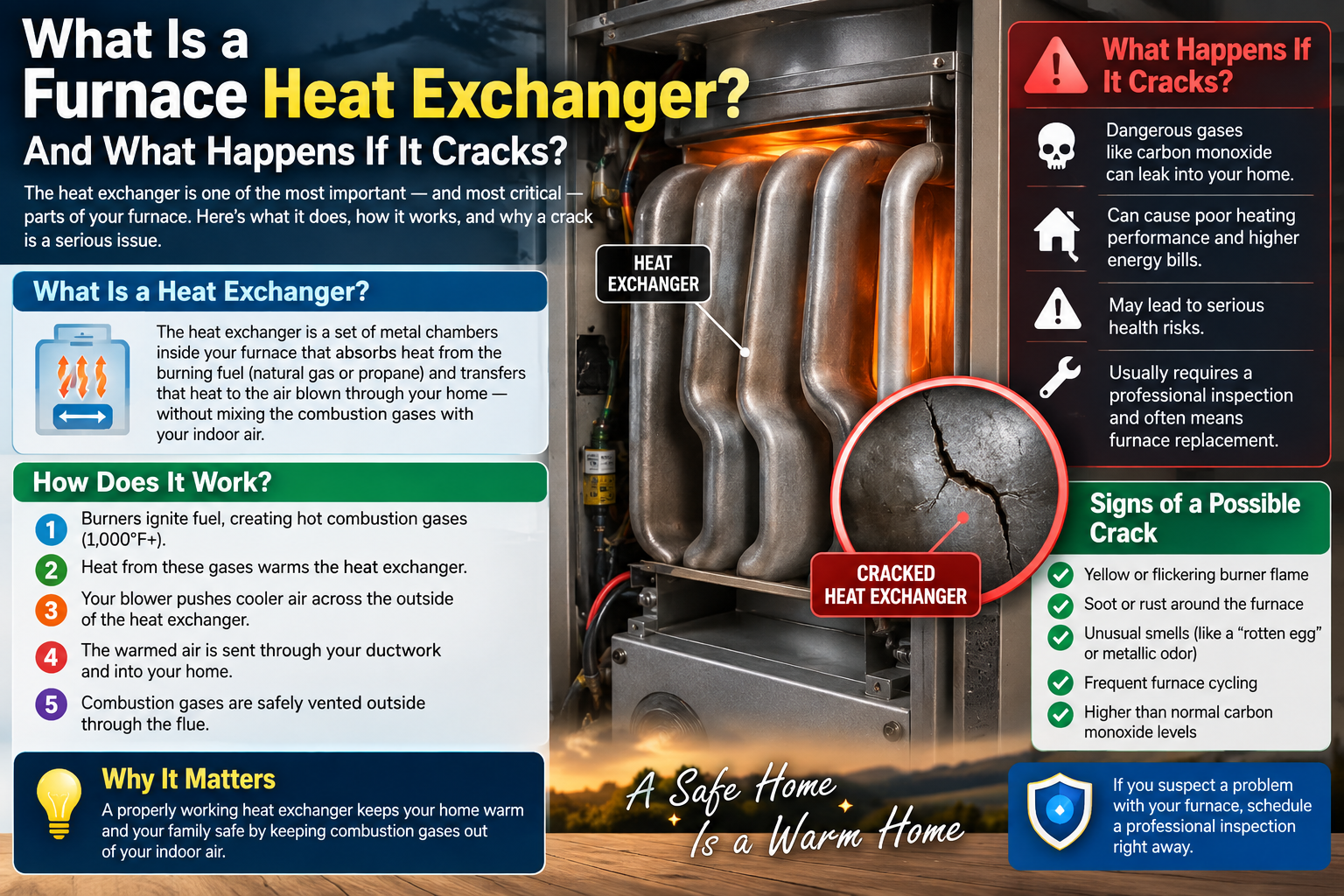
What Is a Furnace Heat Exchanger and What Happens If It Cracks?
If you’ve ever had a furnace technician tell you they’re inspecting the heat exchanger, you may have wondered:
What exactly is a heat exchanger—and why is it so important?
The heat exchanger is one of the most important components inside a gas furnace.
Its basic job is to transfer heat from the furnace’s combustion process to the air that heats your home while helping keep the combustion gases separated from the household air moving through the HVAC system.
Because of that role, the condition of the heat exchanger matters for both furnace performance and safety.
Here’s what homeowners should know.
Key Takeaways
- The heat exchanger transfers heat from combustion to the air circulating through your home.
- It helps separate furnace combustion gases from household supply air.
- Repeated heating and cooling places normal thermal stress on the metal.
- Age, overheating, corrosion and other operating conditions can contribute to heat-exchanger deterioration.
- A crack cannot reliably be diagnosed simply by looking at the color of the furnace flame.
- Carbon monoxide is colorless and odorless.
- A suspected damaged heat exchanger should be evaluated by a qualified HVAC professional.
- A carbon-monoxide alarm should always be treated seriously.
1. What Does a Furnace Heat Exchanger Do?
A gas furnace produces heat by burning fuel.
But the combustion gases created by that process aren’t supposed to simply mix with the air being circulated through your house.
That’s where the heat exchanger comes in.
The burners heat the heat exchanger.
Your furnace blower moves household air across the outside of the heated exchanger.
Heat transfers through the metal into that moving air.
The heated household air is then distributed through the ductwork while combustion products follow the furnace’s designed venting path.
So the heat exchanger acts as an important boundary between the combustion side of the furnace and the household-air side of the HVAC system.
2. Where Is the Heat Exchanger Located?
The heat exchanger is located inside the furnace cabinet.
It’s not something most homeowners can easily see or evaluate.
Depending on furnace design, the heat exchanger can consist of metal tubes, cells, passages or other formed sections positioned above the burners and within the furnace’s airflow path.
High-efficiency condensing furnaces may also incorporate a secondary heat exchanger to capture additional heat from combustion gases before they’re exhausted.
That additional heat recovery is one reason high-efficiency furnaces can achieve greater fuel efficiency.
3. Why Does a Heat Exchanger Expand and Contract?
Think about what happens every time your furnace operates.
The burners ignite.
The heat exchanger gets hot.
The heating cycle ends.
The furnace cools.
Then the process repeats.
Over years of operation, the metal experiences thousands of heating and cooling cycles.
Metal naturally expands when heated and contracts as it cools.
A properly designed furnace accounts for this, but age and operating conditions can eventually contribute to metal fatigue and deterioration.
4. What Can Cause a Furnace Heat Exchanger to Fail?
There’s rarely one universal cause.
Several conditions can contribute to heat-exchanger deterioration over time.
Age
Like other mechanical equipment, furnaces don’t last forever.
Years of heating and cooling cycles can eventually take their toll.
Overheating
Excessive furnace temperatures can place additional thermal stress on the heat exchanger.
That’s one reason airflow is so important.
A furnace that can’t move enough air may operate hotter than intended.
Restricted Airflow
Potential airflow restrictions include:
- Severely clogged filters
- Restricted return air
- Blocked supply airflow
- Dirty blower components
- Duct restrictions
- Incorrect blower operation
Airflow restrictions and overheating are conditions worth catching before they develop into larger heating problems.
Corrosion
Moisture and combustion-related conditions can contribute to corrosion depending on the furnace design and operating environment.
Improper Furnace Operation
Combustion, airflow, installation or venting problems can potentially expose furnace components to operating conditions they weren’t designed to experience.
This is why diagnosing the entire furnace matters.
5. What Does a Cracked Heat Exchanger Look Like?
This is where things become more complicated than many online articles make them sound.
A damaged heat exchanger isn’t always a dramatic opening that’s easy to see.
Depending on the furnace, deterioration might involve:
- Cracks
- Separated seams
- Holes
- Corrosion
- Metal fatigue
- Other structural deterioration
Some areas of a heat exchanger can also be difficult to inspect without appropriate tools or access.
That’s why a heat-exchanger diagnosis should be based on evidence—not simply telling a homeowner, “Your furnace is old, so the heat exchanger must be cracked.”
6. What Are Possible Signs of a Heat-Exchanger Problem?
There isn’t one homeowner symptom that proves the heat exchanger has failed.
However, conditions that deserve professional investigation can include:
- Abnormal burner behavior
- Soot or unusual combustion residue
- Furnace overheating
- Repeated safety shutdowns
- Unusual odors
- Visible deterioration
- Carbon-monoxide concerns
- Changes in furnace operation
Many of these symptoms can have other causes.
That’s why they should be treated as diagnostic clues rather than proof of a failed heat exchanger.
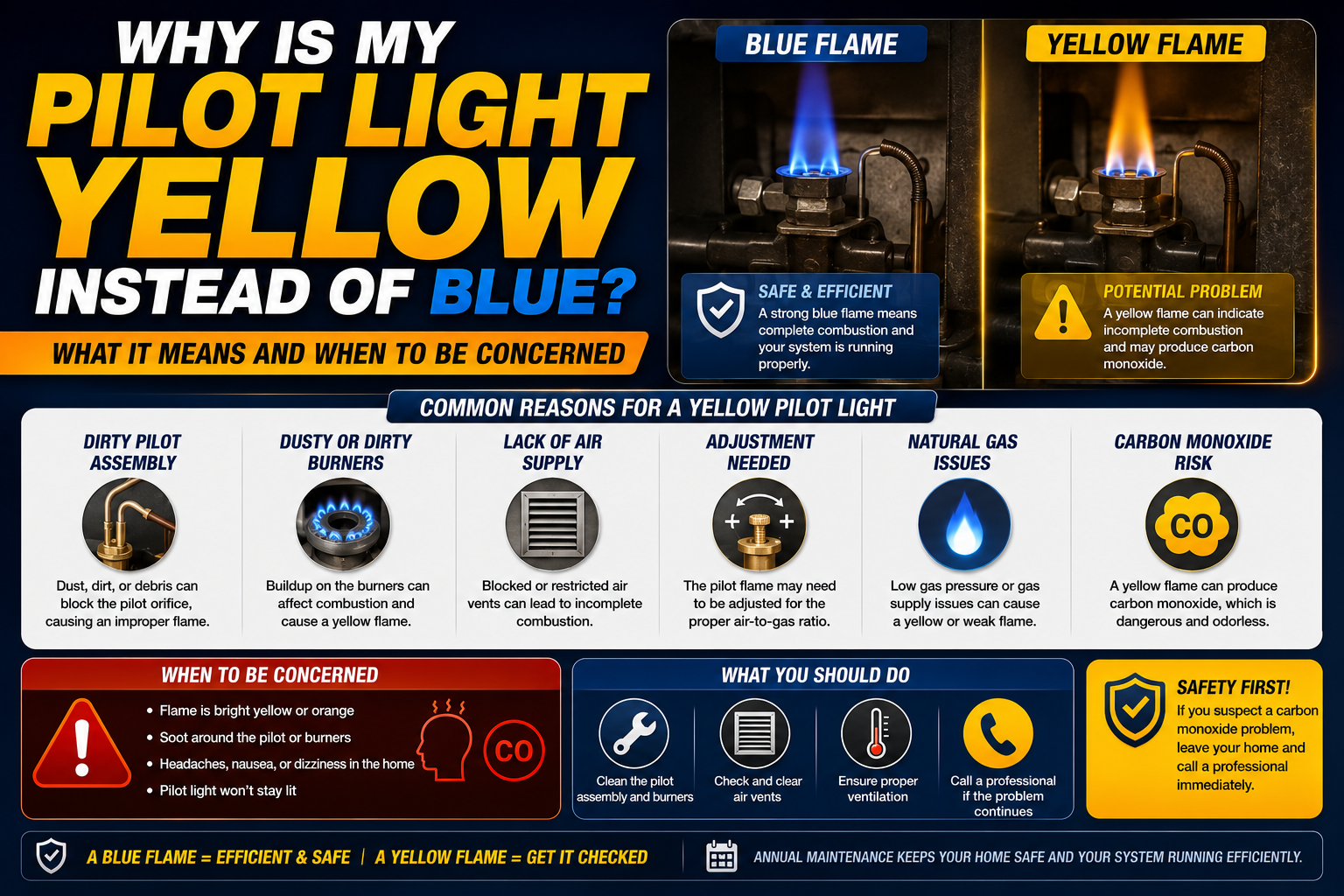
7. Does a Yellow Furnace Flame Mean the Heat Exchanger Is Cracked?
No.
This is an important distinction.
A yellow or orange furnace flame can indicate a combustion condition that deserves professional evaluation, with potential causes including dirty burners, combustion-air issues and venting problems.
But flame color by itself does not prove the heat exchanger is cracked.
A technician should evaluate the combustion system and gather additional evidence before reaching that conclusion.
8. Can a Cracked Heat Exchanger Cause Carbon Monoxide?
A damaged heat exchanger can create a potential pathway between areas of the furnace that are intended to remain separated.
That is one reason heat-exchanger integrity is taken seriously.
However, there’s another important point:
A carbon-monoxide alarm does not automatically prove that your furnace—or its heat exchanger—is the source.
Other fuel-burning appliances can also produce carbon monoxide.
9. Can You Smell Carbon Monoxide?
No.
Carbon monoxide is colorless and odorless.
You cannot depend on your nose to detect it.
That’s why properly installed and maintained carbon-monoxide alarms are so important in homes with fuel-burning appliances.
A strange furnace odor may deserve investigation, but the absence of an odor does not tell you whether carbon monoxide is present.
10. How Does an HVAC Technician Check a Heat Exchanger?
Inspection methods vary depending on the furnace, accessibility and suspected problem.
A professional evaluation may include:
- Visual inspection of accessible areas
- Inspection with appropriate cameras or mirrors
- Evaluating burner operation
- Looking for abnormal flame behavior
- Checking furnace temperature operation
- Evaluating airflow
- Inspecting venting
- Reviewing safety-control operation
- Combustion testing when appropriate
- Carbon-monoxide testing when appropriate
No single test should automatically be treated as the answer in every situation.
The goal is to gather enough evidence to determine what’s actually happening.
Why Airflow Matters to the Heat Exchanger
Airflow is directly connected to how the heat exchanger manages heat.
The furnace produces heat, but the blower must remove that heat at the proper rate.
If airflow becomes severely restricted, furnace temperature can increase.
Safety controls are designed to respond to excessive temperature, but a furnace that repeatedly overheats shouldn’t simply be reset and ignored.
The underlying airflow problem needs to be identified.
This is why seemingly unrelated components such as filters, blower motors, ductwork, and return-air systems can influence furnace operation and potentially affect the stress placed on heating components.
What Is a Furnace High-Limit Switch?
The high-limit control helps protect the furnace from excessive temperature.
If furnace temperature rises beyond the intended operating range, the control can interrupt burner operation.
The blower may continue operating to help remove heat.
If a furnace repeatedly trips its limit, the solution isn’t automatically to replace the limit switch.
A technician should determine why the furnace is overheating.
Potential causes can include restricted airflow, blower problems, duct restrictions and other operating conditions.
Can a Cracked Heat Exchanger Be Repaired?
The appropriate action depends on the furnace design, condition, manufacturer guidance, component availability, equipment age and extent of the damage.
In many situations involving a confirmed failed heat exchanger, the realistic decision becomes comparing heat-exchanger replacement versus furnace replacement.
That doesn’t mean every older furnace automatically needs replacement.
Furnace age is only one factor; condition, repair history, efficiency, and repair cost also matter.
Should I Replace My Furnace If the Heat Exchanger Is Cracked?
A confirmed heat-exchanger failure is significantly different from a minor furnace repair.
Before making a major replacement decision, homeowners should understand:
- What damage was found?
- Where is it located?
- How was it confirmed?
- How old is the furnace?
- Is a replacement heat exchanger available?
- What warranty coverage remains?
- What is the cost of repair compared with furnace replacement?
- Are there other major components showing significant wear?
Those questions help turn an emotional decision into an informed one.
Ask to See the Evidence
If you’re told that your furnace has a cracked heat exchanger and requires major repair or replacement, it’s reasonable to ask the technician to explain what was found.
When possible, ask to see photos, video, the damaged area, or the test results supporting the diagnosis.
Not every failure can be photographed easily, but a reputable HVAC professional should be willing to explain the evidence behind a major recommendation.
This is especially important when the recommendation involves replacing an entire furnace.
Can Furnace Maintenance Prevent a Cracked Heat Exchanger?
Maintenance cannot guarantee that a heat exchanger will never fail.
Components age.
Metal deteriorates.
Mechanical equipment eventually wears.
But regular furnace maintenance can help identify operating conditions that may contribute to excessive stress, including airflow restrictions, overheating, combustion issues and other abnormal operation.
Advanced Heating & Air Conditioning’s heating-maintenance service includes burner inspection, heat-exchanger inspection, blower evaluation, electrical checks, thermostat testing, and safety-control testing.
What Should I Do If My Carbon-Monoxide Alarm Goes Off?
Don’t attempt to determine whether the furnace is responsible while remaining inside the home.
Treat a carbon-monoxide alarm seriously.
Move occupants to fresh air and follow the detector manufacturer’s instructions and appropriate emergency guidance.
A CO alarm should never be ignored, and the furnace is only one potential source among fuel-burning appliances.
Frequently Asked Questions
What does a furnace heat exchanger do?
It transfers heat from the furnace’s combustion process to the household air while helping keep combustion gases separated from the air circulated through the home.
How long does a furnace heat exchanger last?
There isn’t one guaranteed lifespan. Furnace age, operating conditions, airflow, maintenance, installation and equipment design can all influence longevity.
Does a cracked heat exchanger always cause carbon monoxide?
A damaged heat exchanger is a serious concern because it can compromise the intended separation within the furnace, but carbon-monoxide conditions depend on several factors. A suspected failure should be professionally evaluated.
Can I see a cracked heat exchanger myself?
Not necessarily. Much of the heat exchanger may be difficult to access or inspect without appropriate equipment.
Does a yellow furnace flame prove the heat exchanger is cracked?
No. Flame abnormalities can have several causes. A yellow flame deserves professional evaluation but doesn’t prove a heat-exchanger failure by itself.
Can a dirty air filter damage a heat exchanger?
A severely restricted filter can reduce airflow and contribute to furnace overheating. Chronic overheating can place additional thermal stress on furnace components.
Can a cracked heat exchanger be repaired?
The appropriate solution depends on the furnace and type of damage. In some cases heat-exchanger replacement may be possible; in others replacing the furnace may make more practical sense.
Should I get a second opinion on a cracked heat exchanger?
For a major diagnosis that could result in furnace replacement, obtaining clear evidence and, when desired, a second professional opinion is reasonable.
Don’t Diagnose a Furnace by Guesswork
A cracked heat exchanger is serious.
But so is telling a homeowner they have one without properly establishing the diagnosis.
At Advanced Heating & Air Conditioning, our furnace-repair process emphasizes inspecting the complete heating system and finding the root cause before recommending repairs.
That’s particularly important with major furnace decisions.
Homeowners deserve to understand what was found, why it matters, and what their realistic options are.
Furnace & Heating Service in the Temecula Valley
Advanced Heating & Air Conditioning provides furnace repair, heating maintenance, furnace installation and heating-system diagnostics throughout Temecula, Murrieta, Menifee, Winchester, Wildomar, French Valley, Canyon Lake, Lake Elsinore, Hemet and surrounding Southern California communities.
The company is locally owned and operated, has served the Temecula Valley since 2008, services all brands and models, and holds California Contractor License #916901.
Advanced Heating & Air Conditioning
951-609-9881
California Contractor License #916901
AdvancedHeatingAndAir.com
REAL PEOPLE. REAL SERVICE. REAL COMFORT.