


Single-Stage vs Two-Stage vs Modulating Furnaces
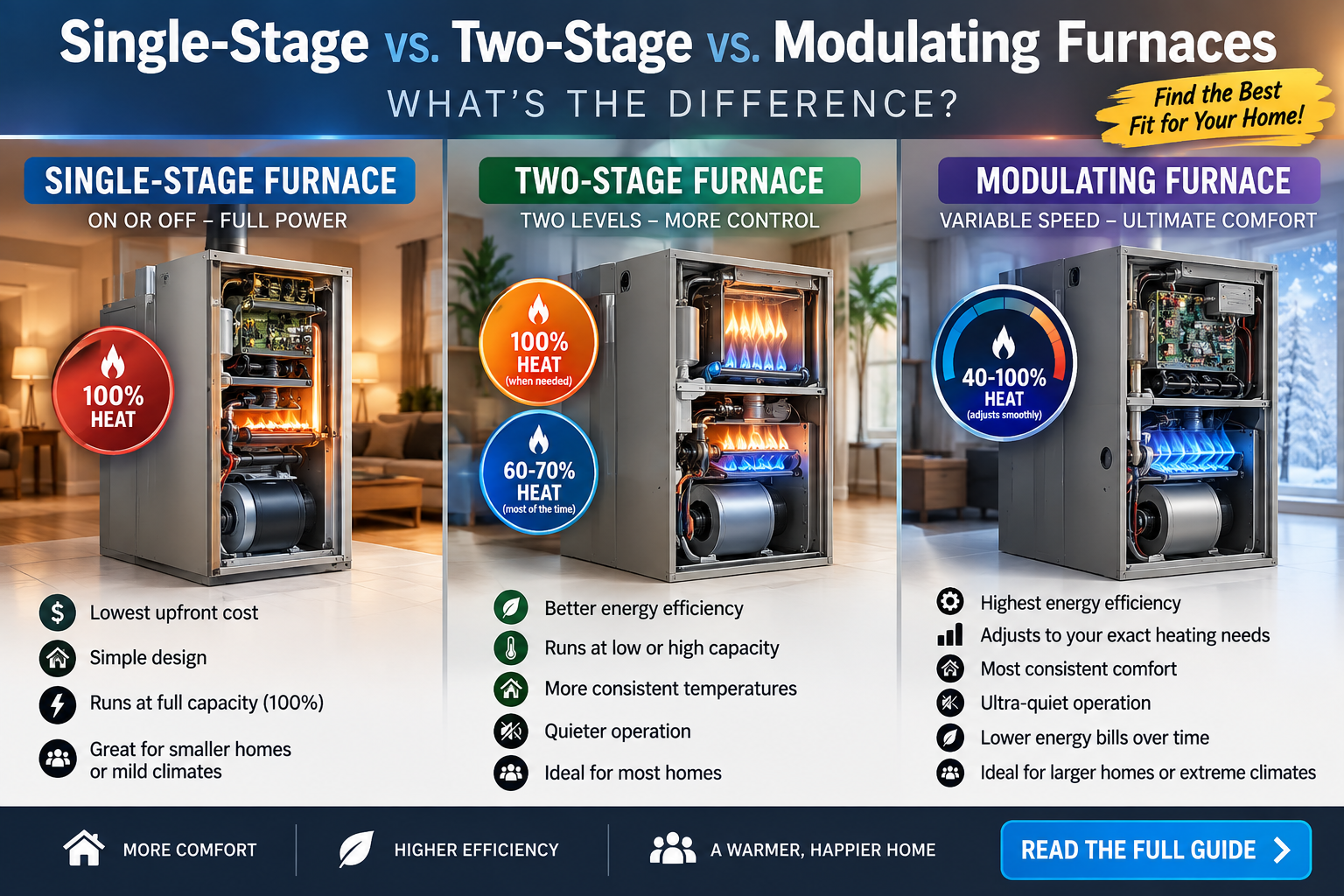
Single-Stage vs. Two-Stage vs. Modulating Furnaces: What’s the Difference?
When homeowners shop for a new furnace, they often focus on one number:
AFUE.
But efficiency isn’t the only difference between furnaces.
You may also see terms like:
- Single-stage
- Two-stage
- Multi-stage
- Modulating
- Variable-speed
What do they actually mean?
And does a more advanced furnace automatically mean lower utility bills?
Not necessarily.
Understanding how these technologies work can help you choose equipment based on comfort, efficiency, noise, airflow and your actual home rather than simply buying the furnace with the longest feature list.
Key Takeaways
- A single-stage furnace generally operates at one heating output when firing.
- A two-stage furnace can operate at a lower and higher heating output.
- A modulating furnace can adjust heating output through a broader range.
- Variable-speed usually describes blower operation and should not automatically be confused with burner stages.
- Longer heating cycles aren’t necessarily bad.
- More stages can improve temperature consistency and comfort when the equipment is properly selected and installed.
- Furnace sizing and ductwork remain critical regardless of furnace technology.
- The most expensive furnace isn’t automatically the best furnace for every Southern California home.
What Is a Furnace Stage?
A furnace’s heating stage describes how much heating output the equipment can produce during operation.
Think of it like driving a vehicle.
A basic single-stage furnace is somewhat like having:
OFF or full throttle.
A two-stage furnace adds another operating level.
A modulating furnace can make smaller adjustments across a wider range.
That’s a simplified analogy, but it helps explain the basic difference.
What Is a Single-Stage Furnace?
A single-stage gas furnace has one primary heating-output level.
When the thermostat calls for heat:
The furnace turns on.
It operates at its designed heating capacity.
When the thermostat is satisfied:
The furnace turns off.
This is a straightforward and widely used furnace design.
Advantages of a Single-Stage Furnace
Potential advantages include:
- Simpler equipment
- Lower initial equipment cost in many cases
- Straightforward operation
- Proven technology
- Appropriate performance for many homes
There’s nothing inherently wrong with a single-stage furnace.
A properly sized and properly installed single-stage furnace can provide excellent heating.
The problems often occur when homeowners assume:
More technology automatically means better installation.
It doesn’t.
What Is a Two-Stage Furnace?
A two-stage furnace has two levels of heating output.
Rather than always operating at maximum capacity, the furnace can operate at a lower heating stage during lighter heating demand and use its higher stage when more heat is required.
Exact percentages vary by furnace model.
The concept is what’s important.
Instead of:
OFF → HIGH → OFF
the furnace can operate more like:
OFF → LOW → HIGH when necessary → OFF
During many heating conditions, the lower stage may be sufficient to maintain indoor temperature.
Why Would I Want My Furnace Running at a Lower Stage?
Because your home doesn’t need maximum furnace capacity every minute of the heating season.
Consider a cool Temecula evening versus one of the coldest mornings of the year.
The heating demand isn’t the same.
A two-stage furnace can potentially operate at lower output when the home’s heating load is relatively small.
That can produce:
- Longer, steadier heating cycles
- More gradual temperature changes
- Quieter operation
- More consistent comfort
and potentially different energy-use characteristics depending on the equipment and application.
Are Longer Furnace Cycles Bad?
Not automatically.
This is a common misconception.
Homeowners sometimes believe:
“If my furnace runs longer, it must be wasting energy.”
But runtime alone doesn’t tell you whether a furnace is operating efficiently.
A correctly operating lower-stage or modulating furnace may intentionally run longer at reduced output.
That can be preferable to repeatedly blasting the house with full heating capacity and shutting off.
The problem is when a furnace runs excessively because it cannot satisfy the heating load or has another performance issue.
That’s very different.
What Is a Modulating Furnace?
A modulating furnace takes the concept further.
Instead of having only one or two heating outputs, a modulating furnace can adjust its heating capacity through a broader operating range.
The exact modulation range and increments depend on the furnace model.
The objective is to more closely match furnace output to the home’s current heating demand.
Instead of repeatedly making large temperature corrections, the furnace can make smaller adjustments.
This can provide very consistent indoor comfort when the entire system is designed correctly.
Does a Modulating Furnace Run All the Time?
It may operate for longer periods at lower output.
That isn’t automatically a problem.
The objective isn’t necessarily to make the furnace run for the shortest possible amount of time.
The objective is to maintain comfort efficiently while avoiding unnecessary temperature swings and excessive cycling.
Think about cruise control.
Maintaining a steady speed can be smoother than repeatedly accelerating hard and then slowing down.
A modulating heating system follows a similar general idea.
What Does Variable-Speed Mean?
This is where furnace terminology gets confusing.
Variable-speed doesn’t necessarily mean the same thing as modulating.
Modulating generally refers to the furnace’s heating output.
Variable-speed commonly refers to the blower motor’s ability to adjust airflow.
They’re related technologies, but they’re not identical.
A furnace can have different combinations of heating stages and blower technology.
That’s why homeowners should ask exactly what a salesperson means when they say:
“This is a variable-speed furnace.”
What Does the Furnace Blower Do?
The blower moves conditioned air through your duct system.
It pulls return air back toward the HVAC equipment and pushes heated air through the supply ductwork into the home.
Blower performance affects:
- Airflow
- Temperature rise
- Duct pressure
- Noise
- Filtration
- Comfort
and overall HVAC performance.
Modern variable-speed blower motors can operate differently and may use less electricity than older single-speed blower designs.
Single-Stage vs. Two-Stage Furnace
Here’s the homeowner-friendly comparison:
- Heating outputs — Single-stage: one. Two-stage: two.
- Basic operation — Single-stage: full heating output. Two-stage: lower + higher output.
- Equipment complexity — Single-stage: lower. Two-stage: higher.
- Initial cost — Single-stage: often lower. Two-stage: often higher.
- Temperature consistency — Single-stage: good when properly sized. Two-stage: potentially better.
- Noise — Single-stage: depends on system. Two-stage: often quieter on lower stage.
- Runtime — Single-stage: typically more on/off operation. Two-stage: can run longer at lower output.
- Comfort control — Single-stage: basic. Two-stage: more adaptable.
These are general differences.
Actual performance depends heavily on the furnace, thermostat, ductwork, installation and home.
Two-Stage vs. Modulating Furnace
A two-stage furnace provides two heating levels.
A modulating furnace can make more gradual changes across a broader range.
That can allow the modulating furnace to more closely match the home’s heating requirement.
But that additional control comes with additional equipment sophistication and potentially higher initial cost.
The question isn’t:
“Which furnace has more technology?”
It’s:
“Will this technology provide meaningful benefits in my home?”
Does a Two-Stage Furnace Save Money?
Potentially—but don’t assume a guaranteed percentage.
Fuel consumption depends on many factors:
- AFUE
- Furnace capacity
- Heating demand
- Outdoor temperature
- Thermostat settings
- Insulation
- Air leakage
- Duct leakage
- Gas prices
- Equipment setup
- Runtime
Two-stage operation can reduce unnecessary full-capacity operation under lighter heating loads, but that doesn’t translate into one universal savings percentage.
Be cautious of anyone promising a specific utility-bill reduction without evaluating the home.
Does a Modulating Furnace Save More Than a Two-Stage Furnace?
Again, it depends.
A modulating furnace can more closely match heating output to demand, but whether the additional equipment cost produces enough energy savings to justify the upgrade depends on the application.
In Southern California, this deserves special consideration because annual heating demand can be much lower than in colder climates.
The comfort benefits may sometimes be more noticeable than the fuel-cost savings.
Which Furnace Provides the Best Comfort?
Generally, equipment that can adjust output has more ability to maintain a consistent temperature.
Imagine your thermostat is set to 70°F.
A basic furnace may produce more noticeable cycles:
Temperature falls → furnace runs at full output → temperature rises → furnace shuts off.
A staged or modulating furnace can potentially maintain the target temperature with smaller adjustments.
That may mean fewer noticeable hot-and-cold swings.
But proper furnace sizing remains essential.
Furnace Staging Does Not Fix an Oversized System
This is extremely important.
Proper sizing matters: oversized heating equipment can cycle too quickly and create hot-and-cold swings.
Don’t use advanced furnace technology as an excuse to skip load calculations.
A furnace still needs to be properly matched to the home.
A good installation considers:
- Home size
- Layout
- Insulation
- Windows
- Air leakage
- Ductwork
- Heating load
and other building characteristics.
What Happens If My Furnace Is Too Big?
An oversized furnace can deliver heat faster than the home actually requires.
That can contribute to:
- Short heating cycles
- Temperature swings
- Uneven comfort
- More noticeable noise
- Potential airflow issues
and unnecessary cycling.
Your thermostat may reach its setpoint quickly, but that doesn’t necessarily mean the system is providing better comfort.
Bigger is not automatically better.
Does My Ductwork Matter With a Two-Stage or Modulating Furnace?
Absolutely.
You can install sophisticated equipment and still have poor comfort if the duct system doesn’t perform correctly.
The ductwork has to distribute the air.
Potential problems include:
- Undersized ducts
- Restricted returns
- Crushed flex duct
- Disconnected ducts
- Excessive duct leakage
- Poor register placement
- High static pressure
- Poor room-to-room balancing
Advanced Heating & Air Conditioning evaluates existing ductwork when recommending new heating and heat-pump equipment.
That’s critical because the equipment and duct system have to work together.
Does a Two-Stage Furnace Need a Special Thermostat?
It depends on the furnace and control strategy.
Some systems use thermostat staging.
Others may use equipment controls to determine when additional heating output is needed.
Communicating and modulating systems can have more specific control requirements.
The correct thermostat should therefore be selected based on the actual furnace and system configuration.
Don’t assume every thermostat supports every advanced furnace feature.
What Is a Communicating Furnace?
Some advanced HVAC systems allow the thermostat, furnace, outdoor equipment and other components to exchange more detailed operating information.
Instead of simple basic commands, a communicating system may coordinate equipment operation more precisely.
Depending on the manufacturer, this can support features such as:
- Modulation
- Variable airflow
- System diagnostics
- Humidity control
- Equipment staging
and more advanced comfort management.
But communicating systems should be evaluated as complete systems.
Compatibility matters.
Is a Variable-Speed Blower Quieter?
It can be.
If the blower can operate at lower airflow during lower heating demand, homeowners may notice less airflow noise than when a system immediately operates at full output.
But equipment technology isn’t the only factor controlling noise.
Poor duct design can create:
- Whistling
- Rushing-air sounds
- Noisy returns
- Register noise
even with expensive HVAC equipment.
Again, the system matters more than the equipment label.
Does Variable-Speed Improve Air Filtration?
Potentially.
Longer periods of air circulation can mean more household air passes through the filtration system.
However, filtration performance also depends on:
- Filter type
- Filter resistance
- Duct design
- Blower setup
- Runtime
and the indoor-air-quality equipment installed.
You shouldn’t install an overly restrictive filter simply because you have a variable-speed blower.
Airflow still matters.
Which Furnace Is Best for Temecula?
There isn’t one furnace that’s best for every Temecula Valley home.
A homeowner who uses very little heat and plans to move soon may make a different decision than someone who:
- Plans to remain in the house for 15 years
- Values extremely consistent temperatures
- Has a large two-story home
- Wants quieter operation
- or is replacing an entire HVAC system at once.
Southern California’s relatively mild heating season also means the economics can differ substantially from colder parts of the country.
That should be part of the conversation.
Should I Spend More on a Two-Stage or Modulating Furnace?
Ask what you’re getting for the additional investment.
Consider:
- Initial equipment cost
- Expected heating usage
- AFUE
- Comfort benefits
- Noise
- Blower technology
- Thermostat/control requirements
- Repair complexity
- Warranty
- Expected ownership period
and whether the home’s ductwork can support the system properly.
Then make the decision based on the complete installation.
Frequently Asked Questions
What is a single-stage furnace?
A single-stage furnace generally has one primary heating-output level when the burners are operating.
What is a two-stage furnace?
A two-stage furnace can operate at a lower heating output and a higher output depending on heating demand and system controls.
What is a modulating furnace?
A modulating furnace can adjust heating output through a broader range rather than operating at only one or two fixed levels.
Is variable-speed the same as two-stage?
No. Two-stage generally describes heating capacity, while variable-speed commonly describes blower operation.
Is a two-stage furnace more comfortable?
It can be. Lower-stage operation can allow longer, gentler heating cycles and potentially reduce noticeable temperature swings.
Is a modulating furnace worth the money?
It depends on the home, climate, heating usage, comfort expectations, equipment cost and how long you plan to own the system.
Does a two-stage furnace run longer?
It may intentionally run longer at lower output. Longer runtime isn’t automatically inefficient or a sign of a problem.
Which is better: high AFUE or two-stage?
They’re different specifications. AFUE describes fuel efficiency; staging describes how the furnace can adjust heating output. A furnace can have both characteristics.
Do I need new ductwork for a variable-speed furnace?
Not automatically. Existing ductwork should be evaluated for size, condition, leakage and airflow before determining whether changes are necessary.
Does the most expensive furnace provide the best comfort?
Not necessarily. Proper sizing, airflow, ductwork, controls and installation quality can be just as important as equipment features.
Don’t Buy a Furnace Based on the Feature List
This is the biggest takeaway.
A furnace brochure might say:
- 97% AFUE
- Modulating gas valve
- Variable-speed blower
- Communicating controls
Those can all be valuable features.
But none of them replaces:
- Correct sizing
- Proper airflow
- Good duct design
- Correct installation
- Proper setup and testing
A good heat-pump installation makes this same system-level point — evaluating the property’s layout, ductwork, airflow, electrical requirements, and heating/cooling needs before equipment selection.
The best HVAC system isn’t necessarily the one with the most technology.
It’s the one that is correctly selected, installed and configured for the home.
Furnace Installation in the Temecula Valley
If you’re comparing single-stage, two-stage, modulating or variable-speed heating equipment, Advanced Heating & Air Conditioning can evaluate the home and explain the differences before you choose a system.
Advanced’s current installation process considers equipment capacity, efficiency, ductwork, airflow, thermostat compatibility and property requirements rather than selecting equipment from one specification alone.
Advanced serves Temecula, Murrieta, Menifee, Winchester, Wildomar, French Valley, Canyon Lake, Lake Elsinore, Hemet and surrounding Southern California communities.
Advanced Heating & Air Conditioning
951-609-9881
California Contractor License #916901
AdvancedHeatingAndAir.com
REAL PEOPLE. REAL SERVICE. REAL COMFORT.