


Should I Replace My Ductwork With a New HVAC System?
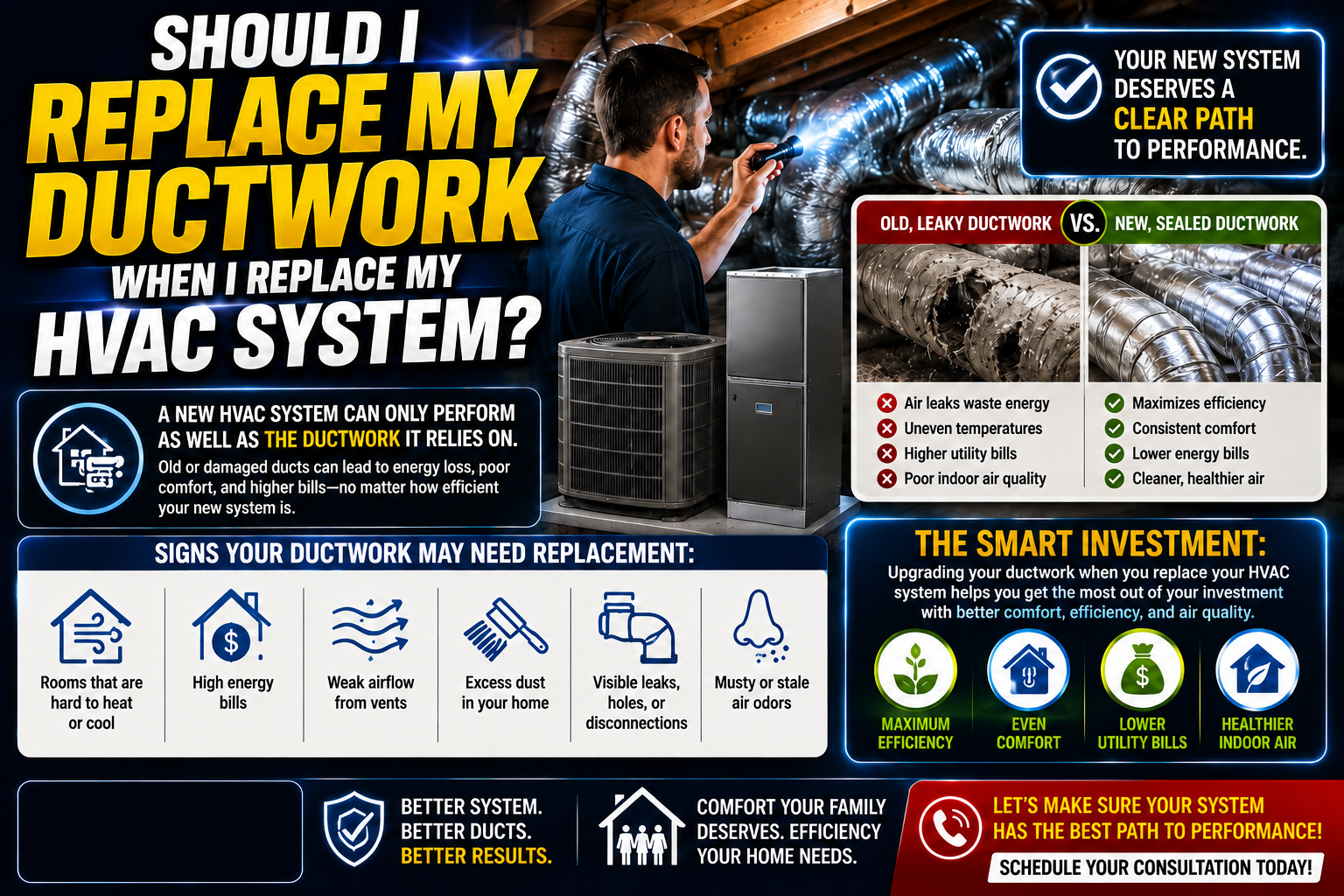
Do You Need New Ductwork When Installing a New HVAC System?
You’re replacing your air conditioner, furnace, or heat pump.
You’ve chosen new equipment.
Then another question comes up:
“What about my ductwork?”
Do the ducts need to be replaced too?
Can you connect brand-new HVAC equipment to the ducts already in your home?
Or would keeping old ductwork reduce the performance of your new system?
The answer is:
It depends on the condition and design of your existing duct system.
Not every HVAC replacement requires completely new ductwork.
But homeowners also shouldn’t automatically assume that ducts installed decades ago are still in good condition simply because they’re hidden from view.
Before investing in new heating and cooling equipment, your ductwork deserves attention.
Why Is Ductwork So Important?
Your HVAC equipment creates conditioned air.
Your duct system delivers it.
Think about purchasing a new high-performance air conditioner and then trying to send the conditioned air through a distribution system that’s:
- Damaged
- Leaking
- Undersized
- Poorly insulated
- Restricted
- Disconnected
Even excellent equipment can struggle to provide the comfort you expect when the air distribution system isn’t functioning properly.
That’s why an HVAC system should be viewed as more than just the outdoor condenser.
The complete system includes the equipment and the way air moves through your home.
What Does Residential Ductwork Do?
During cooling operation, conditioned air leaves the indoor HVAC equipment and travels through supply ducts to rooms throughout the house.
Air then needs a path back toward the equipment through the return-air system.
The basic cycle looks like this:
Return air → HVAC equipment → conditioned air → supply ducts → rooms → return air
This happens repeatedly whenever the system operates.
Problems anywhere in that airflow path can affect comfort and performance.
Do I Automatically Need New Ductwork With a New AC?
No.
If your existing duct system is:
- Properly sized
- In good physical condition
- Properly sealed
- Adequately insulated where appropriate
- Providing good airflow
- Correctly configured for the new equipment
it may be possible to continue using it.
Replacing good ductwork simply because you’re replacing the HVAC equipment may be unnecessary.
The important step is evaluating it rather than assuming.
When Should Ductwork Be Evaluated for Replacement?
Several situations should make homeowners pay closer attention to their existing ducts.
1. Your Ductwork Is Very Old
Duct systems don’t remain new forever.
Over time, materials can deteriorate.
Connections can loosen.
Insulation can degrade.
Flexible duct can become damaged.
Sections may sag, collapse, or disconnect.
Older ductwork isn’t automatically bad, but age makes inspection increasingly important.
If you’re replacing HVAC equipment that has already served the home for many years, the duct system may be just as old — or even older.
2. You Have Damaged Flexible Ductwork
Flexible duct is common in many Southern California homes.
When properly installed and maintained, it can distribute conditioned air effectively.
However, flexible duct can be damaged by:
- Age
- Attic activity
- Pests
- Improper installation
- Crushing
- Kinking
- Excessive sagging
- Accidental contact
A badly crushed or kinked duct can restrict airflow.
A torn duct can allow conditioned air to escape.
3. Sections of Ductwork Are Disconnected
A disconnected supply duct can send conditioned air into an attic instead of into your bedroom.
That means you’re paying to cool a space you don’t live in.
Meanwhile, the affected room may feel:
- Hot
- Stuffy
- Uncomfortable
- Low on airflow
If one room suddenly develops very weak airflow, duct damage or disconnection is one possibility.
4. Your Ducts Are Leaking
Duct leakage can reduce the amount of conditioned air that reaches the rooms in your home.
Depending on where leakage occurs, it may also affect the air being pulled into the return side of the HVAC system.
Potential signs can include:
- Uneven temperatures
- Weak airflow
- Long HVAC cycles
- Difficulty maintaining temperature
- Excessive dust
- Higher-than-expected energy usage
Not every duct leak requires complete duct replacement.
Some systems may be repairable or sealable depending on their condition.
5. Your Ductwork Is Improperly Sized
This is one of the most important issues to consider when installing new HVAC equipment.
Ductwork needs to handle the airflow required by the equipment.
If ducts are too restrictive, the system may have difficulty moving the proper amount of air.
Potential consequences can include:
- Excessive static pressure
- Noisy airflow
- Weak airflow
- Comfort problems
- Equipment performance issues
- Increased system strain
Installing a new HVAC system doesn’t automatically correct an old duct design problem.
6. You Don’t Have Enough Return Air
Supply ducts get a lot of attention because they’re where conditioned air enters the rooms.
But return airflow is equally important.
Your HVAC system can’t effectively distribute air if it has difficulty pulling enough air back toward the equipment.
Insufficient return airflow can contribute to:
- Airflow problems
- Noise
- Comfort issues
- Increased system pressure
- Reduced equipment performance
When new equipment is installed, the return-air system should be considered along with the supply ducts.
7. Certain Rooms Have Always Been Uncomfortable
Think about how your home performed before the old HVAC equipment failed.
Was there a bedroom that was always hot?
An office that never received enough air?
A downstairs room that became freezing while the upstairs stayed warm?
If these problems existed for years, simply replacing the air conditioner with another one may not solve them.
The underlying problem may involve:
- Duct design
- Airflow balance
- Return airflow
- Insulation
- Window heat gain
- Equipment sizing
A replacement project is an excellent time to investigate long-standing comfort complaints.
8. You’ve Added or Remodeled Living Space
Homes change.
Maybe you’ve:
- Added a bedroom
- Converted a garage
- Added an office
- Expanded the living area
- Changed walls
- Modified ceilings
- Completed a major remodel
If the home’s layout or conditioned square footage has changed, the original duct system may no longer match the home’s current needs.
Adding a duct to a new room without considering the rest of the system can also affect airflow elsewhere.
9. Your Duct Insulation Is Damaged
Many ducts travel through unconditioned spaces such as attics.
During summer, attic temperatures can become extremely high.
Duct insulation helps reduce unwanted heat transfer between the conditioned air inside the duct and the surrounding attic.
If insulation is damaged, missing, or deteriorated, conditioned air can gain heat before it reaches the rooms.
This can reduce comfort and increase cooling demand.
10. The Existing Duct Layout Was Poorly Designed
Sometimes the issue isn’t age.
It’s design.
A duct system may have had problems from the day it was installed.
Examples can include:
- Excessively long duct runs
- Poor transitions
- Sharp restrictions
- Inadequate return-air pathways
- Poorly sized ducts
- Too many bends
- Improper branch sizing
If your home has never had balanced temperatures, the duct layout may deserve closer evaluation.
How Can Bad Ductwork Affect a Brand-New HVAC System?
Homeowners sometimes expect new HVAC equipment to solve every comfort problem.
But imagine installing a new system capable of moving a certain amount of air while connecting it to ducts that can’t handle that airflow properly.
The equipment and ductwork are now working against each other.
Possible symptoms can include:
- Loud airflow
- Weak airflow
- Long operating cycles
- Short cycling
- Hot or cold rooms
- Poor comfort
- Equipment performance problems
The new HVAC system is only one part of the installation.
What Is Static Pressure?
Static pressure is an important concept in HVAC airflow.
You can think of it as resistance to airflow within the duct system.
Several things can contribute to excessive resistance, including:
- Restrictive filters
- Undersized ducts
- Closed dampers
- Poor duct design
- Dirty components
- Restricted return air
An HVAC technician can take measurements to evaluate how the air distribution system is operating.
Homeowners don’t need to become airflow engineers.
But it’s worth understanding that duct size and design directly affect how your equipment operates.
Should My Ducts Be Bigger With a New High-Efficiency System?
Not automatically.
Duct sizing should be based on airflow requirements and system design rather than simply whether the equipment is high efficiency.
Different equipment combinations may have different airflow requirements.
This is why existing ductwork should be evaluated when changing equipment.
Can I Replace Only Part of My Ductwork?
Sometimes.
If most of the duct system is in good condition but one section is:
- Damaged
- Crushed
- Disconnected
- Improperly sized
targeted repair or replacement may be appropriate.
Complete duct replacement isn’t always necessary.
The right approach depends on the overall condition and design of the system.
Can Old Ductwork Be Sealed Instead of Replaced?
In some situations, yes.
If the duct material is structurally sound but connections or joints are leaking, sealing may be an option.
However, sealing won’t fix every problem.
It won’t correct:
- Severely damaged ducts
- Collapsed duct sections
- Poor sizing
- Major design deficiencies
- Deteriorated materials
The system needs to be evaluated before deciding whether repair, sealing, modification, or replacement makes the most sense.
Should I Replace Ductwork During HVAC Replacement or Later?
If significant duct problems are already known, addressing them during the HVAC replacement can make sense.
You’re already investing in new equipment.
This is an opportunity to make sure the complete system works together.
Doing the work at the same time may also reduce the frustration of installing a new air conditioner only to discover that old ductwork is preventing the home from becoming comfortable.
However, if the existing ducts are in good condition, replacing them simply because they’re accessible during the project may not provide meaningful benefit.
What Should Be Checked Before Keeping Existing Ductwork?
Before connecting new HVAC equipment to an existing duct system, consider evaluating:
Physical Condition
Are there torn, crushed, deteriorated, or disconnected sections?
Air Leakage
Are obvious leaks present?
Supply Airflow
Are rooms receiving appropriate airflow?
Return Airflow
Can enough air return to the equipment?
Duct Size
Can the system support the airflow requirements of the proposed equipment?
Insulation
Is duct insulation in appropriate condition?
Layout
Does the duct design properly serve the home?
The answers can help determine whether the existing duct system should stay.
Does New Ductwork Improve Energy Efficiency?
It can if the existing ductwork has significant problems.
For example, correcting substantial duct leakage may reduce conditioned-air losses.
Improving damaged insulation may reduce heat transfer.
Correcting airflow restrictions may help equipment operate more effectively.
But homeowners shouldn’t assume that replacing perfectly functional ductwork automatically produces dramatic energy savings.
Improvements should address an actual problem.
Will New Ductwork Make My House More Comfortable?
If poor ductwork is contributing to comfort problems, correcting those issues can make a noticeable difference.
Potential improvements may include:
- Better airflow
- More balanced room temperatures
- Reduced duct noise
- Improved delivery of conditioned air
- Better overall HVAC performance
But ductwork isn’t the only cause of comfort problems.
Insulation, windows, equipment sizing, thermostat location, and the home’s construction can also matter.
What About Ductwork in the Attic?
Attic ductwork deserves special attention in Southern California.
During hot summer afternoons, attic conditions can be severe.
If ducts in that environment are:
- Poorly insulated
- Leaking
- Disconnected
- Damaged
your HVAC system may lose some of the cooling it worked to create before the air reaches your rooms.
This is why attic duct inspection can be valuable during an HVAC replacement project.
Can New Ductwork Reduce HVAC Noise?
Sometimes.
Noisy airflow may be caused by:
- Undersized ducts
- Restrictive grilles
- High air velocity
- Poor duct design
- Inadequate return air
Correcting the underlying airflow problem can reduce certain types of HVAC noise.
However, equipment itself can also produce sound, so the source should be identified before assuming the ducts are responsible.
How Long Does HVAC Ductwork Last?
There’s no exact expiration date that applies to every duct system.
Service life depends on:
- Material
- Installation quality
- Environment
- Attic conditions
- Pest activity
- Physical damage
- Maintenance
- Home modifications
Instead of replacing ductwork simply because it has reached a certain age, evaluate its actual condition and performance.
Frequently Asked Questions About Duct Replacement
Do I need new ducts when I replace my air conditioner?
Not necessarily. Existing ductwork may be reused if it’s appropriately sized, in good condition, properly sealed, and compatible with the new HVAC equipment.
How do I know if my ducts need replacement?
Signs can include damaged or disconnected ducts, poor airflow, significant leakage, deteriorated materials, damaged insulation, and long-standing comfort problems.
Can bad ductwork damage a new HVAC system?
Severe airflow restrictions can negatively affect HVAC operation and place additional strain on equipment. Proper airflow is important for system performance.
Is replacing ductwork expensive?
Cost varies significantly based on home size, duct layout, accessibility, materials, number of runs, and the amount of work required.
Can I repair ducts instead of replacing them?
Often, yes. Some problems can be addressed through targeted repairs, sealing, or replacement of individual sections.
Will replacing ducts lower my electric bill?
If the existing ductwork is losing significant conditioned air or creating serious airflow problems, improvements may reduce wasted energy. Actual savings depend on the home and system.
Should ducts be inspected before installing a heat pump?
Yes. Heat pumps, air conditioners, and other central HVAC systems depend on proper airflow. Existing ductwork should be evaluated when appropriate.
Can new ductwork fix hot rooms?
It can if the hot rooms are caused by poor duct design, leakage, restrictions, or inadequate airflow. Other causes such as insulation and window heat gain should also be considered.
Ductwork and HVAC Replacement in the Temecula Valley
Homes throughout Temecula, Murrieta, Menifee, Lake Elsinore, Winchester, Hemet, Anza, and surrounding Southern California communities often have ductwork running through hot attic spaces.
When homeowners replace older HVAC equipment, it’s an ideal time to evaluate what’s happening above the ceiling.
You don’t necessarily need new ducts.
But you should know whether the ducts you’re connecting to your new equipment are capable of doing their job.
The Bottom Line
You do not automatically need to replace your ductwork every time you replace an HVAC system.
Good ductwork may continue serving the home.
But damaged, leaking, undersized, poorly insulated, or badly designed ducts can prevent new equipment from performing the way you expect.
Before deciding, evaluate:
- Condition
- Sizing
- Airflow
- Leakage
- Insulation
- Design
The goal isn’t to replace everything unnecessarily.
The goal is to make sure the entire heating and cooling system works together.
Replacing Your HVAC System? Don’t Forget the Ductwork.
If you’re considering a new air conditioner, furnace, or heat pump, Advanced Heating & Air Conditioning can evaluate more than just the equipment.
Our team can look at your existing HVAC system, airflow, ductwork, and home comfort needs before recommending the appropriate solution.
We proudly serve homeowners throughout Temecula, Murrieta, Menifee, Lake Elsinore, Winchester, Hemet, Anza, and surrounding communities.
Whether your existing ducts can stay, need repairs, or should be replaced depends on what we actually find.
Contact Advanced Heating & Air Conditioning to schedule an HVAC evaluation or request an estimate.