


What Does an HVAC Warranty Cover? A Homeowner’s Guide
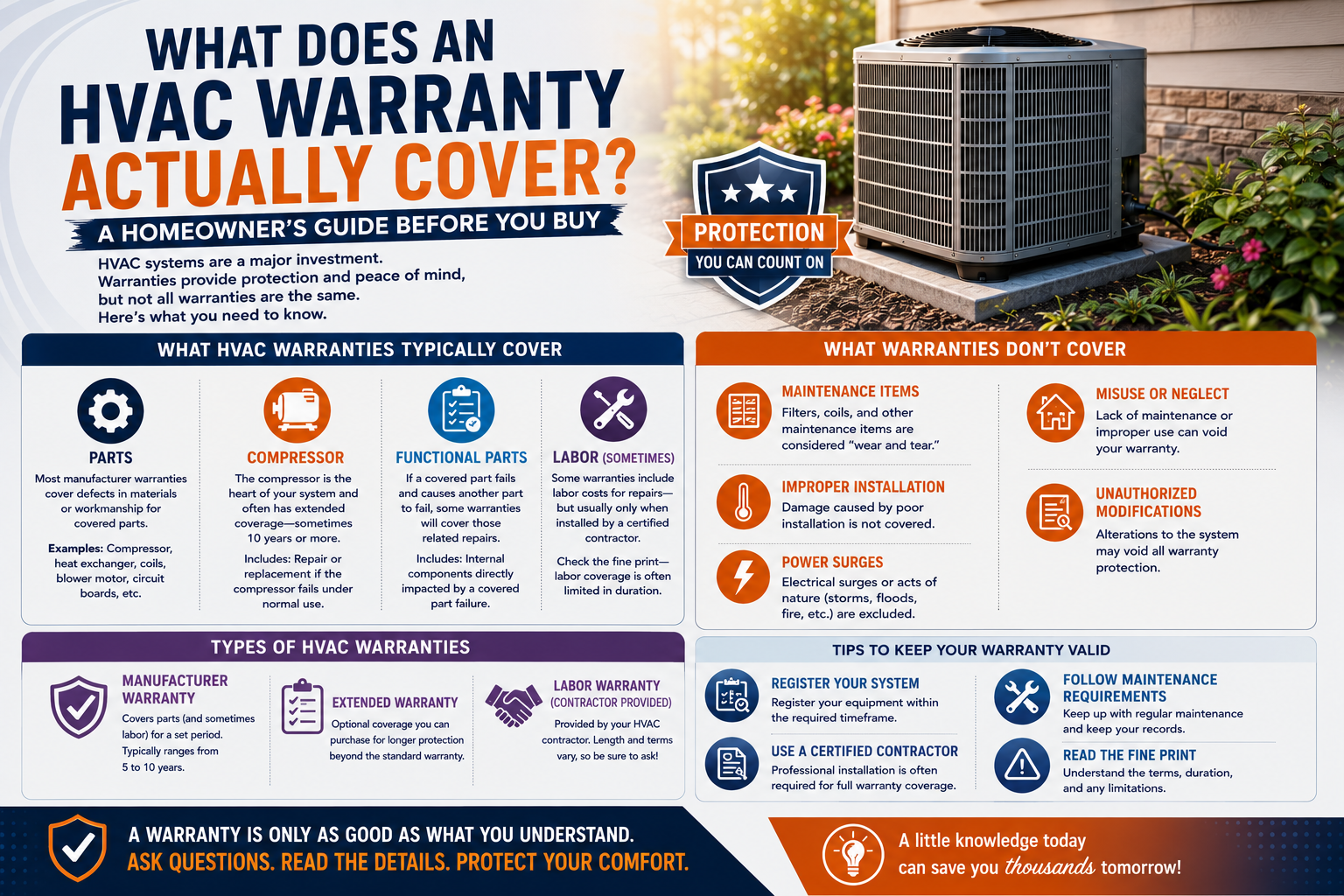
Not All HVAC Warranties Mean the Same Thing
When homeowners compare new heating and cooling systems, one phrase comes up constantly:
“It comes with a warranty.”
That sounds reassuring.
But what exactly does that mean?
Does the warranty cover every repair for the next 10 years?
Does it cover labor?
What happens if a compressor fails?
What if you sell the house?
Does the equipment need to be registered?
And who pays for refrigerant, diagnostic charges, or replacement parts?
These questions matter because a new HVAC system is a major investment.
Before choosing equipment based on a large warranty number printed on a brochure, homeowners should understand what the warranty actually covers.
What Is an HVAC Warranty?
An HVAC warranty is a written agreement that provides certain protections if covered equipment or components fail under specified conditions.
But there isn’t just one type of HVAC warranty.
Depending on the equipment and contractor, you may encounter:
- Manufacturer parts warranty
- Compressor warranty
- Heat exchanger warranty
- Labor warranty
- Extended warranty
- Replacement warranty
- Contractor workmanship warranty
Each one can cover something different.
That’s why the phrase “10-year warranty” by itself doesn’t tell you enough.
1. What Is a Manufacturer Parts Warranty?
The manufacturer parts warranty generally covers certain covered components that fail because of defects during the warranty period.
Depending on the equipment, covered components might include items such as:
- Motors
- Circuit boards
- Coils
- Controls
- Certain electrical components
- Other factory parts
Coverage varies by manufacturer and model.
The key word is:
Parts.
A parts warranty doesn’t automatically mean the labor required to diagnose and replace that part is free.
Parts Warranty vs Labor Warranty
This is one of the biggest misunderstandings homeowners have.
Imagine a covered component fails several years after installation.
The manufacturer may provide the replacement part under warranty.
But someone still has to:
- Diagnose the problem
- Obtain the part
- Remove the failed component
- Install the replacement
- Test the system
- Handle refrigerant if applicable
Those services involve labor.
Unless you also have labor coverage, those costs may be the homeowner’s responsibility.
So when someone says:
“Your system has a 10-year warranty,”
ask:
“Ten years on what?”
2. What Is an HVAC Labor Warranty?
A labor warranty covers certain labor costs associated with covered repairs during the warranty period.
Labor coverage may come from:
- Installing contractor
- Third-party warranty program
- Manufacturer-backed extended coverage
- Other service agreement
Terms vary significantly.
Some labor warranties may last:
- One year
- Two years
- Five years
- Ten years
Others may have different conditions or exclusions.
This is why comparing labor coverage can be just as important as comparing equipment warranties.
Why Labor Coverage Matters
HVAC components can be expensive.
But the part isn’t always the only significant cost.
Some repairs require substantial labor.
For example, replacing a major refrigerant component may require:
- Refrigerant recovery
- Brazing
- Pressure testing
- Evacuation
- Refrigerant charging
- System testing
Even if the manufacturer provides the component, the work required to replace it can still be significant.
Understanding labor coverage helps prevent surprises later.
3. What Is a Compressor Warranty?
The compressor is one of the most important components in an air conditioner or heat pump.
Because compressors can be costly, manufacturers may describe compressor coverage separately from general parts coverage.
Depending on the system, compressor coverage may have:
- A specific warranty period
- Extended registration-based coverage
- Limited lifetime provisions on certain equipment
- Different terms from other components
Don’t assume every system provides identical compressor protection.
Ask to see the actual warranty terms for the equipment you’re considering.
Does a Compressor Warranty Mean a Free Compressor Replacement?
It may mean the covered compressor itself is supplied under warranty if the failure qualifies.
But additional expenses may still apply.
Possible costs can include:
- Labor
- Refrigerant
- Filter-driers
- Miscellaneous materials
- Diagnostic charges
- Shipping or processing
- Other required components
Coverage depends on the warranty terms.
Always ask what’s included beyond the physical compressor.
4. What Is a Heat Exchanger Warranty?
Gas furnaces contain a heat exchanger.
This component separates combustion gases from the heated air distributed through the home.
Because of its importance, furnace manufacturers often provide specific heat-exchanger warranty coverage.
Depending on the furnace, this coverage may be longer than the standard parts warranty.
Some equipment may even advertise limited lifetime heat-exchanger coverage.
Again, the word limited matters.
Read the terms.
Does a Lifetime Warranty Really Mean Forever?
Not necessarily in the way homeowners sometimes interpret it.
A “limited lifetime warranty” generally contains specific conditions defining:
- Who qualifies
- How long coverage applies
- Whether registration is required
- Whether coverage transfers
- What parts are included
- What costs aren’t included
Never assume the word lifetime means every expense associated with that component will be covered forever.
5. What Is a Workmanship Warranty?
The installing HVAC contractor may also provide a warranty on its workmanship.
This is different from the manufacturer warranty.
A workmanship warranty may address certain issues related to the installation itself rather than equipment manufacturing defects.
Examples might include certain problems involving:
- Installation connections
- Drainage
- Equipment setup
- Installation-related issues
The exact coverage depends on the contractor.
Ask for it in writing.
Manufacturer Warranty vs Contractor Warranty
Think of it this way:
Manufacturer Warranty
Protects against certain covered equipment or component defects.
Contractor Warranty
May cover certain labor or installation-related issues.
They’re different.
A strong HVAC proposal should clearly explain both.
Does My HVAC System Need to Be Registered?
Many manufacturers offer different warranty terms depending on whether the equipment is registered within a specified period after installation.
For some systems, registration may provide longer parts coverage.
If registration isn’t completed, coverage may revert to a shorter standard term.
This is extremely important.
Ask your contractor:
Who registers the equipment?
Don’t assume it automatically happens.
Who Should Register My New HVAC Equipment?
Some contractors register equipment for customers as part of the installation process.
Others may require the homeowner to complete registration.
Either approach can work, but you need to know who’s responsible.
After installation, keep documentation showing:
- Manufacturer
- Model number
- Serial number
- Installation date
- Registration confirmation
- Contractor information
These records can save time if warranty service is needed years later.
What Happens If I Forget to Register the HVAC System?
Depending on the manufacturer’s warranty program, failing to register within the required timeframe could reduce the available warranty period.
That’s why registration should be handled promptly.
Don’t wait until something breaks five years later to discover that the equipment was never registered.
Is the HVAC Warranty Transferable if I Sell My House?
Sometimes.
Some manufacturer warranties can transfer to a new homeowner.
Others may:
- Shorten after transfer
- Require transfer paperwork
- Require a transfer fee
- Remain only with the original owner
- Have different terms
If you expect to sell the home before the warranty expires, transferability can be worth considering.
A transferable warranty may also be useful documentation for future buyers.
Does HVAC Maintenance Affect the Warranty?
It can.
Warranty terms may require the equipment to be properly installed, operated, and maintained.
Manufacturers can exclude failures caused by:
- Neglect
- Improper maintenance
- Incorrect installation
- Unauthorized modification
- Misuse
- External damage
Keep maintenance records.
If warranty eligibility is ever questioned, documentation can be valuable.
What Maintenance Records Should I Keep?
Keep records showing:
- Maintenance dates
- Contractor name
- Work performed
- Repairs
- Parts replaced
- Equipment model and serial numbers
You don’t need a complicated filing system.
A folder containing your HVAC records can be extremely useful.
Digital copies are even better.
Does Using Another HVAC Company Void the Warranty?
Not automatically in every situation.
But warranty work must generally follow manufacturer requirements.
Certain warranty programs or labor plans may have specific service-provider rules.
If your system is under an extended labor or contractor warranty, check whether the plan requires service through a particular provider.
Always review the actual agreement rather than relying on assumptions.
Are Refrigerant Costs Covered Under Warranty?
Sometimes they are not.
This surprises homeowners.
A manufacturer may provide a covered replacement coil while costs related to:
- Refrigerant recovery
- Refrigerant replacement
- Labor
- Additional materials
remain separate.
Ask specifically about refrigerant coverage when comparing labor or extended warranty options.
What About Shipping or Warranty Processing Fees?
Warranty claims can sometimes involve additional costs that aren’t part of the component coverage.
Depending on the manufacturer or contractor, there may be:
- Shipping costs
- Processing fees
- Handling charges
- Diagnostic fees
Ask in advance how warranty service is handled.
The more you understand at purchase time, the fewer surprises you’ll have later.
Are Diagnostic Charges Covered?
Not always.
Even if the failed part is covered, someone still has to determine which component failed.
Diagnostic service may or may not be included under labor coverage.
Ask:
“If my system breaks during the warranty period, do I pay a diagnostic fee?”
That’s a very practical question.
What Is an Extended HVAC Warranty?
An extended warranty provides additional coverage beyond the standard warranty.
Depending on the plan, it may extend:
- Parts
- Labor
- Both
Extended coverage can sometimes be purchased during installation or within a specified period afterward.
Before purchasing one, understand:
- Coverage period
- Covered items
- Exclusions
- Deductibles
- Transferability
- Service-provider requirements
- Cancellation terms
Don’t buy extended coverage based only on the word “extended.”
Read what you’re actually getting.
Is an Extended HVAC Warranty Worth It?
It depends.
Consider:
- Cost of the plan
- Length of coverage
- Equipment complexity
- Standard manufacturer warranty
- Existing labor coverage
- How long you plan to own the home
- Your tolerance for unexpected repair costs
A long labor warranty may provide valuable peace of mind for one homeowner.
Another homeowner may prefer to keep the upfront cost lower.
There’s no one correct answer.
Do Higher-End HVAC Systems Need Better Warranty Coverage?
Advanced HVAC equipment may contain more sophisticated components such as:
- Inverter-driven compressors
- Variable-speed motors
- Communicating controls
- Specialized circuit boards
- Advanced sensors
Those systems can provide excellent comfort and efficiency features.
But because some components can be more complex, understanding long-term warranty and service support becomes particularly important.
If you’re considering premium equipment, don’t compare features alone.
Compare ownership support too.
What Happens if the Installing Contractor Goes Out of Business?
This is another reason to understand the difference between manufacturer and contractor warranties.
A manufacturer parts warranty is generally tied to the manufacturer’s terms.
A labor or workmanship warranty offered only by the contractor may depend on that company remaining in business.
Third-party labor warranties may operate differently.
Ask exactly who stands behind each part of the warranty.
Can Improper Installation Void an HVAC Warranty?
Improper installation can create warranty complications.
Manufacturers design equipment to operate under specific conditions.
Installation issues can include:
- Incorrect refrigerant charge
- Improper electrical setup
- Poor airflow
- Incorrect equipment matching
- Improper drainage
- Failure to follow manufacturer requirements
This is one reason choosing the right HVAC contractor matters as much as choosing the equipment brand.
A warranty shouldn’t be treated as a substitute for proper installation.
Does the Warranty Cover Damage From Power Surges?
Often, external electrical damage isn’t treated the same as a manufacturing defect.
Damage from:
- Lightning
- Power surges
- Voltage problems
- External electrical conditions
may not be covered under a standard equipment warranty.
Coverage depends on the actual warranty terms.
Some homeowners consider surge protection for major HVAC equipment as part of broader electrical protection.
Does the Warranty Cover Rodent or Pest Damage?
Usually not as a manufacturing defect.
If rodents damage wiring or equipment components, the issue may fall outside standard manufacturer warranty coverage.
The same can apply to damage caused by:
- Flooding
- Fire
- Physical impact
- Landscaping equipment
- Other external causes
Warranties protect against specified failures—not every possible event.
Does a Warranty Cover Normal Wear and Tear?
Usually, standard manufacturer warranties focus on covered component failures or defects rather than routine maintenance and consumable items.
Items such as filters generally aren’t warranty-covered maintenance items.
Homeowners remain responsible for proper system care.
What About Thermostats?
Thermostat warranty coverage may be separate from the HVAC equipment.
If a communicating or manufacturer-specific thermostat is included with a new system, ask:
- What warranty covers it?
- Is labor included?
- What happens if it fails?
- Is the system dependent on that specific control?
This becomes especially important with advanced communicating HVAC systems.
What Is a Unit Replacement Warranty?
Some premium HVAC systems may include limited replacement provisions for specific major component failures.
For example, under certain circumstances, the manufacturer may provide replacement equipment rather than only replacing the failed component.
These programs can sound very attractive.
But conditions vary.
Ask:
- Which failures qualify?
- How long does coverage last?
- Is labor included?
- Is refrigerant included?
- Is registration required?
- Is replacement equipment identical?
Read the actual terms.
Don’t Judge HVAC Equipment Only by Warranty Length
Imagine two systems.
System A
12-year parts warranty.
System B
10-year parts warranty.
Does that automatically mean System A is better?
No.
You still need to consider:
- Equipment quality
- Installation
- Efficiency
- Comfort features
- Contractor support
- Labor coverage
- Parts availability
- Manufacturer service network
- Price
Warranty length is useful information.
It’s not the entire purchasing decision.
Parts Availability Matters Too
A warranty isn’t very helpful if a replacement component takes an extremely long time to obtain.
When choosing HVAC equipment, ask about:
- Manufacturer presence
- Local parts availability
- Distributor support
- Contractor familiarity
- Replacement component availability
This becomes especially relevant as systems age.
Strong local support can be extremely valuable.
Why the Installing Contractor Matters
Suppose you buy excellent equipment with a strong manufacturer warranty.
But the installer:
- Doesn’t register the system
- Doesn’t size it correctly
- Doesn’t commission it properly
- Doesn’t explain maintenance
- Disappears after installation
That warranty hasn’t solved your biggest problem.
A good HVAC purchase involves three things working together:
Quality equipment.
Quality installation.
Quality support after the sale.
Questions to Ask Before Buying a New HVAC System
Before signing the proposal, ask:
How long is the manufacturer parts warranty?
Get the actual term.
Does registration change the warranty?
Know the deadline.
Who registers the equipment?
Get confirmation.
How long is the labor warranty?
Don’t confuse parts and labor.
Is refrigerant included during warranty repairs?
Ask directly.
Are diagnostic charges covered?
Know what happens if service is needed.
Is the warranty transferable?
Important if you may sell the home.
What is the compressor warranty?
Understand major component coverage.
What is the furnace heat exchanger warranty?
If you’re buying a furnace, ask.
Is there a workmanship warranty?
Understand what the contractor covers.
What maintenance is required?
Protect your warranty and your equipment.
What Documentation Should You Receive After Installation?
Keep copies of:
- Final contract
- Equipment model numbers
- Serial numbers
- Warranty information
- Registration confirmation
- Permit documentation
- Inspection records
- Maintenance requirements
- Contractor contact information
- Thermostat information
You may not need these documents for years.
But when you do need them, you’ll be glad you kept them.
Frequently Asked Questions About HVAC Warranties
What does a 10-year HVAC warranty mean?
It depends on the warranty. It may refer to registered parts coverage and may not include labor, refrigerant, diagnostic charges, or other costs.
Are HVAC parts and labor both covered?
Not necessarily. Parts and labor warranties are often separate.
Does my new AC need to be registered?
Many manufacturer programs require registration to receive enhanced warranty terms. Check the specific equipment requirements.
Who registers my HVAC system?
The contractor may handle registration, or the homeowner may be responsible. Confirm this during installation.
Does HVAC maintenance affect warranty coverage?
Warranty terms may require proper maintenance and may exclude failures caused by neglect.
Is refrigerant covered by an HVAC warranty?
Not always. Ask specifically whether refrigerant and related labor are covered.
Can an HVAC warranty transfer to a new homeowner?
Some can, while others have restrictions or reduced coverage. Check the manufacturer’s terms.
Does a manufacturer warranty cover labor?
Standard manufacturer warranties often focus on covered parts. Labor coverage may come from a separate warranty or service plan.
Is a lifetime heat exchanger warranty really lifetime coverage?
It depends on the specific limited warranty terms, eligibility, ownership status, registration, and exclusions.
Should I buy an extended HVAC warranty?
That depends on the cost, coverage, equipment, standard warranty, labor protection, and how long you plan to own the system.
HVAC Warranties for Temecula Valley Homeowners
Homeowners throughout Temecula, Murrieta, Menifee, Lake Elsinore, Winchester, Hemet, Anza, and surrounding Southern California communities have many HVAC equipment options.
When comparing estimates, don’t look only at:
- Brand.
- Price.
- Efficiency rating.
Look at the support behind the system too.
A strong HVAC proposal should clearly explain:
- Parts warranty.
- Labor warranty.
- Registration.
- Maintenance requirements.
- Major component coverage.
- Who you call when something goes wrong.
That’s part of the value of a professional installation.
The Bottom Line
An HVAC warranty can provide valuable protection.
But “10-year warranty” doesn’t automatically mean 10 years of completely free repairs.
You need to understand the details.
Ask about:
- Parts.
- Labor.
- Compressor coverage.
- Heat exchanger coverage.
- Refrigerant.
- Diagnostics.
- Registration.
- Transferability.
- Maintenance requirements.
- Workmanship.
The best time to understand your HVAC warranty isn’t when the air conditioner breaks on a 100-degree afternoon.
It’s before you buy the system.
Comparing New HVAC Systems?
Advanced Heating & Air Conditioning helps homeowners understand not only the equipment they’re buying, but also the installation, warranty, maintenance, and long-term ownership considerations that come with it.
We provide professional HVAC installation, replacement, repair, maintenance, heat pump, and air-conditioning services throughout Temecula, Murrieta, Menifee, Lake Elsinore, Winchester, Hemet, Anza, and surrounding Southern California communities.
Contact Advanced Heating & Air Conditioning to schedule an HVAC replacement evaluation and get clear answers before investing in your next heating and cooling system.