


Furnace Running but House Still Cold? 10 Causes
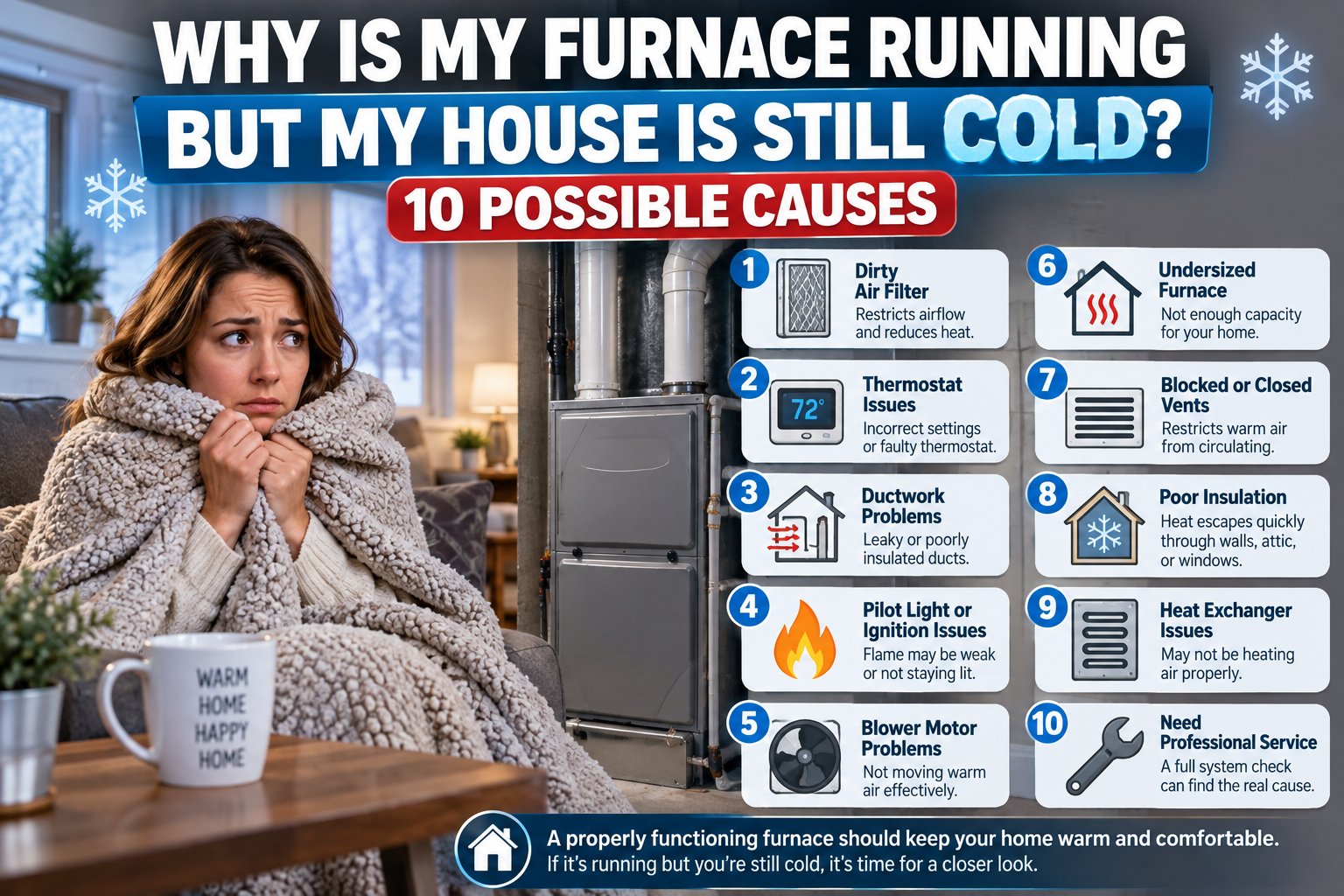
Why Is My Furnace Running but My House Is Still Cold? 10 Possible Causes
Your furnace is running. You can hear the blower. Warm air may even be coming from the vents.
But your house still doesn’t feel comfortable.
This is a frustrating heating problem because the furnace appears to be working—but something is preventing the home from reaching or maintaining the temperature you want.
Sometimes the problem is with the furnace itself. Other times, the furnace is producing heat correctly and the real problem is airflow, ductwork, thermostat location, insulation, air leakage or system design.
Here are 10 possible reasons your furnace is running while your home still feels cold.
Key Takeaways
- A running furnace doesn’t necessarily mean the entire heating system is performing correctly.
- Weak airflow can prevent enough heated air from reaching the rooms.
- Leaking or damaged ductwork can lose heated air before it reaches the registers.
- Poor insulation and air leakage can cause a home to lose heat faster than the furnace can replace it.
- Furnace size should be based on the home’s heating load—not simply square footage.
- Diagnosing the entire system is often more useful than focusing only on the furnace.
1. The Air Filter Is Restricting Airflow
Start with one of the simplest possibilities: the air filter.
As a filter collects dust and debris, resistance to airflow increases. A severely clogged filter can reduce the amount of air moving through the furnace and duct system.
The furnace may still produce heat, but less conditioned air reaches the living areas.
You might notice:
- Weak airflow from registers
- Longer heating cycles
- Some rooms colder than others
- Furnace overheating or cycling
- Increased energy usage
Check the filter and replace it when necessary according to the filter and equipment manufacturer’s recommendations.
If airflow remains weak with a clean filter, the restriction may be somewhere else in the system.
2. Supply Registers or Return Grilles Are Blocked
Furniture, rugs, boxes and other household items can unintentionally block HVAC registers.
Your heating system needs both sides of the airflow system to work properly:
Supply registers deliver heated air into rooms.
Return grilles bring air back to the HVAC equipment.
Blocking either can affect comfort.
Walk through your home and make sure registers and return grilles are open and unobstructed.
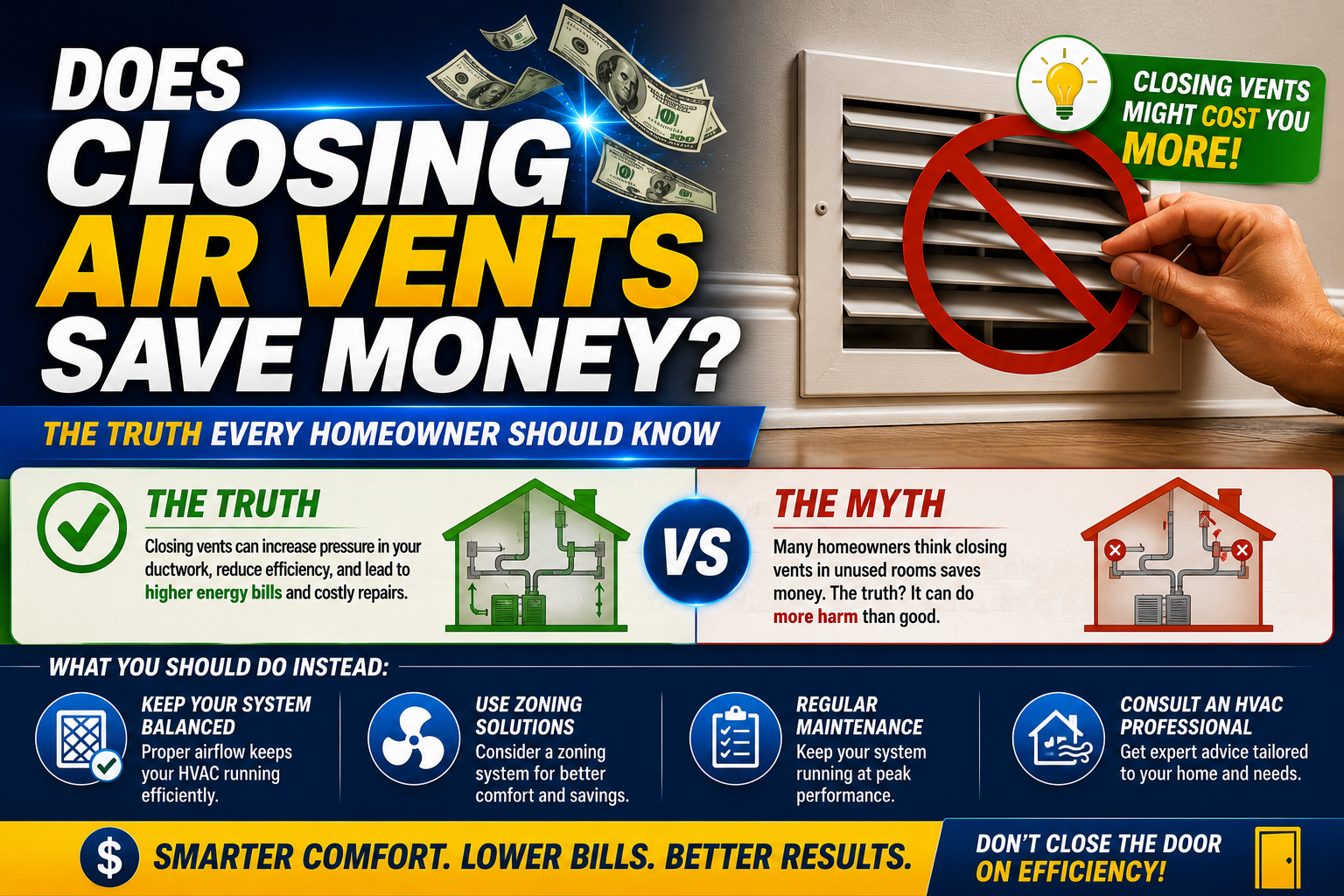
Don’t assume closing several vents will force more heat into another part of the house. Changing airflow without understanding the duct system can sometimes increase static pressure and create additional problems.
3. Your Ductwork Is Leaking
The furnace can work perfectly while the duct system wastes some of the heat it produces.
Disconnected joints, damaged flexible ducts, deteriorated seals or other duct leakage can allow heated air to escape before reaching the intended rooms.
Imagine producing 100% of the heated air you need but losing part of it on the way to the registers.
The furnace isn’t necessarily the problem.
Distribution is.
Possible signs of duct problems include weak airflow, unusually cold rooms, large temperature differences throughout the house or long furnace run times.
4. A Duct May Be Crushed, Restricted or Disconnected
Not every duct problem is a leak.
Flexible ductwork can become crushed, kinked, damaged or disconnected. Poor duct design can also restrict the amount of airflow reaching certain areas.
This is especially noticeable when:
- One bedroom stays cold
- An addition never heats correctly
- Upstairs and downstairs temperatures are very different
- One register has dramatically less airflow than others
In these situations, measuring airflow and evaluating the duct system can reveal much more than simply checking whether the furnace turns on.
5. The Thermostat May Be Reading a Different Temperature Than You Feel
Your thermostat controls the furnace based on the temperature where the thermostat is located.
That doesn’t guarantee every room is the same temperature.
For example, a thermostat located in a warmer central hallway might reach 70°F while a bedroom at the end of the duct system remains considerably cooler.
Sunlight, drafts, nearby heat sources and thermostat location can all influence temperature readings.
If your thermostat says the house is comfortable but certain rooms consistently aren’t, investigate the temperature distribution rather than immediately assuming the furnace is failing.
6. Your Home Is Losing Too Much Heat
Sometimes the furnace is doing its job—but the house is losing heat too quickly.
Heat can escape through:
- Poor attic insulation
- Air leaks around doors
- Older or poorly sealed windows
- Attic penetrations
- Uninsulated areas
- Leaky ductwork
- Gaps around building penetrations
The faster your home loses heat, the longer the heating system must operate to maintain the thermostat setting.
This is why HVAC performance and the home’s building envelope are closely connected.
A high-efficiency furnace cannot completely compensate for a home that loses conditioned air or heat rapidly.
7. The Furnace May Be Too Small for the Home
Bigger isn’t automatically better—but neither is undersized equipment.
A furnace should be selected based on the home’s actual heating requirements.
Factors include:
- Home size
- Insulation
- Windows
- Ceiling height
- Orientation
- Air leakage
- Local climate
- Ductwork
- Building construction
Professional HVAC contractors use heating-load calculations to help determine appropriate equipment capacity.
Correct furnace sizing should consider the home’s size, insulation, layout, and heating load rather than simply choosing a larger unit.
An undersized furnace may run for long periods and still struggle to maintain temperature during colder conditions.
8. An Oversized Furnace Can Cause Comfort Problems Too
It sounds logical that a bigger furnace would heat the home better.
That’s not necessarily true.
An oversized furnace can bring the thermostat area up to temperature quickly and shut down before heat is distributed evenly throughout the house.
This can contribute to noticeable temperature swings and uneven comfort.
Correct equipment sizing isn’t about installing the largest furnace possible.
It’s about matching the equipment to the home.
9. The Furnace Isn’t Producing Enough Heat
So far we’ve discussed problems outside the furnace.
But the furnace itself can also operate while failing to deliver the expected heating performance.
Potential problems can involve:
- Burner operation
- Gas delivery
- Controls
- Blower performance
- Electrical components
- Airflow
- Safety controls
- Other mechanical issues
A furnace that appears to be operating should still be evaluated if the supply-air temperature or system performance is abnormal.
An HVAC technician can measure what’s actually happening rather than relying solely on how the air feels at a register.
10. Your Heating System May Have an Airflow or Design Problem
This is an important one.
HVAC comfort depends on more than the equipment sitting in the garage, attic or closet.
The furnace, blower, return-air system, supply ducts, registers and building itself work together as one system.
That’s why replacing a furnace doesn’t automatically fix:
- Poor duct design
- Inadequate return air
- High static pressure
- Bad register placement
- Damaged ductwork
- Poor insulation
- Significant air leakage
A good heating diagnosis should consider the complete system.
Why Is One Room Colder Than the Rest of My House?
If most of your home feels comfortable but one room stays cold, the furnace itself may not be the main problem.
Start looking at that room’s:
- Supply airflow
- Return-air path
- Duct condition
- Windows
- Exterior walls
- Insulation
- Sun exposure
- Room location
A room located above a garage or at the far end of a duct run, for example, can behave differently from an interior room.
The goal should be identifying why that particular space has a different heating load or airflow condition.
Is It Normal for My Furnace to Run for a Long Time?
Long heating cycles aren’t automatically a sign that something is wrong.
The amount of time a furnace operates depends on outdoor temperature, thermostat setting, furnace capacity, insulation, home construction and equipment design.
During colder weather, longer cycles can be normal.
What’s more concerning is a significant change from normal operation, especially when the furnace runs continuously but cannot reach the thermostat setting.
How Can an HVAC Technician Diagnose the Problem?
Instead of simply asking whether the furnace turns on, a more complete evaluation can include checking:
- Supply and return airflow
- Temperature rise
- Static pressure
- Blower operation
- Filter condition
- Furnace operation
- Burner performance
- Thermostat operation
- Duct condition
- System sizing
- Air distribution
This helps determine whether the problem is heat production, airflow, distribution or heat loss.
That’s an important distinction.
Should I Replace My Furnace If My House Doesn’t Stay Warm?
Not automatically.
An uncomfortable home does not necessarily mean you need a new furnace.
If the actual problem is duct leakage, airflow, thermostat placement or insulation, installing another furnace without correcting the underlying issue may leave you with the same comfort problem.
Deciding whether to replace a furnace should consider system age, repair history, efficiency, and overall condition rather than assuming replacement is always the answer.
A proper diagnosis should come first.
Frequently Asked Questions
Why is my furnace running but not reaching the thermostat temperature?
Possible causes include restricted airflow, heat loss, duct problems, furnace performance issues, thermostat problems or improperly sized equipment.
Why is my house cold even though warm air is coming from the vents?
The system may be producing heat but not distributing enough of it throughout the house, or the home may be losing heat faster than the HVAC system can replace it.
Why are some rooms warm and others cold?
Uneven heating commonly involves airflow differences, duct design, duct damage, room location, insulation or different heating loads throughout the home.
Will installing a bigger furnace make my house warmer?
Not necessarily. Oversized equipment can create short cycles and uneven temperatures. Furnace capacity should be matched to the home’s calculated heating load.
Can bad ductwork make my furnace run longer?
Yes. Leaking, restricted, damaged or improperly sized ductwork can reduce the amount of heated air delivered to the living space.
Can poor insulation make it seem like my furnace isn’t working?
Absolutely. A home that loses heat quickly may remain uncomfortable even while the furnace is operating normally.
Heating & Furnace Service in the Temecula Valley
If your furnace runs but your home still doesn’t feel comfortable, don’t assume the furnace itself is automatically the problem.
Advanced Heating & Air Conditioning can evaluate the heating equipment along with airflow and overall system performance to help identify what’s actually causing the comfort issue.
Advanced Heating & Air Conditioning serves homeowners and businesses throughout Temecula, Murrieta, Menifee, Winchester, Wildomar, French Valley, Canyon Lake, Lake Elsinore, Hemet and surrounding Southern California communities.
Advanced Heating & Air Conditioning
951-609-9881
California Contractor License #916901
AdvancedHeatingAndAir.com
REAL PEOPLE. REAL SERVICE. REAL COMFORT.