


What Is Furnace Temperature Rise? Why It Matters
What Is Furnace Temperature Rise and Why Does It Matter?
When an HVAC technician services your furnace, you may hear the term “temperature rise.”
It sounds complicated, but the basic idea is simple:
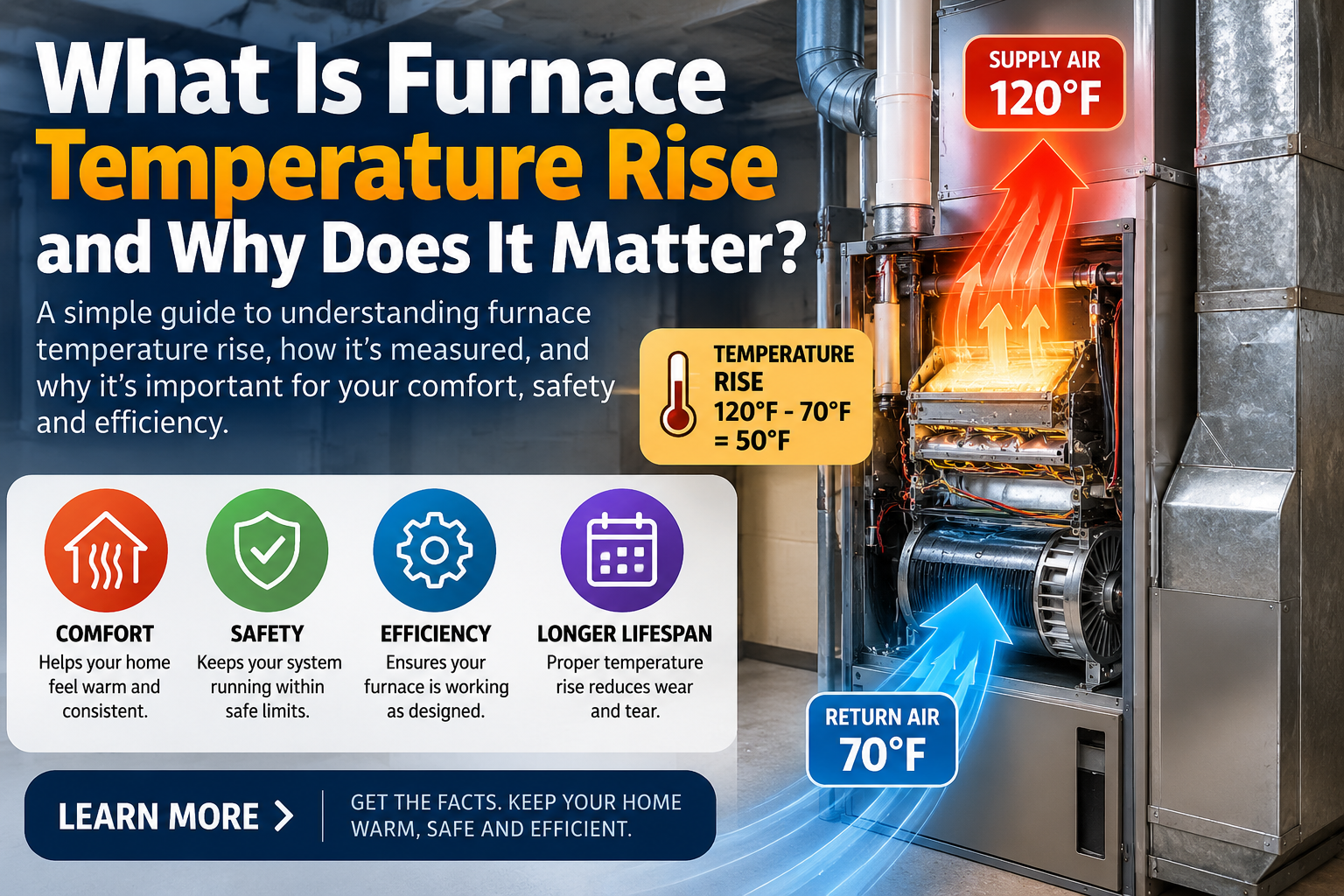
Temperature rise is the difference between the temperature of the air entering your furnace and the temperature of the heated air leaving it.
This measurement can provide valuable information about how your furnace and airflow system are operating.
A furnace that is running doesn’t necessarily mean it’s operating correctly.
That’s why professional heating diagnostics often involve actual measurements—not simply putting a hand over a vent and deciding whether the air “feels hot.”
Let’s explain what furnace temperature rise means and why it matters.
Key Takeaways
- Temperature rise compares return-air temperature with heated supply-air temperature.
- Furnaces are designed to operate within a manufacturer-specified temperature-rise range.
- Excessive temperature rise can indicate inadequate airflow or other system problems.
- An unusually low temperature rise can also indicate a performance or measurement issue.
- The correct temperature rise varies by furnace—there isn’t one universal number for every system.
- Temperature rise is one piece of a complete furnace diagnosis.
1. What Exactly Is Furnace Temperature Rise?
Imagine air entering your furnace through the return duct at 70°F.
After the furnace heats that air, suppose properly measured supply air is 120°F.
The temperature rise would be:
120°F − 70°F = 50°F temperature rise
That’s the basic calculation.
However, technicians need to measure temperatures at appropriate locations so they’re evaluating the equipment accurately.
Temperature measured at a distant bedroom register isn’t necessarily the same as the furnace’s actual supply-air temperature because the duct system itself can gain or lose heat.
2. What Should My Furnace Temperature Rise Be?
There’s no single correct temperature rise for every furnace.
This is important.
Different furnace models are designed to operate within different ranges.
The manufacturer’s rating information generally specifies the acceptable temperature-rise range for that particular furnace.
For example, one furnace might be designed for a different range than another.
That’s why homeowners shouldn’t find a generic number online and assume their furnace must match it.
The correct target is the range specified for your equipment.
3. Why Does Temperature Rise Matter?
Temperature rise helps technicians understand the relationship between heat production and airflow.
Think of it this way:
The furnace creates heat.
The blower moves air across the heating equipment.
That air carries the heat into your home.
If the airflow changes significantly, the temperature relationship can change too.
That’s why temperature rise can be useful when diagnosing:
- Restricted airflow
- Furnace overheating
- Blower problems
- Filter restrictions
- Duct problems
- Equipment setup issues
- Heating-performance concerns
It’s not the only measurement that matters, but it’s an important clue.
4. What Causes Furnace Temperature Rise to Be Too High?
A high temperature rise means the air is gaining more temperature across the furnace than expected for that equipment.
One potential reason is insufficient airflow.
Imagine placing a small amount of air across a hot surface.
That smaller volume of air can become hotter than it would if the correct amount of air were moving through the system.
Several conditions can contribute to inadequate furnace airflow.
These can include:
- A dirty air filter
- Restricted return air
- Closed or blocked registers
- Dirty blower components
- Incorrect blower settings
- Duct restrictions
- Improperly sized ductwork
- Blower motor problems
The actual cause needs to be measured and diagnosed rather than assumed.
Airflow restrictions and overheating are exactly the kinds of problems that should be caught during furnace service.
5. Why Is Excessive Furnace Temperature a Problem?
Your furnace is designed to operate within specific conditions.
If temperatures inside the equipment become excessive, safety controls may shut the burners down to protect the system.
One important component is the high-limit switch.
If the furnace becomes too hot, the limit control can interrupt burner operation.
Once temperatures fall, the furnace may attempt to heat again.
To the homeowner, this can sometimes look like:
- The burners turn on.
- They shut off sooner than expected.
- The blower continues running.
- The burners eventually come back on.
Repeated overheating shouldn’t simply be treated by replacing the safety control.
The important question is:
Why is the furnace getting too hot?
6. Can a Dirty Air Filter Affect Temperature Rise?
Yes.
A heavily loaded filter can restrict airflow.
If less air passes through the furnace while the burners continue producing heat, operating temperatures may increase.
That’s one reason filter condition matters for more than indoor air quality.
The filter is part of the HVAC system’s airflow system.
However, don’t automatically assume every high-temperature problem is caused by the filter.
If the filter is clean and the furnace still isn’t operating within its specified range, further diagnosis may be necessary.
7. Can Ductwork Cause a Furnace to Run Too Hot?
Absolutely.
The furnace and duct system have to work together.
If return ducts can’t deliver enough air back to the equipment—or supply ducts can’t move enough conditioned air away from it—the furnace may experience excessive resistance to airflow.
HVAC technicians often evaluate static pressure when investigating these conditions.
Static pressure helps indicate how much resistance the blower is working against within the duct system.
Temperature rise and static pressure together can provide a much clearer picture than simply checking whether air comes out of the vents.
8. Can a Furnace Temperature Rise Be Too Low?
Yes.
An unusually low temperature rise can also indicate that the system isn’t operating as expected.
Possible factors can include:
- Excessive airflow
- Furnace input or burner issues
- Equipment setup
- Measurement location
- Blower configuration
- Other operating conditions
Again, the important comparison is with the manufacturer’s specifications for that furnace.
Temperature rise shouldn’t be diagnosed in isolation.
9. Why Doesn’t Hotter Air Always Mean Better Heating?
This surprises many homeowners.
If one furnace produces hotter air at the vent, it doesn’t automatically mean that furnace is working better.
Comfort depends on both:
Air temperature
and
Air volume
A system delivering a smaller amount of very hot air may not heat a home as effectively or efficiently as a properly designed system delivering the correct amount of appropriately heated air.
HVAC performance is about moving the correct amount of conditioned air through the house, not producing the hottest air possible.
10. What Does CFM Have to Do With Furnace Performance?
CFM means cubic feet per minute.
It’s a measurement of airflow volume.
Your blower and duct system need to move an appropriate amount of air through the heating equipment.
Too little airflow can contribute to excessive furnace temperatures.
Too much airflow can create different performance and comfort concerns.
That’s why professional HVAC design considers equipment capacity, blower performance, ductwork, static pressure, airflow, registers, and return air.
They all work together.
Temperature Rise vs. Vent Temperature
These aren’t the same measurement.
A homeowner might place a thermometer over a bedroom vent and see 110°F.
That doesn’t automatically tell us the furnace’s temperature rise.
Why?
Because we also need the return-air temperature, and both measurements need to be taken appropriately.
The duct system can also affect temperatures before air reaches a distant register.
So:
Hot air at a vent = useful observation.
Properly measured temperature rise = diagnostic measurement.
Can High Temperature Rise Damage My Furnace?
Operating outside the furnace manufacturer’s intended conditions can place unnecessary stress on the heating system.
Repeated overheating may contribute to:
- Safety-limit trips
- Short cycling
- Component stress
- Reduced comfort
- Higher operating costs
- Premature equipment wear
Rather than repeatedly resetting a furnace that’s overheating, the cause should be identified.
Why Airflow Is So Important to Heating
Homeowners often think of the furnace as the entire heating system.
It isn’t.
Your actual heating system includes the furnace, blower, filter, return ducts, supply ducts, registers, thermostat, and the home itself.
A problem anywhere in that chain can affect comfort and equipment operation.
This is why Advanced Heating & Air Conditioning’s heating maintenance evaluates heating performance, safety, and airflow, rather than looking only at whether the burners ignite.
What Does an HVAC Technician Check?
If temperature rise is outside the manufacturer’s specified range, a technician may investigate several areas.
Depending on the equipment and symptoms, that could include:
- Filter condition
- Supply airflow
- Return airflow
- Static pressure
- Blower operation
- Blower speed/setup
- Duct restrictions
- Burner operation
- Equipment specifications
- Safety controls
- Temperature measurements
The objective isn’t simply to make the number change.
It’s to determine why the system isn’t operating within its intended conditions.
Frequently Asked Questions
What is furnace temperature rise?
It’s the difference between the temperature of the air entering the furnace and the heated air leaving the furnace.
What should my furnace temperature rise be?
It depends on your specific furnace. The correct operating range should be determined from the manufacturer’s specifications for that equipment.
Can a dirty filter make my furnace run hotter?
Yes. A severely restricted filter can reduce airflow and contribute to higher furnace operating temperatures.
Can bad ductwork cause furnace overheating?
Yes. Restricted, undersized or poorly designed ductwork can contribute to airflow problems that affect furnace operation.
Is hotter air from my vents better?
Not necessarily. Proper heating depends on both air temperature and airflow volume. Extremely hot supply air can sometimes indicate inadequate airflow rather than better performance.
What is furnace static pressure?
Static pressure represents resistance to airflow within the HVAC system. Excessive static pressure can reduce airflow and affect furnace performance.
Why does my furnace burner shut off while the blower keeps running?
One possible reason is that a safety limit has interrupted burner operation because the furnace became too hot. There are other possibilities, so the actual operating sequence should be diagnosed.
Can I measure furnace temperature rise myself?
A homeowner can compare room and register temperatures, but accurate furnace temperature-rise diagnosis requires appropriate measurement locations and comparison with the manufacturer’s specifications. Internal furnace testing is best left to qualified HVAC professionals.
Why This Measurement Matters When Buying a New HVAC System
Temperature rise also reinforces something we talk about frequently at Advanced:
The equipment is only one part of a successful HVAC installation.
Installing a high-quality furnace without evaluating airflow and ductwork can leave the new system operating under poor conditions.
Proper HVAC installation should consider equipment sizing, return-air capacity, supply ductwork, blower performance and overall airflow.
That’s why the cheapest equipment replacement isn’t necessarily the best long-term HVAC solution.
Furnace & Heating Service in the Temecula Valley
If your furnace is overheating, repeatedly shutting down, producing weak airflow or struggling to keep your home comfortable, Advanced Heating & Air Conditioning can evaluate the complete heating system.
We focus on diagnosing the root cause — checking ignition, blower, wiring, thermostat, safety, and overall system performance — rather than simply replacing parts based on symptoms.
We serve homeowners and businesses throughout Temecula, Murrieta, Menifee, Winchester, Wildomar, French Valley, Canyon Lake, Lake Elsinore, Hemet and surrounding communities.
Advanced Heating & Air Conditioning
951-609-9881
California Contractor License #916901
AdvancedHeatingAndAir.com
REAL PEOPLE. REAL SERVICE. REAL COMFORT.