


What Is a Mini-Split? Ductless Heating & Cooling Explained
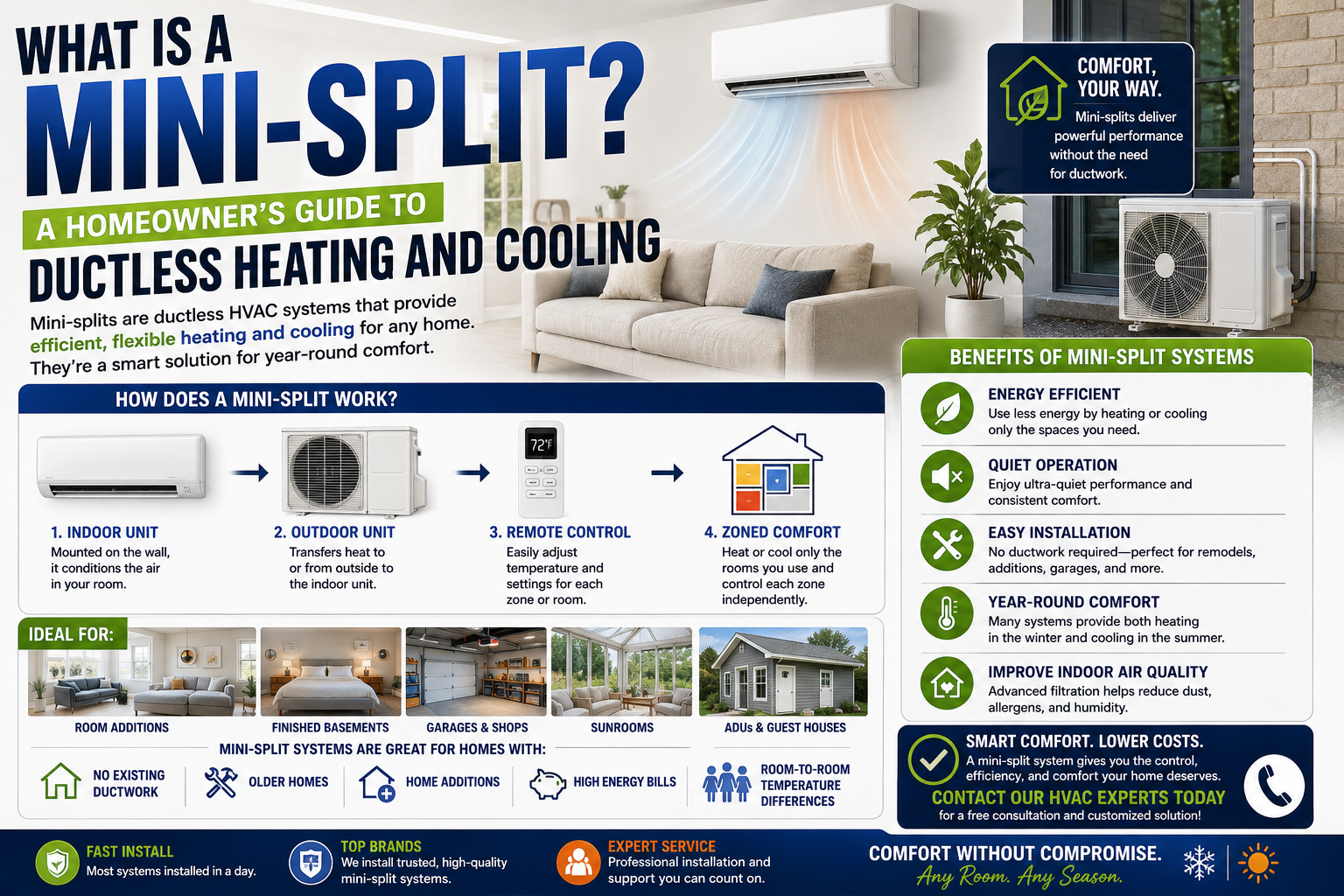
What Exactly Is That Air Conditioner Mounted on the Wall?
You’ve probably seen one.
There’s a rectangular unit mounted high on a wall inside a bedroom, office, garage conversion, or addition.
Outside, there’s a small HVAC unit connected to it.
But there aren’t large supply and return ducts like you’d see with a traditional central heating and cooling system.
That’s commonly called a ductless mini-split.
Mini-splits have become increasingly popular because they can provide heating and cooling to spaces where extending traditional ductwork may be difficult or unnecessary.
But they’re not automatically the best HVAC solution for every house.
Before deciding whether a mini-split makes sense, homeowners should understand what the equipment actually does.
What Is a Ductless Mini-Split?
A mini-split is a heating and cooling system that typically consists of:
An outdoor unit
and
One or more indoor units.
The indoor and outdoor equipment are connected by refrigerant piping, electrical wiring, and drainage components.
Unlike a traditional central HVAC system, a ductless mini-split doesn’t require large ductwork to deliver conditioned air to the room.
Instead, the indoor unit conditions the space directly.
Is a Mini-Split an Air Conditioner or a Heat Pump?
Many modern mini-splits are heat pumps.
That means they can provide both:
Cooling during warm weather
and
Heating during cooler weather.
In cooling mode, the system transfers heat from inside the room to the outdoors.
In heating mode, it reverses operation and transfers available heat from outside into the room.
This gives homeowners heating and cooling from the same system.
How Does a Mini-Split Work?
A ductless mini-split uses the same basic refrigeration principles found in many traditional HVAC systems.
The main difference is how conditioned air reaches the room.
A central HVAC system might look like:
Outdoor unit → Indoor equipment → Ductwork → Entire home
A ductless mini-split is more direct:
Outdoor unit → Refrigerant lines → Indoor unit → Room
Because there’s no long duct system between the indoor unit and the conditioned space, the equipment can be useful in areas where traditional duct installation would be challenging.
Where Do Mini-Splits Make the Most Sense?
Mini-splits can be particularly useful when a specific area needs independent heating and cooling.
Here are some common examples.
1. Garage Conversions
Southern California homeowners frequently convert garages into:
- Offices
- Bedrooms
- Gyms
- Studios
- Workshops
- Living areas
The home’s original HVAC system may never have been designed to condition that additional space.
Simply adding another duct isn’t always the correct solution.
The existing HVAC equipment and ductwork may not have enough capacity for the additional load.
A mini-split can provide dedicated heating and cooling for the converted area without necessarily modifying the entire central HVAC system.
2. Home Additions
Adding square footage changes the heating and cooling requirements of a home.
If you build:
- A new bedroom
- Family room
- Office
- Sunroom
- Guest suite
the original HVAC system may not have been designed for that additional space.
A mini-split may allow the addition to have its own heating and cooling system.
3. Home Offices
A home office can have very different cooling needs from the rest of the house.
Computers, monitors, printers, and other electronics generate heat.
If you’re the only person home during the day, cooling the entire house just to keep one office comfortable may not always be necessary.
A dedicated mini-split gives that room independent temperature control.
4. Workshops
Garages and workshops can become extremely hot during Southern California summers.
If you spend hours working in the space, a mini-split may provide a practical way to improve comfort.
However, the space itself matters.
A poorly insulated garage with large air leaks may place a significant load on any HVAC system.
Improving insulation and air sealing may be worth considering along with the equipment.
5. Guest Houses and ADUs
Accessory dwelling units, commonly called ADUs, have become increasingly common in California.
Because an ADU is a separate living area, it needs its own heating and cooling strategy.
Depending on the building design, a mini-split may provide an effective solution without requiring a traditional central duct system.
6. Older Homes Without Existing Ductwork
Some homes weren’t originally built with central heating and air conditioning.
Adding traditional ductwork can sometimes require significant construction.
Ductless equipment provides another option because large ducts aren’t required throughout the building.
7. Rooms That Are Difficult to Keep Comfortable
Sometimes one room is consistently uncomfortable even though the rest of the home is fine.
Before installing a mini-split, however, determine why.
The problem might be:
- Damaged ductwork
- Poor insulation
- Window heat gain
- Inadequate airflow
- Air leakage
If the underlying problem can be corrected, adding another HVAC system may not be necessary.
But when the room genuinely has different heating and cooling needs, dedicated equipment can make sense.
What Is a Single-Zone Mini-Split?
A single-zone mini-split generally connects one outdoor unit to one indoor unit.
This is useful when you need to condition one specific area.
For example:
One garage conversion → One mini-split system
or
One home office → One mini-split system
This provides independent temperature control for that space.
What Is a Multi-Zone Mini-Split?
Some ductless systems allow one outdoor unit to serve multiple indoor units.
For example, one outdoor unit could serve:
- Bedroom indoor unit
- Office indoor unit
- Guest room indoor unit
Each indoor unit can provide more individualized comfort for its area.
The exact number of indoor units and available capacity depends on the equipment.
Mini-Split vs Central Air Conditioning
Neither system is automatically better.
They’re designed for different applications.
Central HVAC
A central system generally uses one indoor air handler or furnace and distributes conditioned air through ductwork.
It can be an excellent solution for conditioning an entire home.
Mini-Split
A ductless system conditions individual rooms or zones directly.
It can be especially useful where ducts don’t exist or where independent room control is desirable.
The right choice depends on the home.
Do Mini-Splits Save Energy?
They can be efficient, particularly when used appropriately.
Many mini-splits use inverter-driven compressor technology that allows the equipment to adjust output rather than constantly operating at one fixed capacity.
Potential energy advantages may also come from avoiding certain duct losses.
However, actual electricity usage depends on:
- Equipment efficiency
- Outdoor temperature
- Thermostat settings
- Insulation
- Room size
- Windows
- Installation
- Household habits
A mini-split isn’t automatically inexpensive to operate simply because it’s ductless.
Do Mini-Splits Run Constantly?
Some homeowners are surprised to see a mini-split operating for long periods.
Many inverter-driven systems are designed to modulate their output.
Instead of repeatedly turning completely on and off, the equipment may operate at a lower level for longer periods to maintain temperature.
Longer operation doesn’t necessarily mean excessive electricity consumption or equipment failure.
Are Mini-Splits Quiet?
Modern mini-split indoor units can operate relatively quietly, particularly at lower fan speeds.
The outdoor equipment may also operate at varying capacity.
Actual sound levels depend on:
- Equipment
- Installation
- Operating speed
- Mounting location
- Maintenance
For bedrooms and home offices, sound level is worth comparing when choosing equipment.
Do Mini-Splits Need an Outdoor Unit?
Yes.
A typical mini-split heat pump system has an outdoor unit.
The indoor and outdoor components work together to transfer heat.
The outdoor equipment still needs an appropriate location with adequate airflow and service access.
Where Does the Water From a Mini-Split Go?
During cooling operation, moisture can condense on the indoor coil.
That water needs to drain away.
A properly installed mini-split includes a condensate drainage method.
Depending on the installation, drainage may occur through:
- Gravity drain
- Condensate pump
- Other approved drainage configuration
Proper drainage is an important part of installation.
Can Mini-Splits Leak Water?
They can if there’s a drainage or maintenance problem.
Possible causes may include:
- Clogged condensate drain
- Improper drainage
- Dirty indoor unit
- Installation issues
- Frozen coil
Water leaking from an indoor mini-split should be investigated rather than ignored.
Do Mini-Splits Need Maintenance?
Absolutely.
Ductless does not mean maintenance-free.
Mini-split maintenance may include attention to:
- Indoor filters
- Indoor coil
- Blower wheel
- Drainage
- Outdoor coil
- Electrical components
- Refrigerant system
- Overall operation
Indoor mini-split filters may require relatively frequent cleaning depending on usage and household conditions.
Always follow manufacturer recommendations.
What Happens If You Don’t Clean Mini-Split Filters?
Dirty filters can restrict airflow.
Over time, neglected filters may contribute to:
- Reduced performance
- Poor airflow
- Increased operating time
- Indoor-unit contamination
- Comfort problems
One advantage of many mini-split systems is that their filters are relatively accessible.
But homeowners still have to remember to maintain them.
Can a Mini-Split Cool an Entire House?
Potentially, but this depends heavily on the home and system design.
Some homes use multiple ductless indoor units to provide whole-home heating and cooling.
However, installing individual wall units throughout a house isn’t necessarily the best solution for every homeowner.
Central ducted systems, ducted heat pumps, mini-splits, or combinations of systems may all be worth considering depending on the property.
Can a Mini-Split Replace My Central AC?
It can in certain applications, but homeowners shouldn’t assume that replacing central HVAC with ductless equipment is automatically an upgrade.
Consider:
- Number of rooms
- Existing ductwork
- Home layout
- Aesthetics
- Equipment cost
- Maintenance
- Heating requirements
- Electrical requirements
- Comfort preferences
If your existing duct system is in excellent condition, central HVAC may still be a very practical solution.
What Are the Advantages of Mini-Splits?
Depending on the application, advantages may include:
- No large duct system required
- Independent room temperature control
- Heating and cooling from one system
- Variable-capacity operation
- Good solution for additions and conversions
- Flexible installation options
- Ability to condition individual areas
These benefits can make mini-splits extremely useful in the right application.
What Are the Disadvantages of Mini-Splits?
Homeowners should also understand the tradeoffs.
Potential considerations include:
- Indoor units remain visible
- Multiple rooms may require multiple indoor units
- Filters require regular attention
- Installation still requires professional design
- Condensate drainage is required
- Electrical requirements must be addressed
- Upfront cost can vary significantly
- Poor installation can create performance problems
No HVAC technology is perfect for every home.
What About the Appearance of the Indoor Unit?
This is one of the biggest homeowner considerations.
Traditional wall-mounted mini-split units are visible inside the room.
Some homeowners don’t mind them.
Others prefer a less noticeable HVAC system.
Depending on the equipment and construction, other indoor-unit styles may be available, including ceiling cassettes and concealed ducted configurations.
Available options depend on the project.
How Is a Mini-Split Sized?
Mini-splits should be sized according to the heating and cooling requirements of the space.
Don’t simply purchase the largest unit available.
Oversizing can affect comfort and system operation.
Factors can include:
- Room size
- Ceiling height
- Insulation
- Windows
- Sun exposure
- Air leakage
- Local climate
- Room use
A garage with little insulation has very different cooling requirements from a well-insulated bedroom of the same size.
Does a Mini-Split Need a Dedicated Electrical Circuit?
Mini-split systems have specific electrical requirements based on the equipment.
Installation may require:
- Appropriate circuit
- Disconnect
- Wiring
- Overcurrent protection
Electrical requirements should follow the equipment specifications and applicable codes.
An HVAC contractor can determine what the proposed system requires.
Can I Install a Mini-Split Myself?
DIY mini-split products are available, but installing heating and cooling equipment involves more than mounting a unit on the wall.
A proper installation may involve:
- Equipment sizing
- Electrical work
- Refrigerant piping
- Condensate drainage
- Vacuum procedures
- Leak testing
- Equipment commissioning
- Code requirements
Installation quality can significantly affect performance and equipment life.
How Long Do Mini-Splits Last?
There’s no exact lifespan that applies to every mini-split.
Equipment life depends on factors such as:
- Installation quality
- Usage
- Maintenance
- Environment
- Equipment quality
- Operating conditions
Regular maintenance and proper installation can help equipment perform as intended throughout its service life.
Frequently Asked Questions About Mini-Splits
What is a mini-split?
A mini-split is a heating and cooling system that typically uses an outdoor unit connected to one or more indoor units without requiring traditional large ductwork.
Do mini-splits provide heat?
Many mini-splits are heat pumps and can provide both heating and cooling.
Are mini-splits good for garages?
They can be an excellent option for properly finished or converted garages. Insulation and air leakage should also be considered.
Are mini-splits good for ADUs?
Yes. Ductless systems can be a practical heating and cooling option for many accessory dwelling units.
Do mini-splits use a lot of electricity?
Energy use depends on equipment efficiency, room load, thermostat setting, outdoor conditions, and usage.
Do mini-splits need ductwork?
Traditional ductless mini-splits do not require large central duct systems.
Can one mini-split cool multiple rooms?
Multi-zone systems can serve multiple indoor units, but the equipment needs to be properly designed and sized for the spaces.
Are mini-splits better than central AC?
Neither is universally better. The best option depends on the home, existing ductwork, number of rooms, comfort goals, and budget.
Mini-Splits for Temecula Valley Homes
Mini-splits can be especially useful for homeowners throughout Temecula, Murrieta, Menifee, Lake Elsinore, Winchester, Hemet, Anza, and surrounding Southern California communities who are adding or changing living space.
They may be worth considering for:
- ADUs
- Garage conversions
- Home offices
- Additions
- Guest houses
- Workshops
- Rooms without existing ductwork
Instead of automatically extending your existing HVAC system into a new space, determine how much additional heating and cooling that space actually requires.
The Bottom Line
A ductless mini-split can provide heating and cooling without traditional central ductwork.
For the right application, that’s a major advantage.
Mini-splits can be particularly useful for additions, ADUs, garage conversions, offices, guest houses, and other spaces requiring independent temperature control.
But ductless equipment isn’t automatically the best choice for every home.
Consider:
- The space you’re conditioning
- Insulation
- Equipment sizing
- Installation
- Electrical requirements
- Maintenance
- Appearance
- Long-term comfort goals
The goal isn’t to choose between “central HVAC” and “mini-split” based on which technology sounds newer.
The goal is to choose the heating and cooling solution that fits the space.
Considering a Mini-Split for Your Home, ADU, or Addition?
Advanced Heating & Air Conditioning can help determine whether a ductless mini-split, central HVAC system, heat pump, or another heating and cooling solution makes sense for your project.
Our team can evaluate the space, cooling and heating requirements, equipment options, and installation needs.
We proudly serve Temecula, Murrieta, Menifee, Lake Elsinore, Winchester, Hemet, Anza, and surrounding Southern California communities.
Contact Advanced Heating & Air Conditioning to schedule an HVAC evaluation or request an estimate for a ductless heating and cooling system.