


Why Is My House So Dry When the Heater Is On?
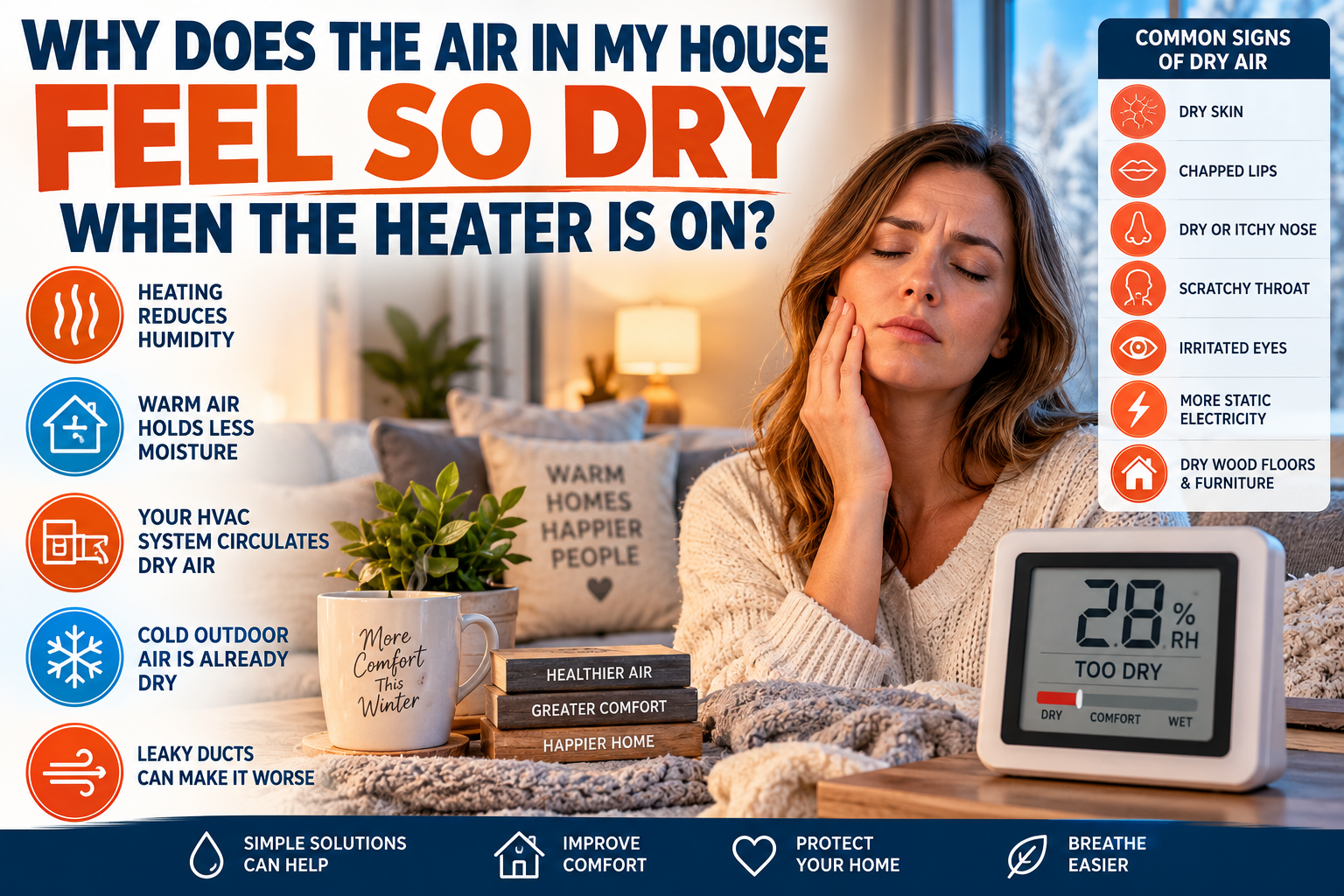
Why Does the Air in My House Feel So Dry When the Heater Is On?
Your furnace comes on and the house gets warmer—but suddenly your skin feels dry, you’re noticing more static electricity, and the indoor air just doesn’t feel as comfortable.
Many homeowners assume:
“My furnace must be drying out the air.”
That’s not quite the whole story.
Heating season can absolutely coincide with lower indoor relative humidity, but a typical furnace isn’t simply “burning the moisture out of your house.”
The relationship between temperature, outdoor air, air leakage and relative humidity is more interesting than that.
Here are eight reasons your home may feel unusually dry during fall and winter.
Key Takeaways
- Heating air changes its relative humidity, even if moisture hasn’t been physically removed from that air.
- Dry outdoor air entering the home can contribute to low indoor humidity.
- Air leakage can make winter dryness worse.
- Longer furnace operation can make an existing humidity problem more noticeable.
- Over-humidifying a home can create condensation and moisture problems.
- Humidity should be considered together with temperature, ventilation, filtration and overall indoor-air quality.
1. Warm Air Can Have a Lower Relative Humidity
This is the most important concept to understand.
Relative humidity depends partly on temperature.
Suppose cooler air enters your home and contains a certain amount of water vapor.
When that air is heated, its capacity to hold moisture increases.
If no additional moisture is added, the relative humidity decreases.
That’s why heated indoor air can feel much drier even though the furnace didn’t necessarily remove water from the air.
In simple terms:
Same moisture + warmer temperature = lower relative humidity.
2. Outdoor Air Can Be Dry
Your home isn’t completely sealed from the outdoors.
Outdoor air enters through normal ventilation and through small leaks around the building.
During periods when the outside air contains relatively little moisture, that air can contribute to lower indoor humidity after it enters the house and is heated.
The amount varies with weather conditions and the home itself.
This is one reason indoor humidity can change substantially from one part of the year to another.
3. Your Home May Have Air Leaks
Air can enter and leave through gaps around:
- Doors
- Windows
- Attic penetrations
- Plumbing penetrations
- Recessed fixtures
- Exterior wall penetrations
- Other openings in the building envelope
The leakier the house, the more outdoor air may replace conditioned indoor air.
During dry conditions, that can make maintaining comfortable indoor humidity more difficult.
This means what feels like an HVAC humidity problem can sometimes involve the house itself.
4. Your Furnace Is Running More Often
When temperatures drop, your heating system operates more.
That doesn’t necessarily mean the furnace is directly removing moisture.
Instead, you’re repeatedly heating indoor air while outdoor-air exchange continues.
As the indoor temperature rises, relative humidity can fall.
That’s why homeowners often notice dry-air symptoms during periods of heavier heating use.
5. Higher Thermostat Settings Can Make Dryness More Noticeable
Turning the thermostat higher increases indoor temperature.
Because relative humidity is temperature-dependent, warmer indoor conditions can make the same amount of moisture correspond to a lower relative-humidity percentage.
That doesn’t mean you need to keep your house cold.
It simply explains why changing the thermostat can affect how the indoor environment feels.
Comfort isn’t determined by temperature alone.
Humidity matters too.
6. Your Home May Not Have Humidity Control
Many HVAC systems control temperature but don’t actively add moisture to the air.
Depending on the home, equipment and local conditions, a professionally selected humidity-control solution may help maintain a more comfortable indoor environment.
Advanced Heating & Air Conditioning offers humidity-control options as part of its indoor-air-quality services, but the correct solution depends on the property and HVAC system rather than simply installing a device based on square footage.
7. Air Distribution Can Affect How Dryness Feels
Sometimes the entire home doesn’t feel the same.
One bedroom may feel warmer and drier while another remains cooler.
That can involve:
- Supply-air distribution
- Return-air pathways
- Duct design
- Room location
- Windows
- Sun exposure
- Air leakage
- Insulation
This is another reason comfort complaints should be evaluated as a whole-house issue rather than assuming the furnace itself is defective.
8. The Problem May Be Perception as Well as Humidity
Air movement and temperature influence comfort.
Warm moving air from a supply register may feel different against your skin than still air in the room.
That can make dryness more noticeable.
The best way to determine whether your home actually has low humidity is to measure it rather than relying only on how the air feels.
A digital hygrometer can provide an approximate indoor relative-humidity reading.
What Are Signs That My Indoor Air May Be Too Dry?
Homeowners sometimes notice:
- Static electricity
- Dry-feeling skin
- Dry nose or throat
- Wood shrinking or developing gaps
- Certain wood furniture or flooring changes
- The home simply feeling less comfortable despite a normal temperature
These symptoms don’t prove that your HVAC system has a problem.
Measure indoor humidity first.
What Is the Best Indoor Humidity Level in Winter?
There’s no single percentage that’s ideal for every home under every condition.
A commonly discussed comfort range is roughly 30% to 50% relative humidity, but the appropriate level can depend on outdoor temperature, building construction, windows, climate and the occupants.
More humidity isn’t always better.
If indoor humidity becomes too high during cooler conditions, moisture can condense on cold surfaces.
That can create a different set of problems.
The goal is balanced humidity, not maximum humidity.
Why Is There Water on My Windows in Winter?
Window condensation can be an important clue.
When warm, humid indoor air contacts a sufficiently cold surface, moisture can condense.
You may see water along the glass or window frame.
That can mean indoor humidity is too high for the temperature of that surface, although window performance and outdoor conditions also matter.
This is why simply adding more humidity without considering the home can be a mistake.
A humidity-control strategy should account for the building, not just the number on a hygrometer.
Does a Gas Furnace Remove Moisture From the Air?
A standard forced-air furnace primarily heats and circulates indoor air.
It’s common to say that a furnace “dries the air,” but that’s an oversimplification.
Much of the dry feeling associated with heating season results from the relationship between outdoor conditions, air leakage, indoor temperature, and relative humidity.
The furnace can make the lower relative humidity more noticeable because it’s raising the air temperature.
Understanding that distinction helps homeowners choose the right solution.
Will a Portable Humidifier Help?
A portable humidifier can add moisture to the room where it’s operating.
That may be useful in certain situations.
But it also requires proper cleaning and maintenance, and it generally doesn’t provide whole-home humidity control.
If dryness affects the entire house, it may be worth evaluating the HVAC system and home before deciding on a solution.
What Is a Whole-Home Humidifier?
A whole-home humidity-control system works with the central HVAC system rather than operating as a standalone appliance in one room.
Depending on the equipment and application, it can add moisture to air distributed throughout the areas served by the duct system.
But proper selection matters.
The HVAC system, available installation space, airflow, controls, water supply and home characteristics should all be considered.
Advanced Heating & Air Conditioning’s indoor-air-quality services include humidity-control solutions alongside air purification and ventilation options.
Can My HVAC System Affect Indoor Humidity in Other Ways?
Yes.
HVAC and indoor-air-quality performance involve more than heating equipment.
Factors can include:
- Ventilation
- Air leakage
- Duct leakage
- Airflow
- Filtration
- Equipment operation
- Indoor temperature
- Outdoor conditions
That’s why a homeowner complaining about “dry furnace air” may benefit from looking beyond the furnace itself.
Should I Seal My House to Keep Humidity In?
Reducing uncontrolled air leakage can improve comfort and efficiency, but a home still needs appropriate ventilation.
The goal isn’t to make the house completely airtight without considering ventilation and indoor-air quality.
Building-envelope improvements and HVAC ventilation should work together.
Can Low Humidity Damage Hardwood Floors or Furniture?
Very low indoor humidity can cause certain wood materials to lose moisture.
Depending on the material and installation, homeowners may notice shrinking, gaps or movement.
Wood manufacturers often provide recommended environmental conditions for their products.
If you have expensive hardwood flooring, cabinetry, musical instruments or furniture, maintaining reasonable indoor conditions may be especially important.
Frequently Asked Questions
Why does my house get dry when I turn the furnace on?
Heating air lowers its relative humidity unless additional moisture is introduced. Outdoor air entering the home and normal air leakage can also contribute to lower indoor humidity.
Does my furnace actually remove humidity?
Not necessarily. A conventional furnace mainly heats and circulates air. Heating the air changes its relative humidity, which can make it feel considerably drier.
Should I buy a humidifier for my furnace?
Not automatically. First determine whether indoor humidity is actually low and consider the home, HVAC equipment, airflow and desired level of humidity control.
Can I have too much humidity during winter?
Yes. Excessive indoor humidity can contribute to condensation on cold surfaces and other moisture-related problems.
Why do I get more static electricity in winter?
Lower indoor humidity can make static electricity more noticeable.
How can I tell if my house is actually too dry?
Measure the indoor relative humidity with a hygrometer rather than relying solely on comfort symptoms.
Can ductwork affect indoor comfort during winter?
Yes. Duct leakage, airflow and air distribution can influence temperature and comfort throughout the home.
Will turning my thermostat lower increase humidity?
Lowering temperature can increase the relative-humidity percentage of the same air, but thermostat changes aren’t a substitute for diagnosing a genuine indoor-humidity problem.
Heating Comfort Is More Than Temperature
A comfortable home isn’t simply a house that’s 70°F.
Comfort can be influenced by:
- Temperature
- Humidity
- Air movement
- Air quality
- Air distribution
- Building insulation and leakage
That’s why good HVAC design looks at the entire home rather than simply installing equipment that produces hot or cold air.
Heating & Indoor Air Quality in the Temecula Valley
If your home feels excessively dry during heating season, Advanced Heating & Air Conditioning can evaluate the HVAC system and discuss appropriate indoor-air-quality and humidity-control options.
Advanced provides heating, air-purification, and humidity-control services throughout Temecula, Murrieta, Menifee, Winchester, Wildomar, French Valley, Canyon Lake, Lake Elsinore, Hemet and surrounding Southern California communities.
Advanced Heating & Air Conditioning
951-609-9881
California Contractor License #916901
AdvancedHeatingAndAir.com
REAL PEOPLE. REAL SERVICE. REAL COMFORT.