


What Is HVAC Static Pressure? Why Airflow Matters
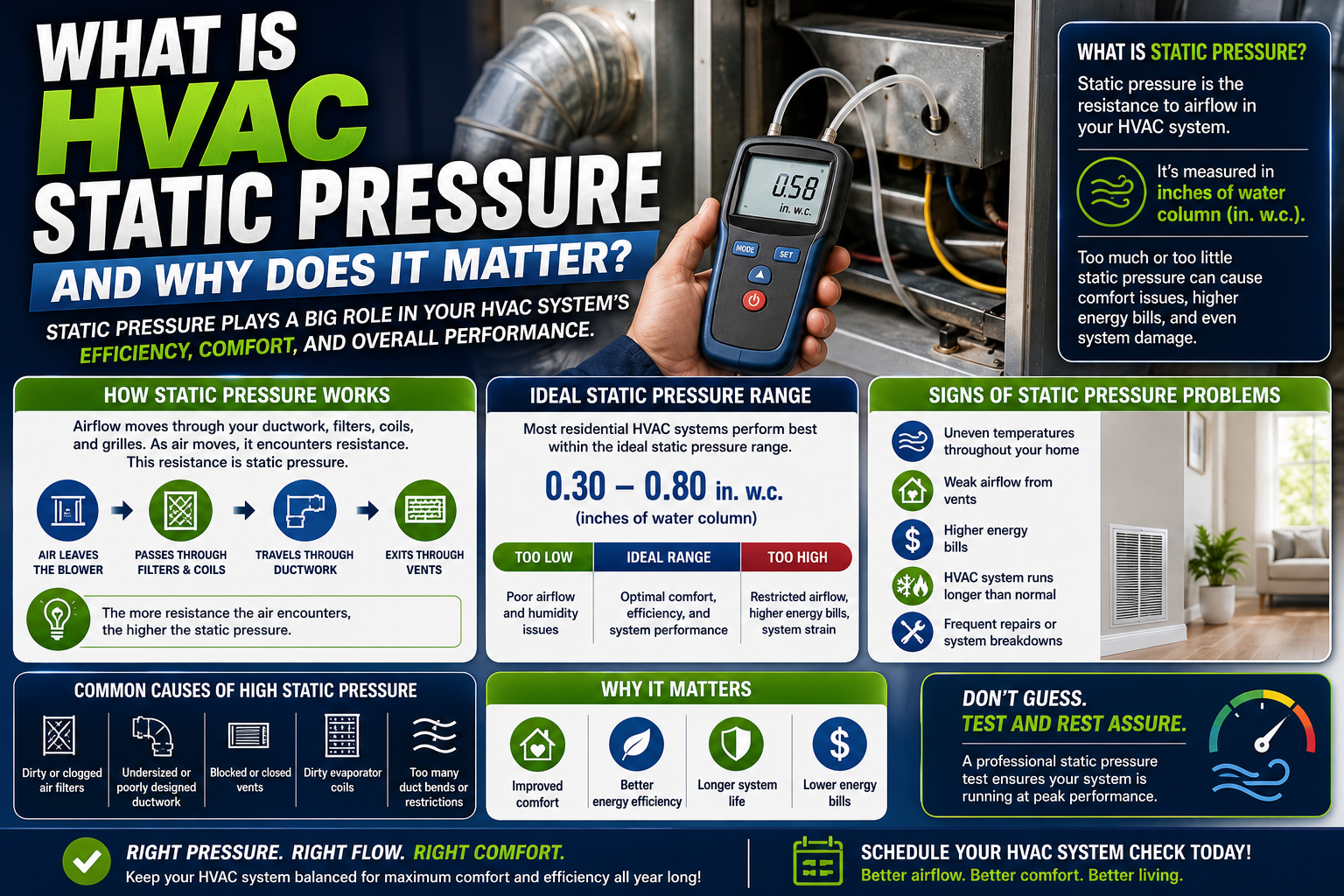
Your HVAC System Doesn’t Just Heat and Cool — It Has to Move Air
When homeowners think about their HVAC system, they usually think about temperature.
Is the air cold?
Is the heater producing warm air?
Is the thermostat working?
But there’s another part of HVAC performance that homeowners rarely hear about:
Static pressure.
Static pressure plays an important role in how effectively your HVAC system moves air through the home.
A system can have a perfectly good compressor, furnace, or heat pump and still struggle to keep the house comfortable if airflow is restricted.
Understanding static pressure can help explain problems such as weak airflow, noisy vents, hot rooms, excessive equipment operation, and even premature component wear.
Here’s what homeowners should know.
What Is HVAC Static Pressure?
In simple terms, HVAC static pressure is the resistance the system’s blower has to work against as it moves air through the HVAC equipment and ductwork.
Think about drinking through a straw.
A wide, unrestricted straw allows air or liquid to move relatively easily.
Now imagine squeezing the straw nearly closed.
You can still try to pull through it, but it becomes much harder.
Your HVAC system can experience something similar.
When airflow pathways become too restrictive, the blower has to work against greater resistance.
Your HVAC System Is an Airflow System
Your central heating and cooling system continuously circulates air.
The process generally looks like this:
Room air → Return vents → Return ductwork → Filter → HVAC equipment → Supply ductwork → Supply vents → Rooms
Every part of this pathway can create some resistance.
HVAC equipment is designed to operate within an appropriate airflow and pressure range.
Problems occur when the resistance becomes excessive.
What Causes High Static Pressure?
There isn’t one single cause.
High static pressure can result from several airflow restrictions throughout the HVAC system.
Let’s look at some of the most common possibilities.
1. A Dirty Air Filter
One of the simplest causes is also one of the easiest to overlook.
As an HVAC filter collects:
- Dust
- Hair
- Pet dander
- Debris
- Airborne particles
it becomes more restrictive.
Eventually, the blower may have difficulty pulling enough air through the filter.
A severely clogged filter can reduce airflow and increase pressure within the system.
This is one reason regular filter inspection is so important.
2. A Filter That’s Too Restrictive
A clean filter can still create excessive resistance if it isn’t appropriate for the HVAC system.
Homeowners sometimes assume:
Higher filtration rating = always better.
But HVAC filters need to balance filtration with airflow.
Some high-efficiency filters can create more resistance than certain systems or filter cabinets were designed to handle.
That doesn’t mean better filtration is bad.
It means the filtration system needs to be properly designed.
3. An Undersized Return-Air System
Your HVAC system needs to pull enough air back toward the equipment.
If the return ductwork or return grille is too small, the blower may struggle to receive the airflow it needs.
Possible signs can include:
- Loud return grille
- Whistling
- Weak supply airflow
- Filter being pulled tightly into place
- Excessive blower noise
- Comfort problems
A large HVAC system connected to inadequate return ductwork can create significant airflow problems.
4. Undersized Supply Ductwork
The supply side can also be too restrictive.
Your blower needs to push conditioned air through the supply ducts and into the rooms.
If the duct system can’t handle the required airflow, pressure can increase.
This is why simply installing larger HVAC equipment on existing ductwork isn’t always appropriate.
The duct system needs to support the airflow requirements of the equipment.
5. Crushed or Kinked Flexible Ducts
Flexible ductwork is common in Southern California homes.
It can work well when installed correctly.
But flexible ducts can become:
- Crushed
- Kinked
- Compressed
- Sagged
- Restricted
Imagine bending a garden hose until the opening becomes smaller.
Water flow drops.
A severely kinked air duct can create a similar restriction for airflow.
6. Too Many Sharp Turns in the Ductwork
Air doesn’t move through every duct layout equally.
Long runs, tight bends, poor transitions, and complicated duct routing can create additional resistance.
Good duct design tries to move air efficiently from the equipment to the rooms and back again.
Poor design can make the blower work harder than necessary.
7. Closed Supply Registers
Some homeowners close vents in unused rooms hoping to save energy or push more air into other parts of the house.
Closing too many registers can increase resistance in the duct system.
Your HVAC equipment was designed around a certain amount of airflow.
Restricting that airflow can create unintended consequences.
If one area of the home receives too much or too little air, professional balancing is generally a better approach than randomly closing multiple registers.
8. A Dirty Evaporator Coil
During cooling operation, air passes across the indoor evaporator coil.
If the coil becomes heavily contaminated with dust or debris, airflow can become restricted.
This can affect:
- Cooling performance
- System airflow
- Equipment operation
- Comfort
Proper filtration helps protect the indoor coil, but maintenance is still important.
9. Blower Problems
The blower is responsible for moving air through the system.
Problems with the blower motor, wheel, controls, or settings can affect airflow.
For example, a dirty blower wheel may not move air as effectively as intended.
Incorrect blower settings can also affect system performance.
Static pressure measurements can help technicians determine whether the problem involves the duct system, equipment, or both.
What Does High Static Pressure Feel Like Inside the House?
Homeowners don’t walk around with pressure gauges.
Instead, they notice symptoms.
Possible signs include:
- Weak airflow from vents
- Some rooms staying too hot
- Loud airflow
- Whistling noises
- Long cooling cycles
- Furnace overheating problems
- AC performance issues
- Excessive blower noise
- Uneven temperatures
- Frequent equipment problems
None of these symptoms proves high static pressure by itself.
But they can justify further airflow testing.
Why Can High Static Pressure Be Hard on the Blower?
The blower’s job is to move air.
When the system creates excessive resistance, the blower has to operate under conditions different from what the HVAC system was designed for.
Depending on the motor type and system, excessive static pressure can affect:
- Airflow
- Motor operation
- Energy consumption
- Equipment performance
- Component life
This is why airflow isn’t just a comfort issue.
It’s also an equipment issue.
Can High Static Pressure Cause Weak Airflow?
Yes.
This sounds strange at first.
You might think higher pressure should mean more air blasting from the vents.
But excessive system resistance can actually reduce the amount of air the blower can move.
The system is fighting against restrictions.
The result may be surprisingly weak airflow at the registers.
Can Static Pressure Affect Air Conditioning?
Yes.
Your air conditioner depends on proper airflow across the indoor evaporator coil.
If airflow becomes too low, cooling performance can suffer.
In certain situations, inadequate airflow can contribute to the evaporator coil becoming excessively cold and potentially freezing.
That can eventually result in:
- Reduced cooling
- Little airflow
- Ice on refrigerant lines or equipment
- Water after the ice melts
Low airflow has several possible causes, and static pressure is one factor technicians may evaluate.
Can Static Pressure Affect a Furnace?
Yes.
A furnace depends on airflow to carry heat away from the heat exchanger and distribute it through the home.
If airflow is inadequate, temperatures inside the furnace can become too high.
Modern furnaces contain safety controls designed to protect the equipment.
In some situations, restricted airflow can contribute to the furnace cycling on its high-temperature safety limit.
This may appear to the homeowner as a heater that starts, stops, and starts again.
Why Does My HVAC System Whistle?
Whistling can be caused by air moving through a restriction.
Possible sources include:
- Restrictive filter
- Small return grille
- Gaps around the filter
- Partially closed damper
- Small duct opening
- Restricted register
The exact location and sound need to be evaluated.
A whistling HVAC system isn’t always a serious problem, but it can be a clue that airflow isn’t ideal.
Why Is My Return Vent So Loud?
A return grille shouldn’t sound like it’s trying to inhale your furniture.
If the return becomes unusually loud, the system may be trying to pull a large amount of air through an opening that’s too restrictive.
Possible causes include:
- Dirty filter
- Restrictive filter
- Undersized return grille
- Insufficient return ductwork
- High blower speed
- Other airflow restrictions
A technician can measure the system instead of guessing.
How Is HVAC Static Pressure Measured?
HVAC professionals can use instruments designed to measure air pressure within the system.
Measurements can be taken at specific locations around the HVAC equipment.
This allows the technician to evaluate how much resistance the blower is working against.
The results can then be compared with equipment specifications and used alongside other airflow measurements.
The important point is:
Static pressure can be measured.
It doesn’t have to be guessed based only on how strong the air feels at a vent.
What Is Total External Static Pressure?
You may hear an HVAC technician use the term:
Total External Static Pressure, or TESP.
This measurement helps evaluate the resistance the blower experiences from components external to the blower assembly, depending on the equipment and test configuration.
Homeowners don’t need to memorize technical pressure values.
What matters is whether the system is operating within the appropriate range for the equipment.
Can You Fix High Static Pressure?
Often, yes — but the correct repair depends on the cause.
Potential solutions may involve:
- Replacing a clogged filter
- Correcting filter selection
- Increasing return-air capacity
- Repairing damaged ductwork
- Correcting restrictive duct sections
- Adjusting dampers
- Cleaning affected HVAC components
- Correcting blower settings
- Modifying duct design
There is no single “static pressure repair.”
The restriction has to be identified first.
Should I Add More Return Vents?
Maybe.
Additional return-air capacity can help certain systems, but homeowners shouldn’t randomly cut new return openings into walls.
Return design needs to consider:
- Duct sizing
- Equipment airflow
- Home layout
- Filter arrangement
- System balance
A professional should determine whether return-air capacity is actually inadequate.
Can Bigger Ductwork Fix Static Pressure?
Sometimes.
If the duct system is undersized or poorly designed, increasing duct capacity or modifying restrictive sections may improve airflow.
But replacing every duct with a larger one isn’t automatically the answer.
HVAC ductwork needs to be properly sized, not simply oversized.
Why Static Pressure Should Be Checked When Replacing HVAC Equipment
Imagine your old HVAC system has struggled with airflow for years.
Then you install brand-new equipment but connect it to the same restrictive duct system.
You may still experience:
- Noise
- Weak airflow
- Hot rooms
- Equipment strain
- Comfort problems
That’s why airflow and ductwork should be considered when replacing major HVAC equipment.
A new air conditioner can’t fix a duct that’s too small.
Frequently Asked Questions About HVAC Static Pressure
What is static pressure in HVAC?
Static pressure is the resistance the HVAC blower works against while moving air through the equipment and duct system.
What causes high static pressure?
Common causes can include dirty or restrictive filters, undersized ductwork, inadequate return air, closed registers, dirty coils, and damaged ducts.
Can a dirty filter cause high static pressure?
Yes. A heavily clogged filter can create significant airflow resistance.
Can high static pressure damage an HVAC system?
Excessive airflow restriction can negatively affect system performance and place additional stress on certain components.
Does high static pressure cause weak airflow?
It can. Excessive resistance can reduce the amount of air the blower is able to move through the system.
Can high static pressure cause an AC coil to freeze?
Restricted airflow can contribute to evaporator coil freezing under certain conditions. Other problems can also cause coil freezing, so professional diagnosis is important.
Can high static pressure cause furnace problems?
Restricted airflow can contribute to excessive furnace temperatures and may cause safety controls to cycle the heating system.
How do HVAC technicians check static pressure?
Technicians use pressure-measuring instruments at appropriate points in the HVAC system and compare the measurements with equipment specifications.
HVAC Airflow Problems in Temecula Valley Homes
Homes throughout Temecula, Murrieta, Menifee, Lake Elsinore, Winchester, Hemet, Anza, and surrounding Southern California communities rely heavily on their HVAC systems during hot summer weather.
When temperatures climb, airflow problems become much more noticeable.
A homeowner may assume the AC isn’t powerful enough when the real issue is that the system can’t move conditioned air effectively.
That’s why good HVAC diagnosis should look beyond just the refrigerant and outdoor unit.
Airflow matters.
The Bottom Line
Your HVAC system doesn’t simply create hot or cold air.
It has to move that air through your home.
Static pressure tells us something about how difficult that job is for the blower.
When resistance becomes excessive, you may experience:
- Weak airflow
- Noisy vents
- Uneven temperatures
- Long HVAC cycles
- Heating or cooling performance problems
The solution isn’t automatically a bigger air conditioner or stronger blower.
The correct approach is to determine where the airflow restriction is occurring and why.
Is Your HVAC System Struggling With Airflow?
If your vents have weak airflow, your return grille is unusually loud, or certain rooms never seem comfortable, Advanced Heating & Air Conditioning can evaluate the HVAC system and help identify the cause.
Our team can inspect equipment operation, filters, airflow, ductwork, and other factors affecting home comfort.
We proudly serve Temecula, Murrieta, Menifee, Lake Elsinore, Winchester, Hemet, Anza, and surrounding communities.
Contact Advanced Heating & Air Conditioning to schedule professional HVAC service or an airflow evaluation.