


Why Does My Heat Pump Keep Switching to Auxiliary Heat?
Why Does My Heat Pump Keep Switching to Auxiliary Heat?
You look at your thermostat and notice:
AUX HEAT
or
AUXILIARY HEAT
has appeared on the screen.
A little while later, it disappears.
Then it comes back.
For homeowners who recently switched from a gas furnace to a heat pump, this can be confusing.
You may wonder:
- Is something wrong with my heat pump?
- Why isn’t the heat pump heating the house by itself?
- Is auxiliary heat making my electric bill go up?
Auxiliary heat is not automatically a problem.
It is a secondary source of heat designed to help the primary heat pump under certain conditions.
But if electric auxiliary heat is operating much more frequently than necessary, it can significantly change how much electricity the heating system uses.
That’s why homeowners should understand why AUX heat is coming on, rather than simply trying to disable it.
Current homeowner discussions show exactly this confusion. People are asking how to determine whether resistance backup heat is operating, what triggers it, and whether a heat pump running for many hours is actually preferable to using auxiliary heat for fewer hours.
Key Takeaways
- Auxiliary heat is a backup or supplemental heating source.
- AUX heat does not automatically mean the heat pump is broken.
- Electric resistance auxiliary heat generally uses considerably more electricity to produce a given amount of heat than a properly operating heat pump under favorable conditions.
- A thermostat may activate AUX heat because of outdoor temperature, indoor temperature difference, recovery settings, system capacity, or equipment controls.
- Large thermostat increases can sometimes bring auxiliary heat on.
- A heat pump problem can also cause AUX heat to operate excessively.
- Dirty filters, airflow problems, refrigerant issues, outdoor-coil problems, thermostat setup, or incorrect system sizing can contribute.
- Dual-fuel systems work differently because the backup source may be a gas furnace rather than electric heat strips.
- AUX HEAT and EMERGENCY HEAT are not necessarily the same operating mode.
- Do not disable backup heat without understanding how the system was designed.
What Is Auxiliary Heat on a Heat Pump?
A heat pump does not create heat the same way a traditional electric resistance heater does.
It primarily moves heat.
During heating mode, refrigerant allows the system to collect heat from outdoor air and transfer it indoors.
Even when the outdoor air feels cold to you, it can still contain usable thermal energy.
But under certain conditions, the heat pump may need assistance.
That’s where:
Auxiliary heat
comes in.
What Actually Produces the Auxiliary Heat?
That depends on your system.
In many all-electric heat-pump systems, auxiliary heat comes from:
Electric resistance heat strips
inside the air handler.
These operate somewhat like a very large electric heater.
- Electric current passes through resistance elements.
- The elements get hot.
- The blower moves air across them.
- Warm air enters the duct system.
Does Every Heat Pump Have Electric Heat Strips?
No.
Some systems use:
Electric resistance backup
while others may use:
- A gas furnace
- Propane furnace
- or another heating source.
Some properly designed heat-pump installations may have little need for supplemental heat under the conditions where they operate.
Equipment selection and climate matter.
Why Does My Thermostat Say AUX HEAT?
Usually because the thermostat or HVAC controls have determined that supplemental heating is needed.
Possible reasons include:
- The heat pump isn’t warming the house quickly enough
- The indoor temperature is far below the setpoint
- Outdoor temperature has dropped
- The thermostat is recovering from a setback
- The system is defrosting
- or the heat pump isn’t producing its expected heating capacity.
The important question is:
Which one is happening at your house?
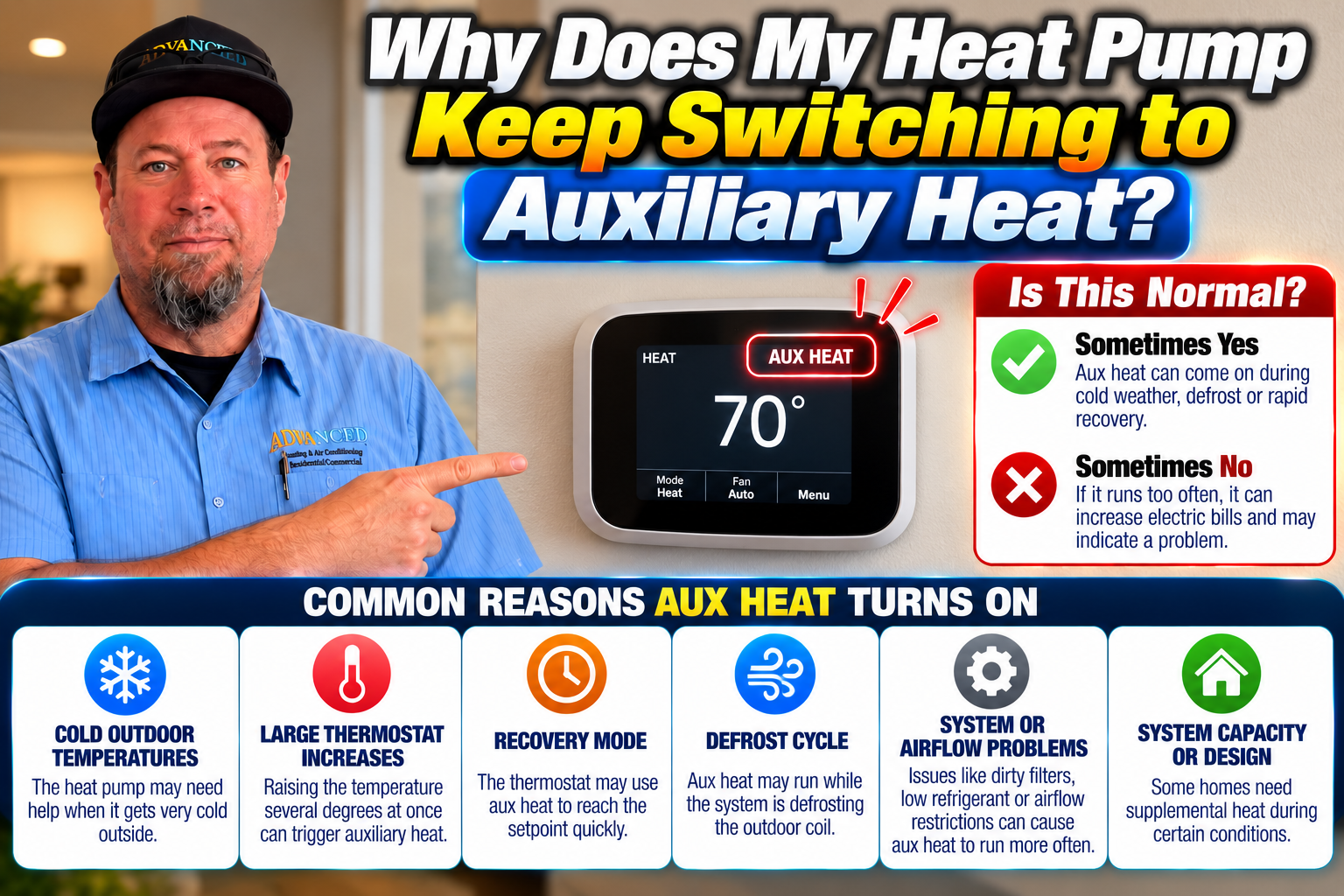
Is AUX Heat Normal?
Yes.
Under the right conditions.
Seeing AUX occasionally does not automatically mean:
“My heat pump is broken.”
For example, auxiliary heat may temporarily operate during:
- Cold weather
- Defrost
- or a large thermostat recovery.
The concern is when AUX heat appears:
- Constantly
- During mild weather
- or far more often than it used to.
Why Does AUX Heat Use So Much Electricity?
A heat pump’s major efficiency advantage is that it moves heat rather than producing all of its heat through electrical resistance.
Electric resistance heating works differently.
At the point of use, resistance heat converts electrical energy directly into heat.
A heat pump can often deliver multiple units of heat for each unit of electricity consumed, depending on equipment and conditions.
That difference is why electric auxiliary heat can noticeably increase electricity consumption.
Is It Cheaper to Let the Heat Pump Run Longer?
Often, yes.
This surprises homeowners.
They see:
- Heat pump running for 12 hours
- versus auxiliary heat running for 4 hours
and assume:
Four hours must cost less than twelve.
Not necessarily.
The amount of time something operates does not tell you how much electricity it consumes.
A recent homeowner asked essentially this exact question after seeing the heat pump run 18–20 hours per day while AUX heat could warm the house in fewer hours.
The better comparison is:
Energy consumed × utility rate
and
Heat delivered.
Long heat-pump runtime can be completely normal.
Are Long Heat-Pump Cycles Bad?
Not necessarily.
Heat pumps—especially modern variable-capacity systems—can be designed for:
- Long
- steady
- low-capacity operation.
That can provide excellent:
- Comfort
- Efficiency
- and temperature consistency.
Don’t confuse:
Long runtime
with
A system struggling.
What Makes Auxiliary Heat Turn On?
There isn’t one universal answer.
Different thermostats and heat-pump systems use different control strategies.
AUX may be activated based on:
- Outdoor temperature
- Indoor temperature
- Difference between room temperature and setpoint
- How long the heat pump has been running
- Rate at which the house is warming
- Equipment staging
- or combinations of these factors.
This is exactly why homeowners online frequently ask what actually triggers AUX heat.
Can Outdoor Temperature Trigger AUX Heat?
Yes, on some systems.
A thermostat or system controller may use an:
Outdoor-temperature threshold
as part of its control strategy.
But avoid the common assumption:
“A heat pump stops working at 40°F.”
That is not universally true.
Modern heat pumps vary enormously in cold-weather performance.
Some can provide useful heating at temperatures far below freezing.
The correct operating range depends on:
- The exact equipment
- Heating load
- Installation
- and manufacturer performance data.
What Is a Heat Pump Balance Point?
This is an important concept.
As outdoor temperature falls:
Your house loses heat faster.
At the same time, the heat pump’s available heating capacity and efficiency may change.
Eventually, depending on the equipment and house, you may reach a condition where the heat pump alone cannot keep up with the building’s heat loss.
That relationship is often discussed as a:
Balance point.
Below certain conditions, supplemental heat may be required.
Is the Balance Point the Same for Every House?
No.
Two identical heat pumps installed in two different homes can behave differently.
Why?
Because heating demand depends on:
- Square footage
- Insulation
- Windows
- Air leakage
- Ductwork
- Ceiling height
- Home orientation
- and thermostat setting.
Equipment selection matters too.
What About Southern California?
This is especially important for Advanced customers.
The Temecula Valley’s winters are generally much milder than climates where prolonged subfreezing temperatures are common.
That can make heat pumps an excellent heating option for many local homes.
A properly selected and installed heat pump can handle a large portion—or potentially all—of a home’s heating demand depending on the equipment and property.
That’s one reason Advanced Heating & Air Conditioning loves installing heat pumps.
They can provide:
- Heating
- and cooling
from one system while taking advantage of Southern California’s relatively mild heating climate.
Why Does AUX Heat Come On When I Raise the Thermostat?
This is one of the most common causes homeowners don’t realize.
Suppose your house is:
64°F.
You walk in and change the thermostat to:
72°F.
The thermostat sees an:
8-degree difference.
Depending on its programming, it may decide:
The heat pump needs help.
So it activates:
AUX heat.
Does Setting the Thermostat Higher Make the Heat Pump Heat Faster?
Not necessarily.
Changing:
68°F → 78°F
does not magically make a basic heat pump produce hotter air.
It can instead cause the thermostat to call for:
- Additional stages
- or auxiliary heat.
That’s an important difference.
Can Large Nighttime Setbacks Trigger AUX Heat?
Yes.
Imagine you set the thermostat to:
62°F overnight.
At 6:00 AM the schedule jumps to:
70°F.
Now the system needs to recover eight degrees.
Depending on the thermostat setup, AUX heat may come on to help the home recover faster.
That can reduce some of the energy savings the homeowner expected from the large setback.
Should I Avoid Thermostat Setbacks With a Heat Pump?
Not necessarily.
But extreme setbacks may not always provide the result you expect.
Moderate adjustments can sometimes work better.
The ideal strategy depends on:
- Equipment
- Thermostat
- Backup heat
- Utility rates
- and the home.
What Is Smart Recovery?
Some smart thermostats use:
- Adaptive recovery
- or smart recovery.
Instead of waiting until 7:00 AM to begin heating, the thermostat starts earlier.
For example:
5:45 AM → heat pump begins gradually warming
so the home reaches:
70°F by 7:00 AM.
That may reduce the need for an aggressive recovery using auxiliary heat.
Why Does AUX Heat Come On During Defrost?
This can be completely normal.
During heating mode, the outdoor coil can develop frost.
The heat pump periodically needs to remove it.
During:
Defrost mode
the refrigeration cycle temporarily changes.
That can temporarily reduce normal indoor heating.
Some systems activate auxiliary heat to prevent the homeowner from feeling a blast of cold air.
When defrost ends:
Normal heat-pump heating resumes.
Does AUX Heat During Defrost Mean Something Is Wrong?
No.
Temporary auxiliary operation during a normal defrost cycle can be part of system design.
The concern would be:
- AUX stays on long after defrost ends
- or the heat pump repeatedly enters abnormal defrost cycles.
Why Is AUX Heat Running When It’s Not Very Cold Outside?
Now we need to investigate.
Possible causes include:
- Thermostat settings
- Large setpoint changes
- Incorrect staging
- Heat-pump performance problem
- Airflow restriction
- Refrigerant problem
- Outdoor-unit issue
- or incorrect system configuration.
If AUX is regularly operating during mild Temecula weather, it may be worth checking why.
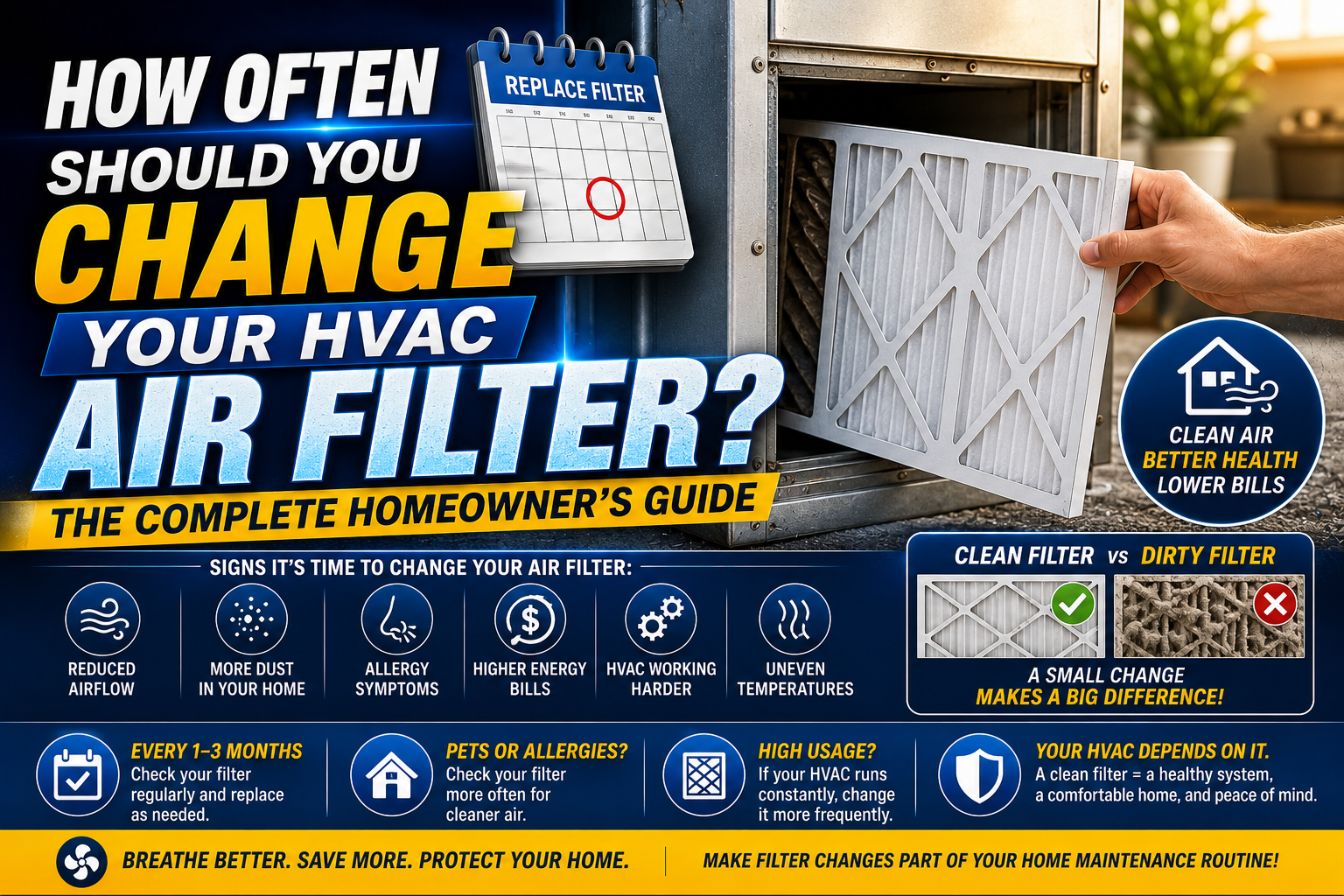
Can a Dirty Air Filter Make AUX Heat Run More?
Potentially.
A dirty filter restricts airflow.
That can reduce the amount of heat effectively delivered to the house.
The heat pump may run longer.
If indoor temperature isn’t rising as expected, the thermostat may call for supplemental heat.
So something as simple as:
A dirty filter
can potentially contribute to unnecessary auxiliary operation.
Can Bad Ductwork Cause AUX Heat to Run?
Yes.
Imagine the heat pump is producing enough heat.
But:
20% of the conditioned air is escaping through duct leaks.
The house warms slowly.
The thermostat doesn’t know:
“The duct is leaking.”
It only knows:
“The room still isn’t warm enough.”
So depending on the controls, it may call for more heat.
That can mean:
AUX.
Can Poor Insulation Make AUX Heat Run More?
Absolutely.
A poorly insulated or leaky home loses heat faster.
That increases the heating load.
The heat pump has to work harder and longer.
One homeowner asking why AUX heat was coming on frequently specifically mentioned having an older poorly insulated home and cold interior wall surfaces.
The HVAC equipment and the building envelope work together.
Can Old Windows Affect Heat-Pump Operation?
Yes.
Windows can contribute to:
- Heat loss
- Air leakage
- and cold surface temperatures.
But don’t automatically replace windows just because AUX appears.
First determine:
How much heat is the home actually losing?
An energy assessment can help identify where improvements will have the greatest impact.
Can Low Refrigerant Make AUX Heat Run More?
Yes.
If the heat pump is low on refrigerant because of a leak, heating capacity can drop.
The thermostat sees:
House isn’t warming fast enough.
It may then call for:
Auxiliary heat.
Can a Dirty Outdoor Coil Cause It?
Potentially.
During heating, the outdoor coil absorbs heat from outdoor air.
If the coil is heavily restricted by:
- Dirt
- Debris
- or abnormal ice accumulation,
heat transfer can suffer.
Reduced heating capacity may increase reliance on backup heat. Regular maintenance helps keep the coil clear.
Can a Bad Outdoor Fan Cause AUX Heat?
Potentially.
The outdoor fan is important for moving air across the outdoor coil.
If it isn’t operating properly, heat-pump performance can suffer.
But note:
The outdoor fan may intentionally stop during defrost.
So seeing it stopped momentarily doesn’t automatically mean it is broken.
Can a Refrigerant Leak Cause a High Electric Bill Because of AUX Heat?
Yes.
This can create a chain reaction:
Refrigerant problem → heat-pump capacity decreases → house warms slowly → thermostat calls for AUX → electric resistance heat operates more → electricity use increases.
This is why a high bill can sometimes be the first clue that something has changed.
Can a Bad Thermostat Make AUX Heat Run Too Much?
Absolutely.
Possible issues include:
- Incorrect equipment configuration
- Wrong staging settings
- Poor sensor location
- Incorrect outdoor-temperature thresholds
- or thermostat malfunction.
What Is an AUX Heat Lockout Temperature?
Some thermostats allow the installer to configure a temperature above which auxiliary heat is not permitted.
For example, the controls might prevent AUX heat from operating above a certain outdoor temperature.
But:
Do not copy somebody else’s setting from the internet.
The correct setup depends on:
- Equipment
- House heating load
- Climate
- and backup heating source.
What Is a Compressor Lockout Temperature?
Some systems can also be configured so the heat-pump compressor does not operate below a selected outdoor temperature.
This may be particularly relevant to:
- Dual-fuel systems
- or equipment with specific operating limitations.
Again, modern heat pumps have very different capabilities.
The manufacturer’s performance data should guide the decision.
Should I Turn AUX Heat Off Completely?
Usually, that’s not the first thing to do.
If auxiliary heat is operating excessively:
Find out why.
Don’t simply disable a system safety or backup strategy without understanding the consequences.
You could leave the house unable to maintain temperature during a situation where supplemental heat is genuinely required.
Can I Tell How Much AUX Heat I’m Using?
Sometimes.
A smart thermostat may show:
Equipment runtime
and potentially distinguish between:
- Heat pump
- and auxiliary heat.
One homeowner recently asked specifically how to determine whether resistance heat strips were operating without a smart thermostat because the system seemed to be maintaining temperature well during unusually cold weather.
An HVAC technician can also verify backup-heat operation electrically.
Can I Tell by Looking at My Electric Meter?
Sometimes a large electric-resistance heating load may create a noticeable increase in whole-home power consumption.
But that isn’t a reliable diagnostic by itself because other large electrical loads may be operating.
A thermostat history or proper electrical measurement is more useful.
How Much Electricity Do Heat Strips Use?
It depends on their capacity.
Electric heat strips can represent a substantial electrical load.
For example, systems may have different kW ratings depending on:
- Equipment
- Home
- and heating requirements.
The actual electrical consumption should be determined from the installed equipment—not guessed from a generic internet number.
Is AUX Heat Always Electric?
No.
This distinction is important.
In some systems, backup heat may be:
- Gas
- Propane
- or another source.
A heat pump paired with a gas furnace is commonly called:
Is a Gas Furnace Considered AUX Heat?
Depending on thermostat terminology and system configuration, the thermostat may display supplemental or alternate heat differently.
The important technical point is:
A dual-fuel system uses:
Heat pump + furnace
rather than:
Heat pump + electric resistance strips.
Its economics and control strategy can therefore be very different.
When Should a Dual-Fuel System Switch to Gas?
There isn’t one universal temperature.
The ideal changeover depends on:
- Heat-pump performance
- Outdoor temperature
- Gas price
- Electricity price
- House load
- and equipment design.
This is sometimes called an:
Economic balance point
as opposed to simply a capacity balance point.
What Is an Economic Balance Point?
This is where the cost of producing heat with one source becomes more favorable than the other.
For a dual-fuel system:
Heat pump operating cost
can be compared with:
Gas-furnace operating cost.
The answer changes with:
- Utility rates
- and equipment efficiency.
That’s why:
“Always switch to gas at 40°F”
is not a universal rule.
What’s the Difference Between AUX Heat and Emergency Heat?
This is one of the most misunderstood heat-pump questions.
AUXILIARY HEAT
typically means:
The system automatically brings in backup heat to assist the heat pump.
EMERGENCY HEAT
generally means:
The homeowner manually selects the backup heating source while disabling or bypassing normal heat-pump heating operation, depending on system design.
They are not simply two names for exactly the same operating strategy.
Should I Switch to Emergency Heat When It Gets Cold?
Usually:
No—not simply because it’s cold outside.
A properly configured system should generally manage its heating stages automatically.
One homeowner asked this exact question before single-digit weather, wondering whether to shut off the heat pump and manually use AUX heat. The responses emphasized that properly configured systems should generally manage backup heat automatically.
Emergency heat is generally intended for situations where the primary heat-pump operation cannot be used appropriately.
When Would Emergency Heat Be Appropriate?
Examples might include certain situations where:
- The outdoor heat pump has failed
- or cannot safely operate,
but the backup heating source remains functional.
The exact operation depends on system design.
If you’re unsure why you’re using emergency heat:
Call your HVAC contractor.
Why Is My Emergency Heat Light On?
First determine whether the thermostat says:
- AUX
- or EM HEAT.
Those mean different things.
If someone manually selected:
Emergency Heat
on the thermostat, the system may intentionally be operating only the backup source.
That can dramatically change operating cost if the backup is electric resistance heat.
Could Someone Accidentally Leave It in Emergency Heat?
Yes.
This happens.
A homeowner may see:
- HEAT
- AUX
- EMERGENCY HEAT
and assume they are interchangeable.
Then the system can operate on backup heat for an extended period.
If the electric bill suddenly jumps:
Check thermostat mode.
Why Did My Electric Bill Suddenly Double?
Possible causes include:
- Colder weather
- More heating hours
- Higher utility rates
- Large thermostat setbacks
- Auxiliary heat
- Emergency heat
- Heat-pump performance problems
- or a combination.
One homeowner reported a winter utility bill jumping to nearly $600 and discovered auxiliary heat had been operating much more as temperatures dropped.
Don’t automatically blame the heat pump itself.
Find out:
Which heating stage actually consumed the energy.
Could AUX Heat Be Running Without the Thermostat Showing It?
Depending on system design and thermostat, homeowners may not always have a clear display of every stage.
That is why runtime data and professional electrical testing can be helpful.
If the bill is unexpectedly high, the technician can verify whether the backup heat is being energized.
Can Heat Strips Get Stuck On?
Electrical control failures can potentially cause improper backup-heat operation.
Possible components include:
- Relays
- Sequencers
- Control boards
- Thermostat wiring
- or related controls.
If electric resistance heat appears to remain energized when it shouldn’t:
Have the system inspected.
What Is a Heat Sequencer?
On some electric heating systems, a sequencer controls how electric heating elements are energized.
Rather than bringing a large electrical load on all at once, stages may activate in sequence.
A failed sequencer can cause:
- Heat strips not to turn on
- or potentially abnormal operation depending on the failure.
Can One Heat Strip Fail While the Others Work?
Yes.
Electric auxiliary heaters may have multiple stages or elements.
A partial failure can result in:
- Some backup heat
- but not the system’s full designed output.
A technician can measure:
- Voltage
- Current
- and control signals to determine which stages are operating.
Why Does My Heat Pump Run at the Same Time as AUX Heat?
That can be completely normal in an all-electric system.
AUX means:
Supplemental.
The heat pump may continue moving heat while the resistance heaters add additional capacity.
That can provide more total heating than either source alone.
Isn’t It Wasteful to Run Both?
Not necessarily.
If the home needs more heat than the heat pump alone can provide under current conditions, running both can be the intended system strategy.
The real issue is whether supplemental heat is being used:
When actually needed
rather than unnecessarily.
Can Better Heat-Pump Equipment Reduce AUX Usage?
Potentially.
Modern heat pumps can offer improved low-temperature heating capacity compared with many older designs.
Variable-capacity equipment can also adjust output to match demand.
When replacing a system, Advanced can evaluate:
- Heating load
- Equipment capacity
- Ductwork
- Electrical requirements
- and whether backup heating is necessary.
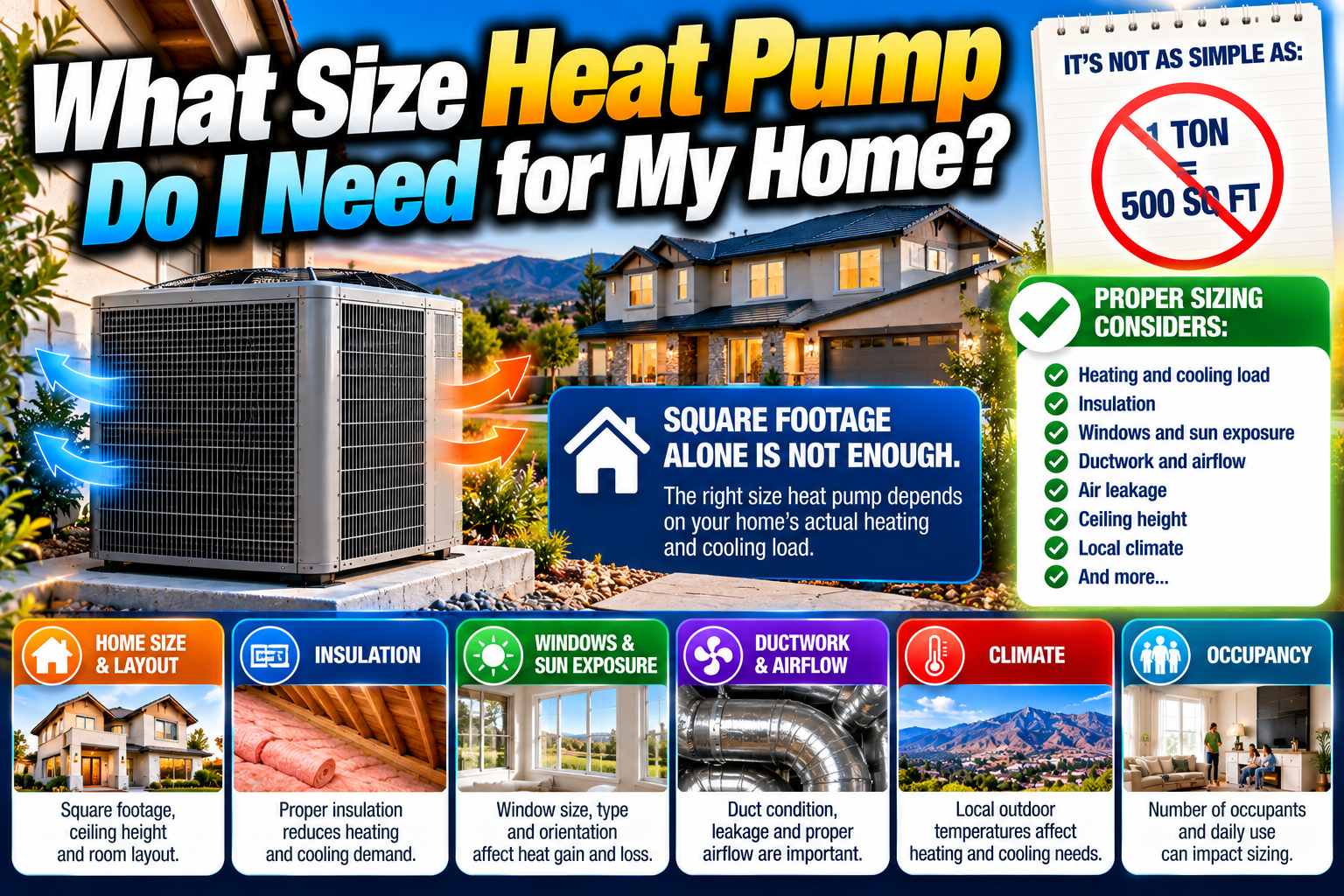
Can Proper Sizing Reduce Auxiliary Heat?
Absolutely.
A system that is undersized for the actual heating load may require more supplemental heat.
But simply installing:
The biggest heat pump available
is not the solution.
Oversizing can create other comfort and performance problems.
Proper equipment selection requires balancing:
- Heating demand
- and cooling demand.
Why Is Southern California Good for Heat Pumps?
Heat pumps tend to be particularly attractive in climates where winters are comparatively mild.
That’s one reason they can make so much sense throughout:
- Temecula
- Murrieta
- Menifee
- Winchester
- Wildomar
- Lake Elsinore
- and surrounding Southern California communities.
Homeowners can get:
- Efficient electric heating
- Air conditioning
from the same equipment.
And modern systems offer options ranging from:
- Single-stage
- to multi-stage
- and variable-capacity heat pumps.
Should I Replace My Gas Furnace With a Heat Pump?
That depends on the home and homeowner.
Consider:
- Existing equipment
- Electrical capacity
- Ductwork
- Solar
- Utility rates
- Comfort goals
- Equipment efficiency
- and whether the homeowner wants all-electric or dual-fuel.
A professional system evaluation is the best way to compare the options for a specific home.
What If I Have Solar?
Heat pumps can be especially interesting for homeowners thinking about electrification and solar.
But solar does not automatically mean:
Electric heat is free.
System size, generation, consumption, utility rate structure, batteries, and time-of-use rates all matter.
Still, heat pumps can be an important part of an electrification strategy.
What Can Homeowners Check Safely?
If AUX heat seems to be running too much, check:
- Thermostat mode
- Thermostat setpoint
- Recent schedule changes
- Whether you made a large temperature increase
- Air filter
- Supply and return vents
- Whether the outdoor unit is operating
- Whether the outdoor coil is unusually iced
- and whether AUX usage has suddenly changed.
If you have thermostat runtime history:
Look at it.
That information can be extremely useful.
What Information Should I Give the HVAC Technician?
Tell them:
- When AUX appears
- Outdoor temperature
- Indoor temperature
- Thermostat setpoint
- Whether the heat pump is running
- How long AUX stays on
- Whether the system is maintaining temperature
- and whether your electric bill changed.
Those details help distinguish:
- Normal supplemental heating
- from a system problem.
When Should I Call for Service?
Have the system checked if:
- AUX runs constantly during mild weather
- AUX suddenly runs much more than it used to
- The heat pump cannot maintain temperature
- Your electric bill suddenly increases
- The outdoor unit isn’t running
- The heat pump is heavily iced
- Emergency heat is operating unexpectedly
- or you aren’t sure whether the thermostat is configured correctly.
The goal isn’t:
Never use AUX.
The goal is:
Use the heat pump efficiently and bring in supplemental heat only when the system actually needs it.
Frequently Asked Questions
Why does my thermostat say AUX HEAT?
The thermostat is calling for supplemental heating in addition to, or depending on system design sometimes instead of, normal heat-pump heating.
Is AUX heat bad?
No. It is a normal part of many heat-pump systems. Excessive or unnecessary AUX operation is what should be investigated.
Does auxiliary heat cost more?
Electric resistance auxiliary heat generally requires more electricity per unit of delivered heat than an efficiently operating heat pump.
Should I turn AUX heat off?
Not simply because you see it operating. Determine why it is running before changing system settings.
Why does AUX come on when I raise the thermostat?
A large temperature difference between room temperature and setpoint can cause some thermostats to request supplemental heating.
Why does AUX come on during defrost?
Backup heat can help maintain indoor comfort while the heat pump temporarily changes refrigeration operation to defrost the outdoor coil.
Should I use emergency heat when it’s cold outside?
Usually not simply because outdoor temperature drops. A properly configured heat-pump system should manage its heating stages automatically.
Are AUX heat and emergency heat the same thing?
No. AUX is generally automatically controlled supplemental heat. Emergency heat is typically a manually selected backup-heating mode.
Can a dirty filter cause more AUX operation?
Potentially. Restricted airflow can reduce heat delivery and system performance.
Can low refrigerant cause AUX heat to run?
Yes. Reduced heat-pump capacity can cause the thermostat to call for supplemental heating more often.
Can a bad thermostat cause excessive AUX heat?
Yes. Incorrect configuration, staging or sensor behavior can result in unnecessary auxiliary operation.
Can bad insulation cause AUX heat to run more?
Yes. Greater building heat loss increases heating demand.
Why did my electric bill jump after installing a heat pump?
Determine how much energy was used by the heat pump versus electric resistance backup. Excessive auxiliary operation is one possible explanation, but weather, rates, thermostat settings and other household loads also matter.
Is it normal for my heat pump to run for hours?
Yes. Long runtime can be completely normal, particularly with variable-capacity equipment.
Can a new heat pump reduce how much AUX heat I need?
Potentially. Modern equipment can provide strong heating performance, but the system must be properly selected for the home’s heating load and climate.
Don’t Be Afraid of Long Heat-Pump Runtime
This is probably the most valuable lesson for homeowners.
A lot of people see:
Heat pump running for hours
and think:
“This must be costing me a fortune.”
Then they manually switch to:
- AUX
- or EMERGENCY HEAT
because the backup heat warms the house faster.
That can be exactly backwards.
Heat pumps often achieve their efficiency by operating:
- Longer
- steadier
- and with less expensive heat production than electric resistance backup heat.
Long runtime, by itself, isn’t the problem. Unnecessary auxiliary or emergency heat is what quietly drives up the bill. Understand why AUX is running, then fix the cause rather than masking it by forcing the backup source on.
Heat Pump Service & Installation in the Temecula Valley
Advanced Heating & Air Conditioning diagnoses and services heat-pump systems—including auxiliary-heat and thermostat-configuration concerns—throughout Temecula, Murrieta, Menifee, Winchester, Wildomar, French Valley, Canyon Lake, Lake Elsinore, Hemet and surrounding communities.
Advanced Heating & Air Conditioning
951-609-9881
California Contractor License #916901
REAL PEOPLE. REAL SERVICE. REAL COMFORT.