


How Can I Improve HVAC Airflow in My Temecula Home?

How Can I Improve HVAC Airflow in My Temecula Home?
If the air coming from your vents feels weak, certain rooms never get comfortable, or your air conditioner seems to run constantly during a hot Temecula afternoon, you may have an HVAC airflow problem.
The good news is that weak airflow does not automatically mean you need a new air conditioner.
In many Temecula homes, airflow problems can be traced to things such as a dirty filter, restricted return air, dirty indoor coil, blower problem, leaking or damaged ductwork, crushed flexible ducts, poor duct design, or an HVAC system that was never properly configured for the home. Advanced Heating & Air Conditioning’s current airflow guidance identifies these as common causes and recommends finding the restriction before considering larger equipment.
At Advanced Heating & Air Conditioning, our approach is: find out where the airflow is being lost or restricted—and fix the actual problem.
Why Is Good HVAC Airflow So Important?
Your air conditioner, furnace, or heat pump doesn’t heat or cool your home by itself.
The HVAC equipment conditions the air. Then the system has to move that air throughout your home.
Think about it as a complete loop: return air travels to the HVAC equipment, through the supply ductwork, into the rooms, and back to return air again.
If something restricts that loop, comfort and HVAC performance can suffer.
ENERGY STAR notes that poor system airflow can contribute to reduced efficiency, higher utility costs, reduced comfort, and potentially shorter equipment life.
That’s why airflow is something we take seriously.
1. Start With Your HVAC Filter
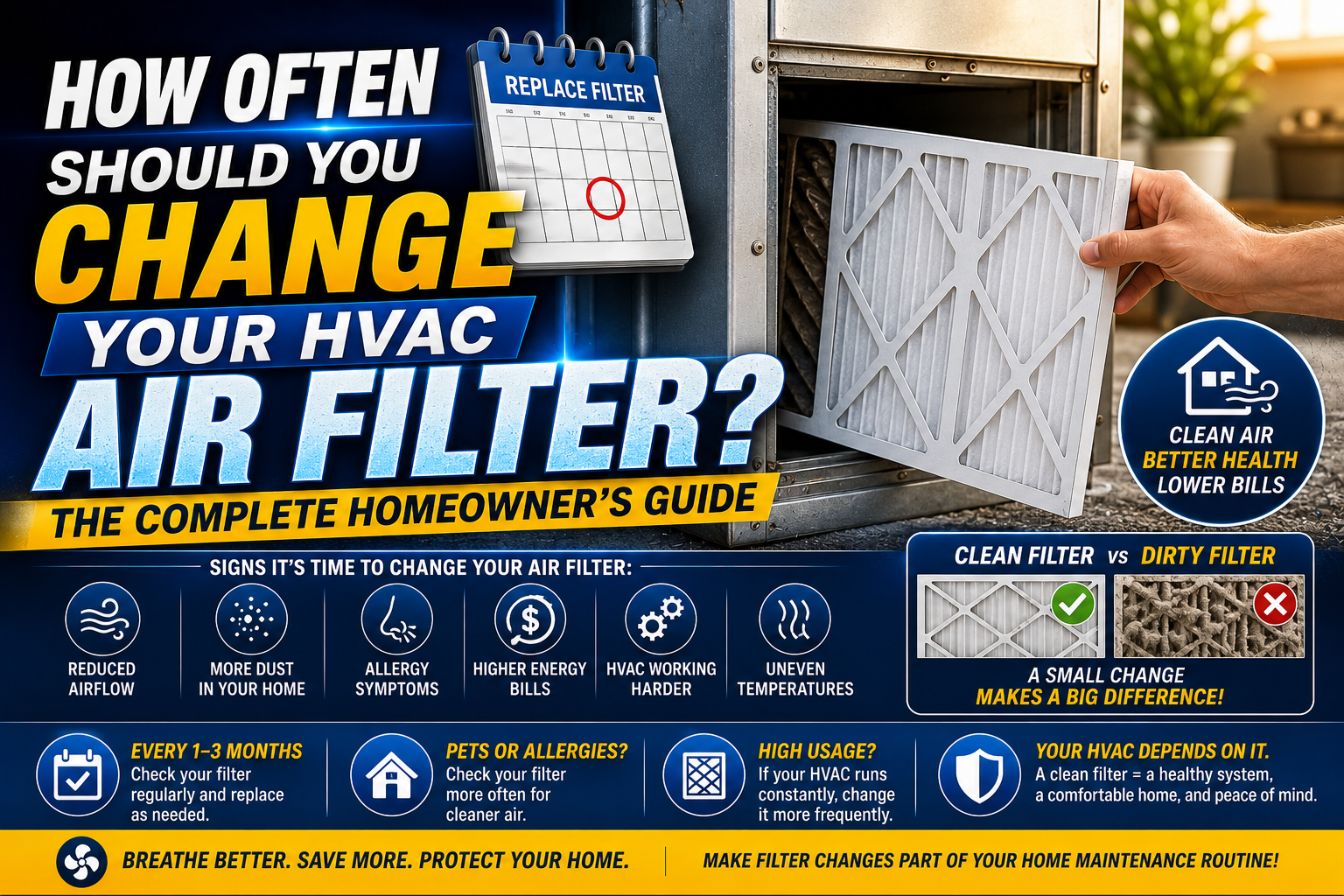
This is the easiest place for a homeowner to start. Check your air filter.
A heavily loaded filter creates resistance and can reduce airflow through the HVAC system.
ENERGY STAR recommends checking the filter monthly during heavy-use periods and replacing it when dirty; its general guidance says filters should be changed at least every three months, although the correct interval depends on the filter and equipment.
But there’s another important point: more restrictive isn’t automatically better.
Don’t simply buy the highest-rated filter you can find without considering whether it’s appropriate for your HVAC system. Filtration and airflow have to work together.
2. Make Sure Your Supply Vents Are Open
Walk through the house and look at your supply registers.
Make sure they’re open, not covered by furniture, not blocked by rugs, not hidden behind curtains, and not packed with excessive dust or debris.
It sounds simple, but we’ve seen rooms where the airflow problem begins with a blocked register.
If you’re troubleshooting one uncomfortable bedroom, compare its airflow with a room that feels comfortable. That comparison can tell us a lot.
3. Don’t Close a Bunch of Vents to “Push” Air Somewhere Else
This is a common idea: “Nobody uses that room, so I’ll close its vent and force more air into the bedroom.”
A forced-air HVAC system isn’t necessarily designed to operate that way.
Closing multiple supply registers can increase resistance in the duct system.
Instead of randomly restricting vents, it’s better to find out why the room you care about isn’t receiving enough airflow. There may be a duct, return-air, balancing, or equipment issue that needs correction.
4. Check Your Return-Air Grilles
Supply air gets most of the attention. But your HVAC system needs to pull air back in before it can send conditioned air out. That’s the job of the return-air system.
Don’t block return grilles with furniture, boxes, curtains, or other objects.
And if airflow throughout the entire house seems weak, return-air restriction is one of the things worth investigating.
ENERGY STAR specifically recommends that professional duct evaluations examine the balance between supply and return air, noting that some systems have undersized return ducts.
5. Have Your Ductwork Checked for Leaks
This can make a major difference.
ENERGY STAR estimates that in a typical forced-air home, approximately 20% to 30% of the air moving through the duct system can be lost through leaks, holes, and poorly connected ducts.
Think about what that means. Your air conditioner produces cold air. Your blower moves it into the ductwork. But part of that conditioned air escapes into the attic before reaching your bedrooms.
You might experience weak airflow, hot rooms, longer HVAC runtime, difficulty maintaining temperature, and potentially higher energy use.
Meanwhile, you may assume, “My AC isn’t big enough.” But the air conditioner may not be the main problem at all.
6. Look for Damaged, Crushed, or Kinked Ductwork
Flexible ductwork is common in Southern California homes.
If a flexible duct becomes crushed, kinked, compressed, disconnected, or damaged, airflow can decline.
ENERGY STAR recommends that professional duct contractors inspect the entire duct system and correct damaged, disconnected, tangled, or crushed flexible ducts.
This becomes especially important when one room has weak airflow while the rest of the house seems normal.
Advanced’s airflow guidance makes the same distinction: when only one room is affected, investigate that room’s air distribution; when airflow is weak throughout the house, look more closely at the central HVAC system.
7. Your Evaporator Coil Could Be Restricting Airflow
Your indoor evaporator coil sits directly in the airflow path.
If the coil becomes excessively dirty, airflow and cooling performance can suffer.
ENERGY STAR recommends cleaning evaporator and condenser coils as part of professional HVAC maintenance because dirty coils reduce cooling performance and can increase system runtime.
A technician may need to inspect coil cleanliness, temperature, refrigeration performance, and airflow across the coil.
Simply replacing the filter won’t correct a coil that’s already heavily contaminated.
8. A Frozen Evaporator Coil Can Reduce Airflow Dramatically
If ice develops on the indoor coil, airflow can become extremely weak. The ice essentially begins blocking the air’s path.
A frozen coil can have several possible causes, so don’t assume that adding refrigerant is automatically the answer.
Possible contributors can include restricted airflow, a dirty filter, blower problems, a dirty coil, or refrigerant-related problems.
If you see ice on refrigerant lines or indoor equipment, the system should be professionally evaluated.
9. Your Blower May Not Be Moving Enough Air
Your indoor blower is responsible for pushing conditioned air through the duct system.
If it isn’t operating correctly, airflow throughout the house can suffer.
Potential issues can involve blower wheel cleanliness, the blower motor, motor controls, fan speed/settings, electrical components, or other mechanical problems.
ENERGY STAR’s professional maintenance checklist specifically recommends cleaning and adjusting blower components to provide proper system airflow and notes that airflow problems can reduce HVAC efficiency.
If airflow is weak from almost every vent, the blower and central HVAC equipment deserve closer inspection.
10. Your Ductwork May Be Too Small
This is a more complicated airflow problem.
Sometimes the equipment is trying to move more air than the duct system can comfortably handle.
That can contribute to weak airflow in certain areas, noisy vents, whistling, high static pressure, reduced system performance, and comfort problems.
In this situation, installing an even larger HVAC system can make matters worse. Bigger equipment does not fix undersized ductwork.
A technician needs to understand what the blower is trying to move and what the duct system can actually handle.
11. Your Return-Air System May Be Too Small
Supply ducts are only half the system.
If the HVAC equipment can’t get enough air back, the blower has to work against excessive restriction.
That’s why Advanced looks at both supply air and return air when diagnosing airflow.
ENERGY STAR likewise advises professional duct contractors to evaluate supply/return balance and specifically notes that return ducts can be undersized.
Adding or modifying return-air capacity can sometimes be part of an airflow solution—but only after the system has been evaluated.
12. Check for Dirty or Restrictive Return Grilles
A return grille can accumulate dust and debris over time.
If the return has a filter installed at the grille, inspect the filter. If furniture has been placed directly in front of it, move the obstruction.
You want the HVAC system to have a clear path for air to return.
Again: your HVAC system cannot properly deliver air if it cannot properly receive air.
13. Have the System Checked for High Static Pressure
Static pressure is one of the more technical—but important—parts of HVAC airflow.
Think of static pressure as the resistance your blower encounters while trying to move air through the system.
Too much resistance can come from dirty filters, restrictive filters, undersized ducts, restricted return air, dirty coils, closed dampers, poor duct design, and other restrictions.
A professional HVAC technician can measure system pressure rather than guessing.
This is particularly useful when homeowners repeatedly experience weak airflow even though the HVAC equipment appears to be running.
14. Your Duct System May Need Air Balancing
Sometimes the HVAC system is producing enough total airflow—but it isn’t distributed correctly.
For example: living room with lots of air, primary bedroom comfortable, back bedroom with barely any air.
The issue isn’t necessarily total system capacity. It may be distribution.
Air balancing involves evaluating how conditioned air is distributed and making appropriate adjustments when the duct system allows it.
The goal isn’t maximum airflow from every vent. The goal is the appropriate airflow for each part of the home.
15. Don’t Ignore Your Attic Ductwork
This is especially important in Temecula.
Many local homes have ductwork running through the attic. During summer, that attic can become extremely hot.
If ducts in that environment are leaking, disconnected, poorly insulated, or damaged, the cooling system may have a much harder job delivering conditioned air where you actually need it.
ENERGY STAR recommends sealing ducts in attics and other unconditioned areas and insulating them after sealing.
16. Don’t Assume Duct Cleaning Will Fix an Airflow Problem
This is another important distinction. Duct cleaning and duct repair are not the same thing.
If your problem is a disconnected duct, crushed flex duct, air leakage, undersized ductwork, poor return-air capacity, or bad system design, cleaning the ducts doesn’t correct the underlying problem.
At Advanced, we want to identify why airflow is weak before recommending the service.
17. Have Your HVAC System Professionally Maintained
Maintenance gives a technician an opportunity to inspect several things that affect airflow.
Depending on the equipment and service, that may include filter condition, blower operation, the evaporator coil, system controls, temperature performance, duct concerns, and other operating conditions.
ENERGY STAR recommends regular HVAC maintenance and specifically includes checking blower components, coils, refrigerant charge, filters, and controls.
For Temecula Valley homes, we generally recommend scheduling cooling maintenance before the heavy summer cooling season and heating maintenance before winter.
18. Make Sure Your HVAC System Is Properly Sized
This is especially important if airflow problems started after an HVAC replacement.
Installing bigger equipment does not automatically mean more comfort.
ENERGY STAR warns that oversized equipment can cycle too frequently and recommends sizing equipment according to the actual characteristics of the home. It also specifically identifies optimized airflow and duct evaluation as parts of quality HVAC installation.
When Advanced replaces HVAC equipment, we want to look at home size, layout, existing ductwork, return-air system, heating and cooling requirements, and other factors.
The new equipment and existing ductwork need to work together.
19. Don’t Automatically Replace Your AC Because Airflow Is Weak
This may be the most important part of this article.
Weak airflow does not automatically mean a bad air conditioner.
Advanced’s current Learning Center guidance specifically identifies dirty filters, restricted returns, damaged ducts, dirty blowers, blower-motor problems, dirty or frozen coils, and poor duct design as possible causes of weak airflow.
Imagine replacing an entire AC system when the actual problem is a crushed duct. You could spend thousands of dollars and still have the same uncomfortable bedroom.
We’d rather find the actual restriction first.
What Can I Do Myself to Improve HVAC Airflow?
There are several safe things homeowners can do before scheduling service:
- Check the HVAC filter. Replace it if it’s dirty and use the type appropriate for your system.
- Open your supply registers. Make sure vents aren’t accidentally closed.
- Move furniture away from vents. Give conditioned air room to circulate.
- Keep return grilles clear. Don’t block them with furniture or boxes.
- Compare airflow between rooms. Notice whether the problem affects one room or the entire house.
- Look for obvious accessible duct damage. If you can safely see ductwork, note any obvious disconnected or crushed sections.
- Pay attention to when the problem occurs. Is airflow always weak or only during certain conditions?
Those observations can make professional diagnosis easier.
What Should I NOT Do Myself?
Avoid opening HVAC equipment, accessing electrical components, handling refrigerant, climbing onto unsafe attic structures, or attempting major duct modifications without the appropriate knowledge and equipment.
You can inspect the basics. Let an HVAC technician handle the mechanical, electrical, refrigeration, and more complicated airflow diagnostics.
How Does Advanced Diagnose Weak HVAC Airflow?
When you call Advanced because your Temecula home has weak airflow, we don’t want to immediately assume you need new equipment. We want to determine where the restriction is occurring.
Depending on the situation, that may involve evaluating the filter, return-air system, supply airflow, blower, evaporator coil, ductwork, duct connections, duct restrictions, system configuration, equipment operation, and the room-to-room comfort pattern.
Advanced’s published airflow guidance emphasizes exactly this distinction: if one room is affected, investigate that room’s distribution; if the whole house is affected, investigate the central HVAC system and airflow.
One Room Has Weak Airflow vs. the Whole House
This is a useful way to narrow the problem.
One room has weak airflow: we may look more closely at that room’s duct, damaged or disconnected ductwork, duct sizing, the register, a damper, the return-air path, and the room’s specific heating or cooling load.
The whole house has weak airflow: we may look more closely at the filter, return-air restriction, blower, evaporator coil, system static pressure, duct-system sizing, and central HVAC operation.
That doesn’t diagnose the system by itself, but it’s a valuable starting point.
Can New Ductwork Improve Airflow?
Yes—when existing ductwork is actually the problem.
ENERGY STAR recommends that duct-improvement contractors inspect the whole system, correct damaged or disconnected ducts, straighten crushed flexible ducts, seal leaks, evaluate supply/return balance, and verify airflow after repairs.
But Advanced doesn’t believe every airflow complaint requires complete duct replacement.
If one damaged section can be repaired, let’s discuss repairing it. If the entire duct system is undersized, deteriorated, badly damaged, poorly designed, or unable to support the HVAC equipment properly, then replacement or redesign deserves consideration.
Can Better Airflow Help My Heat Pump?
Absolutely.
A modern heat pump still depends on the home’s air-distribution system.
If you’re considering replacing an older AC or furnace with a heat pump, we want the existing ductwork and airflow evaluated as part of the project.
ENERGY STAR’s heat-pump installation guidance specifically recommends ensuring that the duct system is well sealed and capable of providing sufficient airflow throughout the living space.
You can buy excellent heat-pump equipment. But it still needs a good distribution system.
Will Improving Airflow Lower My Electric Bill?
It can improve HVAC efficiency when poor airflow or duct leakage is causing unnecessary system losses, but we wouldn’t promise a specific dollar amount.
ENERGY STAR says a dirty filter makes HVAC equipment work harder, while sealing and insulating ducts can improve heating and cooling efficiency.
Your actual energy use also depends on weather, thermostat settings, equipment efficiency, insulation, home size, utility rates, duct condition, and how much the system operates.
So the better goal is to get the HVAC system operating correctly. Energy savings may follow when an airflow or duct-efficiency problem is corrected.
Will Better Airflow Make My Home More Comfortable?
If airflow is the reason certain rooms are uncomfortable, yes, improving it can make a significant difference.
That’s ultimately what matters.
The goal isn’t just seeing a bigger number on an airflow meter. The goal is better room-to-room comfort, proper HVAC operation, more consistent temperatures, and conditioned air reaching the places where your family actually lives.
Why Temecula Homes Can Develop Airflow Problems
Temecula homes come in many sizes and layouts.
We see single-story homes, two-story homes, large homes, older homes, newer developments, homes with additions, and properties where HVAC systems or ductwork have been modified over the years.
Combine that with our hot summer weather and small airflow deficiencies can become much more noticeable.
A bedroom that receives slightly too little conditioned air may seem fine during mild weather. During a hot Temecula afternoon, it can become the room nobody wants to use.
That’s why airflow matters.
Why Choose Advanced Heating & Air Conditioning for HVAC Airflow Problems?
Advanced Heating & Air Conditioning is based in Temecula and provides HVAC repair, airflow diagnostics, ductwork, maintenance, and system evaluations throughout Temecula Valley. Advanced’s current airflow guidance specifically emphasizes that HVAC performance requires proper equipment, proper airflow, proper ductwork, and proper installation working together.
Our approach is straightforward:
- Don’t guess. Determine where the restriction is.
- Don’t automatically replace the AC. Weak airflow can have many causes.
- Repair what actually needs repair. A single damaged duct doesn’t necessarily mean you need an entire new duct system.
- Look at the complete HVAC system. Equipment, filters, blowers, coils, supply ducts and return air all work together.
- Verify the result. After an airflow problem is corrected, the objective is to make sure conditioned air is moving through the home the way it should.
How Can I Improve HVAC Airflow in My Temecula Home?
Start with the basics:
- Check your filter.
- Open and clear your vents.
- Keep return grilles unobstructed.
- Compare airflow from room to room.
- Have leaking, crushed, disconnected, or restricted ductwork evaluated.
- Have the blower and evaporator coil inspected if airflow is weak throughout the house.
- Check whether the duct system and return air are properly sized.
- Have system airflow professionally evaluated instead of assuming you need larger equipment.
ENERGY STAR’s guidance supports this whole-system approach: filters, ducts, blower components, equipment sizing, supply/return balance, and verified airflow all affect HVAC performance and comfort.
Most importantly: find the restriction before replacing the equipment.
If your Temecula home has weak airflow, hot bedrooms, noisy vents, or an HVAC system that struggles to distribute conditioned air, Advanced can evaluate the system and determine what’s actually happening. You can schedule HVAC service with Advanced here.
Advanced Heating & Air Conditioning
HVAC Airflow • Ductwork • AC Repair • Heat Pumps • Heating • Maintenance • Installation
Serving Temecula, Murrieta & the Surrounding Temecula Valley
HVAC Services You Can Count On.
Frequently Asked Questions
Why is barely any air coming from my AC vents?
Possible causes include a dirty filter, restricted return air, dirty or frozen evaporator coil, blower problem, damaged ductwork, or poor duct design. Advanced specifically identifies these among common causes of weak airflow.
Why is airflow weak in only one bedroom?
When one room is affected but airflow elsewhere is normal, the problem is more likely to involve that room’s duct, register, damper, return-air path, or air distribution rather than the entire HVAC system.
Can a dirty air filter reduce HVAC airflow?
Yes. ENERGY STAR says a dirty filter slows airflow and makes the heating or cooling system work harder.
Can leaking ducts cause weak airflow?
Yes. ENERGY STAR estimates that typical duct systems can lose about 20%–30% of moving air through leaks, holes, and poor connections.
Should I close vents to increase airflow in another room?
Closing multiple registers isn’t a good substitute for diagnosing an airflow imbalance. If one room isn’t receiving enough conditioned air, the better approach is to determine why.
Does weak airflow mean I need a new AC?
No. Advanced specifically notes that many airflow problems involve filters, ducts, blowers, coils, or system configuration rather than requiring complete AC replacement.
Can Advanced improve HVAC airflow in my Temecula home?
Yes. Advanced provides HVAC repair, airflow diagnostics, ductwork, maintenance, and system evaluations from its Temecula base and throughout the surrounding service area.