


What Is a Variable-Speed HVAC System and Is It Worth It?
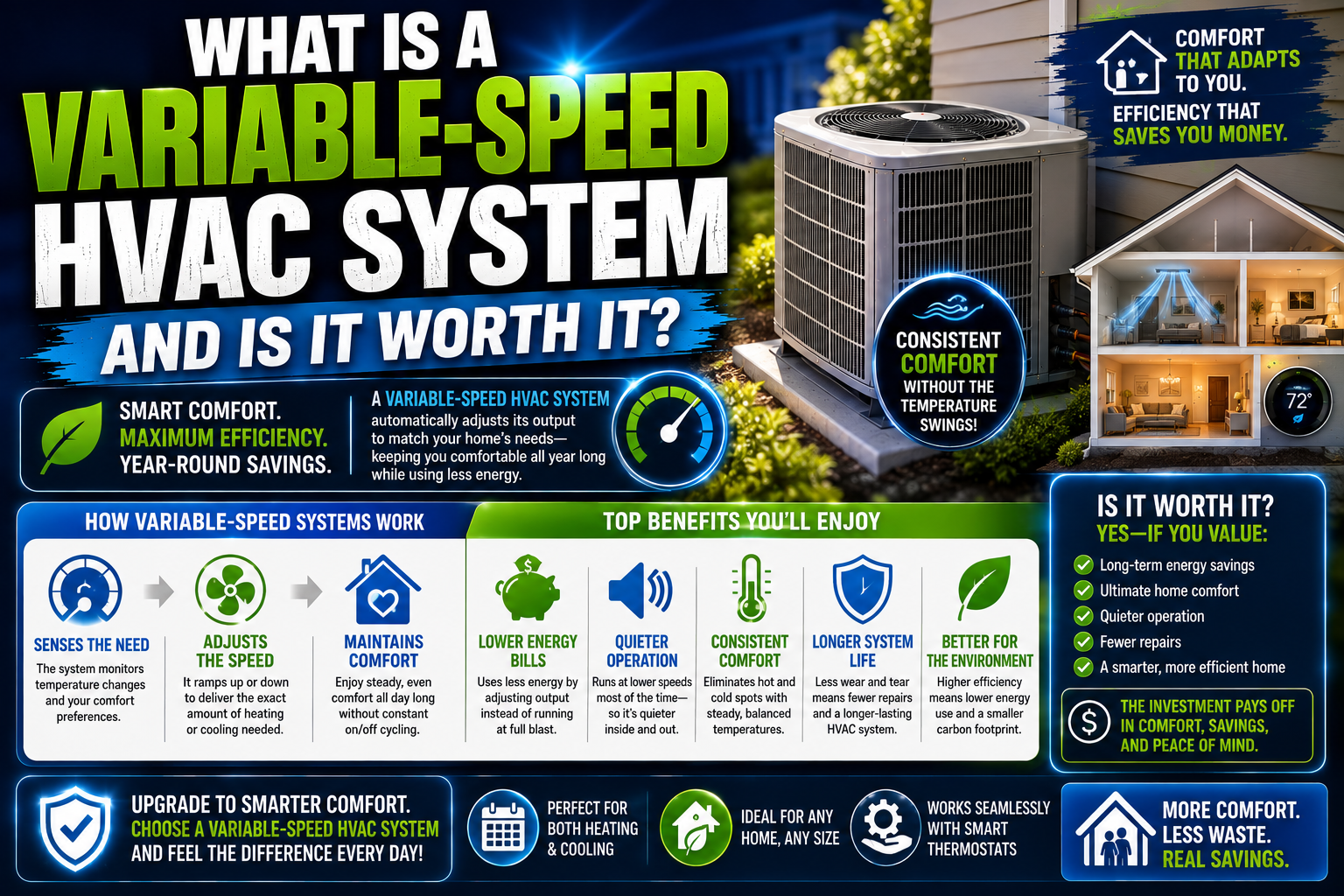
Why Are Homeowners Hearing More About Variable-Speed HVAC?
If you’re shopping for a new air conditioner, heat pump, furnace, or complete HVAC system, you’ll probably hear terms you’ve never needed to think about before.
Single-stage.
Two-stage.
Variable-speed.
Variable-capacity.
Inverter.
The terminology can quickly become confusing.
And when one HVAC system costs more than another, homeowners naturally want to know:
What am I actually paying for?
Variable-speed and variable-capacity HVAC technology can offer meaningful comfort and efficiency advantages in the right home.
But that doesn’t mean every homeowner automatically needs the most advanced equipment available.
Let’s explain what this technology actually does.
First, What Does “Variable-Speed” Mean?
The term variable-speed can refer to components of an HVAC system that are capable of operating at different speeds rather than simply being completely on or completely off.
Depending on the equipment, this may involve the:
- Indoor blower motor
- Outdoor compressor
- Heat pump
- Air handler
- Furnace
Instead of operating at only one output level every time the thermostat calls for cooling or heating, advanced equipment may adjust its operation based on demand.
That can allow the HVAC system to operate more precisely.
Think of It Like Driving a Car
Imagine driving a car that had only two choices:
Engine completely off
or
Full throttle.
Every time you needed to move, the engine immediately went to maximum output.
Then it shut completely off.
That’s somewhat similar to how traditional single-stage HVAC equipment operates.
A variable-capacity system is more like having an accelerator.
Sometimes you need more power.
Sometimes you need less.
The system can adjust its output depending on the conditions.
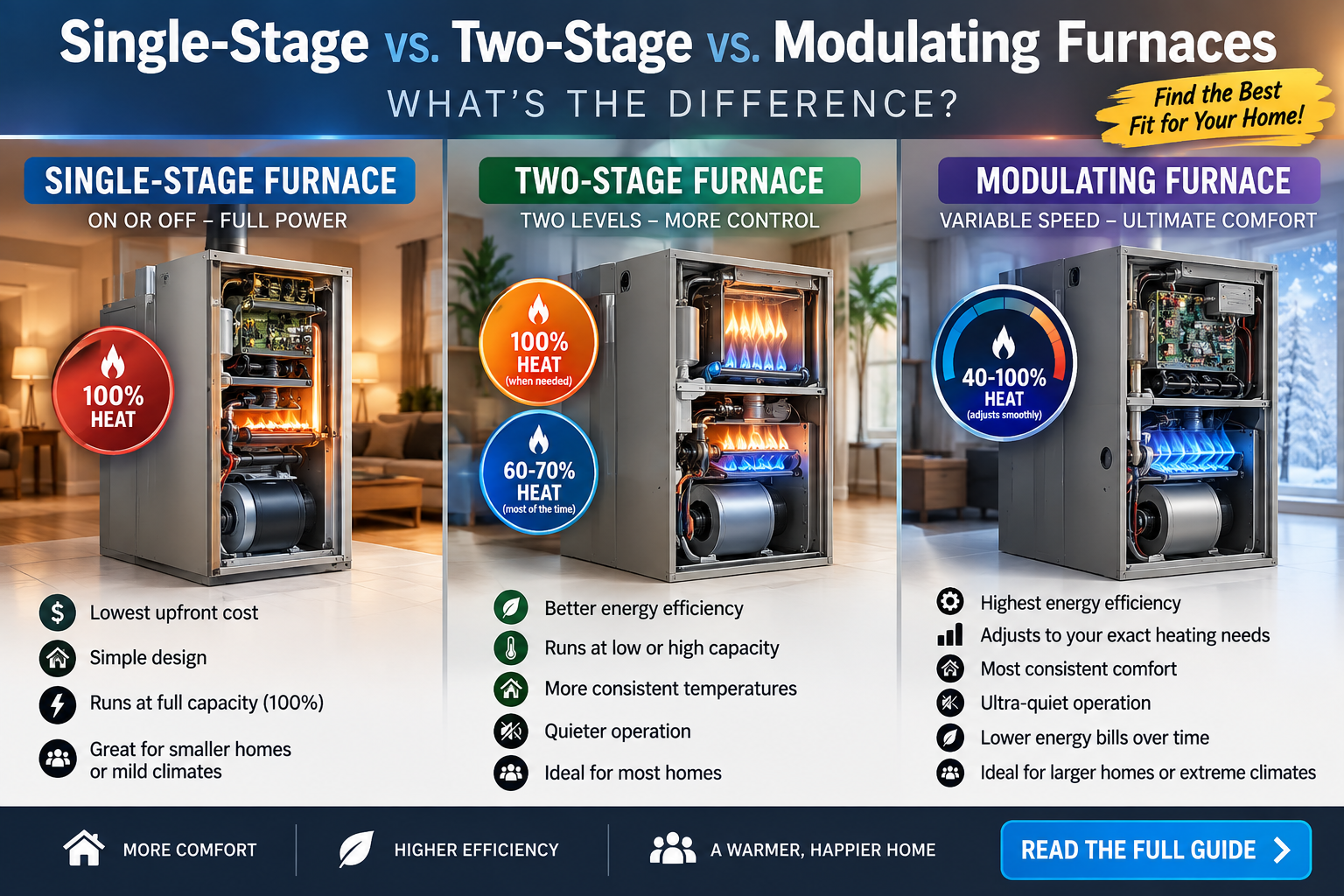
What Is a Single-Stage Air Conditioner?
Single-stage equipment is relatively straightforward.
When the thermostat calls for cooling, the air conditioner turns on at its designed operating capacity.
When the thermostat is satisfied, it shuts off.
Essentially:
ON → full cooling operation
OFF → no cooling operation
Single-stage HVAC systems have been used successfully in homes for many years.
They’re generally simpler than variable-capacity systems and may have a lower initial equipment cost.
What Is a Two-Stage Air Conditioner?
Two-stage equipment adds another level of operation.
Instead of having only one cooling stage, the system can operate at a lower stage or a higher stage.
During moderate conditions, the lower stage may be enough to maintain comfort.
During hotter conditions or greater cooling demand, the system can move into higher-capacity operation.
This gives the HVAC system more flexibility than traditional single-stage equipment.
What Is a Variable-Capacity Air Conditioner?
Variable-capacity equipment can adjust cooling output across a broader operating range.
Instead of choosing only between:
Off
and
Full capacity
the system can adjust its output based on what the home needs.
That may allow the equipment to operate at lower capacity for longer periods rather than repeatedly starting and stopping at maximum output.
Variable-Speed vs Variable-Capacity: Are They the Same Thing?
Not exactly.
These terms are often used together, which can create confusion.
Variable-speed commonly refers to a motor’s ability to operate at different speeds.
For example, an indoor blower motor may adjust how quickly it moves air.
Variable-capacity commonly refers to the ability of equipment such as a compressor to adjust its heating or cooling output.
A modern high-efficiency HVAC system may incorporate both technologies.
When comparing equipment, ask the contractor what components are actually variable rather than relying only on marketing terminology.
What Is an Inverter HVAC System?
You’ll also hear the word inverter, particularly when researching variable-capacity heat pumps and air conditioners.
Inverter technology allows certain compressors to adjust operating speed rather than simply switching between fully on and fully off.
This allows the system to better match its output to the home’s current heating or cooling demand.
For example, the home may not need maximum cooling during a mild morning.
Later, during a hot Temecula Valley afternoon, cooling demand may increase significantly.
Variable-capacity equipment can adjust accordingly within its designed operating range.
Benefit #1: More Consistent Indoor Temperatures
One of the biggest potential advantages of variable-capacity equipment is comfort.
Traditional equipment may allow the indoor temperature to fluctuate slightly as the system cycles:
Temperature rises.
AC starts.
Temperature falls.
AC shuts off.
Temperature rises again.
Variable-capacity equipment may be able to operate at lower output for longer periods, helping maintain a more consistent indoor temperature.
Instead of constantly experiencing noticeable temperature swings, homeowners may experience steadier comfort.
Benefit #2: Longer, Lower-Capacity Cooling Cycles
Many homeowners assume that the best air conditioner is the one that cools the house as quickly as possible.
But rapid cooling isn’t always the goal.
Proper HVAC operation involves maintaining comfortable indoor conditions efficiently.
A variable-capacity system may run longer at a lower output rather than blasting the house with maximum cooling and quickly shutting down.
Longer lower-capacity operation can provide several potential benefits.
Benefit #3: Quieter Operation
HVAC equipment generally produces more noticeable sound when operating at high capacity.
If a variable system can satisfy much of the home’s cooling demand while operating at lower capacity, the equipment may operate more quietly during those periods.
That can be especially valuable when outdoor equipment is located near:
- Bedrooms
- Patios
- Home offices
- Neighboring properties
Indoor airflow may also feel less aggressive when blower speed adjusts with system demand.
Benefit #4: Improved Energy Efficiency
Variable-capacity equipment is commonly associated with higher-efficiency HVAC systems.
Instead of constantly starting at full capacity, the system can adjust operation based on demand.
However, homeowners should remember that equipment technology is only one part of household energy consumption.
Actual energy usage also depends on:
- Thermostat settings
- Outdoor temperatures
- Insulation
- Windows
- Ductwork
- Equipment sizing
- Installation quality
- Maintenance
- Household habits
- Electricity rates
Buying advanced equipment doesn’t make the rest of the house irrelevant.
Benefit #5: Better Air Circulation
Longer HVAC operating cycles can mean air moves through the home for longer periods.
Depending on the equipment and system design, this may help create more consistent air circulation.
That can sometimes improve comfort in homes where temperature differences between rooms are a concern.
However, variable-speed equipment cannot automatically correct poorly designed or damaged ductwork.
The air distribution system still matters.
Benefit #6: Potentially Better Filtration
Your HVAC filter only captures particles when air actually moves through it.
If an appropriately designed variable-speed system circulates air for longer periods, more household air may pass through the filtration system.
The actual filtration benefit depends on:
- Filter type
- Filter efficiency
- System airflow
- Equipment design
- Duct condition
- Operating settings
Variable-speed equipment doesn’t replace the need for appropriate filtration.
Benefit #7: Improved Humidity Control
Longer cooling cycles can provide additional opportunities for moisture removal.
This is especially beneficial in humid climates.
Southern California is generally drier than many parts of the country, but indoor humidity can still vary depending on weather, home construction, occupancy, and household activities.
Equipment selection should always reflect local conditions and the individual home.
Does Variable-Speed HVAC Run All the Time?
This is a common homeowner concern.
A variable system may operate for longer periods than homeowners accustomed to traditional single-stage equipment expect.
But longer operation doesn’t necessarily mean something is wrong.
If the equipment is operating at reduced capacity, it may intentionally run longer while using less power than it would at maximum output.
The goal can be to maintain temperature rather than repeatedly allowing the home to warm up and then cooling it back down.
Does Running Longer Mean a Higher Electric Bill?
Not automatically.
Operating time and energy consumption aren’t the same thing.
A piece of equipment operating at lower capacity for a longer period may use less energy than equipment repeatedly operating at maximum capacity for shorter periods.
The actual energy consumption depends on the equipment and operating conditions.
This is why homeowners shouldn’t judge HVAC efficiency simply by counting how many minutes the system runs.
Are Variable-Speed Systems Better for Temecula Valley Summers?
They can be an attractive option.
Summer temperatures throughout Temecula, Murrieta, Menifee, Lake Elsinore, Winchester, Hemet, and surrounding communities can vary significantly throughout the day.
A morning may require relatively little cooling.
By late afternoon, the cooling demand can be much higher.
Equipment capable of adjusting output can respond differently to changing conditions than traditional single-stage equipment.
Whether that added capability is worth the investment depends on the individual homeowner.
Are Variable-Speed HVAC Systems More Expensive?
Generally, advanced HVAC equipment costs more initially than basic single-stage equipment.
You’re paying for additional technology and control capabilities.
The real question shouldn’t simply be:
“Which system costs the least?”
It should be:
“Which system provides the best combination of comfort, efficiency, features, and long-term value for my home?”
For some homeowners, the additional investment makes sense.
For others, simpler equipment may be perfectly appropriate.
Are Variable-Speed Systems More Complicated to Repair?
Advanced HVAC equipment can contain more sophisticated:
- Electronics
- Controls
- Motors
- Circuit boards
- Compressor technology
- Communication systems
That can make proper diagnosis especially important.
Before purchasing advanced equipment, homeowners should understand:
- Manufacturer warranty
- Labor warranty
- Maintenance requirements
- Replacement component availability
- Contractor familiarity with the equipment
The purchase price isn’t the only cost to consider.
Does Variable-Speed Equipment Require a Special Thermostat?
Some systems use communicating or manufacturer-specific controls to access their full range of features.
Others may have different thermostat requirements.
This varies by equipment.
When comparing HVAC systems, ask exactly what thermostat or control is included and what functionality it provides.
A sophisticated HVAC system needs compatible controls to operate as designed.
Will Variable-Speed HVAC Fix Hot and Cold Rooms?
Maybe — but don’t count on equipment alone.
Uneven temperatures may be caused by:
- Duct problems
- Insufficient return airflow
- Poor insulation
- Window heat gain
- Home orientation
- Air leakage
- Poor system balancing
Variable-capacity equipment can improve overall temperature consistency in some homes, but it cannot magically repair a disconnected duct or add insulation to an attic.
The cause of the comfort problem should be identified first.
Your Ductwork Still Matters
Installing premium HVAC equipment on poor ductwork is like installing a high-performance engine in a vehicle with damaged tires.
The equipment may be excellent.
But the complete system isn’t functioning as it should.
Before investing in advanced HVAC equipment, consider the condition of:
- Supply ducts
- Return ducts
- Duct insulation
- Airflow
- Registers
- Grilles
- Existing leakage
The entire air distribution system needs to work with the equipment.
Proper HVAC Sizing Is Still Critical
Variable-capacity technology doesn’t eliminate the need for correct equipment sizing.
Your HVAC system should still be selected based on the home’s heating and cooling requirements.
Factors can include:
- Square footage
- Insulation
- Windows
- Home orientation
- Ceiling height
- Air leakage
- Ductwork
- Local climate
Advanced technology works best when the equipment is properly selected and installed.
Is Variable-Speed HVAC Worth It?
There’s no universal answer.
A variable-speed or variable-capacity system may be worth considering if you place a high value on:
- Consistent temperatures
- Quiet operation
- Higher efficiency
- Advanced comfort control
- Longer lower-capacity operation
- Modern HVAC technology
But homeowners should compare the additional cost with their individual priorities.
Someone planning to remain in a home for many years may evaluate the investment differently than someone planning to move soon.
Single-Stage vs Two-Stage vs Variable: Which Is Best?
There’s no single “best” option for every homeowner.
Single-Stage
Can provide straightforward heating and cooling with simpler operation and potentially lower initial cost.
Two-Stage
Offers more operating flexibility than single-stage equipment by providing lower and higher output stages.
Variable-Capacity
Offers the greatest ability among these options to adjust output based on changing heating or cooling demand.
The right choice depends on your:
- Home
- Budget
- Comfort expectations
- Efficiency goals
- Equipment options
- Long-term plans
Questions to Ask Before Buying Variable-Speed HVAC
Before choosing a new system, ask your HVAC contractor:
What exactly is variable?
Is it the blower motor, compressor, or both?
How was the equipment sized?
Don’t assume advanced equipment eliminates sizing requirements.
Is my ductwork appropriate?
Premium equipment still needs proper airflow.
What thermostat does the system require?
Understand what controls are included.
What efficiency rating does the system have?
Compare actual equipment specifications.
What warranty is included?
Understand both equipment and labor coverage.
What maintenance does it require?
Know what ongoing ownership involves.
What would I gain compared with a less expensive system?
Your contractor should be able to explain the practical differences.
Frequently Asked Questions About Variable-Speed HVAC
What does variable-speed mean on an HVAC system?
It generally means a motor or other component can operate at different speeds rather than only one fixed operating speed.
Is variable-speed AC better than single-stage?
Variable equipment can provide advantages such as more consistent temperatures, quieter operation, and higher efficiency. Whether it’s “better” depends on the home, budget, and homeowner’s priorities.
Does variable-speed AC save electricity?
Variable-capacity equipment can provide higher rated efficiency, but actual household energy usage depends on many factors beyond the equipment itself.
Does variable-speed AC run longer?
It may. Longer operation at lower capacity can be normal and may be part of how the system maintains consistent comfort.
Is variable-speed HVAC quieter?
It can be quieter during lower-capacity operation because equipment and airflow may not need to operate at maximum output.
Does variable-speed HVAC improve indoor air quality?
Longer air circulation may allow more air to pass through an appropriate filtration system, but indoor air quality depends on many factors.
Is variable-speed HVAC more expensive to repair?
Advanced systems can contain more sophisticated components. Repair costs depend on the specific equipment, failed component, warranty, and labor involved.
Is variable-speed worth it in Southern California?
It can be for homeowners who value efficiency, quieter operation, and consistent comfort. The best choice depends on the individual home and budget.
Variable-Speed HVAC for Temecula Valley Homes
Southern California homeowners have more HVAC choices than ever before.
Traditional air conditioners.
Heat pumps.
Two-stage systems.
Variable-capacity equipment.
High-efficiency systems.
The number of choices can feel overwhelming.
That’s why homeowners should focus less on buying the system with the most impressive technology and more on finding the equipment that properly matches their home and priorities.
The Bottom Line
Variable-speed and variable-capacity HVAC technology allows equipment to adjust its operation instead of always running at maximum output.
Potential benefits can include:
- More consistent comfort
- Quieter operation
- Higher efficiency
- Longer lower-capacity cycles
- Improved air circulation
- More precise temperature control
But advanced technology isn’t automatically the right investment for every home.
Equipment sizing, ductwork, installation quality, efficiency, warranty, budget, and long-term ownership all matter.
The best HVAC system isn’t necessarily the most expensive system.
It’s the system that makes the most sense for your home.
Considering a New HVAC System?
If you’re comparing single-stage, two-stage, variable-speed, heat pump, or high-efficiency HVAC equipment, Advanced Heating & Air Conditioning can help you understand the differences.
Our team can evaluate your home, existing HVAC system, comfort needs, and available equipment options so you can make an informed decision.
We proudly serve Temecula, Murrieta, Menifee, Lake Elsinore, Winchester, Hemet, Anza, and surrounding Southern California communities.
Contact Advanced Heating & Air Conditioning to schedule an HVAC evaluation or request an estimate for a new heating and cooling system.