


Why Your AC Can’t Keep Up During a Temecula Heat Wave

What if your air conditioner isn’t actually broken, but is simply fighting a losing battle against physics in the 113.8-degree Temecula sun? It’s incredibly stressful when your vents are blowing but your home remains uncomfortably warm. You’re likely watching your energy bill spike while worrying that your system is on the verge of a total collapse. We understand that frustration because we’ve been helping our neighbors in the Inland Empire stay cool since 2002. Dealing with an AC not cooling during heat wave Temecula conditions requires a specific local perspective that considers our unique desert-fringe climate.
In this guide, you’ll discover why triple-digit temperatures push even high-efficiency units to their limits and how to tell if your system is failing or just overwhelmed. We will provide the exact steps needed to restore your indoor comfort and protect your equipment from permanent damage. We’ll also look at how current 2026 energy standards and new refrigerant regulations affect your options. By the end, you’ll have a clear plan to decide whether a professional repair or a high-efficiency replacement is the right move for your household’s long-term peace of mind.
Key Takeaways
- Learn why the “20-degree rule” and original home design temperatures often cause modern Temecula heat waves to overwhelm older cooling systems.
- Identify simple maintenance issues, such as clogged filters or dusty coils, that result in an AC not cooling during heat wave Temecula events.
- Apply the “5,000 Rule” to determine if your aging unit is worth repairing or if a high-efficiency replacement is more cost-effective.
- Use strategic cooling techniques like early morning pre-cooling and blackout curtains to protect your system from a total breakdown.
- Understand how local knowledge of Inland Empire housing tracts ensures your HVAC system is properly sized for our specific regional climate.
Why Your AC Struggles During a Temecula Heat Wave: The Science of Triple-Digit Cooling
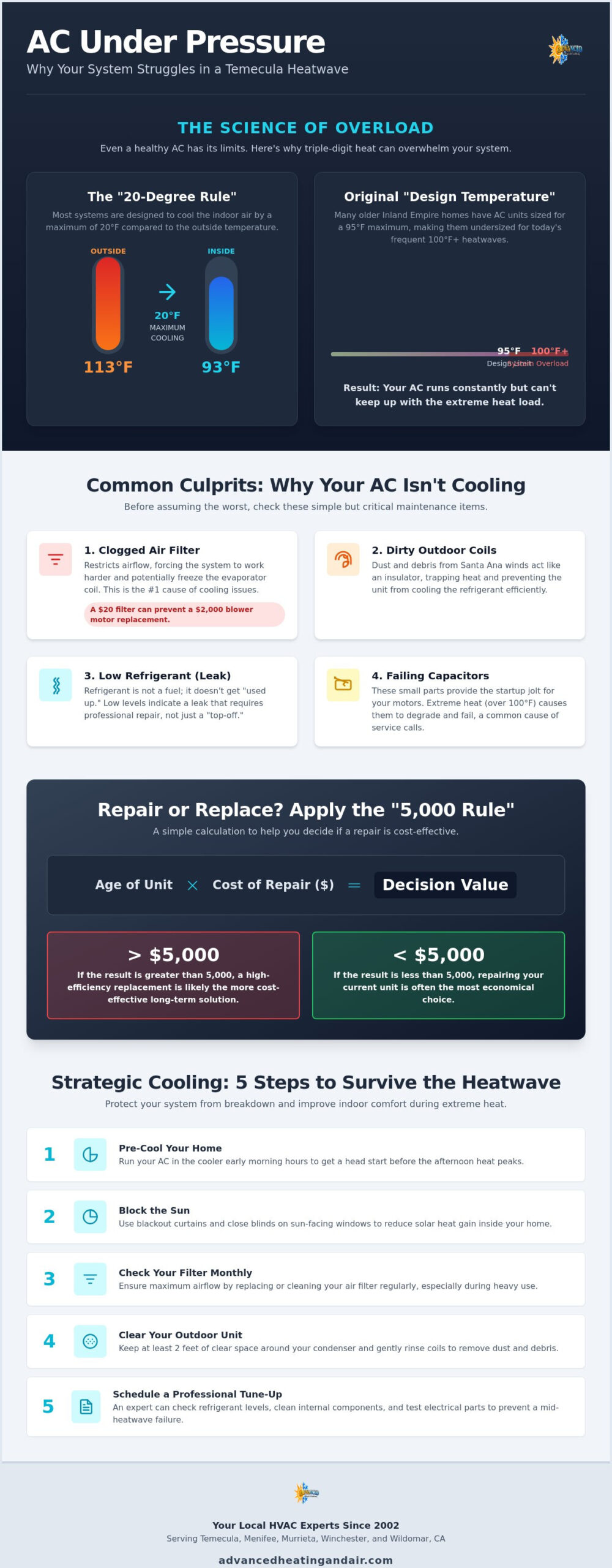
Temecula homeowners often face a harsh reality when the thermometer climbs past 100 degrees. Understanding how air conditioning works is the first step in realizing why your system might be falling behind. Most legacy HVAC systems were designed based on the “20-degree rule.” This industry standard suggests that a traditional air conditioner is engineered to create a 20-degree difference between the outdoor temperature and the indoor air. When our local weather hits a record 113.8°F, a system following this rule might only be able to cool your living room to 93°F. This isn’t necessarily a sign of a broken unit; it is often a sign of a system reaching its mechanical limit.
The problem is compounded by “Design Temperature” standards. Many older homes in the Inland Empire were built using a design temperature of 95°F. This means the HVAC system was sized to maintain comfort when it is 95°F outside. As Temecula experiences more frequent triple-digit days, these older systems simply don’t have the cooling capacity to bridge the gap. When you notice your AC not cooling during heat wave Temecula events, the system is likely “at capacity,” meaning it is running perfectly but cannot keep up with the sheer volume of heat entering the home.
The Impact of Temeculas Microclimate on HVAC Performance
Our local geography creates specific challenges for outdoor condenser units. In neighborhoods like Morgan Hill and Redhawk, the afternoon sun and dry valley winds create a “heat soak” effect. This occurs when your attic and walls absorb so much thermal energy that they continue to radiate heat into your living space long after the sun goes down. During Santa Ana conditions, the extreme drop in humidity and increase in airborne dust can coat your outdoor coils, forcing the compressor to work twice as hard to reject heat. This constant strain leads to premature wear on capacitors and fan motors.
Is My AC Broken or Just Overwhelmed?
It is vital to distinguish between a system that is struggling and one that requires an emergency AC fix. If the air coming out of your vents feels icy cold but the thermostat reading is slowly rising, your system is likely overwhelmed by the “heat load” of the house. However, if the air is lukewarm or the outdoor unit is making a loud buzzing sound, you have a mechanical failure. We have seen many homeowners mistake a frozen evaporator coil for a total system collapse. A quick check of your airflow can often reveal if the issue is a simple blockage or a complex refrigerant leak that needs professional attention.
Common Culprits: Why Your AC is Running But Not Cooling Your Home
It’s one thing if the system won’t turn on, but it’s another when it runs all day without dropping the temperature. This is a classic case of an AC not cooling during heat wave Temecula conditions. Often, the cause is a simple maintenance oversight that has snowballed into a performance crisis. When your system is forced to run continuously against mechanical resistance, it doesn’t just fail to cool; it risks permanent damage to the compressor.
Airflow is the lifeblood of your HVAC system. A standard $20 air filter is your first line of defense, yet a clogged one can lead to a $2,000 blower motor replacement or a frozen evaporator coil. When air can’t move freely—often due to dust buildup that specialists like Pronto Air Duct Cleaning can resolve—the system can’t remove heat from your home. The harder the blower works to pull air through a dirty filter, the more heat the motor generates, eventually leading to a thermal overload and a total system shutdown during the hottest part of the day.
Outdoor condenser coils are equally vital for heat rejection. In the Inland Empire, Temecula dust and debris from Santa Ana winds act as an insulator. This layer of grime traps heat inside the refrigerant, preventing it from being released outdoors. It’s also vital to remember that refrigerant isn’t “fuel” that gets used up. If your levels are low, you have a leak that requires a professional repair rather than just a “top-off.” Running a system low on refrigerant causes the compressor to overheat, which is the most expensive component to replace.
Extreme heat also targets electrical components. Capacitors, which provide the torque needed to start and run your compressor and fan motors, are prone to failing once the outdoor temperature crosses the 100-degree mark. These small parts act like temporary batteries, and high heat causes them to bulge or pop—a vulnerability shared by sensitive electronics like the hardware found at Computech-Solutions. This failure leaves you with a humming outdoor unit that won’t blow cold air, even though the indoor thermostat says the system is “on.”
The Hidden Danger of Attic Duct Leaks
Older homes in Menifee and Murrieta often suffer from deteriorating ductwork hidden behind the drywall. When temperatures in your attic soar to 120°F or higher, even tiny gaps in your ducts can suck that scorching air directly into your cooling stream. This “attic-to-living-room” heat transfer makes it impossible for your unit to keep up with the thermostat settings. Scheduling professional air duct maintenance can seal these leaks and ensure your cooled air actually reaches your bedrooms instead of cooling your attic.
Outdoor Unit Obstructions and Coil Maintenance
Your outdoor condenser needs at least two feet of “breathing room” on all sides to function efficiently. Overgrown shrubs or stored items block the airflow needed to reject heat from the coils. You can help your system by gently rinsing the coils with a garden hose to remove surface dust. Just be careful not to use high pressure, as this can bend the delicate aluminum fins. If you want to conserve energy during a heat wave, keeping these coils clean is one of the most effective steps you can take. If the fan on top of the unit isn’t spinning or is moving slowly, it’s a clear sign of a failing motor. For a detailed inspection of your system’s health, you can always reach out to our team for an honest assessment.
Evaluating the Fix: AC Repair vs. System Replacement in 2026
Deciding whether to sink money into an old unit or invest in a new one is the most critical financial choice a homeowner makes during a summer surge. When you find your AC not cooling during heat wave Temecula conditions, the pressure to make a quick choice is high. We prioritize transparency, which is why we use the “5,000 Rule” to help our neighbors decide. Multiply the age of your equipment by the quoted repair cost. If the total exceeds $5,000, the investment is rarely logical. For instance, a 12-year-old system needing a $500 repair equals 6,000. In this case, the money is better spent on a modern system that won’t leave you stranded when the next triple-digit forecast arrives.
The HVAC landscape changed significantly on January 1, 2026. All new residential systems in California must now use refrigerants with a Global Warming Potential (GWP) of 700 or lower, such as R-454B or R-32. If your current unit uses the now-phased-out R-410A, repair costs for refrigerant leaks will continue to climb as the supply of older gases diminishes. This transition makes older “zombie” systems—units that are technically running but constantly failing—a major financial drain on your household budget.
When a Quick Fix Isn’t Enough
Many homeowners try to “limp” through the summer by repeatedly recharging refrigerant. However, if you’re still dealing with an AC not cooling during heat wave Temecula peaks, you’re essentially pouring money into a leaky bucket. Modern variable-speed compressors are now the gold standard for our climate. Unlike older single-stage units that are either 100% on or off, variable-speed systems adjust their output to match the exact heat load of your home. This prevents the constant, high-stress cycling that kills older components. If the upfront cost of a breakdown is a concern, financing a new high-efficiency AC allows you to restore comfort immediately while paying for the system through significantly lower monthly energy bills.
Energy Efficiency and SEER2 Standards in 2026
California now mandates a minimum of 14.3 SEER2 for all new split-system air conditioners. Upgrading to an 18+ SEER2 unit can result in substantial savings on your SCE bills, especially during our relentless July and August heat waves. These systems are specifically engineered to handle the extreme Inland Empire climate with much less mechanical strain. To maximize these efficiency gains, we often recommend smart thermostat installation. A smart controller can manage “pre-cooling” schedules, ensuring your home is a sanctuary before the afternoon temperatures spike, without wasting energy when the house is empty.
Strategic Cooling: 5 Steps to Survive the Heat Wave
When your air conditioner is struggling, it’s easy to feel like you’re at the mercy of the weather. However, managing your indoor climate is a tactical game. By proactively reducing the “heat load” on your home, you can often provide enough relief for a system to keep up. If you are currently dealing with an AC not cooling during heat wave Temecula peaks, these five steps can bridge the gap between misery and comfort.
- Step 1: Pre-Cooling. Set your thermostat to 70°F at 6:00 a.m. This “charges” the thermal mass of your home. By chilling your furniture, floors, and walls early, you create a reservoir of cold that helps your AC maintain a steady temperature as the afternoon sun begins to bake the exterior.
- Step 2: Solar Load Management. South-facing windows in our local housing tracts act like greenhouses. Use blackout curtains or heavy blinds to block radiant heat. This single step can reduce the temperature in a room by several degrees.
- Step 3: Internal Heat Reduction. Your appliances are hidden heaters. Avoid using the oven, dishwasher, or clothes dryer between 12:00 p.m. and 8:00 p.m. These machines add significant moisture and heat that your system must work overtime to remove.
- Step 4: Airflow Optimization. Ensure all registers are completely open. Closing vents in unused rooms increases static pressure and can actually lead to duct leaks or a frozen coil. Also, verify that your ceiling fans are rotating counter-clockwise to create a direct cooling breeze.
- Step 5: Professional Maintenance. A system with a clean blower and lubricated parts is far less likely to suffer a catastrophic failure. Verify that your HVAC system maintenance is up to date to ensure peak performance.
Using Whole House Fans for Heat Recovery
Many homes in Murrieta and Temecula are equipped with whole house fans, which are the ultimate secret weapon for heat wave recovery. Once the outdoor temperature drops below your indoor temperature in the late evening, switch off the AC and turn on the fan. This flushes out the 120-degree air trapped in your attic. By removing this “heat cap,” you prevent that energy from radiating back into your bedrooms all night, allowing your AC to start the next morning without a massive heat deficit.
Smart Thermostat Strategies for Extreme Heat
Don’t let your home become a “heat oven” while you’re at work. If you set the “away” temperature too high, the “recovery lag” will be too great for your unit to overcome when you return. Most systems struggle to drop the temperature more than one degree per hour during a heat wave. Use geofencing to start the cooling process 45 minutes before you arrive home. This gradual approach is much easier on your compressor than a sudden, high-stress 10-degree demand. If these strategic steps don’t resolve your comfort issues, schedule a professional inspection with our team to identify hidden mechanical failures before they lead to a total breakdown.
Reliable AC Solutions: The Advanced Heating & Air Difference
When you’re facing an AC not cooling during heat wave Temecula conditions, you don’t just need a technician; you need a neighbor who understands our valley’s unique climate challenges. Advanced Heating & Air Conditioning has been family-owned and operated since 2002. We’ve spent over two decades serving families across Temecula, Murrieta, and Menifee, ensuring their homes remain safe havens when the outdoor temperatures become dangerous. Our deep roots in the community mean we don’t just see a mechanical system; we see a household that relies on us for safety and peace of mind.
Our local experience gives us a distinct advantage in diagnostics. We understand the specific HVAC configurations used in housing tracts like Morgan Hill and Redhawk, where attic heat and solar exposure require precise system calibration. We’re committed to transparent pricing and “no-surprise” repairs, providing you with an honest assessment of your equipment’s health. Whether your system is simply overwhelmed by the 113.8-degree record heat or suffering from a critical component failure, we offer clear solutions that prioritize your comfort and your budget.
The Comfort Club: Your Shield Against Summer Breakdowns
The best way to handle a heat wave is to prepare for it before the first triple-digit forecast arrives. Our Comfort Club is designed to provide that essential layer of protection. A professional HVAC tune-up and checkup is the cornerstone of this program. During these visits, we calibrate your system for peak efficiency, clean vital components, and identify minor wear before it turns into a midnight emergency. Regular maintenance is proven to prevent 90% of heat wave emergency calls. As a member, you also receive priority scheduling and exclusive repair discounts, ensuring you’re always at the front of the line when the Inland Empire heat is at its worst.
Schedule Your Temecula AC Diagnostic Today
If you’re currently struggling with an AC not cooling during heat wave Temecula peaks, don’t wait for the system to fail completely. Our diagnostic process is thorough and focused on long-term resolution. We analyze the “heat-load” of your home against your system’s output to determine if the issue is a simple airflow restriction or a more complex mechanical failure. If we find that your unit is reaching the end of its functional life, we’ll help you navigate modern AC replacement options that meet the 2026 SEER2 standards. We prioritize high-efficiency solutions that can lower your SCE bills while providing consistent, reliable cooling. Don’t suffer through another restless, sweltering night. Contact Advanced Heating & Air Conditioning today via advancedheatingandair.com to schedule your inspection and restore your home’s comfort.
Take Control of Your Indoor Comfort Today
Triple-digit heat waves don’t have to dictate your home’s comfort level. By understanding the mechanical limits of your system and implementing strategic cooling habits, you can protect your equipment from the most intense Southern California sun. Whether your issues stem from a simple airflow restriction or an aging unit that no longer meets 2026 efficiency standards, knowing when to act is the key to preventing a total breakdown. Our team is dedicated to providing the transparency you need to make the best decision for your household.
Advanced Heating & Air Conditioning has been family-owned and operated since 2002. Our licensed, bonded, and insured technicians bring over 20 years of Temecula climate expertise to every service call, ensuring your system is prepared for our unique regional challenges. If you’re currently facing an AC not cooling during heat wave Temecula conditions, don’t wait for the temperature to rise further. We’re ready to provide the reliable, honest service you expect from a local authority.
Schedule Your Emergency AC Repair in Temecula Today and let our family care for yours. We look forward to restoring your peace of mind and keeping your home a cool sanctuary all summer long.
Frequently Asked Questions
Why is my AC running but the temperature in my house is going up?
Your system is likely reaching its mechanical capacity or is overwhelmed by the heat load. As discussed earlier, the 20-degree rule means your unit struggles when Temecula hits 105°F or higher. If the air from vents is cold but the house is warming, the heat entering through windows and attics is simply greater than the cooling output of your system. This often happens in older Inland Empire homes.
Is it normal for my AC to run all day during a Temecula heat wave?
Yes, it’s normal for a system to run continuously when outdoor temperatures exceed 95°F. Modern units are designed to stay on to maintain a steady temperature rather than cycling on and off. If you notice an AC not cooling during heat wave Temecula peaks despite running all day, it’s a sign the heat load is exceeding the unit’s design capacity. This is especially true if your home has significant solar exposure.
What temperature should I set my AC to when it is 100 degrees outside?
We recommend setting your thermostat to 78°F during the hottest part of the day. Setting it to 70°F when it’s 100°F outside creates a 30-degree differential that most standard systems cannot achieve. This leads to constant running and potential part failure. Use the pre-cooling strategy mentioned earlier to lower the temperature to 70°F early in the morning instead. This helps manage the workload on your system effectively.
How often should I change my air filter during the summer in Temecula?
You should check your filter every 30 days during our peak summer months. Our local area deals with significant dust and Santa Ana winds, which clog filters faster than in milder climates. A dirty filter restricts the airflow your system needs to stay cool. If the filter looks grey or has a visible layer of debris, replace it immediately to prevent motor strain and avoid expensive repairs during a heat wave.
Why is my AC blowing warm air suddenly during a heat wave?
This usually indicates a mechanical failure like a tripped breaker, a blown capacitor, or a refrigerant leak. High heat puts extreme pressure on electrical components, often causing capacitors to fail when temperatures cross 100°F. If the air isn’t cold, turn the system off immediately to protect the compressor and call for a professional diagnostic to identify the specific component failure. Running a system that blows warm air can lead to permanent damage.
Can I spray my outdoor AC unit with water to help it cool better?
You can gently rinse the condenser coils with a garden hose to remove dust and debris. This helps the unit reject heat more efficiently. However, don’t use high-pressure settings, as this can bend the delicate aluminum fins. Avoid spraying the unit during the hottest part of the day, as the thermal shock can sometimes cause stress to the metal components. Regular rinsing is a great way to keep your unit breathing properly.
At what point is it better to replace my AC instead of repairing it?
It is usually better to replace the unit if it is over 10 to 12 years old and requires a major repair. Use the 5,000 Rule by multiplying the age by the repair cost. If your current unit uses the phased-out R-410A refrigerant, switching to a 2026 SEER2-compliant system will provide better performance and lower SCE bills during future heat waves. Newer systems are much more capable of handling our local climate.