


How Often Should You Change Your HVAC Air Filter?
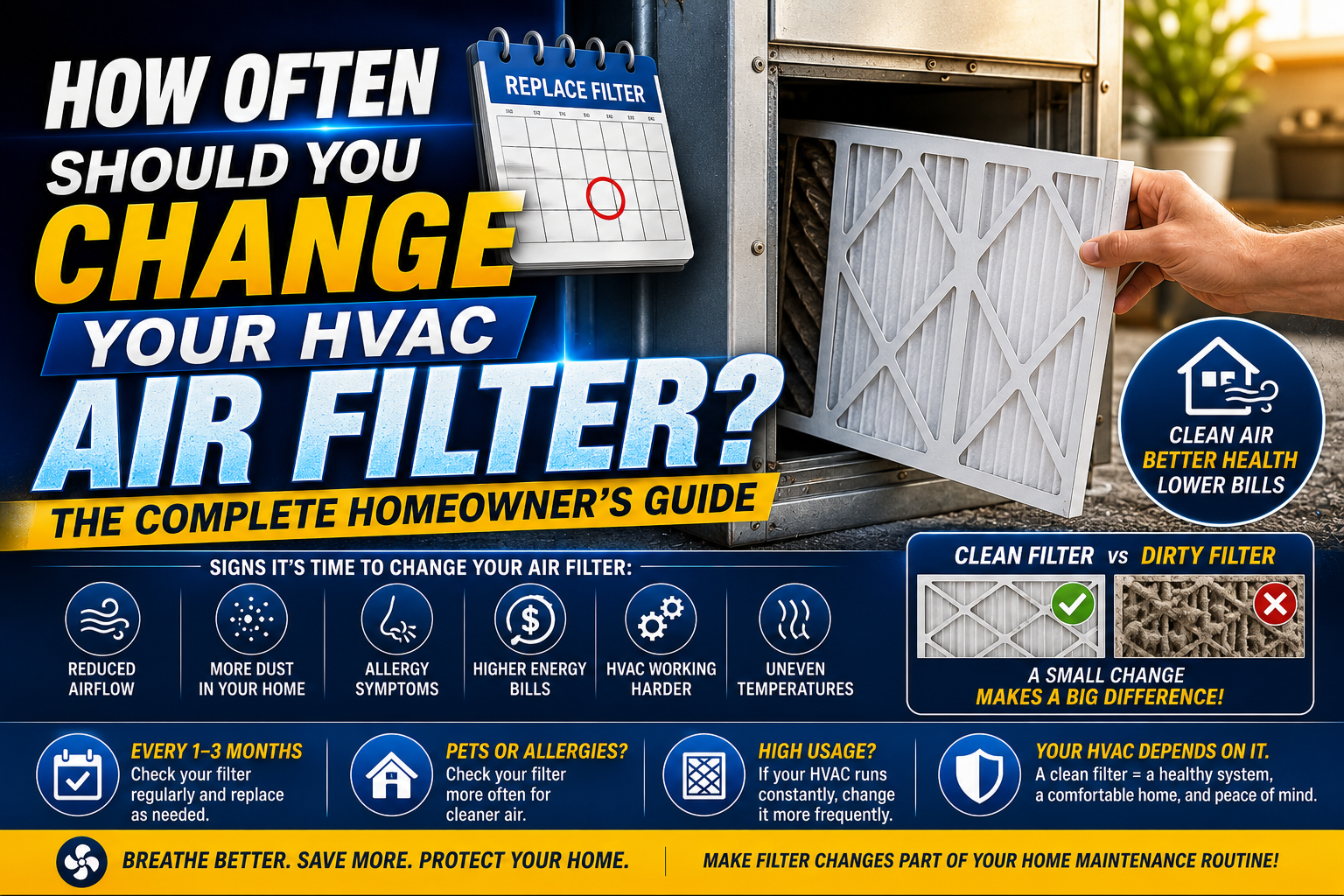
How Often Should You Change Your HVAC Air Filter? The Complete Homeowner’s Guide
Key Takeaways
- Most homeowners should inspect their HVAC air filter every month.
- Depending on your home, filters may need to be replaced every 30, 60, or 90 days.
- Dirty filters reduce airflow, increase energy costs, and place additional strain on HVAC equipment.
- Homes with pets, allergies, or heavy HVAC use often require more frequent filter changes.
- Replacing your air filter is one of the simplest and most effective ways to protect your heating and cooling system.
Table of Contents
- Why Your HVAC Air Filter Matters
- How Often Should You Replace It?
- Factors That Affect Filter Life
- Signs Your Filter Needs Changing
- Choosing the Right Filter
- Common Filter Myths
- Frequently Asked Questions
- Summary
How Often Should You Change Your HVAC Air Filter?
Replacing an HVAC air filter is one of the easiest maintenance tasks homeowners can perform, yet it’s also one of the most commonly overlooked.
Many people wait until their air conditioner stops cooling efficiently or their furnace begins struggling before checking the filter.
By that point, a dirty filter may already be reducing airflow, increasing energy costs, and placing unnecessary strain on the system.
At Advanced Heating & Air Conditioning, one of the first things we inspect during maintenance visits throughout Temecula, Murrieta, Menifee, Winchester, Lake Elsinore, Hemet, Wildomar, French Valley, and surrounding communities is the condition of the air filter.
It’s amazing how often replacing a heavily clogged filter improves airflow and system performance almost immediately.
What Does an HVAC Air Filter Actually Do?
Many homeowners believe the primary purpose of an HVAC filter is to protect the air they breathe.
While it certainly helps improve indoor air quality, its first job is actually to protect your HVAC equipment.
As air circulates through your home, the filter captures:
- Dust
- Dirt
- Pet hair
- Lint
- Pollen
- Mold spores
- Other airborne particles
Without a filter, these contaminants would collect on the evaporator coil, blower motor, and other internal components, reducing efficiency and increasing wear over time.
A clean filter helps keep your system operating as designed.
So… How Often Should You Replace It?
The honest answer is:
It depends on your home.
There isn’t a single replacement schedule that works for everyone.
Several factors influence how quickly a filter becomes dirty, including the number of people living in the home, whether you have pets, how often your HVAC system runs, and local air quality.
A good rule of thumb is to check your filter once a month and replace it when it shows significant dirt buildup.
Below are general recommendations.
Every 30 Days
You may need to replace your filter about every month if:
- You have multiple pets.
- Someone in the home has allergies or asthma.
- Your HVAC system runs almost constantly during the summer.
- You have ongoing remodeling or construction nearby.
- Your home tends to collect dust quickly.
These situations load the filter with particles much faster than average.
Every 60 Days
Many households fall into this category.
Replacing the filter approximately every two months may be appropriate if:
- You have one pet.
- Two to four people live in the home.
- Your HVAC system receives routine maintenance.
- Indoor dust levels are average.
Even if you’re on a 60-day schedule, it’s still a good idea to inspect the filter monthly.
Every 90 Days
Some homes can safely go about three months between filter changes.
This often applies when:
- There are no pets.
- One or two people live in the home.
- Windows remain closed most of the year.
- Indoor air quality is generally good.
- HVAC usage is moderate.
Again, monthly inspections are still recommended because every home is different.
What Happens If You Don’t Change Your Filter?
A neglected filter gradually fills with dust and debris.
As it becomes clogged, airflow through your HVAC system decreases.
That reduced airflow can contribute to several problems.
Higher Energy Bills
Your blower motor has to work harder to move air through a dirty filter.
The longer the restriction remains, the more electricity the system typically uses.
Reduced Cooling Performance
If enough air can’t pass across the evaporator coil, your home may:
- Feel warmer.
- Take longer to cool.
- Develop uneven temperatures between rooms.
Many homeowners mistakenly believe their air conditioner is failing when the real issue is a severely clogged filter.
Frozen Evaporator Coil
Restricted airflow can eventually cause the evaporator coil to become excessively cold.
Moisture freezes on the coil.
Eventually the ice blocks even more airflow.
This often leads to warm air coming from the vents or water leaking around the indoor unit after the ice melts.
Increased Wear on HVAC Components
A dirty filter forces several components to work harder, including:
- Blower motor
- Fan assembly
- Compressor
Over time, the additional workload may shorten equipment life and increase the likelihood of repairs.
Signs Your Air Filter Needs Replacing
Sometimes homeowners lose track of when the filter was last changed.
Fortunately, your HVAC system often provides clues.
Look for:
- Visible dust covering the filter
- Weak airflow from vents
- Longer cooling cycles
- Higher electric bills
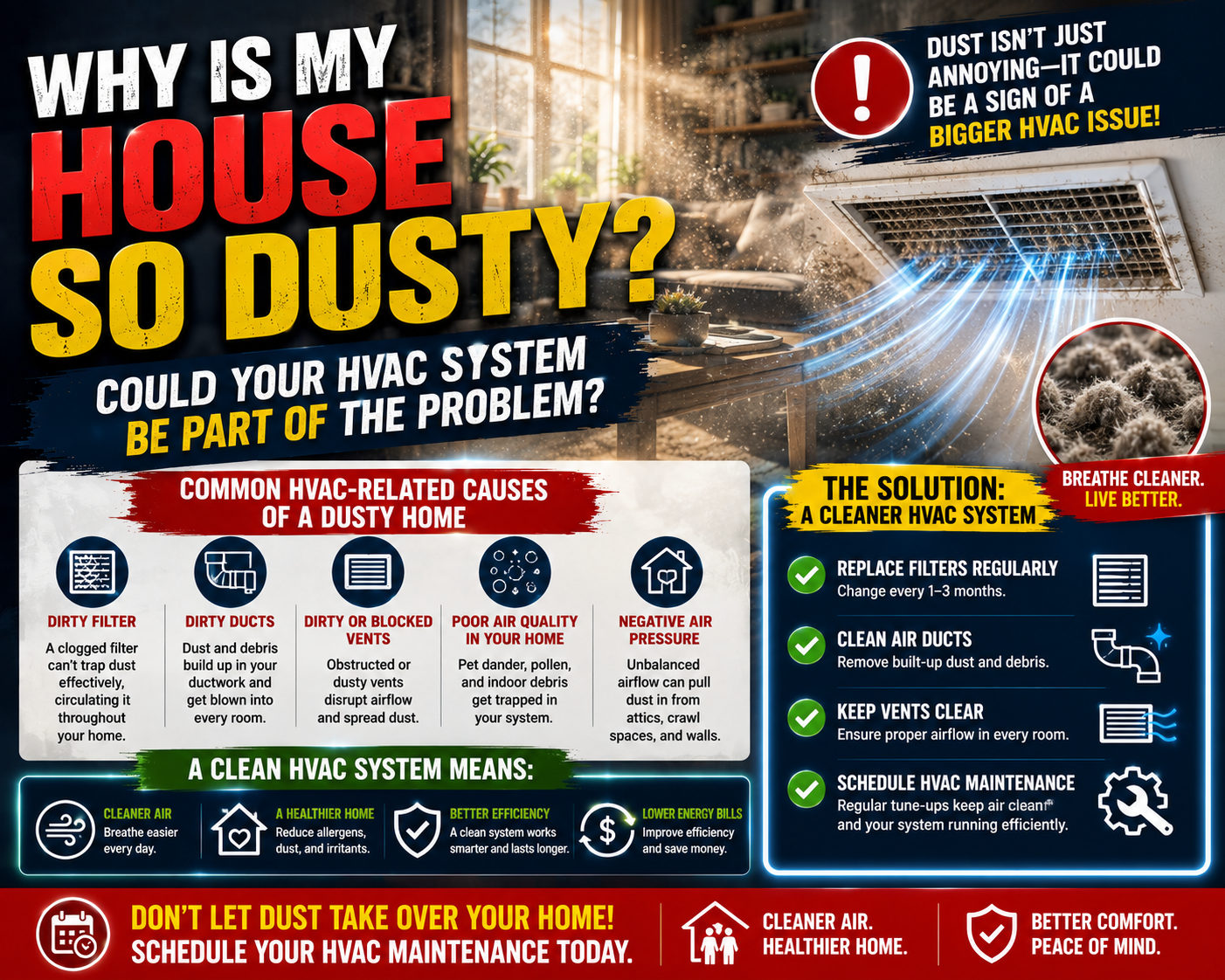
- More dust inside the home
- Allergy symptoms becoming worse
- Musty odors when the system runs
- Ice forming on refrigerant lines
If you notice one or more of these signs, it’s worth checking the filter before assuming a larger HVAC problem exists.
Choosing the Right Air Filter
Replacing your air filter regularly is important, but choosing the right filter is just as important.
Not all HVAC filters are the same.
The filter you choose affects:
- Airflow
- Indoor air quality
- HVAC efficiency
- Equipment lifespan
- Dust levels inside your home
The goal is to find a filter that balances good filtration with proper airflow.
Understanding MERV Ratings
One of the first things you’ll notice when shopping for air filters is the MERV rating.
MERV stands for Minimum Efficiency Reporting Value, and it measures how effectively a filter captures airborne particles.
Generally, the higher the MERV rating, the smaller the particles the filter can trap.
Here’s a simple breakdown:
- MERV 1–4 — Best for: basic protection. Captures: large dust and debris.
- MERV 5–8 — Best for: most homes. Captures: dust, pollen, lint, mold spores.
- MERV 9–12 — Best for: homes with pets or allergies. Captures: fine dust, pet dander, larger bacteria.
- MERV 13+ — Best for: specialized systems. Captures: very small particles; may restrict airflow if the HVAC system isn’t designed for it.
For many residential systems, MERV 8–11 offers a good balance between filtration and airflow. Always follow the recommendations provided by your HVAC manufacturer or consult a qualified technician if you’re unsure.
Fiberglass vs. Pleated Filters
Fiberglass Filters
These inexpensive filters provide basic protection for HVAC equipment by capturing larger particles.
Pros
- Lower cost
- Minimal airflow restriction
- Easy to find
Cons
- Less effective at trapping smaller particles
- May not significantly improve indoor air quality
Pleated Filters
Pleated filters have a larger surface area, allowing them to capture more dust and allergens.
Pros
- Better filtration
- Improved indoor air quality
- Longer service life in many homes
Cons
- Higher cost
- Some high-MERV versions may reduce airflow if the HVAC system isn’t designed for them
What Happens Inside Your HVAC System When the Filter Gets Dirty?
Many homeowners think of the air filter as a simple screen.
In reality, it’s one of the most important protective components in the entire HVAC system.
As the filter becomes clogged:
- Airflow decreases.
- The blower motor works harder.
- Less warm air passes across the evaporator coil.
- Cooling efficiency drops.
- The compressor may run longer.
- Utility bills increase.
- Wear on HVAC components increases.
Replacing a relatively inexpensive filter can help reduce unnecessary strain on much more expensive equipment.
Common Air Filter Myths
Myth #1: “I’ll Just Wait Until It Looks Really Dirty.”
By the time a filter appears heavily clogged, airflow may already be restricted.
Monthly inspections help catch buildup before it affects system performance.
Myth #2: “The Highest MERV Rating Is Always Best.”
Not necessarily.
Some HVAC systems aren’t designed for very restrictive filters.
Using a filter with an excessively high MERV rating may reduce airflow and decrease efficiency.
The best filter is the one that provides effective filtration while allowing your system to move air properly.
Myth #3: “My Air Conditioner Will Tell Me When the Filter Needs Changing.”
Most standard residential systems don’t monitor filter condition.
The responsibility typically falls on the homeowner.
Setting a reminder on your phone or calendar is an easy way to stay on schedule.
Myth #4: “A Dirty Filter Helps Catch More Dust.”
Although a dirty filter may trap more particles, it also restricts airflow.
Reduced airflow forces your HVAC system to work harder and can contribute to frozen coils, reduced comfort, and higher energy bills.
Mistakes Homeowners Should Avoid
Even well-intentioned homeowners sometimes make simple mistakes.
Avoid these common issues:
- Installing the filter backward (follow the airflow arrow).
- Buying the wrong filter size.
- Forgetting to replace the filter after remodeling.
- Ignoring increased dust inside the home.
- Using washable filters that aren’t fully dry before reinstalling them.
- Forgetting to inspect the filter during heavy cooling or heating seasons.
From the Field: What We See Most Often
One of the easiest service calls to prevent starts with a homeowner saying:
“I didn’t realize the filter hadn’t been changed in over a year.”
During maintenance visits, we occasionally find filters that are almost completely blocked with dust, pet hair, and debris. In many of those cases, homeowners have noticed higher electric bills, weaker airflow, or rooms that no longer cool evenly.
While a clogged filter isn’t always the only problem, replacing it often restores airflow immediately and allows the system to operate much more efficiently.
That’s why we encourage homeowners to check their filter every month—even if it doesn’t need to be replaced every month.
Frequently Asked Questions
How often should I check my HVAC filter?
A good habit is to inspect it once a month. Even if it doesn’t need replacing, you’ll know its condition and can catch buildup before it affects performance.
Can a dirty filter cause my AC to stop cooling?
Yes. Restricted airflow can reduce cooling performance and, in some cases, cause the evaporator coil to freeze.
Do homes with pets need more frequent filter changes?
Often, yes. Pet hair and dander can cause filters to load more quickly, especially in homes with multiple pets.
Can changing my air filter lower my electric bill?
A clean filter helps maintain proper airflow, which can improve system efficiency. The exact impact on energy use depends on the condition of the previous filter and the overall HVAC system.
Is it okay to vacuum and reuse my disposable filter?
No. Disposable filters are designed for one-time use. Vacuuming them usually doesn’t restore their filtering ability and may damage the filter media.
Homeowner Filter Checklist
Before each cooling and heating season:
- ✅ Inspect the filter.
- ✅ Confirm it’s the correct size.
- ✅ Verify the airflow arrow points toward the HVAC equipment.
- ✅ Record the replacement date.
- ✅ Keep a spare filter on hand.
This simple routine takes only a few minutes and can help your HVAC system perform more efficiently throughout the year.
In Summary
Changing your HVAC air filter is one of the simplest maintenance tasks you can perform, yet it has a significant impact on comfort, efficiency, and system longevity.
While many homes benefit from replacing filters every 30 to 90 days, the right schedule depends on factors like pets, allergies, occupancy, and how often your system runs.
Checking your filter monthly and replacing it when needed helps maintain proper airflow, protects expensive HVAC components, and contributes to cleaner indoor air.
Why Trust Advanced Heating & Air Conditioning?
Since 2008, Advanced Heating & Air Conditioning has proudly served homeowners and businesses throughout Temecula, Murrieta, Menifee, Winchester, Lake Elsinore, Hemet, Wildomar, French Valley, and surrounding communities.
Our technicians are committed to helping homeowners understand their HVAC systems through honest advice, quality workmanship, and practical education. Whether you’re replacing an air filter, scheduling maintenance, or troubleshooting a comfort issue, our goal is to provide information you can trust.
Related Articles
Continue learning with these resources from our HVAC Learning Center:
- How Often Should You Have Your HVAC System Serviced?
- Why Is My Air Conditioner Running Constantly?
- Why Is My Air Conditioner Freezing Up?
- Why Is My Electric Bill So High During the Summer?
- How Long Does an Air Conditioner Last?
- Should I Repair or Replace My Air Conditioner?
- Why Is My Air Conditioner Blowing Warm Air?