


AC Not Keeping Up During a Heat Wave? 10 Things to Check
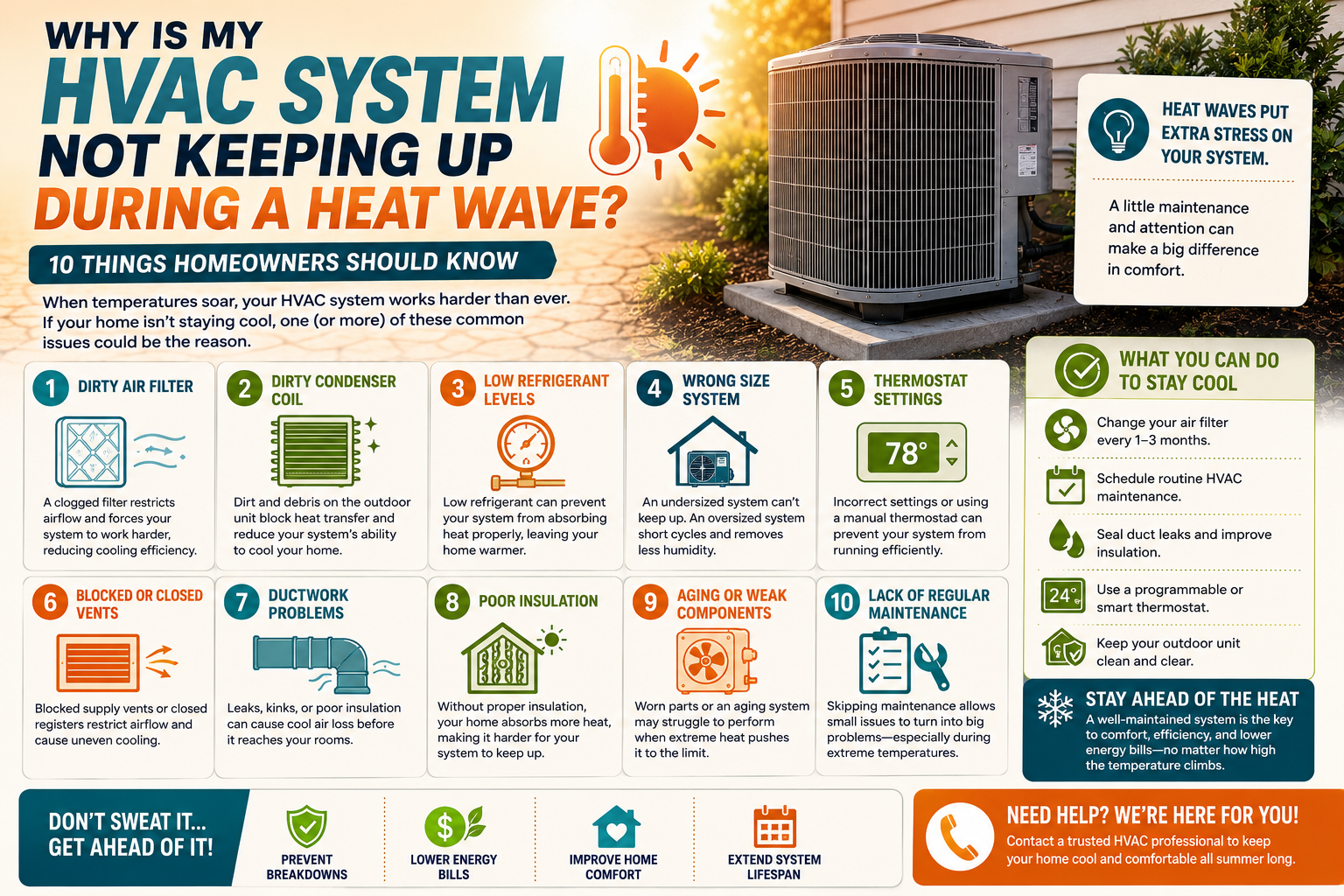
It’s 100°F Outside — and Your House Keeps Getting Warmer
Your thermostat is set to 74°F.
But the temperature inside says 78°F.
Then 79°F.
Your air conditioner hasn’t shut off for hours.
Naturally, you start wondering:
“Is something wrong with my AC?”
Maybe.
But extreme outdoor temperatures create some of the most demanding conditions your heating and cooling system will experience all year.
An air conditioner struggling during a severe heat wave doesn’t automatically mean it’s broken.
At the same time, a system that suddenly can’t maintain temperature may have a problem that needs attention.
The key is understanding the difference.
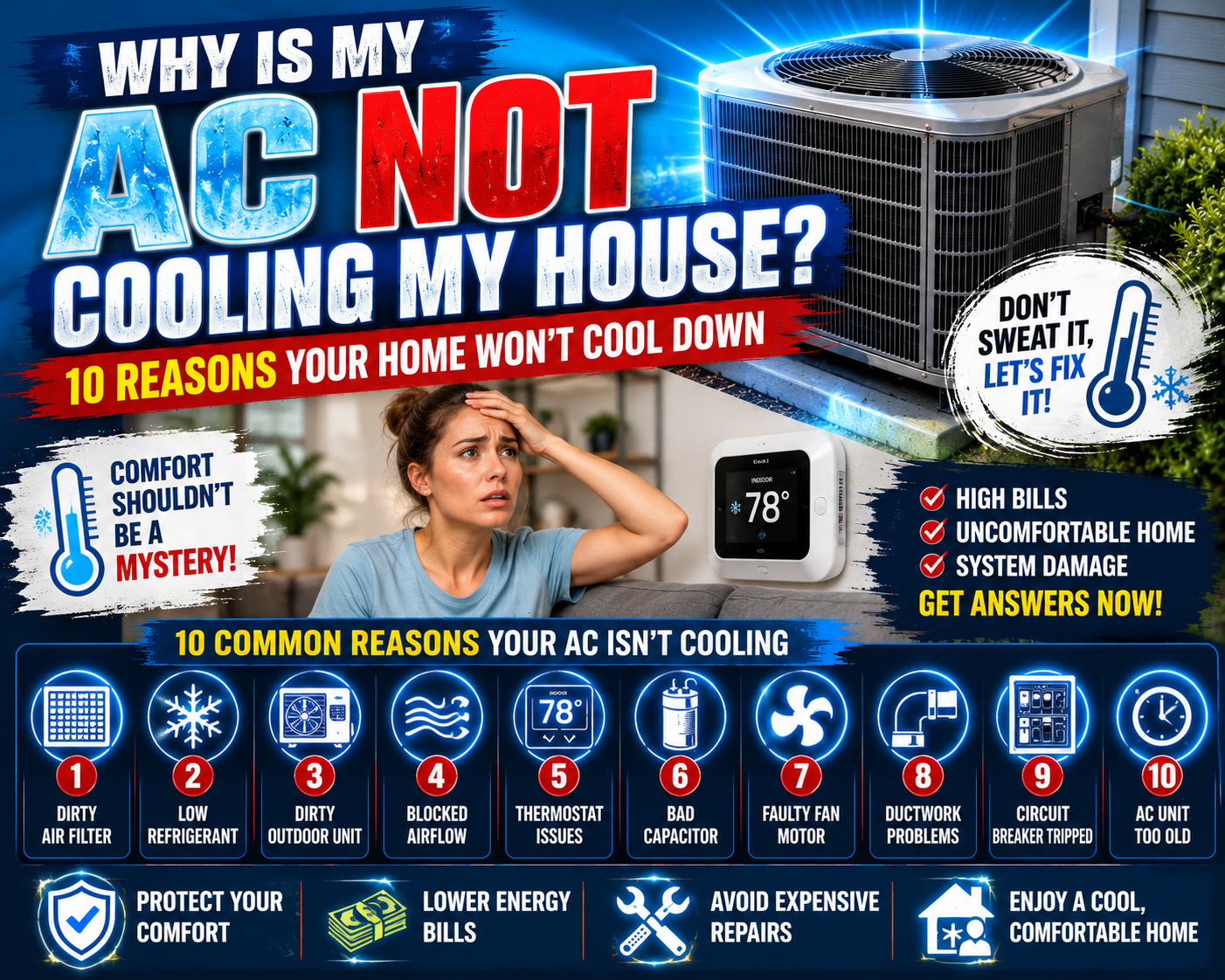
Here are 10 things homeowners should know when their AC isn’t keeping up during extremely hot weather.
1. Your Air Conditioner Is Removing Heat — Not Creating Cold
Understanding this makes everything else easier.
Your air conditioner doesn’t simply pump “cold” into the house.
It removes heat from indoor air and transfers that heat outdoors.
During extremely hot weather, heat is constantly entering your home through:
- Roof
- Attic
- Windows
- Exterior walls
- Doors
- Air leakage
- Sun exposure
Your AC has to remove that heat faster than the home gains it.
When outdoor temperatures become extreme, that job becomes much harder.
2. Extreme Outdoor Temperatures Increase the Cooling Load
Imagine your home on an 82°F day.
Now imagine the same home during a 105°F afternoon.
Everything else may be identical:
- Same thermostat
- Same air conditioner
- Same house
But the cooling demand is completely different.
The greater the difference between outdoor and indoor temperatures, the harder the HVAC system may need to work to maintain comfort.
This is why your AC might cycle normally during moderate weather but operate for very long periods during a heat wave.
3. Long AC Cycles Can Be Normal During Extreme Heat
Homeowners often believe:
“If my AC runs constantly, something must be wrong.”
Not necessarily.
During extremely hot conditions, a properly sized air conditioner may operate for long periods.
In fact, equipment that’s properly matched to the home’s cooling requirements may run extensively during design-level outdoor temperatures.
What matters is how the system is performing.
Ask:
- Is the home remaining reasonably comfortable?
- Is cold air coming from the vents?
- Is airflow normal?
- Is the indoor temperature relatively stable?
- Is this happening only during extreme weather?
If so, the system may simply be experiencing unusually high cooling demand.
4. A Growing Temperature Gap Can Indicate a Problem
There’s an important difference between an AC working hard and an AC losing the battle completely.
Suppose your thermostat is set to 75°F.
The house reaches 76°F during the hottest part of an unusually severe afternoon but later recovers.
That’s different from:
75°F → 78°F → 81°F → 84°F
while the AC continues operating.
If indoor temperature keeps climbing significantly, the system may not be removing enough heat.
That’s when further investigation makes sense.
5. Check the Air Filter First
Before assuming something major has failed, check the HVAC filter.
A heavily clogged filter can restrict airflow through the system.
Reduced airflow may affect:
- Cooling performance
- Comfort
- Equipment operation
- System efficiency
During extreme heat, an existing airflow restriction can become much more noticeable because the system is already operating under heavy demand.
If the filter is dirty, replace or clean it as appropriate.
6. Make Sure the Outdoor Unit Can Breathe
Your outdoor condenser needs airflow to release heat.
Look around the outdoor equipment.
Is it surrounded by:
- Leaves?
- Weeds?
- Landscaping?
- Storage?
- Debris?
The unit needs appropriate clearance.
Don’t cover the condenser or build an enclosure tightly around it for appearance.
Also avoid aggressive DIY cleaning methods that could damage the coil.
If the outdoor coil is heavily contaminated, professional cleaning may be appropriate.
7. Your Attic May Be Adding a Huge Amount of Heat
During a Temecula Valley summer, attic temperatures can become extremely high.
The ceiling separating your living space from the attic is one of the barriers protecting your conditioned home from that heat.
If attic insulation is inadequate, deteriorated, disturbed, or missing in areas, additional heat can enter the living space.
That increases the cooling load.
Your air conditioner now has to fight both the outdoor weather and excessive heat entering from above.
This is why HVAC performance and home insulation are closely connected.
8. Afternoon Sun Can Overpower Certain Rooms
Have you noticed that one side of your house becomes significantly hotter in the afternoon?
Pay attention to the windows.
West-facing and sun-exposed rooms can experience substantial solar heat gain.
Large windows and glass doors can allow significant heat into the home during peak sunlight.
Possible ways to reduce solar heat gain include:
- Closing blinds
- Closing curtains
- Using appropriate window coverings
- Exterior shading
- Improving windows during future renovations
Reducing the amount of heat entering the home gives your AC less heat to remove.
9. Your Ductwork Could Be Losing Conditioned Air
Imagine your air conditioner is working perfectly.
It produces conditioned air.
Then part of that air leaks through damaged ductwork into a 130°F attic.
Your HVAC equipment may be doing its job, but the conditioned air isn’t reaching the rooms efficiently.
Possible duct problems include:
- Disconnected sections
- Torn flexible duct
- Crushed duct
- Deteriorated connections
- Damaged insulation
- Air leakage
Duct problems can become especially noticeable during extreme weather.
10. Your AC May Actually Have a Mechanical Problem
Extreme heat can also expose existing HVAC problems.
Equipment that seemed acceptable during moderate weather may struggle once cooling demand increases.
Possible problems can involve:
- Capacitor
- Contactor
- Compressor
- Condenser fan motor
- Blower motor
- Refrigerant circuit
- Dirty coils
- Airflow
- Electrical components
This is why the hottest days of summer are often when HVAC service calls increase.
The heat didn’t necessarily create the entire problem.
It may have revealed a weakness that was already developing.
Why Does My AC Work Fine at Night but Struggle During the Afternoon?
This is an important clue.
Nighttime temperatures are usually lower.
There’s also no direct solar heat entering through the roof and windows.
The cooling load drops.
Your AC may then be able to reduce the indoor temperature more easily.
During the afternoon, the system is dealing with:
- Higher outdoor temperature
- Hot attic
- Direct sunlight
- Heat through windows
- Heat through walls
- Household activity
If the system catches up quickly after sunset, extreme daytime heat load may be a significant factor.
However, persistent performance problems should still be evaluated.
Should I Lower My Thermostat During a Heat Wave?
Setting the thermostat dramatically lower doesn’t make most traditional central air conditioners cool faster.
If the house is 80°F and you want 75°F, setting the thermostat to 65°F usually won’t cause the equipment to produce dramatically more cooling.
It simply tells the system to continue running.
Choose a reasonable temperature that provides comfort without unnecessarily increasing cooling demand.
Should I Turn My AC Off to “Give It a Break”?
If the system is operating normally during hot weather, you generally don’t need to periodically shut it off simply because it has been running for a long time.
HVAC equipment is designed to operate for extended periods when necessary.
However, turn it off and seek service if you notice signs such as:
- Burning smell
- Electrical problems
- Breaker repeatedly tripping
- Outdoor fan not operating
- Ice forming
- Loud abnormal noises
- No cooling at all
Long runtime and malfunction are not the same thing.
Should I Hose Down My Outdoor AC During a Heat Wave?
You may see online advice telling homeowners to continuously spray water on their condenser to make the AC work better.
Don’t rely on improvised cooling methods.
Your outdoor unit is designed to reject heat through its condenser coil and fan.
If the system cannot operate properly without being sprayed with water, determine why.
The equipment may need cleaning, maintenance, repair, or further evaluation.
Can a Dirty Outdoor Coil Make Heat-Wave Performance Worse?
Yes.
The condenser’s job is to release heat outdoors.
If the coil becomes heavily coated with debris, heat transfer and airflow can be affected.
During mild weather, you may not notice the reduced performance as much.
During a 100°F+ afternoon, however, every part of the cooling system is being challenged.
That’s when maintenance problems often become much more obvious.
Can Low Refrigerant Make an AC Struggle in Hot Weather?
A refrigerant-related problem can reduce cooling performance.
But refrigerant isn’t something an air conditioner should routinely “use up.”
If a system has insufficient refrigerant because of a leak, simply adding refrigerant without addressing the cause may not provide a lasting solution.
A technician should evaluate system operation and determine whether the refrigerant circuit is actually responsible.
How Can I Tell Whether My AC Is Actually Cooling?
A technician can perform measurements to determine how the system is operating.
Homeowners can still observe basic things:
- Is air coming from the vents?
- Does the air feel cooler than room temperature?
- Is the outdoor unit operating?
- Is the thermostat temperature rising or stable?
- Are some rooms much hotter than others?
- Has performance suddenly changed?
Avoid relying on one measurement or internet rule to diagnose the system.
HVAC performance depends on multiple conditions.
Could My Air Conditioner Be Too Small?
Possibly.
If the equipment was incorrectly sized or the home has changed significantly since installation, cooling capacity may not match the current load.
Changes might include:
- Home addition
- Garage conversion
- Large new windows
- Changed ductwork
- Altered insulation
- Added living space
However, don’t assume a struggling AC automatically needs to be larger.
Installing oversized equipment can create other comfort and performance problems.
Proper load calculations and system evaluation matter.
Could My AC Be Too Old to Handle Extreme Heat?
Age alone doesn’t determine whether an air conditioner can handle hot weather.
But older equipment may experience:
- Component wear
- Reduced efficiency
- Coil deterioration
- Motor problems
- Refrigerant-related issues
- Increasing repair needs
If an older AC struggles every summer and requires frequent repairs, it may be time to compare repair and replacement options.
That decision should be based on the system’s overall condition — not just its birthday.
What Can I Do to Help My AC During a Heat Wave?
There are several practical things homeowners can do:
- Check the air filter
- Keep exterior doors closed
- Close blinds on sun-exposed windows
- Avoid unnecessary heat-producing activities during peak afternoon hours
- Keep the outdoor unit clear of debris
- Use ceiling fans in occupied rooms
- Make sure supply and return vents aren’t blocked
- Maintain reasonable thermostat settings
- Schedule service if performance has changed
The goal is to reduce unnecessary heat entering the home while allowing the HVAC system to operate properly.
Don’t Block Your Return Vents
Return vents are essential to HVAC airflow.
Furniture, boxes, curtains, or other objects shouldn’t significantly restrict them.
Your HVAC system needs to pull air back toward the equipment before it can condition and redistribute it.
Poor return airflow can affect system performance.
Should I Close Vents in Unused Rooms During a Heat Wave?
Avoid closing large numbers of supply registers in an attempt to force cooling elsewhere.
Your HVAC system and ductwork were designed around airflow requirements.
Closing too many vents can increase duct-system resistance and may create unintended airflow problems.
If certain rooms consistently receive too much or too little cooling, have the airflow evaluated properly.
When Should I Call an HVAC Company?
Consider professional service if:
- Your AC can’t maintain temperature under conditions where it previously could
- Indoor temperature keeps rising
- Airflow is weak
- Air from the vents isn’t sufficiently cool
- Ice appears on HVAC equipment
- The outdoor fan stops
- The breaker trips
- You hear new abnormal noises
- Cooling performance suddenly changes
- The system doesn’t recover after outdoor temperatures drop
A technician can determine whether you’re dealing with extreme cooling demand or an actual equipment problem.
Frequently Asked Questions About AC Performance During Heat Waves
Is it normal for an AC to run all day when it’s extremely hot?
It can be. During severe heat, properly operating HVAC equipment may run for long periods to maintain indoor temperature.
Why won’t my AC reach the thermostat setting?
Possible reasons include extreme outdoor heat, solar gain, insufficient insulation, duct problems, airflow restrictions, equipment sizing, or HVAC malfunction.
Why does my AC cool better at night?
Outdoor temperatures and solar heat gain decrease at night, reducing the home’s cooling load.
Should I set my AC to 65°F during a heat wave?
Setting the thermostat dramatically lower generally doesn’t make a traditional AC cool the home faster.
Can poor insulation make my AC run constantly?
Yes. Increased heat transfer into the living space can increase cooling demand and HVAC runtime.
Can leaking ducts make the house hotter?
Yes. Conditioned air lost through duct leakage may reduce the amount of cooling reaching the living areas.
Does a heat wave mean my AC is broken if it runs constantly?
No. Long runtime alone doesn’t prove equipment failure. Look at whether the system is maintaining reasonable comfort and whether its performance has changed.
When should I worry?
A rapidly increasing indoor temperature, no cooling, weak airflow, ice, electrical problems, unusual noises, or other major changes should be investigated.
Extreme Heat in Temecula Valley
Summer temperatures throughout Temecula, Murrieta, Menifee, Lake Elsinore, Winchester, Hemet, Anza, and surrounding Southern California communities can put residential HVAC systems under significant demand.
And different homes respond differently.
A well-insulated home with good ductwork may hold temperature better than a similar-sized home with:
- Poor attic insulation
- Leaking ducts
- Large west-facing windows
- Significant air leakage
That’s why solving a heat-wave comfort problem sometimes requires looking beyond the air conditioner itself.
The Bottom Line
If your AC struggles during extreme heat, don’t immediately assume the system is broken.
But don’t automatically assume it’s normal either.
Look at the complete picture:
- Outdoor temperature
- Indoor temperature
- Airflow
- Filter condition
- Ductwork
- Insulation
- Windows and sun exposure
- Equipment performance
The most useful question isn’t:
“Why is my AC running so much?”
It’s:
“Is my HVAC system removing heat from my home the way it should under the conditions we’re experiencing?”
That’s the question proper HVAC diagnosis can answer.
Is Your AC Struggling With Southern California Heat?
If your air conditioner is running continuously, falling behind the thermostat, or no longer keeping your home comfortable, Advanced Heating & Air Conditioning can evaluate the system and determine why.
Our team provides professional AC repair, maintenance, airflow evaluations, HVAC replacement, ductwork, and insulation services throughout Temecula, Murrieta, Menifee, Lake Elsinore, Winchester, Hemet, Anza, and surrounding Southern California communities.
Don’t wait until your AC completely stops during the next heat wave.
Contact Advanced Heating & Air Conditioning to schedule professional air conditioning service or an HVAC evaluation.