


Why Does My Heat Pump Keep Turning On and Off?
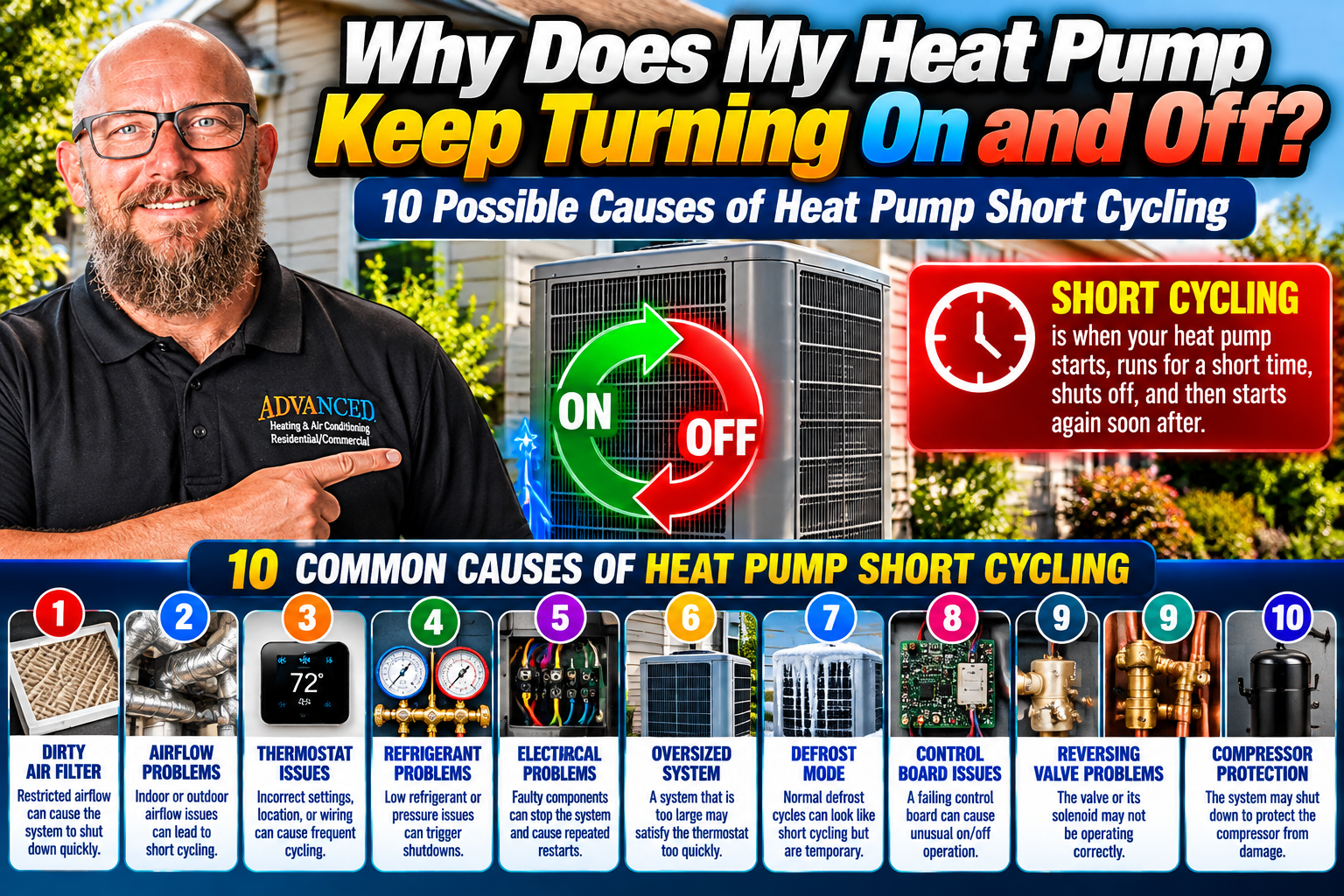
Why Does My Heat Pump Keep Turning On and Off?
Your heat pump starts.
A few minutes later:
It shuts off.
Then shortly afterward:
It starts again.
And the cycle keeps repeating.
Homeowners often describe this as:
“My heat pump keeps turning on and off.”
HVAC technicians commonly call frequent, unusually short operating cycles:
Short cycling.
A heat pump should naturally turn on and off as heating and cooling demand changes.
So cycling itself is not a problem.
The concern is when the system starts and stops far more frequently than normal, especially when each run lasts only a few minutes.
Short cycling can reduce comfort, increase wear on equipment, and sometimes indicate an airflow, electrical, refrigeration, thermostat, sizing, or control problem.
Key Takeaways
- Heat pumps naturally cycle on and off, so not every shutdown is a problem.
- Short cycling means the equipment is starting and stopping unusually frequently.
- A dirty filter or restricted airflow can contribute to short cycling.
- Outdoor-unit airflow matters too.
- Thermostat location, setup, staging, or wiring can cause frequent cycling.
- Refrigerant and pressure-related problems may cause protective shutdowns.
- Electrical problems can stop the compressor and cause repeated restart attempts.
- Oversized heat pumps may satisfy the thermostat too quickly.
- Variable-speed heat pumps can behave differently from single-stage equipment.
- Defrost should not be confused with ordinary short cycling.
- Repeated compressor starts deserve attention because the compressor is one of the system’s most important components.
What Is Heat-Pump Short Cycling?
Short cycling is when the heat pump operates for an unusually short period before shutting down, then starts again soon afterward.
For example:
Starts → runs 3 minutes → stops → restarts 3 minutes later → repeats.
That is very different from:
Runs 30–60 minutes → satisfies thermostat → stays off until the house needs heating or cooling again.
There is no universal number of minutes that defines a proper cycle for every system.
Weather, equipment type, thermostat settings, house load, and system staging all matter.
The pattern is what matters.
Is It Normal for a Heat Pump to Turn On and Off?
Yes.
A heat pump does not necessarily have to run continuously.
A single-stage system may naturally:
Start → run → satisfy the thermostat → shut off.
Later, when indoor temperature changes enough:
It starts again.
That is normal operation.
The concern is excessive cycling.
How Often Is Too Often?
There is no one number that applies to every heat pump.
But if your system repeatedly:
- Runs for only a few minutes
- Shuts off for only a few minutes
- and immediately starts again,
that deserves investigation.
A 2026 homeowner reported a heat pump doing exactly this and eventually focused troubleshooting on airflow, outdoor-coil condition, refrigerant pressures and protective controls.
Why Is Short Cycling Bad?
Frequent starts and stops can create additional stress on system components.
Each compressor startup involves:
- Electrical demand
- Pressure changes
- and mechanical loading.
Excessive cycling may also result in:
- Uneven temperatures
- Poor comfort
- Reduced efficiency
- and potentially increased equipment wear.
The goal is not:
Make the heat pump run forever.
The goal is:
Allow it to run appropriately for the actual heating or cooling demand.
1. Dirty Air Filter
Start with one of the simplest possibilities.
A dirty or excessively restrictive filter can reduce indoor airflow.
Reduced airflow can affect system performance and may contribute to conditions that cause the heat pump to shut down or fail to satisfy the thermostat normally.
Check the filter if:
- Airflow seems weaker
- The system has recently started cycling differently
- or the filter has not been changed recently.
Can a High-MERV Filter Cause Short Cycling?
Potentially, if the filter creates excessive pressure drop for the existing duct system.
A high-quality filter is not automatically bad.
The issue is whether the system can move adequate airflow through it.
A larger properly designed filter cabinet may allow good filtration with less resistance than forcing airflow through a small, restrictive filter.
This is why:
Filter + return duct + blower + coil
should be viewed as one airflow system.
2. Blocked or Closed Registers
Closing many supply registers can increase resistance in the duct system.
Homeowners sometimes close vents because they believe it will:
- Save energy
- or push more air somewhere else.
But closing too many registers can increase static pressure and reduce proper airflow.
Keep normal supply registers open unless the HVAC system was specifically designed for zoning.
3. Restricted Return Air
The heat pump needs to move air:
- Out to the rooms
- and back to the equipment.
Possible return-air problems include:
- Blocked return grille
- undersized return duct
- dirty filter
- furniture blocking the return
- or poor return pathways.
If the blower cannot get enough air, the entire system can be affected.
4. Outdoor Unit Is Not Getting Enough Air
Heat pumps depend on outdoor airflow too.
The outdoor coil should have adequate clearance.
Problems can occur when the unit is surrounded by:
- Bushes
- weeds
- leaves
- debris
- or stored items.
This came up directly in the recent 2026 short-cycling discussion: the outdoor unit was heavily surrounded by foliage, and airflow around the coil was one of the first issues commenters identified.
Keep landscaping trimmed according to the manufacturer’s required clearances.
Can a Dirty Outdoor Coil Cause Short Cycling?
Yes, potentially.
A dirty outdoor coil can interfere with heat transfer.
That can cause:
- Higher system pressures in cooling
- or abnormal operating conditions in heating,
depending on mode and conditions.
Protective controls may shut the system down if operating pressures move outside acceptable ranges.
5. Thermostat Location
The thermostat may be causing the heat pump to stop too quickly.
For example, imagine the thermostat is mounted:
- Near a supply register
- In direct sunlight
- Next to a kitchen
- or in another location that does not represent the rest of the house.
The thermostat may quickly sense a temperature change and shut the equipment off even though the rest of the home is not comfortable.
Thermostat location can contribute to inconsistent temperatures and short cycling.
Can a Thermostat Being Too Close to a Vent Cause Short Cycling?
Absolutely.
If warm air from a supply register blows toward the thermostat during heating:
Thermostat warms quickly → heat shuts off → thermostat cools again → heat restarts.
The same type of problem can happen during cooling.
Thermostat placement matters.
6. Thermostat Configuration
Modern heat pumps can have more complicated thermostat settings than traditional AC/furnace systems.
Settings may include:
- Temperature differential
- Cycle rate
- Compressor staging
- Auxiliary heat staging
- Minimum compressor run time
- Minimum compressor off time
- and other controls.
Incorrect settings can lead to strange cycling behavior.
What Is Minimum Compressor Off Time?
Many controls intentionally prevent the compressor from restarting immediately after shutdown.
You may see a thermostat display:
- WAIT
- DELAY
- or something similar.
A common compressor-protection delay is several minutes.
Messages such as “Waiting” can indicate a built-in compressor-protection delay rather than a failure.
This delay is designed to help prevent rapid restarting.
Does That Mean a Five-Minute Delay Is Short Cycling?
No.
A compressor protection delay by itself is normal.
The concern is when the system repeatedly:
- Runs only briefly
- then enters that delay,
- then restarts,
- over and over.
That pattern suggests something is repeatedly causing the heating or cooling call to end or the equipment to shut down.
7. Refrigerant Pressure Problem
Heat pumps have operating pressures that change with:
- Outdoor temperature
- Indoor conditions
- Airflow
- Refrigerant charge
- and operating mode.
If system pressures become abnormal, protective controls may shut down the compressor.
Possible reasons include:
- Incorrect refrigerant charge
- Refrigerant leak
- Airflow restriction
- Dirty coil
- Metering-device problem
- or other refrigeration issues.
A homeowner in the 2026 short-cycling discussion specifically wondered whether the equipment was cycling on a high- or low-pressure condition.
What Is a High-Pressure Switch?
Some heat pumps use a safety control that can shut the system down if refrigerant pressure becomes excessively high.
Possible contributors can include:
- Restricted airflow
- Dirty outdoor coil
- Fan problem
- Overcharge
- or other system conditions.
The exact cause should be diagnosed.
Do not bypass the safety.
What Is a Low-Pressure Switch?
Some systems also monitor low-side refrigerant pressure.
A low-pressure condition might be associated with:
- Low refrigerant
- Restriction
- very low load
- or other refrigeration problems.
Again:
Pressure-switch trip is a symptom.
The technician needs to determine what caused the pressure condition.
Should a Pressure Switch Ever Be Bypassed?
Not as a permanent repair.
Safety and protective controls are installed for a reason.
A technician may perform specific temporary diagnostic tests when appropriate, but the system should not simply be left operating with a safety defeated.
8. Refrigerant Leak
A refrigerant leak may reduce the system’s ability to operate normally.
Depending on conditions, it can contribute to:
- Poor heating
- Poor cooling
- Long runtime
- Icing
- or protective shutdowns.
Is Short Cycling Proof of Low Refrigerant?
No.
Absolutely not.
Short cycling has many possible causes.
Do not let anyone diagnose:
“It needs refrigerant”
solely because the heat pump cycles frequently.
Refrigeration measurements should support that diagnosis.
9. Electrical Problem
A heat pump contains multiple electrical components.
Depending on the equipment, these may include:
- Contactor
- Capacitor
- Control board
- Fan motor
- Compressor
- Inverter electronics
- and low-voltage controls.
An electrical component that fails intermittently can cause:
Startup → shutdown → restart attempt patterns.
Can a Bad Capacitor Cause Short Cycling?
Potentially, especially on equipment that uses traditional capacitors.
A weak capacitor can interfere with starting or running:
- Compressor
- or fan motor.
But not every modern heat pump uses the same electrical design.
Some inverter-driven systems use different compressor-control architecture.
Always diagnose the actual equipment.
Can a Bad Contactor Cause Short Cycling?
Yes.
A contactor is an electrically controlled switch that supplies high-voltage power to components in many HVAC systems.
If the contactor is:
- Pitted
- Loose
- failing electrically
- or receiving an unstable control signal,
the equipment can cycle abnormally.
Can Low Voltage Cause Heat-Pump Cycling?
Yes.
Control-voltage problems can make relays and contactors:
- Drop out
- then re-energize.
Possible causes include:
- Loose wiring
- transformer issues
- thermostat problems
- float switches
- or damaged low-voltage conductors.
10. Condensate Float Switch
This one surprises homeowners.
Many indoor HVAC systems have a condensate safety switch.
If the drain system backs up, the float switch may interrupt equipment operation to help prevent water damage.
A partially clogged drain can sometimes create an intermittent pattern:
Water rises → switch opens → system stops → water drains down → system starts again.
A commenter in the recent 2026 short-cycling discussion specifically suggested checking a condensate float switch and drain restriction as a possible intermittent shutdown cause.
This is one reason short cycling should be diagnosed as a system, not just an outdoor-unit problem.
Can a Clogged Condensate Drain Affect a Heat Pump During Heating?
It depends on system configuration and operating conditions.
During cooling, condensate production is much more obvious.
Some heating configurations may still have moisture-related safety concerns associated with indoor equipment.
The technician should understand the specific installation.
11. Oversized Heat Pump
This is one of the classic causes of short cycles.
Suppose the house needs:
24,000 BTU/h
under a certain condition,
but the heat pump delivers far more than that whenever it turns on.
The thermostat may be satisfied very quickly.
Then:
System shuts off.
A short time later:
Temperature drifts again.
Then:
System starts again.
That can create frequent cycling.
Doesn’t Bigger Equipment Keep the House More Comfortable?
Not necessarily.
Oversized equipment can cause:
- Frequent cycling
- Temperature swings
- Noise
- and potentially weaker humidity control during cooling.
Bigger is not automatically better.
Can a Variable-Speed Heat Pump Short Cycle?
Yes.
Variable-speed equipment is designed to reduce output and operate longer at lower capacity.
But it still has a:
Minimum capacity.
If the system is significantly oversized and even minimum output exceeds the home’s demand, it may still cycle more than desired.
That is why sizing remains important even with inverter equipment.
Could the Heat Pump Be Failing to Modulate?
Potentially.
A variable-capacity system that is supposed to reduce output but remains stuck at higher capacity could satisfy the thermostat too quickly.
Possible causes may involve:
- Control setup
- Communication
- Sensors
- Thermostat configuration
- or equipment faults.
This should be diagnosed based on the specific manufacturer and model.
12. System Is Reaching Setpoint Too Quickly
Not every short cycle is caused by a broken component.
For example, imagine:
- Mild 65°F outdoor day
- Very well-insulated home
- and a single-stage 5-ton system.
The home may simply need very little heating or cooling.
The equipment’s minimum output is still its full single-stage capacity.
The result may be shorter cycles.
That does not necessarily mean a new failure occurred—but it may illustrate why equipment sizing and staging matter.
Why Does My Heat Pump Short Cycle Only When the Weather Is Mild?
This is a particularly useful clue.
During mild weather, the home’s heating or cooling load is small.
A large single-stage system may produce more capacity than the house needs.
So the thermostat gets satisfied quickly.
During extreme weather, the same system may run longer because demand is higher.
That can point toward:
Capacity vs. load
rather than a traditional mechanical failure.
Why Does My Heat Pump Short Cycle Only When It’s Very Hot?
Now the diagnosis changes.
Possible causes might include:
- Dirty outdoor coil
- restricted condenser airflow
- outdoor fan issue
- high-pressure shutdown
- electrical overheating
- or another problem that appears under heavy load.
One older homeowner case described a heat pump that short cycled progressively worse as outdoor temperature increased into the 90s.
That kind of weather-dependent behavior is useful diagnostic information.
Why Does My Heat Pump Short Cycle Only in Heating Mode?
That is also important.
If cooling operates normally but heating short cycles, consider systems and controls that behave differently in heating mode, such as:
- Defrost
- Reversing valve
- Heating pressure conditions
- Thermostat staging
- and backup heat.
A homeowner previously reported short cycling only during heating, which helped narrow attention toward heating-specific operation rather than a generic thermostat cycle problem.
Can Defrost Look Like Short Cycling?
Sometimes.
During heating, the heat pump may temporarily change operation to remove frost from the outdoor coil.
The outdoor fan may:
- Stop temporarily
- and system sound may change.
That is different from the entire system repeatedly shutting off and restarting because of a fault.
Can the Reversing Valve Cause Short Cycling?
Potentially, depending on the failure.
A reversing-valve or control problem may cause abnormal refrigerant pressures or incorrect mode operation.
But short cycling alone is not enough to condemn a reversing valve.
Can Auxiliary Heat Cause Frequent Cycling?
It can complicate what the homeowner observes.
You may have:
- Heat pump compressor
- and auxiliary heat
cycling independently based on thermostat logic.
A homeowner may think:
“My heat pump keeps turning off.”
when the system is actually switching between heating stages.
This is why the thermostat display and actual equipment operation should both be observed.
Can a Smart Thermostat Cause Short Cycling?
Yes.
Possible reasons include:
- Incorrect heat-pump setup
- Aggressive temperature differential
- Improper staging
- Incorrect equipment configuration
- or wiring issues.
Smart does not mean:
Automatically configured correctly.
Can Wi-Fi Problems Cause Short Cycling?
Usually, loss of Wi-Fi itself should not make a properly designed thermostat stop controlling the basic HVAC system.
But software configuration, remote-sensor behavior, automation, or thermostat hardware problems can influence system calls.
If short cycling began immediately after:
- Thermostat installation
- Software change
- or new automation,
tell your HVAC technician.
Can Room Sensors Cause Short Cycling?
Potentially.
If a remote sensor is:
- Near a supply vent
- In direct sunlight
- Near an exterior door
- or in a room with rapidly changing temperature,
the thermostat may respond to that sensor and cycle more frequently.
Review which sensor is actually controlling the system.
What About HVAC Zoning?
Zoned systems require careful design.
Suppose you have a large central heat pump but only one small zone is calling.
The available system capacity may be much larger than that zone’s load.
This can create challenges involving:
- Airflow
- static pressure
- and cycle length.
Variable-capacity equipment can help when properly integrated with zoning, but the zoning and duct system still need proper design.
Can Short Cycling Damage My Heat Pump?
Frequent compressor starts can increase wear.
The compressor is designed to start many times throughout its life.
But excessive cycling is not ideal.
Potential concerns include increased wear on:
- Compressor
- Contactors
- Electrical components
- and motors.
If the system is clearly cycling abnormally:
Find the cause rather than ignoring it.
Can Short Cycling Increase My Electric Bill?
Potentially.
Starting and stopping inefficiently can reduce effective performance.
The system may also fail to maintain comfortable temperatures efficiently.
But energy use depends on the cause.
For example:
- Oversized equipment
- and a heat pump repeatedly tripping a safety
are very different situations.
Can Short Cycling Cause Poor Humidity Control?
Yes, during cooling.
Moisture removal takes time.
If a cooling cycle ends too quickly, the indoor coil may not stay cold long enough to remove as much moisture from the indoor air.
A homeowner with oversized heat pumps described good cooling but poor humidity control while the systems ran only about 10–20 minutes per cycle.
Southern California is not generally as humid as the Southeast, but indoor moisture control can still matter.
Could My Heat Pump Simply Be Too Efficient?
Not in the sense that efficiency itself causes short cycling.
But a high-capacity system in a low-load home can satisfy the thermostat quickly.
The issue is:
Capacity matching
not:
Too much efficiency.
What Is a Normal Cycle for a Variable-Speed Heat Pump?
Variable systems may operate for:
- Long periods
- at low capacity.
So if a variable-speed heat pump suddenly begins cycling every few minutes, that may be even more noteworthy because the equipment is typically designed to modulate rather than repeatedly stop and start.
What Can Homeowners Check Safely?
Before calling for service, you can check:
- Air filter
- Thermostat settings
- Whether supply vents are open
- Whether return grilles are blocked
- Whether landscaping is crowding the outdoor unit
- Whether the outdoor coil is visibly dirty
- Whether the unit is covered in ice
- and how long each cycle lasts.
Timing the cycles can be useful.
For example:
Runs 4 minutes → off 3 minutes → runs 4 minutes
is useful information for the technician.
Should I Record the Heat Pump?
Yes.
Short cycling is sometimes intermittent.
A short phone video showing:
Outdoor unit starts → runs → shuts off → restarts
can be helpful.
Also write down:
- Outdoor temperature
- Thermostat setting
- Indoor temperature
- and whether the system is in heating or cooling.
That can make diagnosis faster.
Should I Keep Resetting the Breaker?
No.
If the breaker repeatedly trips or the heat pump repeatedly shuts itself down:
Do not keep forcing it to restart.
Protective controls exist for a reason.
For repeated breaker trips or unsafe startup problems, heat-pump repair guidance is to shut the system down and have it evaluated.
Should I Bypass a Pressure Switch?
No.
Do not bypass protective controls as a homeowner.
If the system trips a safety:
Find out why.
Bypassing the safety can allow the compressor to operate under potentially damaging conditions.
When Should I Call for Heat-Pump Service?
Schedule service if:
- The heat pump runs only a few minutes at a time
- The system turns on and off repeatedly throughout the hour
- Comfort is getting worse
- Short cycling only happens during hot or cold weather
- The thermostat repeatedly shows a compressor delay
- The outdoor unit starts and stops while the thermostat still calls
- The system freezes
- The breaker trips
- or the pattern has suddenly changed.
Advanced Heating & Air Conditioning lists short cycling among the heat-pump problems it diagnoses, along with airflow, thermostat, refrigerant, electrical, frozen-coil and comfort issues.
Frequently Asked Questions
Why does my heat pump turn on and off every few minutes?
Possible causes include thermostat issues, airflow restrictions, oversized equipment, pressure-related shutdowns, electrical problems, condensate safeties or refrigeration faults.
Is it normal for a heat pump to cycle on and off?
Yes. Normal cycling is expected. The concern is repeated unusually short cycles.
How long should a heat pump run?
There is no universal cycle length. It depends on the equipment, outdoor conditions, home load and thermostat.
Can a dirty filter cause heat-pump short cycling?
Yes. Restricted airflow can contribute to abnormal system operation.
Can bushes around my heat pump make it short cycle?
Potentially. Restricted outdoor airflow can interfere with heat transfer and contribute to pressure and performance problems.
Can low refrigerant cause short cycling?
It can, but short cycling alone does not prove refrigerant is low.
Can too much refrigerant cause short cycling?
Incorrect refrigerant charge can contribute to abnormal system pressures. A technician should verify charge using the manufacturer’s procedure.
Can a thermostat cause short cycling?
Yes. Incorrect location, configuration, staging, wiring or sensor behavior can cause frequent cycling.
Can an oversized heat pump short cycle?
Yes. Oversized equipment may satisfy the thermostat too quickly, particularly during mild weather.
Can a variable-speed heat pump short cycle?
Yes, particularly if it is significantly oversized, incorrectly configured, or experiencing a control or mechanical problem.
Can a clogged drain make a heat pump shut off?
A condensate safety switch can shut down equipment if water backs up in certain indoor-system configurations.
Is short cycling bad for the compressor?
Excessive compressor starts can increase wear and should be investigated.
Why does my heat pump short cycle only in hot weather?
Potential causes include restricted outdoor airflow, dirty coils, pressure-related shutdowns, fan issues or electrical problems that become more noticeable under heavy load.
Why does my heat pump short cycle only in heating?
Heating-specific controls, defrost, refrigerant conditions, thermostat staging and reversing-valve operation may need to be evaluated.
Don’t Diagnose Short Cycling From One Part
This is the biggest takeaway.
A heat pump that keeps turning on and off can be caused by something simple:
Dirty filter.
Or something completely different:
- Oversizing
- Thermostat
- Float switch
- Outdoor airflow
- Pressure safety
- Refrigerant
- Electrical fault
- or a control problem.
That’s why the correct approach is:
Observe the cycle → check airflow → check thermostat and controls → check electrical operation → check refrigerant/system pressures when indicated → determine what is actually causing the shutdown.
Do not simply replace the thermostat.
Do not automatically add refrigerant.
And do not assume:
“Heat pumps just do that.”
Heat Pump Repair in the Temecula Valley
Advanced Heating & Air Conditioning diagnoses short-cycling heat pumps throughout Temecula, Murrieta, Menifee, Winchester, Wildomar, French Valley, Canyon Lake, Lake Elsinore, Hemet and surrounding communities.
Advanced’s heat-pump repair process evaluates issues including airflow, thermostat operation, refrigerant pressures and leaks, electrical components, safety controls, condensate drains, fan motors, blower operation, reversing-valve operation and overall system performance.
Advanced Heating & Air Conditioning
951-609-9881
California Contractor License #916901
REAL PEOPLE. REAL SERVICE. REAL COMFORT.