


Why Does My AC Take So Long to Cool My House? 10 Reasons
You Lower the Thermostat — But the Temperature Barely Moves
You come home on a hot afternoon.
The house is 82°F.
You set the thermostat to 75°F.
An hour later, it’s still 81°F.
Another hour passes.
Now it’s 79°F.
The air conditioner is running, and the vents are blowing cool air, but the house seems to be cooling incredibly slowly.
So you start wondering:
How long should it actually take an air conditioner to cool a house?
There’s no universal answer.
Cooling time depends on the outdoor temperature, indoor temperature, home construction, HVAC system, humidity, insulation, ductwork, windows, and many other factors.
But if your AC suddenly takes much longer to cool the house than it used to, there may be a reason.
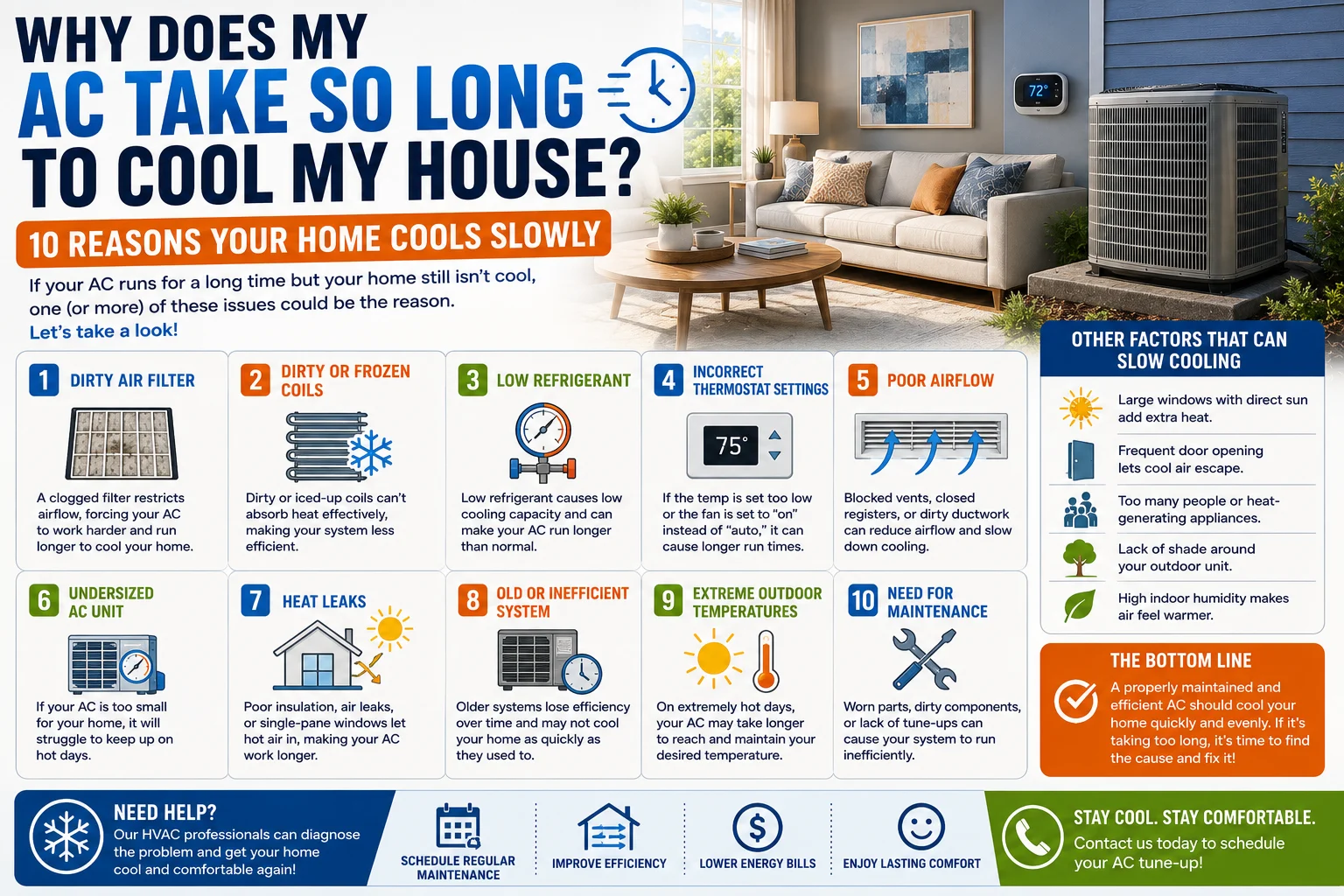
Here are 10 possibilities homeowners should understand.
1. You Started With a Very Hot House
The farther the indoor temperature is from your desired thermostat setting, the longer cooling will generally take.
Imagine coming home to a house that’s 85°F and immediately setting the thermostat to 72°F.
Your air conditioner now needs to remove a significant amount of heat.
And that heat isn’t only stored in the air.
Heat has also been absorbed by:
- Walls
- Furniture
- Flooring
- Cabinets
- Ceilings
- Interior materials
Cooling the air is only part of the job.
The entire house has been absorbing heat.
That’s why recovering from a large temperature increase can take time.
2. Lowering the Thermostat Doesn’t Usually Make the AC Cool Faster
This is one of the biggest thermostat misconceptions.
Suppose your home is 80°F and you want it to be 75°F.
Setting the thermostat to 65°F usually doesn’t make a traditional single-stage air conditioner suddenly produce colder air.
It simply tells the system:
Keep cooling until the lower temperature is reached.
If the system is already operating at full cooling capacity, lowering the thermostat further doesn’t create extra capacity.
Set the temperature where you actually want it.
3. Your Air Filter May Be Restricting Airflow
Your air conditioner needs airflow.
A heavily loaded filter can restrict the amount of air moving through the HVAC system.
Reduced airflow can affect:
- Cooling performance
- Comfort
- Equipment operation
- System runtime
If the house is cooling unusually slowly, checking the filter is a good first step.
A filter that looks severely clogged should be replaced or cleaned according to the system’s requirements.
4. Your Evaporator Coil May Not Be Getting Enough Air
The indoor evaporator coil absorbs heat from the air moving through the HVAC system.
For that process to work properly, the system needs adequate airflow.
Problems that can reduce airflow include:
- Dirty filter
- Dirty indoor coil
- Blower problem
- Restricted return
- Duct restrictions
- Incorrect blower settings
If insufficient air moves across the coil, the system may struggle to transfer heat effectively.
This is why HVAC cooling problems aren’t always refrigerant problems.
Sometimes they’re airflow problems.
5. Your Outdoor Condenser May Be Struggling to Release Heat
Remember what your AC is actually doing:
It’s moving heat from inside your house to the outdoors.
The outdoor condenser has to release that heat.
If the condenser coil is heavily contaminated with:
- Dirt
- Leaves
- Grass
- Landscaping debris
- Dust
heat transfer can be affected.
The outdoor unit also needs adequate space around it for airflow.
Crowding the condenser with plants or storage can interfere with its ability to operate as designed.
6. Your Ductwork May Be Losing Conditioned Air
Your air conditioner may be producing plenty of cool air.
But is that air actually reaching your rooms?
Many homes throughout Southern California have HVAC ducts located in hot attic spaces.
If the ductwork is:
- Torn
- Disconnected
- Poorly sealed
- Damaged
- Crushed
some of the conditioned air may never reach the living space.
Instead, you may be paying to cool the attic.
Possible signs of duct problems include:
- Weak airflow
- Hot rooms
- Long cooling times
- Uneven temperatures
- High energy bills
Ductwork deserves attention whenever an HVAC system struggles to cool a home.
7. Poor Attic Insulation May Be Adding Heat Faster Than Your AC Removes It
Your air conditioner is only one part of your home’s comfort system.
The building itself matters.
During hot Temecula Valley summers, attic temperatures can become extremely high.
Insulation helps slow heat transfer from the attic into the conditioned living space.
If insulation is inadequate or has been disturbed, your home may gain heat faster.
That means your AC has more heat to remove.
The result?
Longer cooling times.
8. Your Windows May Be Adding Significant Heat
Sunlight can add a surprising amount of heat to a home.
Large windows — particularly those exposed to strong afternoon sun — can increase cooling demand.
You may notice certain rooms becoming much hotter during specific times of day.
Closing blinds or curtains during peak sunlight can help reduce some of that heat gain.
Other long-term improvements may include:
- Exterior shading
- Improved windows
- Window treatments
- Building-envelope improvements
Reducing heat entering the house can be just as important as increasing cooling capacity.
9. Your Air Conditioner May Have Lost Cooling Capacity
If your AC previously cooled the house normally but now takes much longer, the equipment itself may have a problem.
Possible causes include:
- Refrigerant-related problem
- Compressor issue
- Dirty coils
- Blower problem
- Electrical component issue
- Fan motor problem
- Airflow restriction
The key clue is change.
If the same system used to cool your home much faster under similar weather conditions, something may have changed.
Professional testing can determine whether the equipment is still delivering its expected cooling performance.
10. The HVAC System May Not Be Properly Sized
Equipment sizing matters.
An air conditioner that’s too small may struggle to satisfy the home’s cooling demand during hot weather.
But here’s something homeowners often don’t realize:
Bigger isn’t automatically better.
An oversized air conditioner can create its own problems, including short cycling and reduced comfort under certain conditions.
Proper HVAC sizing should consider more than square footage.
Factors can include:
- Home size
- Insulation
- Windows
- Orientation
- Ceiling height
- Air leakage
- Local climate
- Ductwork
- Building construction
This is why simply replacing an old unit with “one size bigger” isn’t necessarily a good strategy.
How Long Should an AC Take to Drop the Temperature?
There isn’t a reliable universal rule such as:
“Your AC should lower the house exactly one degree every X minutes.”
Real-world cooling performance varies too much.
Consider two homes of identical size.
Home A
- Good insulation
- Shaded windows
- Tight ductwork
- Properly sized equipment
Home B
- Poor attic insulation
- Large west-facing windows
- Leaking ducts
- Significant air leakage
Even with similar HVAC equipment, these houses can cool very differently.
That’s why cooling time should be evaluated in context.
Why Does My House Cool Quickly at Night but Slowly During the Day?
Because your home’s heat load changes throughout the day.
During the afternoon, your AC may be fighting:
- High outdoor temperature
- Direct sunlight
- Hot attic
- Heated walls
- Window heat gain
After sunset, several of those heat sources decrease.
The air conditioner can then begin gaining ground more quickly.
If your home always struggles badly during daytime conditions, however, there may still be opportunities to improve HVAC performance or reduce heat gain.
Why Does My AC Cool Downstairs Faster Than Upstairs?
Two-story homes often experience temperature differences.
Heat can affect upper floors differently because of:
- Attic exposure
- Roof heat
- Window orientation
- Airflow distribution
- Duct design
- Insulation
- Thermostat location
If downstairs reaches 74°F while upstairs remains 80°F, the problem isn’t necessarily that the entire AC is too small.
Air distribution and building characteristics should also be evaluated.
Why Does One Bedroom Take Forever to Cool?
If most of the house becomes comfortable but one room stays hot, focus on that specific area.
Possible causes include:
- Restricted supply duct
- Damaged duct
- Poor return-air pathway
- Closed damper
- Insulation issue
- Window heat gain
- Room addition
- Duct sizing
Replacing the entire air conditioner may not solve a problem affecting only one room.
Does Running Ceiling Fans Help the AC Cool Faster?
Ceiling fans don’t lower the actual room temperature in the same way an air conditioner does.
They move air across your skin, which can make you feel cooler.
This may allow some homeowners to remain comfortable at a slightly higher thermostat setting.
Fans are most useful in occupied rooms.
There’s usually little comfort benefit from leaving ceiling fans running continuously in empty rooms.
Should I Leave Interior Doors Open?
It depends on the HVAC design.
Rooms need both supply airflow and an effective path for air to return toward the HVAC equipment.
In some homes, closing bedroom doors can affect pressure relationships and airflow if adequate return pathways aren’t provided.
If rooms become noticeably uncomfortable whenever doors are closed, the airflow design may deserve evaluation.
Can a Dirty Outdoor Unit Make Cooling Take Longer?
Yes.
Your condenser needs to transfer heat to the outdoor air.
If airflow across the condenser coil is severely restricted, cooling performance can suffer.
Keep vegetation and debris from crowding the outdoor unit.
Professional maintenance can address coil condition when necessary.
Could Low Refrigerant Cause Slow Cooling?
A refrigerant-related problem can reduce cooling capacity.
However, refrigerant isn’t fuel.
An air conditioner shouldn’t routinely need refrigerant added simply because it’s getting older.
If refrigerant is missing because of a leak, the source should be investigated.
Adding refrigerant without understanding why the system is low may only provide temporary improvement.
Does an Older AC Naturally Cool More Slowly?
Not necessarily.
An older system that’s properly operating may still cool the home effectively.
But aging equipment can develop:
- Coil deterioration
- Compressor wear
- Motor problems
- Electrical problems
- Refrigerant leaks
- Reduced reliability
If cooling performance has noticeably declined over time, the system should be evaluated.
Should I Replace My AC Because It Takes Too Long to Cool?
Not before diagnosing the problem.
Imagine replacing the air conditioner when the actual problem is a disconnected attic duct.
You could spend thousands of dollars and still have an uncomfortable house.
Before deciding on replacement, evaluate:
- Equipment operation
- System age
- Repair history
- Airflow
- Ductwork
- Insulation
- Cooling load
- Equipment sizing
Replacement makes sense when the complete situation supports it — not simply because the house cools slowly.
How Can I Help My House Cool Faster?
Start by reducing unnecessary heat gain and making sure airflow isn’t restricted.
Homeowners can:
- Check the HVAC filter
- Keep supply vents open and unobstructed
- Keep return vents clear
- Close blinds during strong afternoon sun
- Keep exterior doors closed
- Use ceiling fans in occupied rooms
- Avoid generating unnecessary indoor heat during peak afternoon hours
- Keep the outdoor condenser area clear
- Schedule maintenance when performance changes
If these basic steps don’t help, professional diagnosis may be needed.
When Should I Call an HVAC Professional?
Schedule service if:
- Cooling has suddenly become slower
- The AC runs for hours without reaching temperature
- Airflow is weak
- Air from the vents isn’t sufficiently cool
- Certain rooms have major temperature differences
- Ice appears on the system
- The outdoor fan isn’t operating correctly
- The system makes unusual noises
- Energy bills have increased unexpectedly
- The house doesn’t recover even after outdoor temperatures fall
The goal should be to determine why cooling performance has changed.
Frequently Asked Questions
Why does my AC take hours to cool my house?
Possible causes include high outdoor temperatures, a large thermostat setback, restricted airflow, duct leakage, poor insulation, solar heat gain, equipment problems, or improper sizing.
Does setting my thermostat lower cool the house faster?
Usually not with a traditional single-stage system. If the AC is already operating at full capacity, lowering the setting further generally doesn’t increase cooling output.
Why is my AC running but the temperature is dropping slowly?
The system may be removing heat while the home is simultaneously gaining significant heat. Airflow, equipment performance, ducts, insulation, and outdoor conditions should all be considered.
Why does my upstairs take longer to cool?
Upper floors can experience greater heat gain from the attic, roof, windows, and other factors. Airflow distribution can also contribute.
Can leaking ducts make an AC cool slowly?
Yes. Conditioned air lost through damaged or leaking ducts may reduce the amount of cooling reaching your rooms.
Can poor insulation make my AC run longer?
Yes. Poor insulation can allow additional heat into the conditioned space, increasing the cooling load.
Does slow cooling mean I need a bigger AC?
Not necessarily. The problem should be diagnosed before changing equipment size.
When should I worry about slow cooling?
If cooling performance has noticeably changed, the indoor temperature continues rising, airflow is poor, or the system shows other abnormal symptoms, professional evaluation is appropriate.
Slow Cooling in Temecula Valley Homes
Homes throughout Temecula, Murrieta, Menifee, Lake Elsinore, Winchester, Hemet, Anza, and surrounding Southern California communities face significant cooling demands during summer.
And the air conditioner isn’t working alone.
Your home’s ductwork, insulation, windows, air leakage, sun exposure, and HVAC equipment all work together to determine how quickly the house becomes comfortable.
That’s why good HVAC troubleshooting looks at the entire comfort system, not just the outdoor AC unit.
The Bottom Line
If your air conditioner takes a long time to cool your home, don’t immediately assume you need a larger system.
Start by determining what’s slowing the cooling process.
It could be:
- Extreme heat
- A dirty filter
- Poor airflow
- Duct leakage
- Insulation problems
- Solar heat gain
- HVAC equipment problems
- Improper sizing
Sometimes the air conditioner isn’t the real problem at all.
The best solution comes from understanding how heat is entering the home, how effectively the AC is removing it, and whether conditioned air is reaching the rooms where you need it.
Is Your Home Taking Too Long to Cool?
If your air conditioner runs for hours but your home still takes too long to become comfortable, Advanced Heating & Air Conditioning can evaluate the complete system and identify what’s holding it back.
We provide professional AC repair, maintenance, HVAC replacement, airflow evaluation, ductwork, and insulation services throughout Temecula, Murrieta, Menifee, Lake Elsinore, Winchester, Hemet, Anza, and surrounding Southern California communities.
Contact Advanced Heating & Air Conditioning to schedule an HVAC evaluation and find out why your home isn’t cooling the way it should.