


Do You Need a Permit to Replace HVAC in California?
Replacing Your HVAC System? There’s More to the Job Than Installing New Equipment
When homeowners start planning an HVAC replacement, most of the conversation naturally focuses on the equipment.
Which brand?
What efficiency?
Heat pump or traditional system?
How much will it cost?
How long will installation take?
But there’s another important part of a California HVAC replacement that homeowners shouldn’t overlook:
Permits and code compliance.
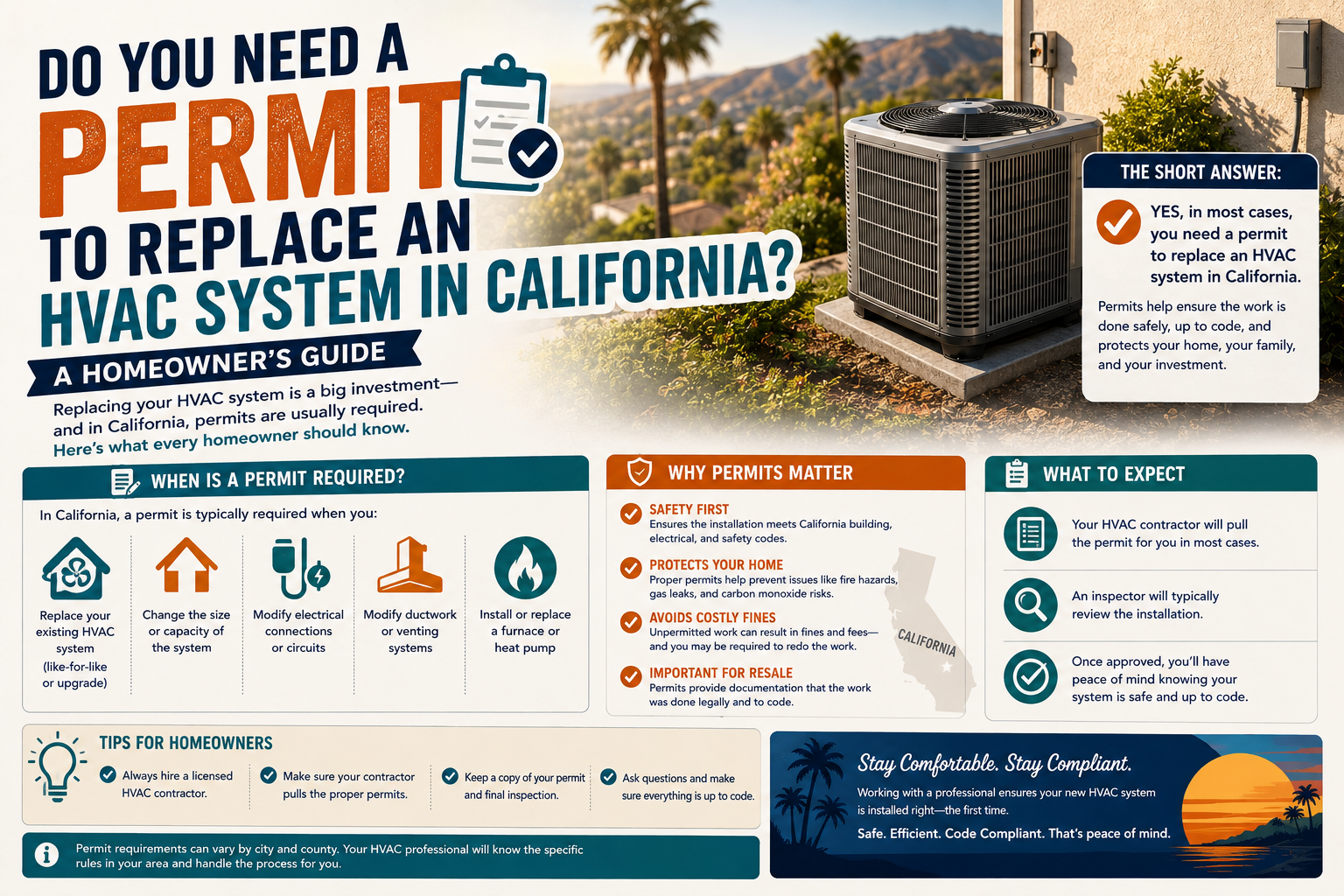
In California, HVAC replacement or alteration generally requires a building permit through the local building department. The California Energy Commission specifically advises homeowners replacing HVAC equipment to use a licensed contractor who properly permits the work.
That may sound like paperwork.
But permits are actually part of protecting the homeowner.
Let’s explain what they mean and why they matter.
Why Does California Require HVAC Permits?
An HVAC system involves much more than an appliance sitting outside your house.
Depending on the installation, the project can involve:
- Electricity
- Gas
- Refrigerant
- Drainage
- Venting
- Ductwork
- Heating equipment
- Cooling equipment
- Building penetrations
- Energy-efficiency requirements
Improper installation can create safety, comfort, efficiency, and property problems.
Permits create a process for verifying that applicable work meets building and energy-code requirements.
The California Energy Commission notes that permits can provide consumer protections, improve occupant safety, reduce potential obstacles when selling or financing a property, and provide for jurisdictional inspection of completed work.
Is an HVAC Permit Required When Replacing an Air Conditioner?
In California, replacing or altering HVAC equipment generally requires permitting.
The California Energy Commission states that when an HVAC unit is replaced or altered, a permit is required so the installation can be checked for compliance with applicable building-code requirements.
The exact process can vary by local jurisdiction and by the scope of the project.
That’s why your HVAC contractor should understand the requirements where your home is located.
What About Replacing a Furnace?
Furnace replacement can also involve permitting and inspection requirements.
A furnace installation may involve:
- Gas connections
- Electrical connections
- Venting
- Combustion air
- Equipment clearances
- Drainage for certain equipment
- Duct connections
- Safety requirements
Replacing a furnace isn’t simply disconnecting the old box and sliding a new one into place.
Proper installation matters.
What About Installing a Heat Pump?
Heat pump installations are also subject to applicable California building and energy requirements.
The California Energy Commission identifies split systems, mini-splits, packaged systems, and other HVAC equipment as systems that must comply with California’s Building Energy Efficiency Standards when installed.
That includes new installations and, where applicable, alterations to existing homes.
What Is Title 24?
California homeowners often hear contractors mention:
“Title 24.”
Title 24 refers to California’s Building Standards Code.
The Building Energy Efficiency Standards are contained in Title 24, Part 6 and establish energy-efficiency requirements for residential and nonresidential buildings.
These standards affect more than HVAC.
They cover many parts of building energy performance.
For HVAC projects, requirements can involve areas such as:
- Equipment
- Ductwork
- Controls
- Installation
- Testing
- Verification
For permit applications submitted on or after January 1, 2026, California’s 2025 Energy Code applies.
Does the Energy Code Apply Only to New Houses?
No.
This is an important misconception.
California’s Energy Code HVAC requirements don’t apply only when someone builds a brand-new home.
The California Energy Commission explains that the requirements can also apply to:
Additions
and
Alterations to existing buildings.
HVAC equipment replacement can fall within alteration requirements depending on the work being performed.
So owning an older house doesn’t automatically exempt an HVAC replacement from current applicable requirements.
Why Do HVAC Codes Change?
Building technology changes.
Equipment changes.
Efficiency standards change.
Installation practices improve.
California periodically updates its Energy Code to reflect new technologies, energy goals, building science, and efficiency requirements.
The current 2025 Energy Code took effect January 1, 2026 for applicable permit applications and includes updated HVAC provisions along with broader building-efficiency changes.
This is one reason homeowners shouldn’t rely on what happened when their previous HVAC system was installed 15 or 20 years ago.
Requirements may be different today.
What Happens After an HVAC Permit Is Pulled?
The exact process depends on the local jurisdiction and project.
Generally, there may be several stages.
1. Permit Application
The appropriate permit is obtained for the HVAC work.
2. Installation
The contractor installs the equipment according to applicable manufacturer requirements, building codes, and energy standards.
3. Required Documentation or Testing
Depending on the project, California Energy Code compliance documentation and diagnostic testing may apply.
4. Inspection
The local building authority may inspect applicable portions of the completed work.
5. Finalization
Once required steps have been completed and approved, the permit can be finalized.
Homeowners should ask their contractor how the process works for their specific project.
What Is HVAC Field Verification and Diagnostic Testing?
Some California HVAC projects require third-party field verification and diagnostic testing.
The California Energy Commission states that field verification and diagnostic testing is mandatory for new single-family construction and is prescriptively required for most HVAC additions and alterations. The exact required testing is identified on the project’s compliance documentation.
The purpose is to verify certain aspects of the installation rather than simply assuming everything performs as intended.
Is This the Same Thing Homeowners Used to Call HERS Testing?
California’s compliance terminology changed beginning in 2026.
Historically, homeowners and contractors commonly referred to certain third-party HVAC verification as HERS testing.
Beginning January 1, 2026, the field verification and diagnostic testing portion of the former HERS compliance process moved into California’s Energy Code Compliance (ECC) Program.
You may still hear people use the older term in everyday conversation.
The important thing for homeowners is understanding that certain HVAC projects can require independent compliance testing.
Why Would Ducts Need to Be Tested?
Your new air conditioner may be highly efficient.
But what happens if a significant amount of conditioned air escapes through leaking ducts before reaching your rooms?
That’s why duct performance can matter during HVAC replacement.
Depending on the project and applicable requirements, duct leakage testing may be part of California’s compliance process.
The goal is to make sure the air you’re paying to heat or cool is actually being delivered where it belongs.
What Is a Duct Leakage Test?
A duct leakage test measures how much air escapes from the duct system under controlled test conditions.
Specialized equipment is used to pressurize or depressurize the ducts.
The resulting measurements help determine how tight the duct system is.
This is much more accurate than simply looking at the ducts and saying:
“They look fine.”
A duct can appear acceptable while still leaking at connections or hidden locations.
Why Does Duct Leakage Matter?
Leaky ducts can contribute to:
- Energy waste
- Longer HVAC runtime
- Uneven temperatures
- Reduced comfort
- Conditioned air loss
- Unwanted attic or crawl-space air entering the system
This can be especially important in Southern California homes where ductwork frequently runs through hot attic spaces.
You don’t want to spend money cooling air only to lose part of it above your ceiling.
What If My Existing Ducts Are Old?
Replacing HVAC equipment is a good time to evaluate existing ductwork.
That doesn’t mean every HVAC replacement requires completely new ducts.
But older duct systems may have:
- Deteriorated insulation
- Damaged connections
- Leakage
- Crushed sections
- Poor design
- Previous repairs
- Inadequate sizing
The condition of the ducts should be considered when designing the new HVAC system.
Does Replacing Ductwork Affect California Energy-Code Requirements?
It can.
California’s Energy Code includes specific requirements for HVAC alterations and duct systems.
The applicable requirements depend on the project’s scope and configuration. The 2025 compliance documents specifically address alterations involving newly installed or replaced space-conditioning equipment and certain amounts of ductwork installed in unconditioned or indirectly conditioned spaces.
This is another reason homeowners benefit from working with contractors familiar with California compliance requirements.
What About DIY Mini-Splits?
This is a particularly interesting area.
A mini-split may look simple because the indoor unit hangs on a wall and the outdoor equipment is relatively compact.
But California doesn’t automatically treat a split-system HVAC installation like plugging in a window fan.
The California Energy Commission states that installation of a space-conditioning appliance other than a plug-in room appliance requires a building permit. It also notes that new HVAC systems require load calculations and that certain refrigerant work must meet applicable requirements.
So “DIY” equipment doesn’t necessarily mean “no permit.”
Why Should Homeowners Care Whether Their Contractor Pulls a Permit?
Because the permit isn’t simply for the contractor.
It’s connected to your property.
The California Energy Commission identifies several homeowner benefits of obtaining required permits, including:
- Improved occupant safety
- Compliance with local codes
- Jurisdictional inspection
- Fewer potential obstacles during a future property sale
- Fewer potential complications with financing
- Eligibility requirements for certain incentives or rebates
When comparing HVAC estimates, permitting should therefore be part of the conversation.
What Happens If an HVAC Contractor Says a Permit Isn’t Necessary?
Ask why.
Requirements can vary depending on the exact scope of work and local jurisdiction, so there can be legitimate differences between projects.
But don’t simply accept:
“Nobody gets permits for these.”
Ask:
- Does this specific HVAC replacement require a permit?
- Who is responsible for obtaining it?
- Is the permit included in my estimate?
- What inspections or testing are required?
A professional contractor should be able to explain the process.
Should the Homeowner Pull the HVAC Permit?
For a professionally contracted HVAC replacement, homeowners should discuss permit responsibility before work begins.
The California Energy Commission recommends hiring a licensed contractor who properly permits HVAC replacement work through the local building department.
Make sure the written proposal explains what’s included.
You don’t want to discover after installation that you were expected to handle an important part of the process yourself.
How Do I Know Whether My HVAC Contractor Is Licensed?
California homeowners can verify contractor licensing through the California Contractors State License Board.
For significant HVAC work, using an appropriately licensed contractor helps protect the homeowner and supports proper permitting and code compliance.
Don’t base a major HVAC decision only on who offers the lowest price.
Ask about:
- Licensing
- Insurance
- Permits
- Equipment
- Installation scope
- Warranty
- Testing
- Inspections
The complete installation matters.
Does a Permit Guarantee a Perfect HVAC Installation?
No.
A permit and inspection are important, but they aren’t substitutes for choosing a qualified HVAC contractor.
Inspectors verify applicable code requirements within the scope of their inspection.
HVAC installation quality also depends on factors such as:
- Equipment selection
- System design
- Workmanship
- Refrigerant procedures
- Airflow setup
- Duct design
- Commissioning
- Attention to detail
Think of permitting as one important layer of the overall quality process.
What Is HVAC Commissioning?
Commissioning means checking that the installed system is actually operating as intended.
Depending on the equipment and project, technicians may evaluate things such as:
- Equipment operation
- Airflow
- Temperature performance
- Refrigerant operation
- Electrical operation
- Thermostat configuration
- Drainage
- Heating performance
- Cooling performance
Installing equipment and turning it on isn’t the end of a professional HVAC installation.
The system should be checked and properly set up.
Does the Cheapest HVAC Estimate Include Everything?
Not necessarily.
This is where homeowners need to compare scope, not just the bottom-line number.
Suppose Contractor A quotes:
$10,000
and Contractor B quotes:
$12,000.
At first glance, Contractor A looks cheaper.
But what if Contractor B includes:
- Permit
- Required compliance documentation
- Required testing
- Duct repairs
- Electrical work
- New thermostat
- Equipment pad
- Drain modifications
- System commissioning
while Contractor A doesn’t?
Those aren’t necessarily comparable proposals.
Ask what’s included.
Questions to Ask Before Signing an HVAC Replacement Contract
Before approving a major HVAC replacement, ask:
Is the required permit included?
Get a clear answer.
Who obtains the permit?
Understand who’s responsible.
What code-compliance testing applies?
Requirements depend on the project.
Are third-party verification or diagnostic tests required?
Ask whether they’re included in the proposal.
Is my existing ductwork being evaluated?
New equipment depends on proper airflow.
Are electrical modifications included?
Equipment changes can affect electrical requirements.
What happens if something additional is discovered?
Understand how change orders are handled.
Who schedules the final inspection?
Don’t assume.
Will I receive documentation when the project is completed?
Keep your HVAC installation records with your home documents.
Keep Your HVAC Paperwork
After installation, don’t throw everything into a drawer and forget about it.
Keep records related to:
- Equipment model numbers
- Serial numbers
- Warranty registration
- Installation date
- Contractor information
- Permit information
- Inspection documentation
- Maintenance records
- Equipment manuals
These records can be useful years later when you need service, warranty work, or eventually sell the home.
Can Unpermitted HVAC Work Affect Selling a House?
Unpermitted improvements can create questions during a future real-estate transaction.
The exact consequences depend on the property, work performed, jurisdiction, and transaction.
California’s Energy Commission specifically identifies reducing obstacles to property sales and financing among the consumer benefits of obtaining required permits.
That’s one more reason to handle the project correctly when the equipment is installed rather than years later.
Does Every California City Have Exactly the Same HVAC Permit Process?
No.
California establishes statewide building and energy standards, but permits and enforcement are handled through local jurisdictions.
Local processes, fees, inspection procedures, and certain requirements can vary.
Some California jurisdictions can also adopt approved local energy standards that exceed statewide requirements.
For homeowners in the Temecula Valley, the exact process should be confirmed for the city or jurisdiction where the property is located.
Does the 2025 California Energy Code Affect HVAC Replacement?
Potentially, yes.
California’s 2025 Energy Code applies to permit applications submitted on or after January 1, 2026.
It contains requirements affecting new construction as well as applicable additions and alterations to existing homes.
Because HVAC codes evolve, homeowners should rely on current requirements rather than information from an HVAC replacement performed many years ago.
Why This Is Actually Good for Homeowners
Nobody gets excited about paperwork.
But think about what you’re purchasing.
A complete HVAC replacement can be one of the larger investments you make in your home.
You want to know that:
- The contractor is legitimate.
- The installation follows applicable requirements.
- Required testing is completed.
- The work can be inspected.
- The project is properly documented.
Permitting isn’t just bureaucracy.
Done correctly, it’s another layer of protection for the homeowner.
Frequently Asked Questions About California HVAC Permits
Do I need a permit to replace my AC in California?
HVAC replacement or alteration generally requires a permit in California. The exact requirements should be confirmed with the applicable local building department.
Does replacing a furnace require a permit?
Furnace replacement can require permitting because the work may involve gas, electrical, venting, mechanical, and energy-code requirements.
Do heat pumps require permits?
Heat pump and split-system installations are subject to applicable building and California Energy Code requirements.
Does a DIY mini-split need a permit in California?
The California Energy Commission states that installing a space-conditioning appliance other than a plug-in room appliance requires a building permit.
What is Title 24?
Title 24 is California’s Building Standards Code. Part 6 contains California’s Building Energy Efficiency Standards.
What happened to HERS testing in 2026?
Beginning January 1, 2026, field verification and diagnostic testing used for Energy Code compliance moved from the HERS compliance program into California’s Energy Code Compliance Program.
Does replacing HVAC mean I need all new ducts?
Not automatically. Existing duct condition, project scope, system design, and applicable code requirements should be evaluated.
Who should pull the HVAC permit?
Discuss this with your contractor before signing the proposal. California’s Energy Commission recommends using a licensed contractor who properly permits HVAC replacement work.
HVAC Replacement in Temecula Valley
Homeowners throughout Temecula, Murrieta, Menifee, Lake Elsinore, Winchester, Hemet, Anza, and surrounding Southern California communities shouldn’t evaluate HVAC replacement based only on equipment price.
A professional replacement involves considering the complete installation:
- Equipment
- Sizing
- Ductwork
- Electrical requirements
- Drainage
- Controls
- Permitting
- Applicable testing
- Inspection
- Commissioning
The goal isn’t simply to get a new AC installed.
It’s to have the new HVAC system installed correctly.
The Bottom Line
If you’re replacing an HVAC system in California, don’t treat the permit as an optional piece of paperwork.
California requires permits for applicable HVAC replacement and alteration work, and current Energy Code requirements may also trigger documentation, testing, or verification depending on the project.
Before signing an HVAC proposal, ask:
- Is the permit included?
- What testing is required?
- Who handles the inspection?
- Is my ductwork being evaluated?
- Will I receive the completed documentation?
You’re making a major investment in your home.
Make sure you’re buying a complete, properly installed HVAC system — not just a new piece of equipment.
Planning an HVAC Replacement?
If you’re considering replacing an air conditioner, furnace, heat pump, or complete HVAC system, Advanced Heating & Air Conditioning can help you understand the equipment and installation process for your home.
We proudly serve homeowners throughout Temecula, Murrieta, Menifee, Lake Elsinore, Winchester, Hemet, Anza, and surrounding Southern California communities.
Contact Advanced Heating & Air Conditioning to schedule an HVAC replacement evaluation and discuss the right system for your home.