


What Temperature Should I Set My Heat Pump in Winter
What Temperature Should I Set My Heat Pump in Winter?
When homeowners switch from a gas furnace to a heat pump, one of the first questions they ask is:
“What temperature should I set it to?”
Then comes the second question:
“Should I turn it down at night or when I leave the house?”
The answer is a little different than it can be with a traditional gas furnace.
Heat pumps are designed to provide steady, efficient heating. Many modern systems—especially variable-capacity equipment—perform very well when they are allowed to maintain a relatively consistent indoor temperature instead of repeatedly recovering from large thermostat changes.
But that does not mean every homeowner needs to leave the thermostat at exactly one temperature 24 hours a day.
The best setting depends on:
- Your comfort
- Your heat pump
- Your home’s insulation
- Your backup heat
- Outdoor temperature
- Utility rates
- and how long you’ll be away.
The goal is not to find one magical thermostat number.
The goal is to operate the heat pump in a way that balances:
Comfort + efficiency + reasonable energy use.
Key Takeaways
- There is no single perfect heat-pump temperature for every home.
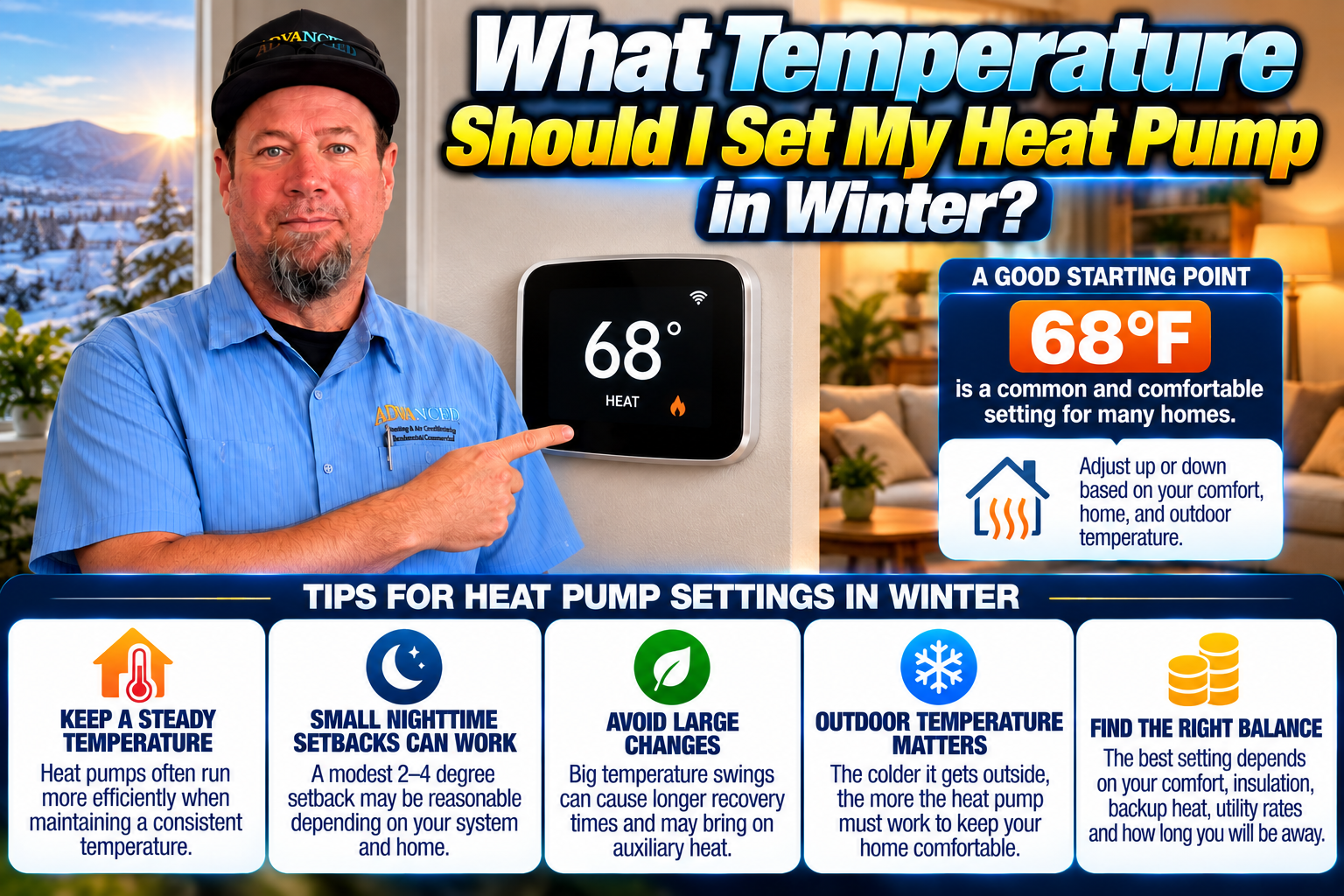
- A common starting point for heating is around 68°F, then adjust for personal comfort.
- Heat pumps often benefit from relatively steady thermostat settings.
- Large temperature setbacks can cause longer recovery periods.
- On systems with electric auxiliary heat, aggressive recovery can sometimes bring on expensive backup heat.
- Small nighttime setbacks may be reasonable depending on the system.
- Variable-speed heat pumps are designed to operate for long periods at lower capacity.
- Long runtime does not automatically mean high energy consumption.
- Don’t judge heat-pump efficiency solely by how long it runs.
- The thermostat should be configured for the actual heat pump and backup-heating system.
- There is no universal outdoor temperature at which every heat pump should be shut off.
- Modern heat pumps can continue providing heat at surprisingly low outdoor temperatures, depending on the equipment.
- Southern California’s relatively mild winter climate can be particularly well suited to heat-pump heating.
Is 68°F a Good Heat-Pump Setting?
For many homeowners:
68°F is a reasonable starting point.
But it is not a rule.
Some people are comfortable at:
66°F
while others prefer:
70°F or 72°F.
The best temperature is the lowest setting that keeps your household comfortably warm.
Every degree of additional indoor temperature increases the difference between:
- Indoor temperature
- and outdoor temperature.
The greater that difference becomes, the more heat the home generally loses.
That means the heat pump has more work to do.
Why Does Outdoor Temperature Matter?
Your house is constantly losing heat during winter.
If it is:
50°F outside
and
68°F inside,
the temperature difference is:
18°F.
If it drops to:
35°F outside,
the difference becomes:
33°F.
Now the house generally loses heat faster.
The heat pump has to replace that heat.
That’s why your heat pump may run much longer on a cold Temecula Valley morning than it does during a mild afternoon.
That does not automatically mean something is wrong.
Should I Leave My Heat Pump at One Temperature?
Often, a relatively consistent temperature works well.
Heat pumps generally operate efficiently when maintaining a consistent indoor temperature instead of being repeatedly turned on and off.
But this advice needs context.
It does not mean:
Never touch your thermostat.
A modest adjustment can still make sense.
The concern is more about dramatic temperature changes.
For example:
70°F → 60°F → 70°F
is very different from:
69°F → 67°F → 69°F.
Why Are Heat Pumps Different From Gas Furnaces?
A gas furnace can deliver a large amount of heat quickly.
Traditional furnaces commonly operate:
ON at full output → warm the house → OFF.
A modern variable-capacity heat pump can behave differently.
It may operate:
- Longer
- at lower capacity
to maintain temperature.
Instead of repeatedly blasting hot air and shutting off, it can provide steady heating.
That can improve:
- Comfort
- Temperature consistency
- Noise
- and potentially efficiency.
Is It Bad for a Heat Pump to Run for a Long Time?
No.
This is one of the biggest misconceptions homeowners have about heat pumps.
People see:
Heat pump running for 45 minutes
and assume:
“This thing is wasting electricity.”
Not necessarily.
A variable-speed compressor running for 45 minutes at low capacity may use less electricity than repeatedly operating at maximum output.
Runtime alone does not tell you energy consumption.
You need to know:
How hard the equipment is actually working.
Why Do Variable-Speed Heat Pumps Run So Long?
Because that is often exactly what they are designed to do.
Imagine driving your car.
You could:
Floor the accelerator → brake → floor it again → brake again.
Or you could maintain a steady speed.
Variable-capacity HVAC works on a similar general principle.
Instead of constantly:
FULL OUTPUT → OFF → FULL OUTPUT → OFF
the system can adjust capacity closer to what the house actually needs.
Should I Turn My Heat Pump Down at Night?
You can.
But large setbacks may not always provide the savings homeowners expect.
For example:
- Daytime setting: 70°F
- Night setting: 62°F
- Morning setting: 70°F
Now the heat pump has to recover:
8°F.
Depending on your equipment and thermostat configuration, that large recovery could cause:
- Higher compressor capacity
- or auxiliary heat
to operate.
That can change the energy equation.
What Is a Better Nighttime Setback?
There is no universal answer.
But homeowners with heat pumps may want to experiment with a more modest change, such as:
1–3°F
rather than immediately using a very large setback.
For example:
- Day: 69°F
- Night: 67°F
- Morning: 69°F.
Then observe:
- Comfort
- System operation
- and energy use.
Your particular home and heat pump determine the result.
What If I Like Sleeping in a Cold Bedroom?
Comfort matters.
If you genuinely prefer a much cooler bedroom, you don’t have to sacrifice comfort just because you own a heat pump.
But understand what happens the next morning.
The important question becomes:
How does the system recover?
If recovery causes electric auxiliary heat to operate heavily, you may want to:
- Recover more gradually
- or start recovery earlier.
What Is Smart Recovery?
Some thermostats have features called:
- Smart Recovery
- Adaptive Recovery
- or similar names.
Instead of waiting until:
7:00 AM
to change the thermostat from:
65°F → 70°F,
the thermostat may begin heating earlier.
It attempts to reach:
70°F by 7:00 AM
rather than starting the recovery at 7:00.
That can allow the system to recover more gradually.
Can Raising the Thermostat Trigger Auxiliary Heat?
Yes, depending on the system and thermostat settings.
Suppose the house is:
64°F
and you suddenly change the thermostat to:
72°F.
The thermostat may interpret the large temperature difference as:
“We need a lot of heat quickly.”
It may activate:
Auxiliary heat.
If your backup source is electric resistance heat, that can use considerably more electricity than the heat pump compressor alone.
This is one reason heat-pump thermostat setup matters.
What Is Auxiliary Heat?
Auxiliary heat is a secondary heating source that helps the heat pump when necessary.
Depending on your system, that might be:
- Electric resistance heat
- or another heating source.
Is Auxiliary Heat Bad?
No.
Auxiliary heat exists for a reason.
It may be needed when:
- Outdoor temperature is very low
- The heat pump needs assistance
- The system is defrosting
- or the house needs rapid temperature recovery.
The concern is not:
“Aux heat came on.”
The concern is:
“Why is auxiliary heat running constantly when the heat pump should be able to handle the load?”
What Temperature Should Auxiliary Heat Come On?
There is no universal temperature.
This is another question homeowners are actively asking online.
One homeowner asked whether a 35°F auxiliary-heat threshold was correct. The useful answer was that the setting depends on the specific heat pump’s performance data and system design—not an internet rule.
That’s exactly right.
The correct threshold can depend on:
- Heat-pump model
- Heating capacity
- Home heating load
- Backup heat type
- Electricity cost
- Gas cost
- and thermostat/control strategy.
Should I Turn My Heat Pump Off Below 40°F?
Not automatically.
This is an outdated assumption for many modern heat pumps.
A homeowner recently asked whether a thermostat’s suggested 40°F heat-pump lockout made sense. Responses correctly pointed out that the actual equipment model and backup heating source matter.
Many modern heat pumps can continue operating well below 40°F.
Exactly how low depends on the equipment.
What Is Heat-Pump Balance Point?
This is an important concept.
The home’s:
Heating load
increases as outdoor temperature falls.
Meanwhile, a heat pump’s available heating capacity can change with outdoor temperature.
At some point, the house may need more heat than the heat pump alone can provide.
That general relationship helps establish a:
Balance point.
Below that point, supplemental heating may be needed.
But the balance point is not automatically:
- 40°F
- 35°F
- or 32°F.
It depends on the system and the house.
Why Does Home Insulation Matter?
Two identical heat pumps installed in two different homes can behave very differently.
House A:
- Good insulation
- Good windows
- Sealed ducts
- Low air leakage.
House B:
- Poor insulation
- Leaky ducts
- Old windows
- Major air leakage.
House B loses heat faster.
Its heat pump must work harder to maintain the same thermostat setting.
This is why thermostat advice without understanding the house has limits.
Does Ductwork Affect the Best Thermostat Setting?
Indirectly, yes.
If ducts leak into:
- Attic
- Garage
- Crawlspace
- or another unconditioned area,
some of the heat you paid to produce never reaches the rooms.
Poor duct design can also create:
- Uneven rooms
- Weak airflow
- and comfort complaints.
The homeowner then responds by raising the thermostat.
But:
Turning the thermostat from 68°F to 74°F doesn’t repair bad ductwork.
Fix the distribution problem.
What If One Room Is Always Cold?
Don’t automatically raise the entire house temperature.
If the house is comfortable at:
69°F
investigate:
- Supply airflow
- Return-air pathway
- Duct leakage
- Insulation
- Windows
- Room exposure
- and register placement.
Otherwise you may overheat the entire house trying to solve one room.
What Temperature Should I Set My Heat Pump When I Leave for Work?
A modest setback may be reasonable.
If you’re gone for:
8–10 hours,
reducing the setpoint can reduce heat loss because the house is maintained at a lower average indoor temperature.
But again, consider the recovery.
A huge setback followed by an aggressive recovery may cause backup heat to operate.
A smaller setback may produce a better balance.
What If I’m Leaving for Several Days?
That is different.
If the home will be unoccupied for an extended period, a larger setback may make sense.
But do not turn the heat off completely during cold weather without considering:
- Plumbing
- Pets
- Plants
- Humidity
- Building materials
- and other property needs.
Southern California winter conditions are generally mild compared with many parts of the country, but individual properties and higher-elevation areas can still experience cold nights.
Should I Turn My Heat Pump Off When I Leave the House?
Usually, no.
Turning it completely off every time you leave can cause large indoor temperature swings.
Instead, use:
- A reasonable setback
- or your thermostat’s Away, Eco or scheduling feature.
Does Turning the Thermostat Higher Heat the House Faster?
Usually not in the way homeowners imagine.
If your house is:
65°F
and you want:
70°F,
setting the thermostat to:
78°F
does not necessarily make the heat pump produce heat faster.
It may simply cause the system to continue operating longer—and depending on controls, it could potentially trigger additional heating stages.
Set the thermostat to the temperature you actually want.
Should I Set My Heat Pump to 72°F?
If that’s where you’re comfortable, you can.
But compare:
- Comfort
- and energy use.
If you’re equally comfortable at:
69°F
there is little reason to maintain:
72°F
just because someone online said that was the correct heat-pump setting.
There is no universal comfort number.
Is 65°F Too Low?
Not inherently.
If you’re comfortable and the home/property can safely be maintained there, the heat pump can maintain a lower indoor setpoint.
The bigger issue is what happens when you later request:
70°F or 72°F.
A large recovery can change system operation.
What About 75°F?
Again, you can choose your comfort temperature.
But maintaining a warmer house generally increases heat loss to colder outdoor air.
That means:
More heating demand.
If energy savings are a priority, consider lowering the setpoint slightly and seeing whether comfort remains acceptable.
Should I Use AUTO or HEAT?
This is different from the thermostat’s:
FAN AUTO vs. FAN ON
setting.
If your thermostat has:
- HEAT
- COOL
- and AUTO CHANGEOVER,
AUTO may automatically switch between heating and cooling.
That can be useful during Southern California shoulder seasons when:
- Morning = cold
- and afternoon = warm.
But the heating and cooling setpoints should have enough separation to prevent unnecessary mode changes.
What About the Fan Setting?
For most systems, the thermostat’s fan setting and heat-pump temperature setting are separate decisions. For the full explanation, see Should I Leave My Thermostat On Auto or On?
Does 1°F Really Make a Difference?
It can.
The effect depends on:
- Weather
- house
- equipment
- and how long the temperature is maintained.
You do not need to obsess over every degree.
A practical approach is:
Start where you’re comfortable.
Then try:
1°F lower.
If you remain comfortable, keep it.
If not, put it back.
Should I Use a Programmable Thermostat With a Heat Pump?
It can be useful.
Scheduling can help manage:
- Sleeping
- Working hours
- Vacations
- and occupancy.
But make sure the thermostat is actually configured for:
Heat-pump operation.
Can My Smart Thermostat Save Money?
Potentially.
Useful features may include:
- Scheduling
- Remote adjustment
- Occupancy sensing
- Energy reports
- and adaptive recovery.
But the thermostat cannot compensate for:
- Oversized equipment
- Leaking ducts
- Low refrigerant
- Poor insulation
- or improper installation.
Smart controls are only one part of system efficiency.
What Temperature Should a Heat Pump Be Set to in Temecula?
There isn’t a special Temecula thermostat number.
But the Temecula Valley’s climate is important.
Winters are generally much milder than climates where heat pumps regularly face prolonged extreme cold.
That can make heat pumps an attractive heating option because they can provide efficient heating through much of Southern California’s winter season.
Advanced Heating & Air Conditioning actively installs heat-pump systems for year-round heating and cooling and evaluates the home’s size, layout, ductwork, airflow, electrical access, and heating/cooling needs before recommending equipment.
Why Are Heat Pumps a Good Fit for Southern California?
A heat pump does not have to create heat through combustion.
It moves heat.
During Southern California’s relatively moderate winter conditions, there is generally substantial heat available in the outdoor air for the refrigeration system to transfer indoors.
That can make heat pumps an excellent option for homeowners looking for:
- Heating + cooling from one system
- and potentially lower reliance on gas.
System selection and installation still matter.
What If I’m Replacing a Gas Furnace?
This is where thermostat habits may need to change.
A homeowner accustomed to:
Furnace OFF → house gets cold → thermostat raised 8°F → furnace blasts hot air
may initially expect the heat pump to behave the same way.
It may not.
A modern heat pump can be designed around:
- Longer
- steadier
- lower-capacity heating.
That is not a weakness.
It is a different way of maintaining comfort.
Does Heat-Pump Air Feel Cooler Than Furnace Air?
Often, yes.
A gas furnace can produce very warm supply air.
A heat pump may produce air that is:
- Warm enough to heat the house
- but does not feel extremely hot against your hand.
That sometimes causes new heat-pump owners to raise the thermostat unnecessarily.
Judge performance by:
Whether the house reaches and maintains the setpoint.
Not solely by:
How hot the register feels.
What If My Heat Pump Can’t Reach 68°F?
Then thermostat strategy may not be the problem.
If the system runs continuously but indoor temperature continues falling, possible causes include:
- Equipment sizing
- Refrigerant problem
- Airflow
- Duct leakage
- Outdoor-unit problem
- Defrost issue
- Auxiliary-heat problem
- or another system fault.
Don’t keep raising the thermostat.
Find out why the system isn’t meeting the load.
Should I Raise the Thermostat When It’s Very Cold Outside?
Not necessarily.
If you’re already comfortable at:
68°F,
raising it to:
72°F
during colder weather actually increases the heating demand.
The system now has to maintain an even larger indoor/outdoor temperature difference.
Keep the thermostat at the comfort level you actually need.
Can I Save Money by Using Space Heaters Instead?
Not automatically.
Electric resistance space heaters convert electricity directly into heat.
A functioning heat pump can often move more heat energy than the electrical energy it consumes.
Whether supplemental heaters make financial sense depends on:
- What rooms you’re heating
- Your heat pump
- Electric rates
- and how the home is occupied.
Be cautious about replacing whole-home heat-pump operation with multiple portable heaters without actually comparing energy use.
How Can I Find My Best Heat-Pump Setting?
Try a simple experiment.
Start at:
68°F.
Live with it for a few days.
Then adjust by:
1°F.
Pay attention to:
- Comfort
- Runtime
- Auxiliary-heat use
- and energy consumption.
Do not change five thermostat settings at once.
Otherwise you won’t know which change affected the system.
Frequently Asked Questions
What temperature should I set my heat pump to in winter?
Around 68°F is a reasonable starting point for many households, but the best setting is based on your comfort and home.
Should I leave my heat pump at the same temperature all day?
A relatively steady temperature often works well with heat pumps, particularly variable-capacity systems. Small setbacks can still be reasonable.
Should I turn my heat pump down at night?
You can. Consider a modest setback rather than assuming a large setback will always save more.
Does turning a heat pump down save electricity?
Reducing indoor temperature can reduce heat loss, but the eventual recovery and auxiliary-heat strategy also affect total energy use.
Can raising my thermostat make auxiliary heat come on?
Yes. Depending on thermostat configuration, a large temperature increase may cause additional heating stages or auxiliary heat to operate.
Should I shut my heat pump off below 40°F?
Not automatically. The appropriate operating range depends on the exact heat pump and backup-heating system.
What outdoor temperature is too cold for a heat pump?
There is no universal temperature. Modern heat pumps vary significantly in low-temperature capacity and operating limits.
Why does my heat pump run constantly at 68°F?
Long runtime can be normal, particularly with variable-capacity equipment. The important question is whether the home maintains the desired temperature and the system is operating correctly.
Is 72°F too high for a heat pump?
Not if that’s the temperature you need for comfort, but higher indoor temperatures generally increase heating demand.
Should I turn the heat pump off while I’m at work?
Usually a moderate setback is preferable to completely shutting the system off for a normal workday.
Is a smart thermostat better for a heat pump?
It can provide useful scheduling and control features, but it must be compatible and correctly configured for the heat pump.
Why does my heat-pump air not feel very hot?
Heat pumps commonly deliver gentler supply-air temperatures than gas furnaces. The house can still warm normally.
The Best Heat-Pump Setting Isn’t a Magic Number
This is the main takeaway.
Homeowners often search:
“What temperature should my heat pump be set at?”
expecting one number.
But the better answer is:
Start around 68°F → adjust for comfort → avoid unnecessary large temperature swings → watch auxiliary-heat use → let variable-capacity equipment do what it was designed to do → evaluate the house and system if it can’t maintain the setpoint.
And don’t automatically shut down a modern heat pump because the outdoor temperature crosses an arbitrary:
- 40°F
- or 35°F.
Use the performance characteristics of the actual equipment.
Heat Pump Installation in the Temecula Valley
Advanced Heating & Air Conditioning installs, repairs and maintains heat pumps throughout Temecula, Murrieta, Menifee, Winchester, Wildomar, French Valley, Canyon Lake, Lake Elsinore, Hemet and surrounding communities.
Advanced’s heat-pump installation, repair and maintenance specifically identifies thermostat setup/calibration, proper sizing and system optimization as important parts of heat-pump performance.
Advanced Heating & Air Conditioning
951-609-9881
California Contractor License #916901
REAL PEOPLE. REAL SERVICE. REAL COMFORT.