


Is My Heat Pump Smoking? Why Steam Comes From a Heat Pump
Is My Heat Pump Smoking? Why Steam Comes From the Outdoor Unit in Winter
You look outside on a cold morning and suddenly notice something alarming.
Your outdoor heat pump appears to be:
Smoking.
You may also notice:
- The outdoor fan isn’t spinning.
- The unit makes a different sound.
- A large white cloud rises from the equipment.
And then, a few minutes later:
Everything goes back to normal.
For many heat-pump owners, especially people who previously had a traditional gas furnace and air conditioner, this can look like a serious equipment failure.
But in many cases:
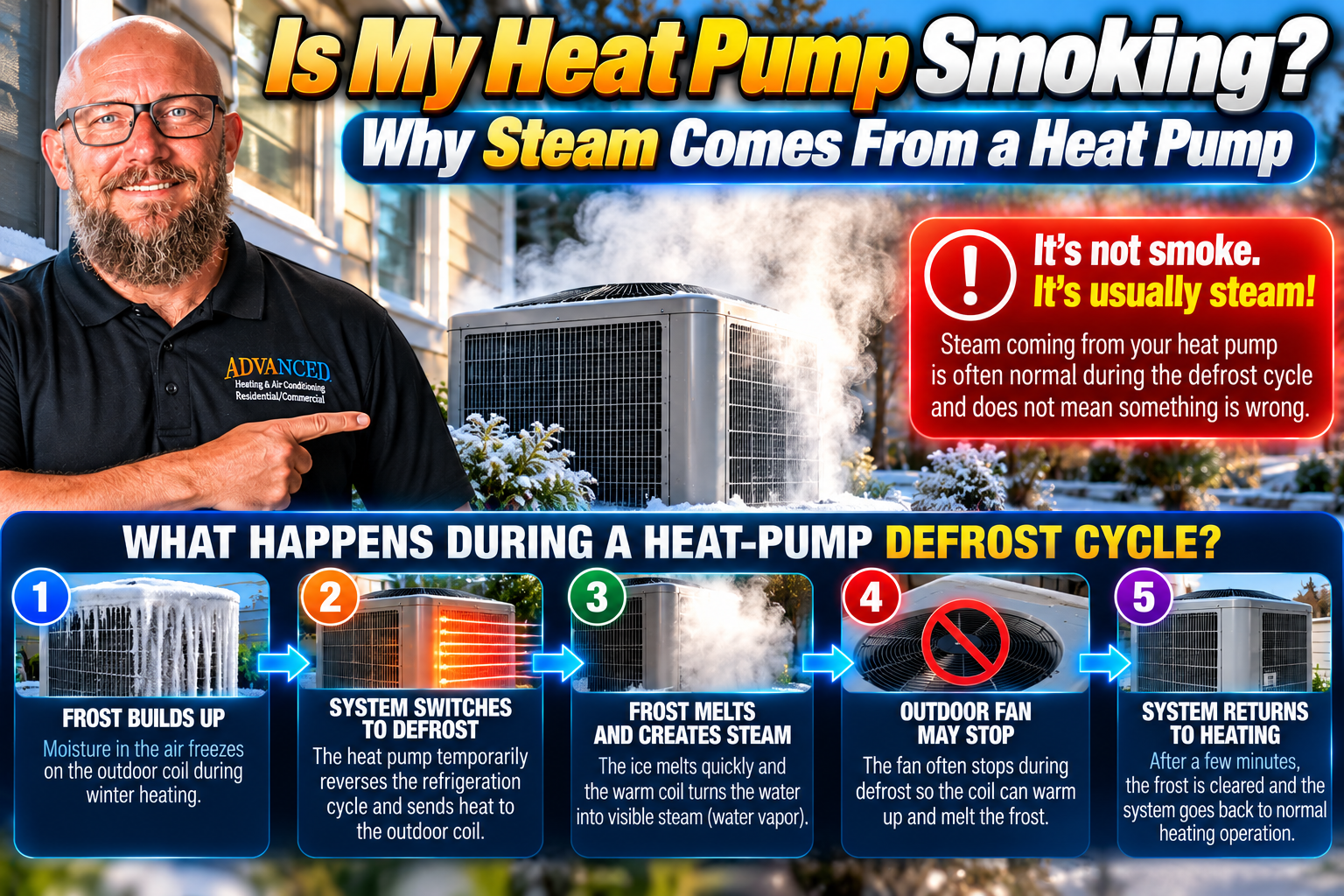
That isn’t smoke. It’s steam.
And your heat pump may simply be going through its normal:
Defrost cycle.
This is one of those heat-pump behaviors that can look dramatic even when the system is operating exactly as designed.
Homeowners regularly mistake normal defrost steam for smoke. Recent homeowner discussions describe seeing vapor coming from the unit while the outdoor fan temporarily stopped—the classic appearance of a heat pump going through defrost.
Why Does a Heat Pump Need to Defrost?
During winter, your heat pump uses the outdoor coil to collect heat from the outside air.
Yes—even when it feels cold outside, there is still heat energy available.
To absorb that heat, the outdoor coil can operate at a temperature below the surrounding outdoor air temperature.
When humid outdoor air contacts that cold coil:
Moisture can condense.
If the coil is cold enough:
That moisture freezes.
A light layer of frost is therefore not automatically a problem.
The problem would be allowing that frost to continue building until the coil becomes a block of ice.
So the heat pump periodically needs to:
Melt it.
That’s the job of the defrost cycle.
What Happens During a Heat-Pump Defrost Cycle?
During normal winter heating:
Outdoor coil absorbs heat → refrigerant carries that heat indoors → indoor coil releases heat into your home.
During defrost, the heat pump temporarily changes how the refrigeration system operates.
Essentially, it temporarily sends heat toward the:
Outdoor coil.
That heat melts accumulated frost.
Once the frost is removed:
The system switches back to normal heating.
Why Does the Heat Pump Produce So Much Steam?
This is the part that scares homeowners.
Imagine the outdoor coil has:
- Cold frost
- and water
on it.
Then the heat pump suddenly warms that coil during defrost.
The frost melts.
Water encounters a warm surface.
And you can get a large visible cloud of:
Water vapor / steam.
Depending on:
- Outdoor temperature
- Humidity
- Amount of frost
- and lighting,
the cloud can look surprisingly dramatic.
It may look almost exactly like:
Smoke.
A recent homeowner saw this around 40°F weather and assumed something was wrong; responses correctly identified normal heat-pump defrost.
Can This Happen When It’s 40°F Outside?
Yes.
This surprises a lot of homeowners.
They think:
“It isn’t freezing outside. Why would my heat pump have frost?”
Because the important temperature isn’t just:
Outdoor air temperature.
The outdoor coil itself can be colder than the surrounding air while extracting heat.
That means frost can potentially develop even when your outdoor thermometer reads above 32°F, depending on operating conditions and humidity.
This is particularly important for Southern California homeowners because a Temecula winter night does not need to look like a Minnesota winter for a heat pump to enter defrost.
Is Steam From a Heat Pump Normal?
During a normal defrost cycle:
Yes.
You may see:
- White vapor
- Steam
- Water dripping
- and changing equipment sounds.
Then the system should return to normal heating operation.
A homeowner in a 2026 discussion about outdoor-coil frost was specifically reassured that steam during defrost is normal and shouldn’t automatically be mistaken for smoke.
Why Does the Outdoor Fan Stop?
This is another thing that makes homeowners nervous.
They walk outside and see:
- Compressor running
- but outdoor fan stopped.
During defrost, that can be normal.
The system wants heat to remain at the outdoor coil long enough to melt the frost.
Running the outdoor fan would move cold outdoor air across that coil.
So many heat pumps temporarily stop the outdoor fan during defrost.
Once defrost finishes:
The fan resumes normal operation.
Does a Stopped Fan Always Mean Defrost?
No.
This distinction is important.
If:
- The system is in defrost
- Steam is coming from the coil
- The fan temporarily stops
- Everything returns to normal afterward,
that can be completely normal.
But if:
- The fan doesn’t restart
- or the unit overheats
- or there is an electrical smell
- or the system stops heating,
there may actually be a problem.
Do not assume every stopped outdoor fan is normal.
How Can I Tell Steam From Smoke?
Look at the entire situation.
Normal defrost vapor is typically:
- White
- Moist-looking
- Temporary
- and associated with cold-weather heat-pump operation.
It should dissipate relatively quickly.
Actual electrical or mechanical smoke may be accompanied by:
- Burning odor
- Electrical smell
- Melting-plastic smell
- Discoloration
- Sparks
- Breaker trip
- or abnormal equipment behavior.
If you’re unsure:
Turn the system off and call for service.
Safety is more important than trying to diagnose it from the backyard.
Should Steam Smell Like Anything?
Normal water vapor should not have a strong:
- Burning
- Electrical
- or melting-plastic
odor.
A noticeable burning or electrical smell changes the situation.
That deserves investigation.
Why Does My Heat Pump Make a Loud Whoosh During Defrost?
The heat pump is changing refrigerant flow and operating pressures.
That can create:
- Whooshing
- Hissing
- Pressure-change sounds
- or a noticeable mechanical transition.
Then it may make another sound when switching back to heating.
For someone who has never owned a heat pump:
It can sound broken.
But a brief mode-change sound can be normal.
Why Does the Heat Pump Suddenly Release a Huge Cloud?
Sometimes frost has accumulated across much of the outdoor coil.
When defrost warms the coil:
A lot of moisture can release quickly.
That can create the dramatic cloud homeowners see.
It may happen:
- Suddenly
- and then disappear just as quickly.
Does the Heat Pump Switch Into Air-Conditioning Mode During Defrost?
In a simplified sense:
Yes.
The refrigeration cycle temporarily reverses so heat can be delivered to the outdoor coil.
That’s how the system melts frost.
But there’s an obvious problem:
If the system temporarily directs heat outside:
What happens inside the house?
That brings us to auxiliary heat.
Does Auxiliary Heat Turn On During Defrost?
It can, depending on system design.
Some systems use supplemental heat during defrost to reduce the amount of cool air delivered indoors.
That supplemental heat might be:
- Electric resistance heat
- or another backup heating source.
Why Does Cooler Air Come From My Vents During Defrost?
Because the heat pump temporarily changes refrigeration operation.
Depending on system design and backup heat:
Supply-air temperature may temporarily decrease.
That doesn’t necessarily mean the heat pump has failed.
The key is that defrost should be:
Temporary.
Afterward, normal heating should resume.
How Long Should Defrost Last?
Defrost duration varies by:
- Manufacturer
- Equipment
- Outdoor conditions
- Amount of frost
- and control strategy.
There isn’t one universal homeowner number that applies to every heat pump.
But defrost should be a:
Temporary operating mode.
A homeowner reported being told that a heat pump blowing cold air for hours overnight was simply performing a defrost cycle. That’s very different from a normal short defrost event and deserves investigation rather than being dismissed as normal.
How Often Should My Heat Pump Defrost?
Again:
There is no universal schedule.
Some systems use:
- Timers
- Temperature sensors
- Coil sensors
- or more sophisticated demand-defrost logic.
Defrost frequency can change based on:
- Outdoor temperature
- Humidity
- Runtime
- and frost accumulation.
Does High Humidity Cause More Frost?
It can.
The more moisture available in outdoor air, the greater the opportunity for moisture to collect on a cold outdoor coil.
That means a:
Cold + damp
night can sometimes create more frost than a colder but very dry night.
Homeowners have specifically reported much more frequent defrost operation during cold, high-humidity weather.
Why Is There Water Under My Heat Pump?
Defrost melts frost.
Where does that water go?
Down.
So during winter you may see water underneath or around the outdoor heat pump.
That can be completely normal.
This is another major difference between:
- Heat pump
- and traditional AC-only outdoor condenser.
An AC-only condenser generally isn’t regularly defrosting itself during winter because it isn’t providing your heating.
Should the Heat Pump Have a Drain?
Outdoor-unit drainage depends on:
- Equipment design
- Pad
- Installation
- and site conditions.
The important thing is that defrost water should be able to:
Drain away appropriately.
It should not create a persistent problem around the equipment.
Can Defrost Water Refreeze?
In colder climates:
Absolutely.
Water from one defrost cycle can potentially freeze around or beneath the unit.
That is one reason cold-climate heat-pump installations require careful consideration of:
- Elevation
- Drainage
- Snow
- and ice.
This is usually less dramatic in the Temecula Valley than in colder parts of the country, but proper installation still matters.
Should I Pour Hot Water on My Heat Pump?
Generally:
No.
Do not attempt to manually manage a normal defrost cycle.
The heat pump is designed to defrost itself.
And do not:
- Chip ice from the coil
- Use a screwdriver
- Hit the cabinet
- or strike ice around the fan.
Outdoor coils and fan components can be damaged.
What If the Heat Pump Is Completely Covered in Ice?
That is different from normal light frost.
A heat pump can develop frost during heating.
But it should periodically remove that frost.
If the outdoor coil becomes:
- Heavily encased in ice
- and stays that way,
the defrost system may not be working properly.
What Can Cause Defrost Problems?
Potential causes can include:
- Defrost sensor
- Temperature sensor
- Control board
- Reversing valve
- Outdoor fan
- Refrigerant issue
- Coil airflow
- or other system problems.
The exact defrost architecture depends on the heat pump.
What Is Demand Defrost?
Some modern heat pumps do not simply defrost at a rigid fixed interval.
They monitor conditions to determine when defrost is actually needed.
Depending on equipment, the controls may evaluate information such as:
- Outdoor coil temperature
- Outdoor temperature
- Runtime
- and other operating conditions.
The goal is to defrost:
When necessary
rather than unnecessarily.
Why Is Unnecessary Defrost Bad?
Because during defrost the heat pump temporarily stops delivering its normal heating capacity indoors.
Defrost also consumes energy.
So ideally:
Defrost when necessary → remove frost efficiently → return to heating.
You don’t want:
- Never defrost
- or defrost constantly.
Can a Heat Pump Defrost Too Often?
Yes.
If the heat pump appears to enter defrost unusually frequently, possible causes can include:
- Sensor problems
- Control problems
- Airflow issues
- Refrigerant problems
- or unusual outdoor conditions.
Frequency alone needs context.
A damp, cold night can legitimately create more frost than a mild, dry afternoon.
Can a Heat Pump Not Defrost Enough?
Yes.
That’s the opposite problem.
If frost continues accumulating until the coil becomes:
Heavily iced,
the heat pump can lose airflow and heating performance.
That is not normal.
What Happens If the Outdoor Coil Becomes a Block of Ice?
Heat transfer decreases.
The heat pump needs outdoor airflow to absorb heat.
If the coil becomes heavily covered:
Airflow decreases → heat transfer decreases → heating capacity drops → system may run longer → backup heat may operate more.
That can affect both:
- Comfort
- and energy use.
Can Defrost Affect My Electric Bill?
Normal defrost is simply part of heat-pump operation.
But excessive defrost or a heat pump that cannot maintain capacity because of ice can potentially increase energy use.
Backup electric heat may also operate more frequently.
If your electricity usage suddenly increases along with:
- Heavy icing
- Poor heating
- or very frequent defrost,
have the system checked.
Why Does My Heat Pump Steam More on Some Days?
Weather.
The amount of visible vapor can change with:
- Humidity
- Outdoor temperature
- Frost accumulation
- Wind
- and the amount of water on the coil.
One defrost might produce:
Almost no visible steam.
Another might produce:
A giant cloud.
Both could be normal.
Why Can I See the Steam Better at Night?
Lighting can make vapor much more visible.
Porch lights, vehicle headlights or outdoor lighting can illuminate the cloud and make it look extremely dramatic.
That’s one reason homeowners often notice it for the first time:
- Early morning
- or at night.
Why Didn’t My Old Furnace Do This?
Because your gas furnace wasn’t extracting heat from outdoor air.
Your old setup may have been:
- Outdoor AC condenser for summer
- Indoor gas furnace for winter.
During winter, the outdoor AC unit essentially sat there.
With a heat pump:
The outdoor unit works during winter too.
That’s why you now see:
- Winter fan operation
- Frost
- Defrost
- Water
- and occasionally steam.
Is This a Reason Not to Buy a Heat Pump?
No.
It is simply part of understanding how the equipment works.
In fact, educating homeowners about these behaviors before installation can prevent unnecessary worry later.
When Advanced Heating & Air Conditioning installs a heat pump, explaining:
- Defrost
- Steam
- Auxiliary heat
- Longer heating cycles
- and the difference between heat-pump air and furnace air
can make the homeowner much more comfortable with their new system.
Do Heat Pumps Work in Temecula Winters?
Yes, heat pumps can be an excellent heating and cooling option for Southern California homes when properly selected, sized and installed.
The Temecula Valley’s relatively mild winter climate can make heat pumps particularly attractive because the system can provide:
- Efficient heating
- High-efficiency cooling
from one system.
Equipment selection still matters.
The right heat pump should be matched to:
- The home
- Heating and cooling load
- Ductwork
- Electrical system
- and homeowner goals.
Should I Choose a Heat Pump Instead of a Gas Furnace?
That depends on the home.
Consider:
- Existing equipment
- Utility rates
- Electrical capacity
- Solar
- Ductwork
- Comfort preferences
- Equipment cost
- and long-term goals.
Advanced can also discuss:
- Heat pump only
- or dual fuel — heat pump + gas furnace.
The goal shouldn’t be:
Sell every homeowner the exact same system.
It should be:
Install the system that makes sense for that particular home.
What Should New Heat-Pump Owners Expect in Their First Winter?
You may notice:
- Longer heating cycles
- Outdoor-unit operation
- Different supply-air temperatures
- Frost
- Defrost cycles
- Temporary fan changes
- Whooshing sounds
- Water underneath the outdoor unit
- and steam.
Most of these can be normal.
Understanding them makes owning a heat pump much less mysterious.
When Is “Smoke” NOT Normal?
This section is important.
Turn the system off and call for service if what appears to be smoke is accompanied by:
- Burning smell
- Electrical odor
- Melting-plastic smell
- Sparks
- Breaker trip
- Fan or motor overheating
- Persistent smoke after the system stops
- or other obviously abnormal electrical behavior.
A real equipment failure can produce actual smoke.
Do not assume:
“It’s always just defrost.”
What If I Can’t Tell Whether It’s Steam or Smoke?
Don’t take chances.
Turn the heat pump off at the thermostat and contact an HVAC professional.
Explain exactly what you observed:
- Color of vapor
- Odor
- Outdoor temperature
- Whether the fan was running
- How long it lasted
- and whether the system returned to normal.
A short video can also be very helpful.
Should I Record It?
Yes.
This is one of the best homeowner tips for intermittent heat-pump behavior.
If you safely can, take a video from a reasonable distance showing:
- The vapor
- Outdoor fan
- Sound
- and how long the event lasts.
By the time a technician arrives, the system may be operating normally again.
The video can help determine whether you witnessed:
- Normal defrost
- or something abnormal.
Frequently Asked Questions
Why is smoke coming from my heat pump?
In many cases, what looks like smoke is actually water vapor or steam produced when the heat pump melts frost during its normal defrost cycle.
Is steam coming from a heat pump normal?
Yes. Visible steam during defrost can be completely normal.
Why does my heat-pump fan stop when it is steaming?
Many systems temporarily stop the outdoor fan during defrost so heat remains at the outdoor coil to help melt frost.
Why does my heat pump make a loud whoosh?
Refrigerant flow and pressure change when the system enters or exits defrost, which can create temporary whooshing or hissing sounds.
Can a heat pump defrost when it’s above freezing outside?
Yes. The outdoor coil can be colder than the surrounding outdoor air, allowing frost to form under the right temperature and humidity conditions.
Why is water coming from my outdoor heat pump?
Defrost melts frost from the outdoor coil, producing water that drains away from the unit.
Is frost on a heat pump normal?
Some frost can be normal during heating. Heavy ice that does not clear is not.
Why does my heat pump blow cooler air during defrost?
The refrigeration cycle temporarily changes to warm the outdoor coil. Depending on system design, auxiliary heat may help maintain indoor comfort.
How long should defrost last?
It varies by equipment and conditions, but defrost should be temporary. Hours of continuous cold-air operation should not simply be assumed to be normal defrost.
Why does my heat pump defrost more when it’s humid?
More outdoor moisture can create more frost on a cold outdoor coil, potentially increasing the need for defrost.
Should I remove ice myself?
Do not chip, strike or pry ice from the coil or fan. If the unit becomes heavily iced and cannot clear itself, call for service.
Does steam mean my heat pump is broken?
Usually not when it occurs briefly during normal defrost. Burning odors, electrical smells, sparks or persistent actual smoke are different and require attention.
The Big Takeaway
If your heat pump suddenly looks like:
It’s smoking…
but it’s a cold morning, the outdoor fan temporarily stops, a white cloud appears, and then the system returns to normal heating:
You probably just watched your heat pump defrost.
That can be completely normal.
It’s actually evidence of one of the important things a heat pump knows how to do:
Recognize frost → temporarily change operation → warm the outdoor coil → melt the frost → return to heating your home.
For a first-time heat-pump owner, it can look alarming.
Once you understand what’s happening:
It makes perfect sense.
Heat Pump Installation & Service in the Temecula Valley
Advanced Heating & Air Conditioning installs, repairs and maintains heat-pump systems throughout Temecula, Murrieta, Menifee, Winchester, Wildomar, French Valley, Canyon Lake, Lake Elsinore, Hemet and surrounding communities.
If you’re considering replacing an older air conditioner and furnace, a modern heat pump is worth discussing—especially in Southern California’s climate.
Advanced Heating & Air Conditioning
951-609-9881
California Contractor License #916901
REAL PEOPLE. REAL SERVICE. REAL COMFORT.