


Auxiliary Heat vs. Emergency Heat on a Heat Pump
What Is Auxiliary Heat on a Heat Pump—and Is It the Same as Emergency Heat?
If you own a heat pump, you may eventually look at your thermostat and see something you weren’t expecting:
AUX HEAT
or perhaps:
EM HEAT
That can immediately raise questions.
Is the heat pump broken?
Should auxiliary heat be running?
Is emergency heat better when it’s cold outside?
Why did the electric bill suddenly increase?
And what’s the difference between the two settings?
The short answer is:
Auxiliary heat and emergency heat are related—but they are not the same thing.
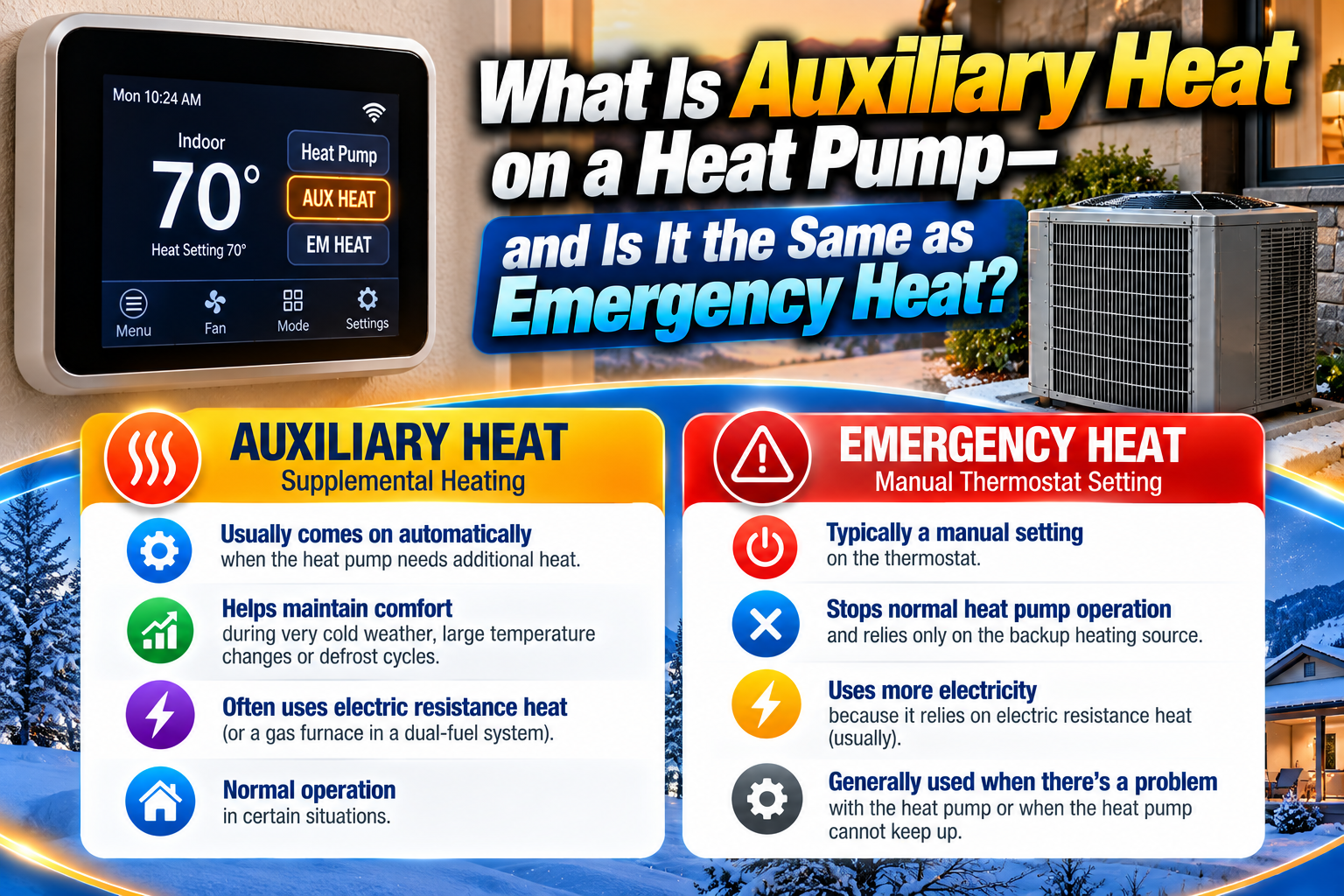
Auxiliary heat is generally a secondary heating source that the system can bring on automatically when additional heating is needed.
Emergency heat is typically a manual thermostat mode that stops normal heat-pump operation and relies on the backup heating source instead.
Understanding the difference can prevent unnecessary energy use and help homeowners recognize when their heat pump may actually need service.
What Does AUX HEAT Mean?
AUX stands for:
Auxiliary.
Auxiliary heat is supplemental heating available to support the heat pump.
In many all-electric systems, that supplemental source consists of electric resistance heating elements located in the indoor air handler.
In a dual-fuel system, the secondary source may instead be a gas furnace.
The heat pump remains the primary heating source under normal conditions.
When the controls determine that additional heating is needed, the backup source can assist.
Why Does a Heat Pump Need Auxiliary Heat?
A heat pump doesn’t create heat the same way a traditional furnace does.
It moves heat from outside the home to inside.
As outdoor conditions change, the amount of heat available and the heat pump’s capacity also change.
There can be circumstances when the system needs additional help maintaining indoor temperature.
That’s one reason a backup heating source may be included.
However, modern heat-pump technology has improved substantially, and many systems can provide meaningful heating capacity at low outdoor temperatures. The exact need for supplemental heat depends on the particular equipment, climate, home heating load and system design. ENERGY STAR notes that modern air-source heat pumps can maintain heating performance at low outdoor temperatures, with equipment performance varying by model.
When Does Auxiliary Heat Come On?
It depends on the equipment and thermostat programming, but several situations can cause auxiliary heat to operate.
1. The Heat Pump Needs Help Meeting the Heating Load
If the heat pump alone isn’t raising the indoor temperature quickly enough, the controls may bring on the supplemental heating source.
That doesn’t automatically indicate a problem.
It may simply mean the heating demand is temporarily greater than what the heat pump is providing by itself.
2. You Raise the Thermostat Several Degrees
Suppose your house is:
65°F
and you suddenly change the thermostat to:
72°F.
Some thermostat configurations may interpret that large temperature difference as a request for rapid recovery and activate auxiliary heat.
This is why heat-pump homeowners sometimes see AUX appear after making a large thermostat adjustment.
3. The Heat Pump Enters Defrost Mode
Heat pumps can develop frost on the outdoor coil during heating operation under certain outdoor conditions.
The system may periodically enter a defrost cycle to remove that frost.
During defrost, the refrigeration cycle temporarily changes operation.
Some systems use auxiliary heat during this process to help maintain indoor comfort.
Homeowners are actively asking online whether heat-pump defrost operation is normal because it can look unusual if you’ve never owned a heat pump before.
4. There May Be a Heat-Pump Problem
Auxiliary heat may also begin operating more than expected if the primary heat pump cannot perform correctly.
Possible reasons include:
- Restricted airflow
- thermostat or control problems
- refrigerant-related issues
- outdoor-unit problems
- defrost problems
- or other system faults.
That is why the important question isn’t simply:
“Did AUX come on?”
It’s:
“Why did AUX come on, and how long is it staying on?”
Is Auxiliary Heat Normal?
Yes, under the right circumstances.
Seeing AUX HEAT briefly does not automatically mean your system is broken.
The backup source exists because there are times when additional heating may be useful or necessary.
What deserves attention is auxiliary heat that:
- Runs constantly
- appears during mild weather without a clear reason
- suddenly starts operating far more than it used to
or is accompanied by:
- Poor comfort
- very high electricity use
- outdoor unit not running
- ice that doesn’t clear
- unusual noises
- or other performance problems.
Why Can Auxiliary Heat Increase My Electric Bill?
This is especially important with electric resistance backup heat.
A heat pump primarily moves heat.
Electric resistance heat creates heat directly from electricity.
Those are very different processes.
Electric resistance heating typically requires substantially more electrical energy to deliver the same amount of heat than normal heat-pump operation.
That’s why homeowners can notice a major increase in electricity use when electric auxiliary heat operates frequently. Carrier and Trane both caution that excessive electric auxiliary-heat use can increase operating costs.
Is Auxiliary Heat Always Electric?
No.
This depends on the system.
All-Electric Heat Pump
A common configuration is:
Heat pump + air handler + electric supplemental heat
In this setup, auxiliary heat may be electric resistance heating.
Dual-Fuel Heat Pump
Another configuration is:
Heat pump + gas furnace
The heat pump can provide primary heating while the gas furnace serves as the alternate or backup source.
So when discussing auxiliary or backup heat, homeowners should first understand what equipment their home actually has.
What Is Emergency Heat?
Emergency heat is different.
On many heat-pump thermostats, EM HEAT or Emergency Heat is a manual mode.
When selected, it generally stops normal operation of the outdoor heat-pump compressor and uses the backup heating source instead.
That is why it’s called:
Emergency Heat.
It isn’t intended to be the homeowner’s normal winter setting.
Auxiliary Heat vs. Emergency Heat
Here’s the simplest way to remember the difference:
- Auxiliary Heat — automatically assists the heat pump when additional heat is needed.
- Emergency Heat — manually bypasses normal heat-pump heating and relies on the backup source.
That distinction is extremely important.
Auxiliary heat = assistance.
Emergency heat = backup takes over.
Should I Turn On Emergency Heat When It’s Cold Outside?
Normally:
No.
You generally should not switch to Emergency Heat simply because the weather became colder.
A properly operating heat-pump system should determine how to respond through its normal controls.
Emergency Heat is typically intended for situations where the primary heat pump cannot operate properly and you need the backup heating source until the system can be repaired.
Does Emergency Heat Make the House Heat Faster?
Possibly depending on the system, but that isn’t what the setting is designed for.
Emergency Heat shouldn’t be viewed as:
“Turbo heat.”
Its purpose is to provide heat when the normal heat-pump system cannot.
If the heat pump is operating correctly, manually selecting emergency heat can bypass the more efficient primary heating source.
Why Is Emergency Heat More Expensive?
If your backup source is electric resistance heating, running only that source can use considerably more electricity than normal heat-pump operation.
That’s why accidentally leaving the thermostat in Emergency Heat can lead to a surprising electric bill.
A 2026 homeowner discussion described exactly that problem: the homeowner had been operating Emergency Heat for an extended period and was seeing an electricity bill approaching three times normal.
Is Emergency Heat Always Expensive?
Not necessarily in exactly the same way.
If the backup source is a gas furnace, operating-cost comparisons depend on:
- Electricity rates
- natural-gas rates
- furnace efficiency
- heat-pump efficiency
- and outdoor conditions.
That’s one reason dual-fuel control strategies can be more complicated than a simple all-electric heat pump.
How Do I Know If I Have Electric Backup Heat?
The equipment configuration tells you.
A heat pump paired with an air handler may have electric heating elements installed inside the indoor equipment.
A heat pump paired with a gas furnace instead has a combustion heating source available.
Your HVAC technician can identify the system configuration and explain exactly what happens when AUX or Emergency Heat operates.
Why Does My Thermostat Say AUX HEAT When It’s Not Very Cold?
There are several possible explanations.
Large Thermostat Change
You raised the thermostat significantly and the system brought on additional heat to recover faster.
Thermostat Programming
The thermostat’s staging settings may be bringing on auxiliary heat sooner than necessary.
Heat Pump Not Keeping Up
The controls may detect that indoor temperature isn’t rising as expected.
Airflow Problem
A dirty filter or airflow restriction can reduce system performance.
Equipment Problem
A refrigerant, outdoor-unit, defrost or control issue may reduce heat-pump heating capacity.
So AUX during mild weather deserves investigation if it becomes frequent or persistent.
Can a Dirty Filter Cause Auxiliary Heat to Run More?
Potentially.
A dirty or overly restrictive filter can reduce airflow through the indoor equipment.
Reduced airflow can interfere with normal HVAC performance.
If the house then struggles to reach the thermostat setting, the controls may call for additional heat.
That’s another reason filter condition should be one of the first simple checks when heating performance changes.
Can a Thermostat Cause Too Much Auxiliary Heat?
Absolutely.
Heat-pump thermostats do more than simply turn heating on and off.
They may control:
- Heating stages
- auxiliary heat
- compressor operation
- reversing valve operation
- and, in some systems, outdoor-temperature-based staging.
Carrier describes the heat-pump thermostat as responsible for coordinating compressor operation, reversing-valve operation and supplemental heating.
Incorrect thermostat configuration can therefore have a significant effect on system behavior.
What Is an Auxiliary Heat Lockout?
Some heat-pump control systems can prevent auxiliary heat from operating above a particular outdoor temperature.
The purpose is to reduce unnecessary use of backup heat when the heat pump should be capable of handling the heating load itself.
The exact setting should be based on:
- Equipment performance
- home heating load
- backup heat type
- local climate
- and manufacturer/control recommendations.
It should not simply be copied from another homeowner’s thermostat.
What Is a Compressor Lockout?
In certain control strategies, the system may also stop using the heat pump below a selected outdoor temperature and transition to another heating source.
This is particularly relevant to some dual-fuel systems.
Again, the correct setting is specific to the equipment and economics of the installation.
What Is the Heat Pump Balance Point?
The term balance point generally refers to the outdoor condition where the heating capacity provided by the heat pump matches the home’s heating requirement.
Above that point, the heat pump may be able to handle the heating load alone.
Below it, additional heat may be required depending on the equipment and building.
But there’s no universal balance-point temperature for every house.
It changes with:
- Heat-pump model
- equipment capacity
- insulation
- windows
- air leakage
- ductwork
- home size
- and local weather.
Does Every Heat Pump Need Auxiliary Heat?
System designs differ.
Some installations include electric supplemental heat.
Some use a gas furnace.
Modern heat pumps can also maintain substantial heating capacity at much colder temperatures than many older systems.
ENERGY STAR notes that qualifying cold-climate heat pumps are tested for low-temperature performance, demonstrating how much the technology has advanced.
For Southern California, this makes equipment selection particularly interesting because winter conditions are generally milder than many northern climates.
Do Heat Pumps Need Much Auxiliary Heat in Temecula?
There isn’t one answer for every home.
A properly sized modern heat pump in the Temecula Valley may have relatively little need for supplemental heating compared with the same system installed in a very cold climate.
But that depends on:
- Exact equipment
- home heating load
- thermostat settings
- ductwork
- outdoor conditions
- and system configuration.
This is why heat-pump sizing matters so much.
Could My Heat Pump Be Too Small?
Possibly.
If the system has insufficient heating capacity for the home’s actual heating load, supplemental heat may operate more frequently.
But frequent AUX operation does not automatically prove the heat pump is undersized.
Other possibilities include:
- Airflow problems
- building heat loss
- thermostat configuration
- equipment problems
- or poor system setup.
Diagnosis matters.
Could My Heat Pump Be Too Large?
Yes.
Bigger is not automatically better.
An oversized system can create its own problems, including comfort and cycling issues.
Heat pumps should be selected according to the home’s actual heating and cooling requirements—not simply by copying the old equipment size or installing the largest unit possible.
Does Insulation Affect Auxiliary Heat Use?
Absolutely.
Your HVAC system has to replace heat that the house loses.
If a home has:
- Poor attic insulation
- drafty windows
- air leaks
- unsealed doors
- or other significant heat loss,
the heating load increases.
A recent homeowner discussion showed how improving attic insulation dramatically helped a heat pump maintain temperature during very cold conditions.
The heating system and the building work together.
What About Large Nighttime Thermostat Setbacks?
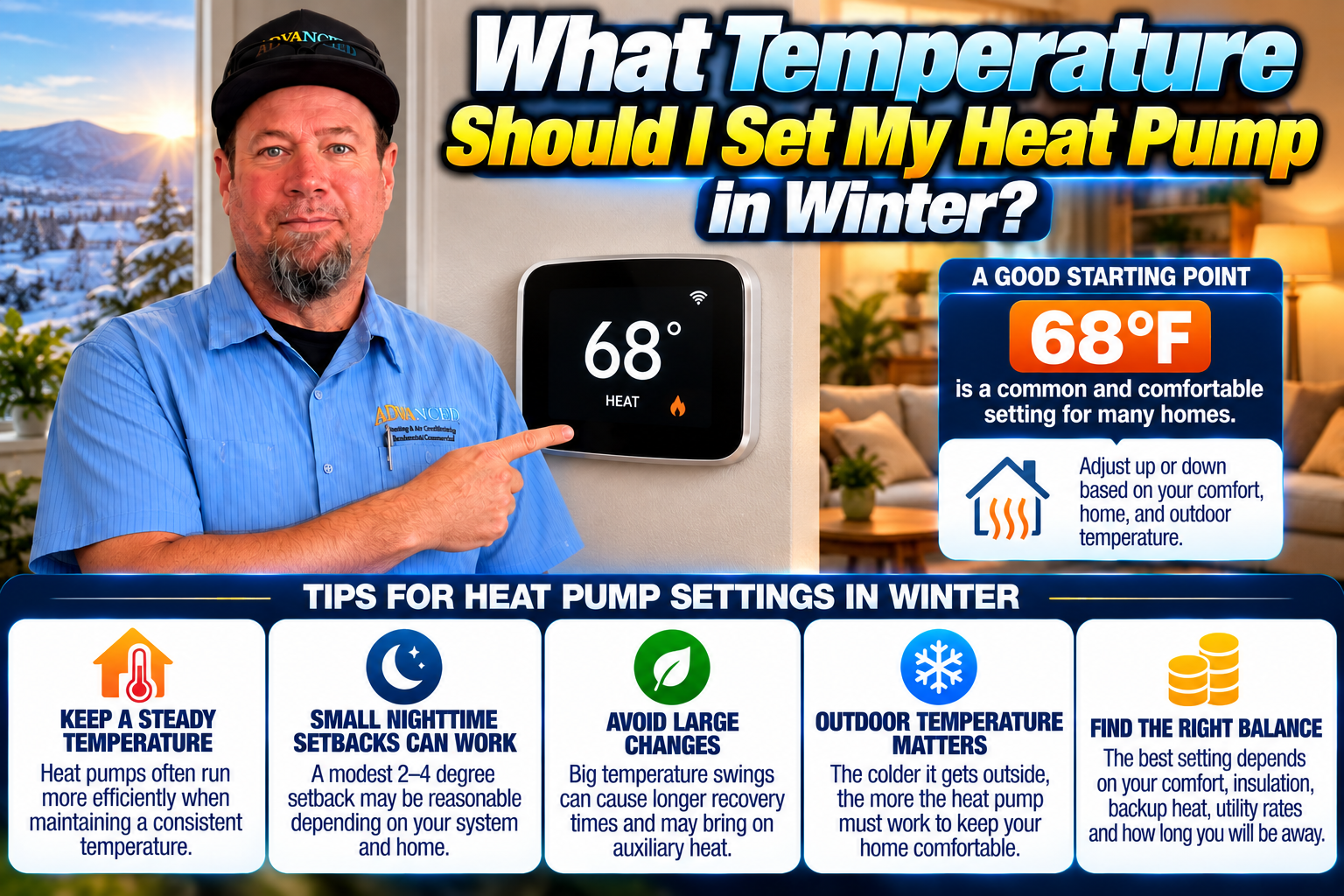
Heat pumps often benefit from a different thermostat strategy than gas furnaces.
If you drop the temperature several degrees overnight and then request a large increase in the morning, the thermostat may bring on auxiliary heat to recover rapidly.
ENERGY STAR recommends maintaining a relatively steady temperature rather than relying on large setbacks with heat pumps.
That doesn’t mean every thermostat or heat pump behaves identically.
But it is something homeowners should understand.
Why Does AUX HEAT Come On During Defrost?
During heating operation, the outdoor coil can sometimes become cold enough for frost to accumulate.
When the system enters defrost mode, it temporarily changes operation to warm the outdoor coil and remove the frost.
During that process, some systems activate auxiliary heat indoors to reduce the chance of uncomfortable cool air entering the home.
So seeing AUX briefly during defrost may be completely normal.
How Long Should Defrost Last?
Defrost cycles are normally temporary.
The exact duration and frequency depend on:
- Equipment
- outdoor temperature
- humidity
- coil condition
- and control logic.
What is more concerning is an outdoor unit that:
- Remains heavily iced
- never clears the ice
- or repeatedly struggles to return to normal heating.
That may indicate a defrost or system problem requiring service.
Is Steam Coming From My Heat Pump Normal?
During a defrost cycle, homeowners may sometimes see what looks like smoke or steam around the outdoor unit.
It can simply be moisture evaporating as ice melts from the coil.
That can be startling if you’ve never seen a heat pump defrost.
If there is an actual burning smell, electrical odor, smoke from wiring, or another safety concern, shut the equipment down and call for service.
Should I Ever Manually Use Emergency Heat?
Emergency heat may be appropriate when the normal heat pump cannot operate and the home needs temporary heating while repairs are arranged.
For example:
- Outdoor heat-pump unit has failed
- compressor isn’t operating
- or another condition prevents normal heating.
The specific situation should be evaluated by an HVAC professional.
What If My Outdoor Unit Stops Running but I Still Have Heat?
Your home may be heating entirely from the backup source.
That’s an important clue.
If the thermostat is calling for normal heat but:
- The outdoor heat pump never operates
while
- warm air still comes from the vents,
the backup heat may be carrying the heating load.
That can hide a heat-pump failure temporarily.
The homeowner may not notice until the electric bill arrives.
Why Did My Electric Bill Suddenly Go Up After Installing a Heat Pump?
One possibility is excessive electric auxiliary-heat operation.
But don’t immediately assume that is the cause.
Also consider:
- Outdoor temperature
- thermostat setting
- equipment sizing
- duct leakage
- house insulation
- system setup
- utility rates
- and overall household electricity use.
The correct approach is to determine how the system is actually operating.
Can Heat-Pump Thermostat Settings Be Wrong After Installation?
Yes.
Heat-pump installations require the thermostat to be configured for the equipment.
That may include settings for:
- Heat-pump type
- reversing valve
- number of compressor stages
- number of auxiliary stages
- dual-fuel controls
- and staging logic.
Heat-pump thermostats need specific compatibility with reversing-valve and auxiliary-heat control.
That makes thermostat setup an important part of commissioning a new heat pump.
Can I Use Any Smart Thermostat With a Heat Pump?
No.
The thermostat needs to support the particular heat-pump system and its control requirements.
This becomes especially important with:
- Multi-stage systems
- variable-capacity systems
- auxiliary heat
- and
- dual-fuel equipment.
Homeowners are actively asking this exact question when installing new heat pump + gas furnace combinations.
Always verify compatibility with the actual equipment.
Signs Auxiliary Heat Should Be Checked
Schedule service if you notice:
- AUX running almost constantly during mild weather
- sudden increase in electricity use
- heat pump not maintaining temperature
- outdoor unit not running
- outdoor coil remaining heavily iced
- thermostat acting strangely
- breaker problems
- poor airflow
- or a major change from how the system normally operates.
Advanced Heating & Air Conditioning’s heat-pump repair diagnoses thermostat, airflow, electrical, defrost, refrigerant and auxiliary-control concerns when a heat pump isn’t operating correctly.
Frequently Asked Questions
Is auxiliary heat bad?
No. Auxiliary heat is a normal part of many heat-pump systems. Excessive or unexpected use is what may deserve investigation.
Is AUX heat the same as Emergency Heat?
No. AUX generally comes on automatically to assist normal heat-pump heating. Emergency Heat is typically manually selected and relies on the backup heat source instead of normal heat-pump operation.
Should I switch to Emergency Heat when it gets cold?
Normally, no. The heat-pump controls should manage normal heating operation automatically.
Why does AUX heat cost more?
If your supplemental heat is electric resistance heating, it generally requires more electricity than normal heat-pump operation.
Why does AUX appear after I turn my thermostat up?
A large thermostat increase can cause some controls to activate supplemental heat for faster recovery.
Can AUX heat come on during defrost?
Yes. Some systems use auxiliary heat during defrost to help maintain indoor comfort.
Why is my AUX heat running in mild weather?
Possible causes include thermostat setup, large temperature changes, airflow restrictions or a heat-pump performance problem.
Does a dual-fuel heat pump have auxiliary heat?
A dual-fuel system uses a secondary heating source—typically the gas furnace—when appropriate according to its control strategy.
Is Emergency Heat safe to use?
It is a legitimate system mode, but it’s intended for situations where normal heat-pump heating isn’t available. It should not normally be used as the everyday heating setting.
Will Emergency Heat raise my electric bill?
If the backup source is electric resistance heating, extended operation can substantially increase electricity use.
Why is the outdoor heat pump not running while my house is warm?
The backup heating source may be operating instead. If you did not intentionally select Emergency Heat, the system should be checked to determine why.
Should my heat pump use auxiliary heat in Temecula?
It depends on the equipment, heating load, weather and system design. Modern heat pumps can often handle relatively mild Southern California winter conditions efficiently, so frequent unexplained AUX use deserves evaluation.
A Simple Rule for Heat-Pump Owners
Remember this:
AUX HEAT appearing occasionally does not automatically mean something is wrong.
But:
EMERGENCY HEAT should not be your normal heating setting.
And if AUX suddenly begins running constantly:
Find out why.
Don’t simply accept the increased electric bill.
The heat pump may need service, the thermostat may need adjustment, airflow may be restricted, or the system may not be configured correctly.
Heat Pump Service & Installation in the Temecula Valley
Advanced Heating & Air Conditioning provides heat-pump installation, repair, maintenance, thermostat setup and system-performance evaluation throughout the Temecula Valley.
Advanced’s current heat-pump installation process evaluates the indoor equipment, ductwork, electrical service, thermostat and backup-heating requirements as part of designing the system.
We serve homeowners in Temecula, Murrieta, Menifee, Winchester, Wildomar, French Valley, Canyon Lake, Lake Elsinore, Hemet and surrounding communities.
Advanced Heating & Air Conditioning
951-609-9881
California Contractor License #916901
REAL PEOPLE. REAL SERVICE. REAL COMFORT.