


What Size HVAC System Do I Need? Why Bigger Isn’t Always Better
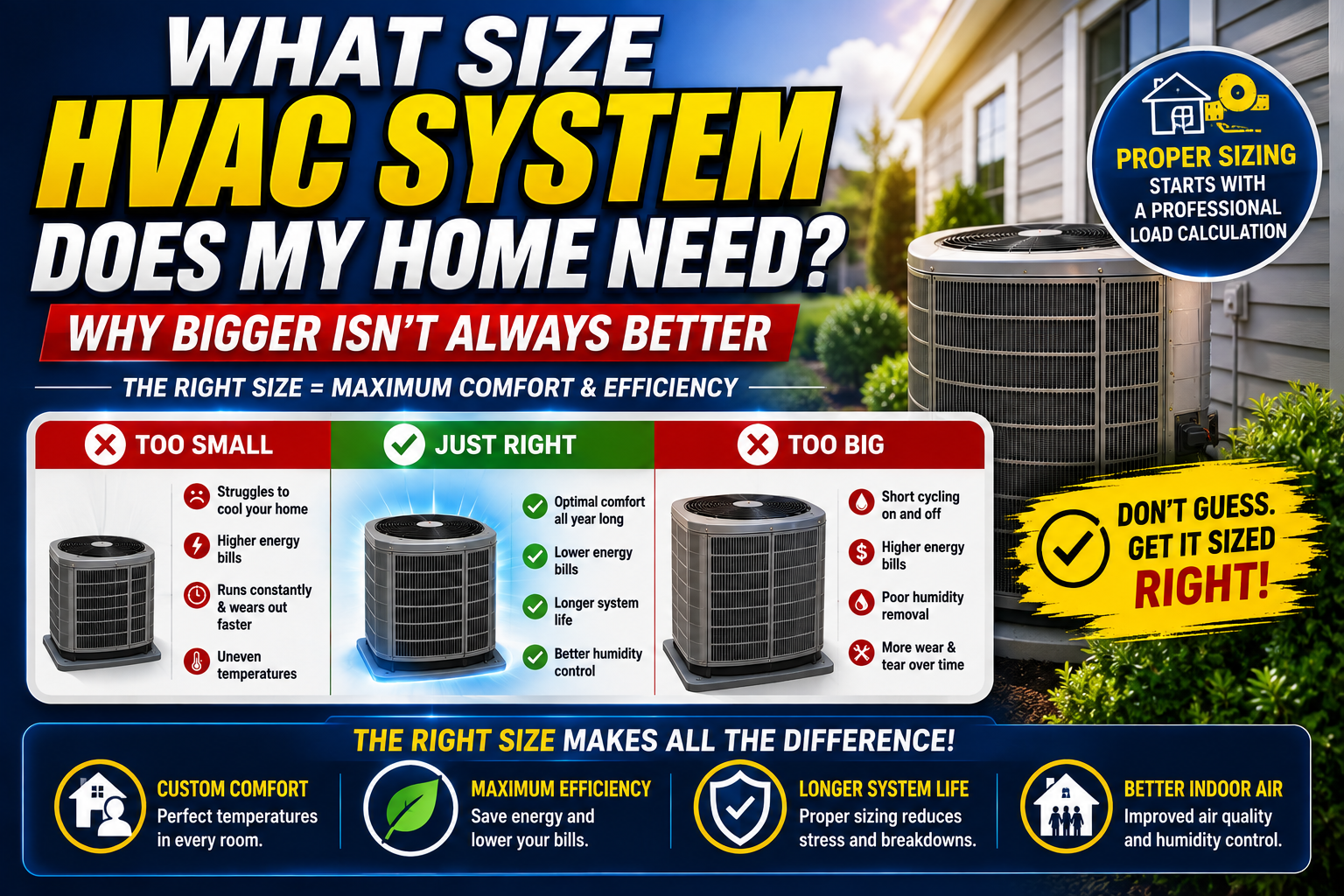
What Size HVAC System Does My House Actually Need?
When homeowners start shopping for a new air conditioner, heat pump, or complete HVAC system, one of the first questions is usually:
“What size system do I need?”
It seems like there should be a simple answer.
A 1,500-square-foot home gets one size.
A 2,000-square-foot home gets another.
A 3,000-square-foot home gets something bigger.
But proper HVAC sizing isn’t quite that simple.
Your home’s square footage is important, but it’s only one part of the equation.
Two houses with exactly the same square footage can have very different heating and cooling requirements.
And one of the biggest mistakes homeowners can make is assuming:
Bigger HVAC system = better HVAC system.
It doesn’t.
The goal is to install equipment that’s appropriately matched to the home’s actual heating and cooling needs.
Here’s why that matters.
What Does HVAC “Size” Actually Mean?
When HVAC professionals talk about the size of an air conditioner or heat pump, they usually aren’t talking about its physical dimensions.
They’re talking about its capacity.
Cooling capacity is commonly described in BTUs per hour or tons.
A ton of air conditioning capacity equals approximately 12,000 BTUs per hour of cooling capacity.
For example:
- 2-ton system = approximately 24,000 BTUs/hour
- 3-ton system = approximately 36,000 BTUs/hour
- 4-ton system = approximately 48,000 BTUs/hour
- 5-ton system = approximately 60,000 BTUs/hour
But this does not mean every home of a certain square footage automatically needs a specific tonnage.
Proper sizing requires looking at the home as a complete system.
Why HVAC Sizing Matters
Your HVAC system needs enough capacity to keep the home comfortable during demanding weather conditions.
But simply adding extra capacity isn’t the answer.
An appropriately sized system should be able to provide comfortable temperatures while operating as the equipment was designed to operate.
When equipment is significantly oversized or undersized, homeowners may experience comfort, efficiency, humidity, noise, or equipment-life problems.
What Determines the Correct HVAC Size?
Several factors can influence how much heating and cooling a home requires.
1. Square Footage
Home size is obviously important.
A larger home generally requires more heating and cooling capacity than a smaller home.
But square footage alone doesn’t tell the entire story.
2. Insulation
Insulation helps slow heat transfer between conditioned living spaces and areas such as the attic or outdoors.
A well-insulated home may have very different cooling requirements from a poorly insulated home of the same size.
In Southern California, attic insulation can be especially important because attic temperatures can become extremely high during summer.
3. Windows
Windows can significantly affect heat gain.
Factors include:
- Number of windows
- Window size
- Window type
- Glass efficiency
- Direction windows face
- Amount of direct sunlight
- Shading
A house with large west-facing windows may experience a very different afternoon cooling load than a similar house with less direct solar exposure.
4. Ceiling Height
Square footage measures floor area.
It doesn’t tell you how much air is actually inside the home.
A house with high ceilings contains more conditioned space than a similar home with standard-height ceilings.
That’s another reason simple square-footage rules can be misleading.
5. Air Leakage
Outside air can enter a home through gaps and leaks around:
- Doors
- Windows
- Attic penetrations
- Plumbing penetrations
- Recessed fixtures
- Other openings
More air leakage can increase the heating and cooling load.
6. Ductwork
Your HVAC equipment can only perform properly if conditioned air is effectively delivered throughout the home.
Ductwork problems can include:
- Leakage
- Poor sizing
- Restrictions
- Disconnected ducts
- Poor design
- Insufficient return airflow
Installing new HVAC equipment without considering existing ductwork can leave homeowners wondering why their brand-new system still doesn’t provide the comfort they expected.
7. Home Orientation
The direction your home faces can influence solar heat gain.
Rooms receiving intense afternoon sunlight may require significantly more cooling than shaded areas.
This is especially noticeable during hot Southern California summers.
8. Local Climate
HVAC equipment should be selected with local weather conditions in mind.
A home in Southern California doesn’t experience the same conditions as a home in Minnesota, Florida, or Arizona.
Homes throughout Temecula, Murrieta, Menifee, Lake Elsinore, Winchester, Hemet, and surrounding communities experience hot summers and relatively mild winters.
Local climate should be part of equipment selection.
Why Bigger Isn’t Always Better
This is one of the most important things homeowners should understand.
Suppose your home needs approximately a certain amount of cooling capacity.
Installing significantly more capacity doesn’t necessarily make the home more comfortable.
An oversized air conditioner may cool the home too quickly.
That sounds good at first.
But air conditioners are designed to operate in cycles.
If the system reaches the thermostat setting too quickly, it may shut down after a short operating period.
Then the house warms slightly.
The system starts again.
Then shuts off.
This pattern is commonly called short cycling.
Signs Your HVAC System May Be Oversized
Possible signs of an oversized cooling system can include:
- Frequent starting and stopping
- Short operating cycles
- Uneven indoor temperatures
- Certain rooms becoming too cold quickly
- Comfort fluctuations
- Excessive equipment cycling
- Indoor humidity concerns in climates where humidity is a factor
- Premature wear on certain components
Not every short-cycling problem is caused by oversized equipment.
Thermostat issues, electrical problems, refrigerant issues, and other conditions can also cause short cycling.
Proper diagnosis is important.
Why Short Cycling Can Be Hard on HVAC Equipment
Starting an HVAC system places demand on electrical and mechanical components.
If equipment constantly starts and stops, components may experience unnecessary cycling.
Over time, this can contribute to wear on parts such as:
- Contactors
- Capacitors
- Motors
- Compressors
- Electrical components
Longer, appropriate operating cycles are generally part of normal system design.
What Happens If Your HVAC System Is Too Small?
Going too small creates the opposite problem.
An undersized air conditioner or heat pump may struggle to satisfy the home’s cooling demand.
During hot weather, you may notice:
- AC running almost constantly
- Indoor temperature rising during the afternoon
- Difficulty reaching the thermostat setting
- Certain rooms staying too warm
- Higher-than-expected energy use
- Excessive equipment operation
However, an AC that runs for long periods isn’t automatically undersized.
Dirty equipment, airflow restrictions, refrigerant problems, duct leakage, insulation deficiencies, or mechanical problems can produce similar symptoms.
Can You Determine HVAC Size From Square Footage Alone?
Not accurately.
You may find online charts that say something like:
“X square feet = X tons.”
Those charts can provide a very rough starting point, but they shouldn’t replace an actual evaluation of the home.
Imagine two 2,000-square-foot houses.
House A
- Good insulation
- Efficient windows
- Shaded exposure
- Tight building envelope
- Proper ductwork
- Standard ceilings
House B
- Poor attic insulation
- Large sun-exposed windows
- Significant air leakage
- High ceilings
- Leaky ductwork
- Heavy afternoon sun
Both houses have the same floor area.
But their cooling requirements may be very different.
That’s why HVAC equipment shouldn’t be selected from square footage alone.
What Is an HVAC Load Calculation?
A load calculation estimates the amount of heating and cooling a home requires based on building characteristics and design conditions.
For residential HVAC systems, you may hear professionals refer to Manual J.
A proper load evaluation can consider factors such as:
- Square footage
- Insulation levels
- Window characteristics
- Door characteristics
- Home orientation
- Ceiling height
- Air leakage
- Building materials
- Local climate
- Internal heat sources
The purpose is to make an informed equipment selection rather than guessing.
What Is Manual J?
Manual J is a residential load calculation methodology developed by the Air Conditioning Contractors of America (ACCA).
It is used to estimate the heating and cooling loads of a home.
Homeowners don’t need to understand every calculation behind Manual J.
The important takeaway is simple:
HVAC sizing should be based on the home’s actual heating and cooling requirements — not just a guess based on the old equipment or square footage.
Should My New AC Be the Same Size as My Old AC?
Maybe — but not automatically.
Replacing an existing 4-ton system doesn’t necessarily mean the new equipment should automatically be 4 tons without further evaluation.
Several things may have changed since the original system was installed.
For example, homeowners may have:
- Added insulation
- Replaced windows
- Added living space
- Modified ductwork
- Completed remodeling
- Improved air sealing
The original system may also have been incorrectly sized from the beginning.
A replacement project is an opportunity to evaluate what the home actually needs today.
Can Newer HVAC Equipment Perform Differently From My Old System?
Yes.
HVAC technology changes over time.
Modern systems may have different:
- Efficiency ratings
- Blower technology
- Compressor designs
- Staging capabilities
- Variable-speed operation
- Controls
- Thermostat requirements
That’s another reason replacing equipment isn’t always as simple as matching the number printed on the old unit.
The complete system needs to work together.
Why Airflow Must Match the HVAC Equipment
Correct equipment capacity alone isn’t enough.
The duct system and indoor blower need to move the appropriate amount of air.
Poor airflow can create problems even with properly sized equipment.
Potential airflow issues include:
- Undersized return ducts
- Restricted filters
- Closed dampers
- Poor duct design
- Collapsed flexible duct
- Dirty equipment
- Improper blower settings
When installing a new HVAC system, airflow should be part of the conversation.
Should Ductwork Be Checked When Replacing an HVAC System?
Yes.
Your ducts are the delivery system for your heating and cooling equipment.
Installing a high-efficiency HVAC system while ignoring damaged or poorly designed ductwork may limit the comfort improvements you expect.
Before or during replacement, it can be useful to evaluate:
- Duct condition
- Air leakage
- Return-air capacity
- Supply-air distribution
- Damaged ducts
- Insulation
- Airflow to individual rooms
The goal isn’t simply to install new equipment.
The goal is to create a complete system that properly conditions the home.
Does Insulation Affect What Size AC I Need?
Yes, insulation can affect heating and cooling demand.
A poorly insulated attic can allow more heat to enter the living space during hot weather.
That increases the amount of heat the AC must remove.
Improving insulation may help reduce heat transfer and improve overall home comfort.
This is why HVAC equipment, ductwork, insulation, windows, and the building envelope should sometimes be considered together rather than as completely separate systems.
What About Two-Story Homes?
Two-story homes can present additional comfort challenges.
Heat naturally rises, and upstairs rooms can experience significant solar and attic heat gain.
Homeowners may notice:
- Hot upstairs bedrooms
- Cooler downstairs areas
- Long AC cycles
- Temperature differences between floors
Simply installing a larger AC isn’t necessarily the correct solution.
The system may need evaluation for:
- Airflow balance
- Duct design
- Return-air capacity
- Insulation
- Equipment sizing
- Zoning options
- Thermostat location
Should I Buy the Highest-Efficiency HVAC System Available?
Efficiency is important, but efficiency rating alone shouldn’t determine your purchase.
A high-efficiency system that’s improperly sized or poorly installed may not deliver the performance you expected.
When comparing HVAC equipment, homeowners should consider the complete picture:
- Proper sizing
- Installation quality
- Efficiency
- Equipment features
- Ductwork
- Home comfort
- Maintenance requirements
- Budget
- Warranty
- Long-term plans for the home
The “best” HVAC system isn’t necessarily the most expensive one.
It’s the system that appropriately matches the home and homeowner’s needs.
Frequently Asked Questions About HVAC Sizing
What size AC unit do I need for my house?
The appropriate size depends on more than square footage. Insulation, windows, ceiling height, orientation, air leakage, ductwork, climate, and other building characteristics can affect cooling requirements.
Is a 5-ton AC better than a 4-ton AC?
Not automatically. More capacity isn’t better unless the home actually requires it. Oversized equipment can create comfort and cycling problems.
Can an AC be too powerful for a house?
Yes. Significantly oversized equipment may reach the thermostat setting too quickly and cycle on and off frequently.
Can an AC be too small?
Yes. An undersized system may struggle to maintain comfortable temperatures during high cooling demand.
Does replacing windows affect HVAC sizing?
It can. More efficient windows may reduce heat gain and heat loss, which can affect the home’s heating and cooling requirements.
Does attic insulation affect AC performance?
Yes. Insulation helps reduce heat transfer between the attic and conditioned living space, which can influence cooling demand.
Should I replace my ducts when I replace my AC?
Not automatically. Existing ductwork should be evaluated. If it’s appropriately sized, properly sealed, insulated, and in good condition, complete replacement may not be necessary.
What is the best HVAC size for a Temecula home?
There isn’t one standard HVAC size for Temecula homes. Each property should be evaluated based on its individual characteristics.
HVAC Sizing for Temecula Valley Homes
Southern California homes face significant cooling demand during summer.
Homes in Temecula, Murrieta, Menifee, Lake Elsinore, Winchester, Hemet, and surrounding communities can experience intense afternoon heat, especially during extended summer heat waves.
That makes correct HVAC sizing especially important.
A system needs enough capacity to handle the home’s cooling requirements without simply being oversized “just to be safe.”
The Bottom Line
When it comes to HVAC equipment:
Bigger isn’t automatically better.
And smaller isn’t automatically more efficient.
The goal is proper sizing.
Your home’s square footage matters, but so do insulation, windows, orientation, ceiling height, air leakage, ductwork, and local climate.
If you’re replacing an air conditioner, furnace, or heat pump, don’t choose equipment based only on what was installed before.
Have the home and HVAC system properly evaluated.
A new heating and cooling system is a major investment.
It should be selected for your home, not just pulled from a square-footage chart.
Thinking About Replacing Your HVAC System?
If your existing air conditioner or heating system is getting older, requiring frequent repairs, or no longer keeping your home comfortable, Advanced Heating & Air Conditioning can help you understand your replacement options.
Our team can evaluate your existing equipment, home comfort needs, airflow, ductwork, and available HVAC options before recommending a new system.
We provide professional HVAC installation and replacement throughout:
- Temecula
- Murrieta
- Menifee
- Lake Elsinore
- Winchester
- Hemet
- Anza
- And surrounding communities
Contact Advanced Heating & Air Conditioning to schedule an HVAC evaluation or request an estimate.