


What Happens When Your Furnace Turns On? Explained
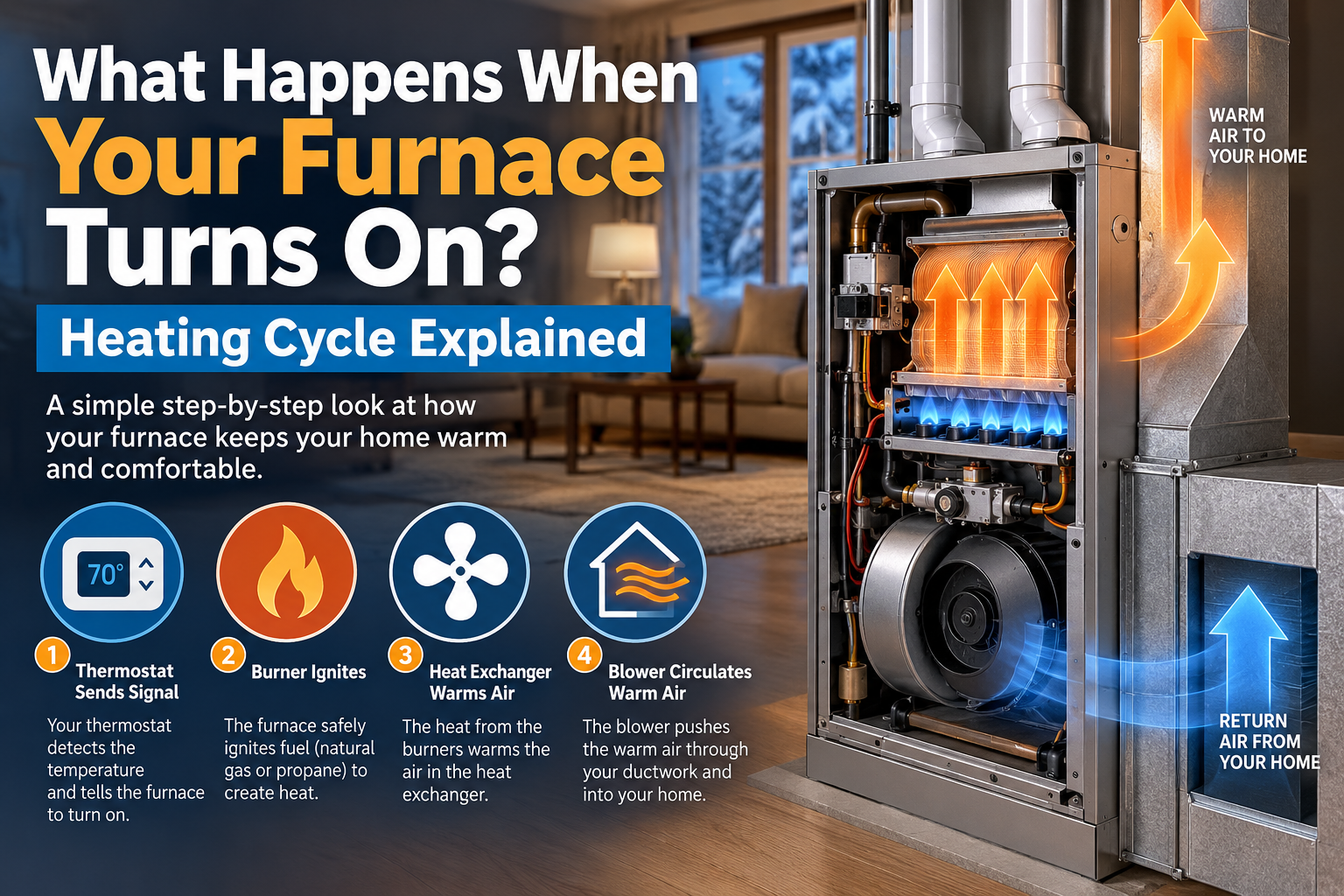
What Happens When Your Furnace Turns On? A Homeowner’s Guide to the Heating Sequence
You turn up the thermostat.
A few moments later, you hear your furnace start. Then the burners ignite, the blower begins running, and warm air eventually comes through the vents.
It may seem like one simple process, but a modern gas furnace actually goes through a carefully controlled sequence of operations every time your home needs heat.
Understanding that sequence can help homeowners recognize why a furnace may start but fail to produce heat—and why HVAC technicians don’t simply replace the first part that appears to be malfunctioning.
Key Takeaways
- Your thermostat doesn’t directly turn on the furnace burners. It sends a call for heat to the furnace controls.
- The furnace must complete several safety checks before allowing gas to ignite.
- The blower normally doesn’t start immediately after the burners ignite.
- A failure at one stage can prevent the furnace from proceeding to the next stage.
- Understanding where the sequence stops can help an HVAC technician diagnose the actual problem.
Step 1: The Thermostat Calls for Heat
The process begins when the indoor temperature falls below your thermostat’s heating setpoint.
The thermostat sends a signal to the furnace indicating that the home needs heat.
Think of this as the thermostat saying:
“It’s too cold. Begin a heating cycle.”
If the furnace never responds, the problem could involve the thermostat, electrical power, wiring, control board, safety switch, or another component.
That’s why a furnace that doesn’t turn on isn’t automatically a bad thermostat.
Step 2: The Furnace Control Board Responds
Modern furnaces use an electronic control board to manage much of the heating sequence.
Once it receives the call for heat, the board begins coordinating the components needed to safely start the furnace.
It also monitors several safety devices throughout operation.
If the furnace detects certain unsafe conditions, the control system may interrupt the heating cycle rather than allowing the furnace to continue operating.
Step 3: The Inducer Motor Starts
Before the burners ignite, you may hear a small motor begin running.
That’s typically the draft inducer motor.
Its job is to help establish proper airflow through the furnace’s combustion and venting system before ignition.
This is an important safety step.
The furnace doesn’t simply open the gas valve and hope combustion gases vent correctly.
It first verifies that the proper conditions exist for the ignition sequence to continue.
Step 4: The Pressure Switch Confirms Draft
After the inducer begins operating, the furnace uses a pressure switch as part of its safety sequence.
The pressure switch helps verify that the inducer and venting system are creating the expected pressure conditions.
If those conditions aren’t detected, the furnace may stop the ignition sequence.
Potential causes can include issues involving the inducer, venting, pressure switch, tubing or other system conditions.
This is one reason replacing a pressure switch simply because the furnace displays a pressure-switch fault isn’t always the correct repair—the switch may be responding to another problem.
Step 5: The Igniter Activates
Once the furnace confirms that the previous safety conditions have been satisfied, the ignition system prepares to light the burners.
Many modern furnaces use a hot-surface igniter.
The igniter becomes extremely hot and provides the ignition source for the gas burners.
Older furnaces may use different ignition systems, including pilot-based designs.
A failed igniter is one possible reason a furnace can begin its startup sequence but never produce heat.
Step 6: The Gas Valve Opens and the Burners Ignite
Once the ignition source is ready, the control board allows the gas valve to open.
Gas flows to the burners and ignites.
At this point, the furnace is finally producing heat—but another important safety check still has to occur.
Step 7: The Flame Sensor Confirms a Flame
The furnace needs to know that the burners actually ignited.
That’s where the flame sensor comes in.
It detects whether a proper flame is present.
If the furnace opens the gas valve but can’t verify flame, the control system will typically shut the gas supply back off.
This safety function prevents unburned gas from continuing to flow when ignition hasn’t been confirmed.
A dirty or malfunctioning flame sensor can sometimes cause burners to ignite briefly and then shut off.
However, several other problems can produce similar symptoms, so diagnosis should involve the entire heating sequence.
Step 8: The Heat Exchanger Warms Up
Once the burners remain lit, heat is transferred through the furnace’s heat exchanger.
The furnace doesn’t necessarily turn the main blower on the instant the flame appears.
It typically allows the system to warm first.
That’s why you may notice a short delay between hearing your furnace ignite and feeling air coming from the registers.
That delay can be completely normal.
Step 9: The Blower Motor Starts
After the appropriate delay or temperature condition is reached, the furnace’s blower begins moving air.
Return air from your home enters the HVAC system, passes through the filter and heating equipment, and is then distributed through the supply ductwork.
Now you begin feeling warm air from your vents.
This is where airflow becomes extremely important.
A furnace can produce heat correctly but still struggle to heat the home if airflow is restricted by problems such as a clogged filter, dirty blower components, undersized ductwork, blocked returns or other restrictions.
Step 10: Your Home Reaches the Thermostat Setting
The furnace continues heating until the thermostat determines that the desired indoor temperature has been reached.
The thermostat then ends the call for heat.
The burners shut off.
But you may notice something interesting:
The blower can continue running for a short period afterward.
That’s usually intentional.
The furnace is moving the remaining usable heat out of the equipment and into your home rather than leaving that heat inside the furnace cabinet.
Once the shutdown sequence is complete, the blower stops and the furnace waits for the next call for heat.
Why Does My Furnace Start but Then Shut Down?
Now the sequence becomes useful.
Suppose you hear the inducer start.
Then the burners ignite.
Three seconds later, the burners shut off.
That symptom is very different from a furnace where nothing happens at all.
Likewise, a furnace whose burners remain operating but whose blower never starts points technicians toward a different part of the heating process.
Rather than guessing at parts, a qualified HVAC technician can determine where the normal sequence stopped and investigate why.
What Can Prevent the Heating Sequence From Completing?
Many different problems can interrupt furnace operation, including:
- Thermostat or control issues
- Electrical problems
- Inducer motor problems
- Venting restrictions
- Pressure-switch-related problems
- Failed ignition components
- Gas supply or gas valve issues
- Flame-sensing problems
- Blower motor problems
- Restricted airflow
- Overheating
- Safety-control activation
The important point is that the same homeowner complaint can have multiple possible causes.
“My furnace won’t heat” isn’t a diagnosis.
It’s a symptom.
Why Furnace Diagnosis Should Follow the Entire System
Replacing parts based solely on symptoms can become expensive quickly.
For example, if a furnace repeatedly shuts down because it is overheating, the underlying cause could be an airflow restriction rather than the safety switch that actually shut the furnace off.
Similarly, a pressure-switch fault doesn’t automatically mean the pressure switch itself has failed.
Good HVAC diagnosis asks:
- What should the furnace be doing right now?
- What is it actually doing?
- At which step did the sequence stop?
- Why did it stop there?
That’s how technicians get closer to identifying the actual cause instead of simply swapping parts.
What Homeowners Can Check Safely
There are a few basic things homeowners can check without opening or modifying the furnace.
Make sure the thermostat is set to HEAT, verify the temperature setting is above the current room temperature, check the air filter, make sure supply and return vents aren’t blocked, and verify that obvious furnace power switches haven’t accidentally been turned off.
Beyond those basic checks, gas, combustion, electrical and internal furnace diagnosis should be left to qualified professionals.
Never bypass a furnace safety switch to force the equipment to operate.
When Should You Call an HVAC Professional?
Schedule an inspection if your furnace:
- Doesn’t start
- Starts but never ignites
- Ignites and immediately shuts off
- Repeatedly starts and stops
- Runs without producing warm air
- Has weak airflow
- Makes unusual noises during startup
- Produces unusual odors
- Frequently locks itself out or requires resetting
If you smell gas, detect carbon monoxide, see smoke or sparks, or believe there is an immediate safety concern, leave the affected area and follow the appropriate emergency or utility guidance.
Frequently Asked Questions
Why doesn’t my furnace blow warm air immediately?
Most furnaces intentionally delay the blower until the heat exchanger has had time to warm. A short delay between burner ignition and airflow can therefore be normal.
Why do my furnace burners light and then shut off?
One possible cause is a flame-sensing problem, but other ignition, combustion, airflow or safety issues can produce similar symptoms. The complete heating sequence should be diagnosed.
Why does the furnace blower keep running after the burners turn off?
A brief blower run after the burners shut down is often normal. It helps move remaining heat from the furnace into the home.
Does the thermostat directly turn on the furnace?
The thermostat initiates a call for heat, but the furnace’s controls and safety devices manage the actual startup and heating sequence.
Why won’t my furnace continue to the next startup step?
Modern furnaces are designed to verify certain operating and safety conditions before moving through the sequence. If a required condition isn’t confirmed, the control system may stop or retry the cycle.
Furnace Service in Temecula Valley
Understanding how your furnace operates makes it easier to understand why proper diagnosis matters.
Advanced Heating & Air Conditioning’s furnace-repair approach is to inspect the heating system and determine the cause rather than guessing at a component, with full-system diagnostics covering airflow, ignition, and safety-related problems.
Advanced Heating & Air Conditioning provides furnace repair, heating maintenance, furnace installation, heat-pump service and other HVAC services throughout Temecula, Murrieta, Menifee, Winchester, Lake Elsinore, Wildomar, French Valley, Hemet and surrounding communities.
California Contractor License #916901
951-609-9881
REAL PEOPLE. REAL SERVICE. REAL COMFORT.