


How Much Electricity Does an Air Conditioner Use?
How Much of Your Electric Bill Is Coming From Your Air Conditioner?
Summer arrives.
Your air conditioner starts running more often.
Then the electric bill arrives.
And suddenly you’re wondering:
“How much electricity is my AC actually using?”
For many Southern California homeowners, air conditioning can represent a significant portion of household electricity use during hot weather.
But there isn’t one simple number that tells you exactly how much electricity every air conditioner uses.
A small, efficient system operating in a well-insulated home may use significantly less electricity than an older system trying to cool a large house during an extended heat wave.
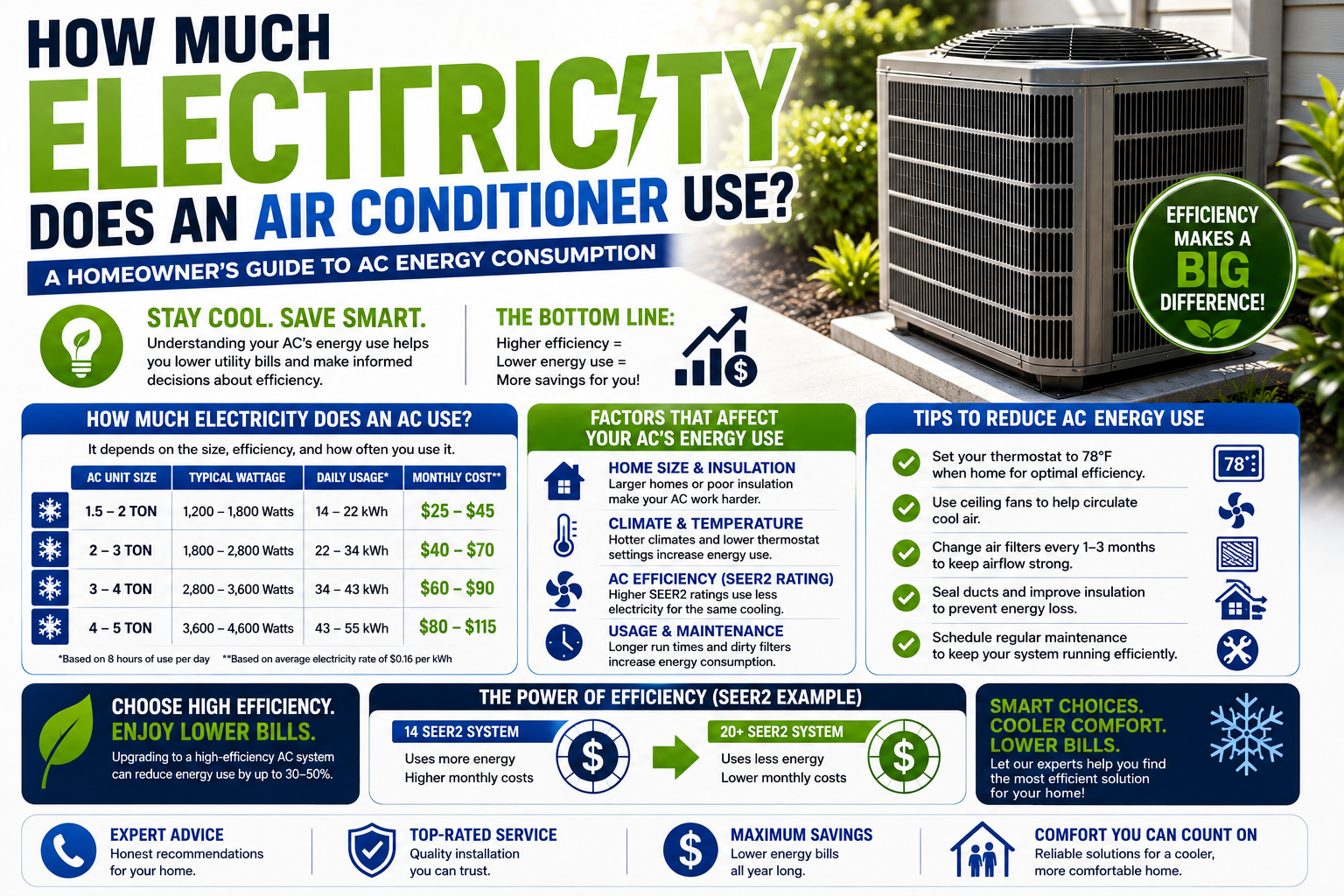
Understanding what affects AC energy consumption can help you make smarter decisions about your HVAC system and your home.
Air Conditioners Don’t All Use the Same Amount of Electricity
Several factors determine how much electricity an air conditioning system consumes.
These include:
- Equipment size
- Efficiency rating
- Outdoor temperature
- Indoor thermostat setting
- System condition
- Home insulation
- Ductwork
- Windows
- Air leakage
- Maintenance
- How many hours the AC operates
This is why two neighboring homes can have dramatically different summer electricity bills even when they’re approximately the same size.
Understanding Watts and Kilowatts
Electricity consumption is often discussed in watts and kilowatts.
1,000 watts = 1 kilowatt
Electric utilities generally bill residential customers based on kilowatt-hours, commonly abbreviated as kWh.
A kilowatt-hour represents using one kilowatt of power for one hour.
For example:
A device drawing 1 kilowatt for one hour uses:
1 kWh
A device drawing 1 kilowatt for five hours uses:
5 kWh
Your utility then charges according to the applicable electricity rate structure.
Why AC Electricity Usage Isn’t as Simple as Watts × 24 Hours
An air conditioner doesn’t necessarily operate continuously at the same electrical demand all day.
Traditional systems cycle on and off based on thermostat demand.
More advanced equipment may operate at different capacities.
Cooling demand also changes throughout the day.
Your AC may barely operate during a mild morning and then run extensively during a hot afternoon.
That’s why estimating monthly AC energy use requires considering both:
How much electricity the equipment uses while operating
and
How long it operates.
Factor #1: The Size of Your Air Conditioner
Larger-capacity HVAC equipment generally has greater electrical demand than smaller-capacity equipment of similar technology and efficiency.
But that does not mean homeowners should choose a smaller system simply to save electricity.
The equipment must be properly sized for the home’s cooling requirements.
An undersized system may run excessively while struggling to maintain temperature.
An oversized system can create its own efficiency and comfort problems.
Correct sizing matters.
Factor #2: Your AC’s Efficiency
Air conditioners are available at different efficiency levels.
Modern equipment uses ratings such as SEER2 to help describe seasonal cooling efficiency.
Generally, more efficient equipment is designed to provide a given amount of cooling using less energy than less efficient equipment under standardized conditions.
However, the efficiency rating on the equipment isn’t the only thing that determines your electric bill.
Installation and home conditions matter too.
Factor #3: Outdoor Temperature
The hotter it gets outside, the more heat your air conditioner may need to remove from the home.
During a mild 80-degree day, cooling demand may be relatively moderate.
During a prolonged Southern California heat wave, the system may operate much longer.
This is why electricity usage can change dramatically from one month to another even when you haven’t changed your thermostat settings.
Factor #4: Your Thermostat Setting
Thermostat settings matter.
Trying to maintain an extremely low indoor temperature during very hot outdoor conditions increases the cooling demand placed on the HVAC system.
For example, maintaining a very cold home during a 100°F afternoon generally requires more cooling than maintaining a more moderate indoor temperature.
There isn’t one perfect thermostat setting for every household.
Comfort preferences vary.
But homeowners should understand that thermostat choices can affect energy consumption.
Factor #5: How Long Your AC Runs
Runtime matters significantly.
An air conditioner that operates four hours per day will generally consume less electricity than the same equipment operating 12 hours per day under otherwise identical conditions.
However, long cycles aren’t automatically a sign of a problem.
During extremely hot weather, properly operating equipment may run for extended periods.
The concern is when the AC runs excessively because of an underlying issue.
Why Would an AC Run Longer Than It Should?
Possible reasons include:
- Dirty air filter
- Dirty outdoor coil
- Refrigerant-related problems
- Poor airflow
- Duct leakage
- Insufficient insulation
- Equipment problems
- Incorrect sizing
- Extremely low thermostat setting
- Aging equipment
If your system’s operating pattern suddenly changes, it may be worth investigating why.
Factor #6: Your Air Filter
A heavily clogged air filter can restrict airflow.
When the HVAC system can’t move air properly, performance can suffer.
That can contribute to:
- Longer operating cycles
- Reduced comfort
- Equipment strain
- Cooling problems
Checking the filter is one of the simplest things homeowners can do to help maintain proper HVAC airflow.
Factor #7: Your Ductwork
Your AC can cool the air efficiently, but that doesn’t help much if conditioned air leaks into the attic before reaching your rooms.
Duct leakage can waste conditioned air and contribute to longer system operation.
Duct problems may also cause:
- Hot rooms
- Weak airflow
- Uneven temperatures
- Comfort complaints
- Excessive system runtime
The duct system is an important part of overall HVAC efficiency.
Factor #8: Attic Insulation
Your air conditioner is constantly fighting heat entering the home.
In Southern California, attic heat can be especially significant during summer.
Proper insulation helps slow heat transfer between the attic and conditioned living space.
If attic insulation is insufficient, the home may gain heat more quickly.
That means the air conditioner has more heat to remove.
Factor #9: Windows and Sun Exposure
Large windows can add substantial cooling demand, particularly when exposed to direct afternoon sunlight.
West-facing windows may receive intense solar heat during some of the hottest hours of the day.
Cooling demand can be influenced by:
- Window size
- Glass type
- Window age
- Exterior shading
- Interior window coverings
- Home orientation
This helps explain why two rooms of similar size can require very different amounts of cooling.
Factor #10: The Age and Condition of Your HVAC System
An older air conditioner isn’t automatically inefficient simply because of age.
However, aging equipment may experience:
- Component wear
- Dirty coils
- Reduced performance
- Airflow problems
- Mechanical issues
- Increasing repair needs
Older equipment may also have been manufactured to different efficiency standards than newer systems.
If your energy usage has increased substantially while your household habits remain similar, HVAC condition is one factor worth investigating.
How Can I Estimate What My AC Costs to Run?
To make a rough estimate, you need three pieces of information:
- Approximate electrical consumption while operating
- Number of operating hours
- Your electricity cost per kilowatt-hour
A simplified calculation is:
Kilowatts × Operating Hours × Electricity Rate = Estimated Operating Cost
For example, imagine an HVAC system draws an average of 3 kilowatts while actively cooling.
If it operates for 6 hours:
3 kW × 6 hours = 18 kWh
If electricity hypothetically costs $0.30 per kWh:
18 kWh × $0.30 = $5.40
That would be an estimated $5.40 for those six hours of operation.
This is only an example.
Actual HVAC power consumption and utility rates vary.
California utility pricing can also involve different rate structures, time periods, tiers, and other factors.
Why Your Electric Bill Can Increase Even When Nothing Is Wrong
A higher summer electric bill doesn’t automatically mean your air conditioner is failing.
Your AC may simply be operating more because:
- Outdoor temperatures increased
- A heat wave lasted several days
- More people were home
- Thermostat settings changed
- Doors opened more frequently
- You spent more time indoors
- Electricity rates changed
Compare both energy usage and household conditions before assuming the HVAC system is malfunctioning.
How Do I Know If My AC Is Using Too Much Electricity?
Look for changes.
If your electricity consumption suddenly increases without an obvious explanation, investigate what changed.
Pay attention to:
- Longer AC cycles
- Poor cooling
- Weak airflow
- Unusual noises
- Uneven temperatures
- AC running constantly
- Dirty filter
- Higher utility usage compared with similar weather periods
A sudden performance change may indicate that the HVAC system needs attention.
Can HVAC Maintenance Reduce Electricity Usage?
Maintenance can help keep equipment operating as intended.
Depending on the system, professional maintenance may include evaluating:
- Airflow
- Filter condition
- Electrical components
- Motors
- Capacitors
- Indoor equipment
- Outdoor equipment
- Cooling performance
- Drainage
- Overall operation
Maintenance can’t change electricity prices or outdoor weather.
But a system that’s dirty or malfunctioning may use energy unnecessarily while providing poor comfort.
Does Turning the AC Off When I Leave Save Electricity?
Reducing unnecessary cooling can reduce energy consumption, but the best thermostat strategy depends on the home, equipment, weather, and how long you’ll be away.
Allowing the indoor temperature to rise somewhat while the house is unoccupied can reduce cooling demand.
However, extreme temperature changes aren’t always necessary.
Programmable and smart thermostats can make temperature scheduling easier.
Does Turning the Thermostat Way Down Cool the House Faster?
For most traditional central air conditioners, no.
If your home is 82°F and you want it to be 75°F, setting the thermostat to 65°F usually doesn’t make the AC produce colder air.
It simply tells the system to continue operating until the lower target is reached.
Setting an unnecessarily low temperature can result in additional runtime if you forget to change it back.
Do Ceiling Fans Reduce AC Electricity Use?
Ceiling fans don’t actually lower the room’s air temperature.
They move air across occupants, which can make people feel cooler.
That may allow some homeowners to remain comfortable at a slightly higher thermostat setting.
The important thing to remember is:
Fans cool people, not empty rooms.
Turn fans off when the room is unoccupied unless they’re serving another specific purpose.
Can Closing Blinds Help?
Yes.
Reducing direct solar heat gain through windows can lower the amount of heat entering the home.
Window coverings can be particularly helpful on windows receiving strong afternoon sunlight.
This doesn’t replace air conditioning, but reducing heat gain can reduce the cooling load placed on the HVAC system.
Does New HVAC Equipment Automatically Mean Lower Bills?
Not automatically.
Newer high-efficiency equipment may use electricity more efficiently, but actual household savings depend on:
- Old equipment efficiency
- New equipment efficiency
- Installation quality
- Equipment sizing
- Ductwork
- Thermostat habits
- Weather
- Electricity prices
- Home insulation
- System usage
Be cautious of anyone guaranteeing a specific electric bill solely based on replacing the HVAC equipment.
Should I Replace My AC Because My Electric Bill Is High?
A high electric bill by itself isn’t enough reason to replace an air conditioner.
First determine what’s causing the increased energy consumption.
If the HVAC system is older and also experiencing:
- Frequent repairs
- Poor cooling
- Long operating cycles
- Major component problems
- Increasing energy use
- Comfort issues
then comparing replacement options may make sense.
But if the equipment is functioning properly, there may be other ways to reduce household cooling demand.
Frequently Asked Questions About AC Electricity Usage
Does air conditioning use a lot of electricity?
Central air conditioning can represent a significant portion of household electricity consumption during hot weather, particularly in climates where cooling systems operate for many hours.
How much does it cost to run an AC for one hour?
There isn’t one universal amount. Cost depends on the equipment’s electrical demand and your utility rate.
Does a bigger AC use more electricity?
Larger-capacity equipment generally has greater electrical demand than smaller equipment of similar technology, but correct equipment sizing is essential.
Does an old AC use more electricity?
Older equipment may be less efficient than newer equipment, but age alone doesn’t determine actual electricity consumption. Condition, maintenance, installation, and home characteristics also matter.
Does a dirty filter increase AC energy usage?
A severely dirty filter can restrict airflow and negatively affect system performance, potentially contributing to longer operating cycles.
Is it cheaper to leave the AC running all day?
The answer depends on thermostat settings, outdoor conditions, occupancy, equipment, and the home. Reducing unnecessary cooling when the home is unoccupied can reduce cooling demand.
Does setting the AC lower make it work faster?
Most traditional central AC systems don’t cool faster simply because the thermostat is set dramatically lower.
Can insulation lower AC usage?
Proper insulation can reduce heat transfer into the living space, potentially reducing the cooling load on the HVAC system.
Air Conditioning Electricity Use in the Temecula Valley
Summer cooling is a major consideration for homeowners throughout Temecula, Murrieta, Menifee, Lake Elsinore, Winchester, Hemet, Anza, and surrounding Southern California communities.
When temperatures climb, your HVAC system may become one of the hardest-working systems in your home.
That’s why reducing energy waste requires looking beyond just the outdoor air conditioner.
Consider the entire house:
- HVAC equipment
- Ductwork
- Insulation
- Windows
- Thermostat settings
- Maintenance
- Household habits
All of these can affect how much cooling your home requires.
The Bottom Line
So, how much electricity does an air conditioner use?
It depends.
The size and efficiency of the equipment matter.
But so do outdoor temperatures, thermostat settings, runtime, ductwork, insulation, windows, maintenance, and the condition of the HVAC system.
Instead of focusing only on how many watts your AC uses, look at the complete picture.
If your electricity consumption suddenly increases or your air conditioner seems to be running much longer than it used to, find out why.
Reducing unnecessary cooling demand and keeping your HVAC system operating properly can help you get more value from every kilowatt-hour you use.
Concerned About Your AC’s Energy Usage?
If your air conditioner seems to be running excessively or you’re considering upgrading to a more efficient HVAC system, Advanced Heating & Air Conditioning can help.
Our team can evaluate your HVAC equipment, airflow, ductwork, and overall system performance and explain your options clearly.
We proudly serve homeowners throughout Temecula, Murrieta, Menifee, Lake Elsinore, Winchester, Hemet, Anza, and surrounding communities.
Contact Advanced Heating & Air Conditioning to schedule HVAC service or request an estimate for a new energy-efficient heating and cooling system.