


What Is SEER2? A Homeowner’s Guide to HVAC Efficiency
What Does SEER2 Mean on an Air Conditioner?
If you’ve started researching a new air conditioner or heat pump, you’ve probably seen a number followed by the term SEER2.
You may see one HVAC system advertised with one efficiency rating and another system with a higher rating.
Naturally, that leads to several questions:
What exactly is SEER2?
Does a higher number mean a better air conditioner?
Will a higher-SEER2 system dramatically lower my electric bill?
And how much should the efficiency rating influence which HVAC system I buy?
These are important questions because an HVAC system is a major investment that may serve your home for many years.
Here’s what homeowners should understand before comparing HVAC efficiency ratings.
What Is SEER2?
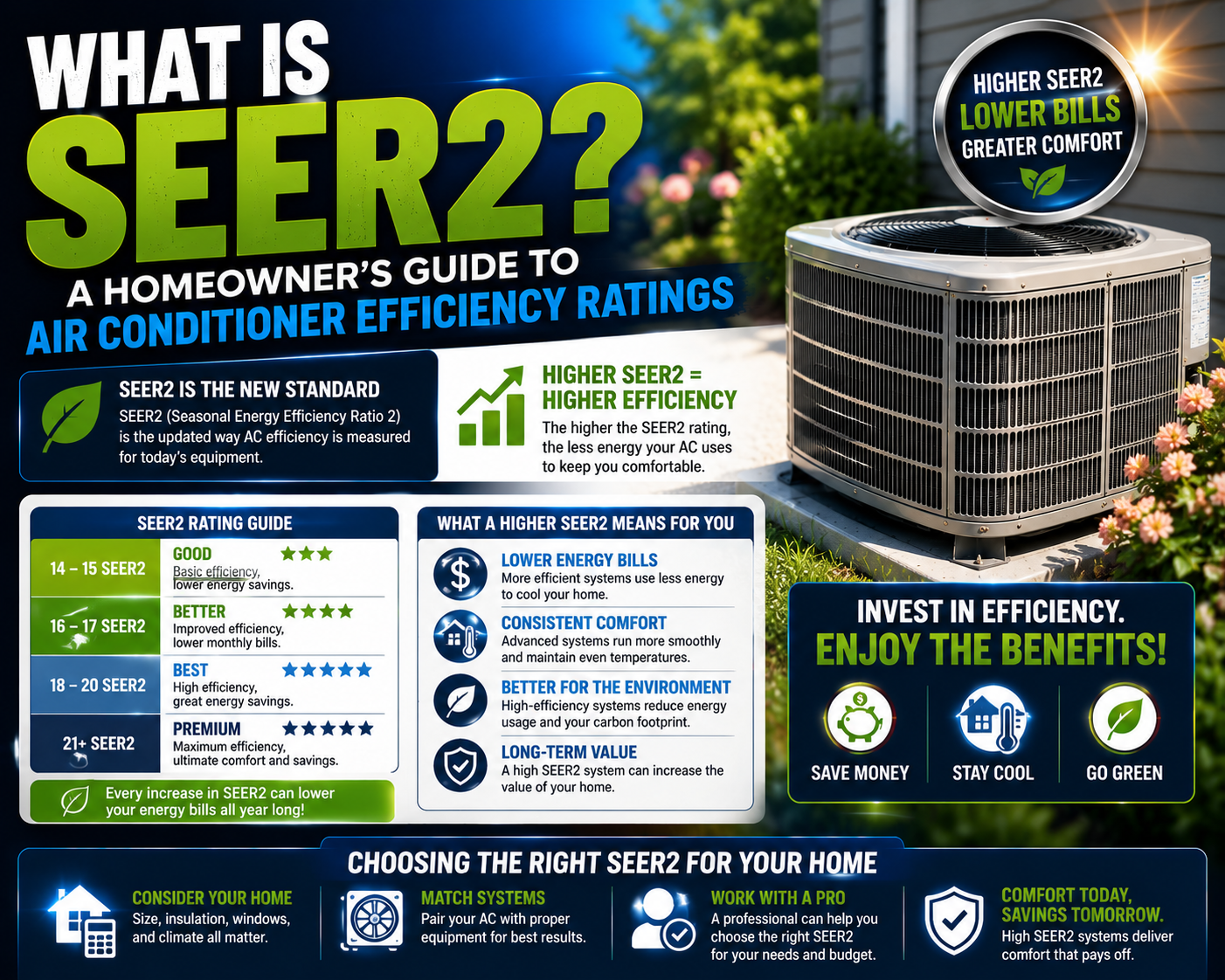
SEER2 stands for:
Seasonal Energy Efficiency Ratio 2
It’s an efficiency metric used for certain cooling equipment, including central air conditioners and heat pumps.
In simple terms, SEER2 helps describe how efficiently cooling equipment can operate over a cooling season under standardized testing conditions.
Think of it somewhat like fuel economy when comparing vehicles.
Two cars may both get you to the same destination, but one may require less fuel to do it.
Similarly, two air conditioning systems may both cool a home, while one is designed to provide that cooling more efficiently under the rating conditions.
What Happened to the Old SEER Rating?
Homeowners who have purchased HVAC equipment in the past may be familiar with SEER rather than SEER2.
SEER2 is part of an updated efficiency testing and rating system.
The newer testing procedures are designed to better represent certain real-world conditions that HVAC equipment may experience when installed in homes.
That’s why you may see older HVAC systems described using SEER and newer equipment described using SEER2.
The important thing for homeowners is not to assume that an older SEER number and a newer SEER2 number can always be compared as though they’re exactly the same measurement.
Does a Higher SEER2 Rating Mean a More Efficient Air Conditioner?
Generally, a higher SEER2 rating indicates greater rated seasonal cooling efficiency.
For example, if you’re comparing appropriately matched systems, equipment with a higher efficiency rating is designed to provide cooling while using energy more efficiently under the standardized test conditions.
But there’s an important point:
SEER2 is only one part of HVAC performance.
Buying the system with the highest number doesn’t automatically guarantee:
- The lowest electric bill
- The best comfort
- The longest equipment life
- The quietest operation
- The best value for your home
The complete HVAC system matters.
Why HVAC Efficiency Matters in Southern California
Homeowners throughout the Temecula Valley know how much an air conditioner can operate during summer.
During extended periods of high temperatures, your AC may run for hours throughout the day.
When equipment operates frequently, efficiency becomes increasingly important.
A more efficient system may reduce the amount of electricity required to provide a given amount of cooling compared with less efficient equipment under similar conditions.
But actual household energy usage depends on much more than the number printed on the equipment.
Will a Higher-SEER2 Air Conditioner Lower My Electric Bill?
Potentially — but no contractor should promise an exact savings amount based only on SEER2.
Your electricity usage depends on many factors, including:
- Outdoor temperature
- Thermostat settings
- Home size
- Insulation
- Window efficiency
- Duct leakage
- Equipment sizing
- HVAC maintenance
- Household habits
- Electricity rates
- Equipment condition
- Installation quality
Efficiency rating matters, but your air conditioner doesn’t operate in a laboratory.
It operates inside your house.
Why Installation Quality Matters as Much as Equipment Efficiency
Imagine purchasing a very efficient air conditioner but connecting it to a poorly performing HVAC system.
Maybe the ducts leak.
Maybe airflow is incorrect.
Maybe the equipment is improperly sized.
Maybe the refrigerant circuit isn’t commissioned correctly.
Maybe the return-air system is inadequate.
You may have purchased high-efficiency equipment, but the complete installation may prevent you from receiving the comfort and performance you expected.
This is why homeowners should consider both:
The equipment being installed
and
The quality of the installation.
Your Ductwork Can Affect HVAC Efficiency
Your ductwork carries conditioned air from the HVAC equipment to your rooms.
If conditioned air is lost through damaged or leaking ducts, some of the energy used to cool that air may be wasted before it reaches your living space.
Duct issues can also affect airflow and comfort.
Potential signs of duct problems include:
- Uneven temperatures
- Weak airflow
- Hot or cold rooms
- Long HVAC cycles
- Excessive dust
- Difficulty maintaining temperature
Installing higher-efficiency equipment without evaluating obvious duct problems may leave part of the home’s efficiency problem unresolved.
Insulation Matters Too
Your air conditioner removes heat from your home.
But if heat is constantly entering through a poorly insulated attic or other areas of the building envelope, your HVAC system has more work to do.
This is especially relevant in Southern California, where attic spaces can become extremely hot during summer.
Proper insulation can help reduce heat transfer between the attic and conditioned living areas.
That’s why overall home efficiency isn’t just about buying a more efficient AC.
The house and HVAC equipment work together.
Does Thermostat Temperature Affect Energy Usage?
Absolutely.
The thermostat tells your HVAC system what indoor temperature you’re trying to maintain.
The greater the difference between outdoor and desired indoor temperatures, the more cooling work may be required.
For example, maintaining an extremely low indoor temperature during a very hot afternoon may require substantially more system operation than maintaining a more moderate temperature.
Even highly efficient equipment still consumes energy when it runs.
What Is Variable-Speed HVAC Equipment?
As homeowners compare higher-efficiency systems, they may also hear terms such as:
- Single-stage
- Two-stage
- Multi-stage
- Variable-speed
- Inverter-driven
These describe how certain HVAC components can operate.
A traditional single-stage system generally operates at one primary capacity when cooling.
More advanced systems may be able to operate at different output levels depending on the home’s cooling demand.
Rather than always operating at maximum output, some equipment can adjust its operation.
Potential benefits, depending on the equipment and application, may include:
- More consistent temperatures
- Longer, lower-capacity operating cycles
- Improved comfort
- Quieter operation
- Better efficiency
- More precise temperature control
However, advanced equipment isn’t automatically the right choice for every homeowner.
Is the Highest SEER2 Rating Always Worth the Extra Cost?
Not necessarily.
Higher-efficiency HVAC systems can cost more initially.
Whether the additional investment makes sense depends on factors such as:
- How often you use your AC
- Local electricity costs
- How long you plan to own the home
- Condition of your existing ductwork
- Home insulation
- Comfort priorities
- Equipment features
- Initial installation cost
- Available system options
For one homeowner, upgrading efficiency may make excellent sense.
For another, a different system may provide a better balance of purchase price, comfort, efficiency, and long-term ownership cost.
There isn’t one perfect efficiency rating for every house.
Don’t Choose an HVAC System Based on SEER2 Alone
Efficiency is important.
But a homeowner should also consider:
- Correct equipment sizing
- Installation quality
- Reliability
- Comfort features
- Noise levels
- Warranty
- Maintenance requirements
- Ductwork condition
- Contractor experience
- Long-term repair considerations
- Overall budget
A number on a specification sheet can’t tell you everything about how an HVAC system will perform in your home.
What Does HVAC System Matching Mean?
Central HVAC equipment contains components designed to operate together.
A typical cooling system may include:
- Outdoor condenser or heat pump
- Indoor evaporator coil
- Furnace or air handler
- Blower
- Thermostat or controls
Efficiency ratings are based on specific equipment combinations.
Changing one component can affect the performance of the complete system.
That’s why professional equipment selection involves more than choosing an outdoor unit with an attractive efficiency number.
Does HVAC Size Affect Efficiency?
Yes.
Even efficient equipment needs to be properly sized for the home.
An oversized system may satisfy the thermostat too quickly and cycle frequently.
An undersized system may struggle during periods of high cooling demand.
Proper sizing considers factors beyond square footage, including:
- Insulation
- Windows
- Orientation
- Ceiling height
- Air leakage
- Ductwork
- Local climate
- Home construction
Correct sizing helps the equipment operate as intended.
Should I Replace My Old AC Just to Get a Higher SEER2 Rating?
Not necessarily.
If your existing HVAC system is operating reliably and keeping your home comfortable, replacement shouldn’t automatically be based on efficiency rating alone.
However, efficiency becomes an important consideration when an older system is already approaching replacement.
For example, you may be dealing with:
- Frequent repairs
- Major component failure
- Poor comfort
- Increasing energy usage
- Aging equipment
- Excessive noise
- Difficulty maintaining temperature
At that point, comparing newer equipment and efficiency levels can be worthwhile.
What Should I Compare When Getting HVAC Replacement Estimates?
Don’t compare estimates based only on the price at the bottom of the page.
Ask what you’re actually receiving.
Important considerations can include:
Equipment
What system is being proposed?
Efficiency
What are the applicable efficiency ratings?
Sizing
How was the equipment capacity selected?
Ductwork
Has the existing duct system been considered?
Installation
What is included in the installation?
Controls
What thermostat or control system will be used?
Warranty
What manufacturer and labor warranty information applies?
Maintenance
What maintenance will the equipment require?
A lower initial price doesn’t automatically mean a better value.
Neither does the highest-priced system.
Homeowners should understand what they’re comparing.
What Is the Best SEER2 Rating for a Temecula Valley Home?
There isn’t one universal answer.
The appropriate equipment depends on the individual home and homeowner.
A homeowner who plans to remain in the house for many years may evaluate efficiency differently from someone planning to move soon.
Someone with high summer cooling usage may place greater value on efficiency than someone who uses their AC less frequently.
The home’s insulation, ductwork, equipment sizing, and overall condition also matter.
The goal should be to find the right balance of efficiency, comfort, reliability, features, and cost.
Frequently Asked Questions About SEER2
What does SEER2 stand for?
SEER2 stands for Seasonal Energy Efficiency Ratio 2. It is an efficiency metric used for certain air conditioning and heat pump equipment.
Is a higher SEER2 rating better?
A higher rating generally indicates greater rated seasonal cooling efficiency, but efficiency rating isn’t the only factor that determines HVAC performance or value.
Is SEER2 the same as SEER?
No. SEER2 uses updated testing procedures, so homeowners should be careful when directly comparing older SEER ratings with newer SEER2 ratings.
Does higher SEER2 mean my AC will cool better?
Not necessarily. Cooling capacity and efficiency are different concepts. A higher-efficiency system still needs to be properly sized and installed to provide appropriate comfort.
Will high-efficiency HVAC equipment pay for itself?
That depends on the price difference, energy usage, electricity costs, climate, how long you own the equipment, and many other variables.
Does ductwork affect AC efficiency?
Yes. Damaged, leaking, restricted, or poorly designed ductwork can negatively affect overall HVAC performance.
Does insulation matter if I buy a high-efficiency AC?
Yes. HVAC equipment and the building envelope work together. Reducing unwanted heat transfer can reduce the cooling demand placed on the air conditioner.
Should I buy the highest-efficiency AC available?
Not automatically. Compare efficiency with equipment cost, comfort features, installation quality, home characteristics, and long-term ownership goals.
Choosing Efficient HVAC Equipment in the Temecula Valley
Homeowners throughout Temecula, Murrieta, Menifee, Lake Elsinore, Winchester, Hemet, Anza, and surrounding communities depend heavily on air conditioning during Southern California summers.
That makes efficiency worth understanding.
But choosing new HVAC equipment shouldn’t become a contest to find the biggest efficiency number.
The best system is one that’s properly selected for your home, professionally installed, and capable of delivering the comfort and performance you’re expecting.
The Bottom Line
SEER2 gives homeowners a useful way to understand and compare the rated cooling efficiency of HVAC equipment.
But it’s only one piece of the puzzle.
A high-efficiency air conditioner connected to poor ductwork, incorrectly sized for the house, or improperly installed may not deliver the results you expected.
When replacing your HVAC system, look at the entire picture:
- Efficiency
- Equipment sizing
- Installation quality
- Ductwork
- Home insulation
- Comfort
- Long-term value
Understanding those factors can help you make a much more informed decision than simply choosing the highest number on the equipment label.
Thinking About a New High-Efficiency HVAC System?
Advanced Heating & Air Conditioning helps Southern California homeowners understand their options before making a major HVAC investment.
Whether you’re considering a traditional air conditioning system, heat pump, or another HVAC replacement option, our team can evaluate your home and explain the differences between available systems.
We proudly serve homeowners throughout Temecula, Murrieta, Menifee, Lake Elsinore, Winchester, Hemet, Anza, and surrounding communities.
Contact Advanced Heating & Air Conditioning to schedule an HVAC evaluation and learn which system makes sense for your home.