


Why Is My House So Dusty? Could Your HVAC System Be the Cause?
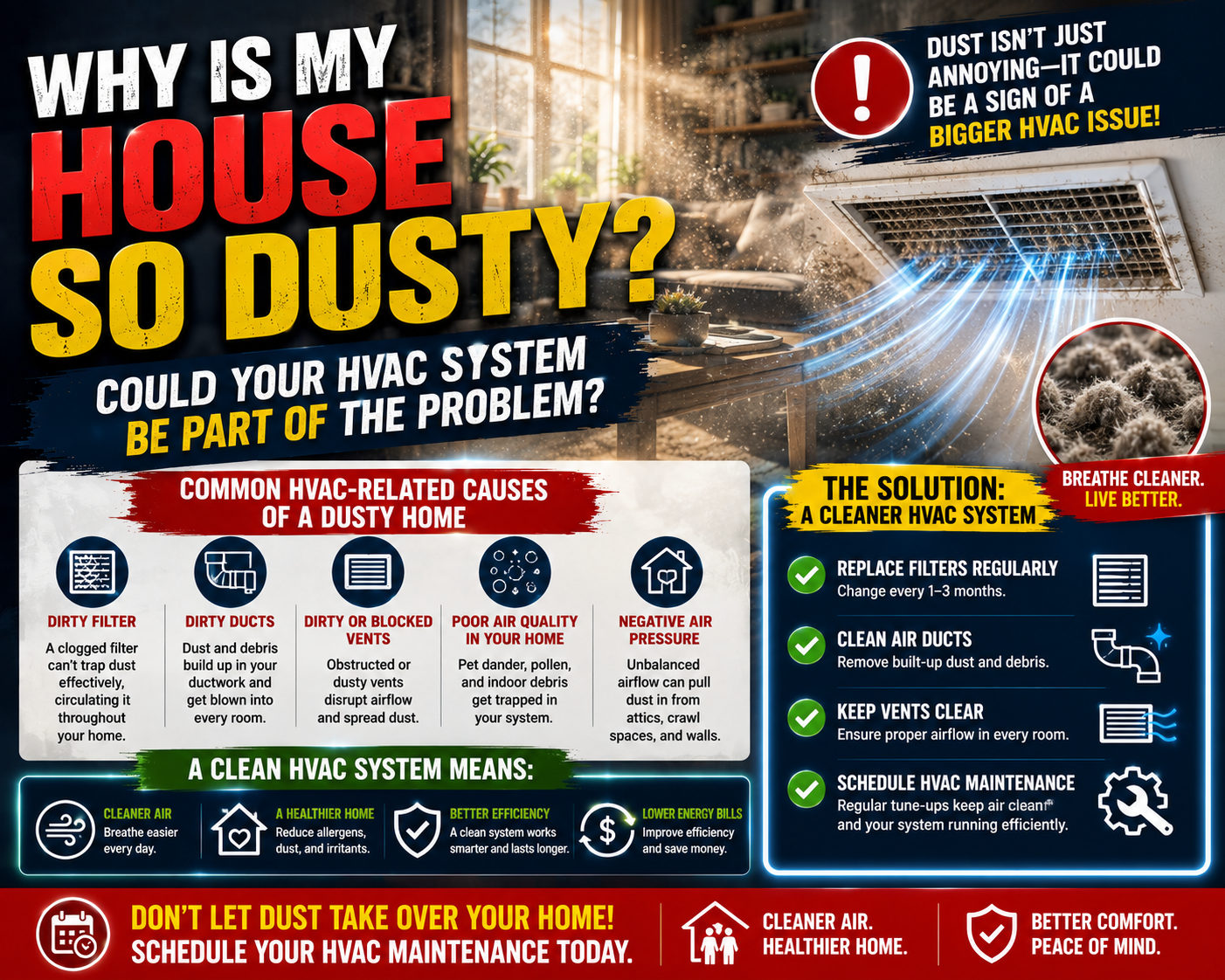
Why Does My House Get Dusty So Fast?
You clean the furniture.
You vacuum the floors.
You wipe down the countertops.
A few days later, there’s another layer of dust.
If it feels like you’re constantly cleaning your house only for the dust to return, you may start wondering:
Where is all this dust coming from?
There isn’t one answer.
Household dust can come from many sources, including outdoor particles, clothing fibers, skin cells, pet hair and dander, carpets, furniture, soil, and everyday household activity.
But your heating and air conditioning system also moves large volumes of air throughout your home.
That means the HVAC system, air filter, ductwork, and overall air circulation can affect how airborne particles move through your living space.
Here’s what homeowners should know.
1. Your HVAC Filter May Be Dirty
Your HVAC filter is one of the first places to check if you’re concerned about indoor dust.
As air returns to your heating and cooling system, the filter captures certain airborne particles before the air moves through the equipment.
Over time, the filter loads with debris.
A filter that becomes excessively dirty can restrict airflow and negatively affect HVAC performance.
How often a filter needs attention depends on several factors, including:
- Filter type
- Household size
- Pets
- Indoor conditions
- System usage
- Home renovations
- Local environment
Instead of relying only on a calendar, homeowners should inspect filters regularly and replace or clean them according to the filter and equipment requirements.
2. Your Filter May Not Fit Properly
Installing a filter isn’t enough.
It also needs to fit correctly.
If there’s a significant gap around the filter, some return air may be able to move around it rather than through the filter media.
That can reduce the effectiveness of the filtration setup.
When replacing your HVAC filter, make sure you’re using the appropriate dimensions and type for the system.
If you’re unsure, an HVAC professional can help identify the correct filter configuration.
3. Your Filter Isn’t Designed to Capture Every Particle
Not all HVAC filters provide the same level of filtration.
Some basic filters are primarily intended to protect HVAC equipment from larger debris.
Other filters can capture smaller particles.
This is where homeowners may hear about MERV ratings.
MERV stands for Minimum Efficiency Reporting Value and is one way of describing a filter’s ability to capture particles within specified size ranges.
A higher MERV rating can indicate greater filtration efficiency for certain particles.
But that doesn’t mean homeowners should automatically install the highest-rated filter they can find.
4. Higher-MERV Isn’t Automatically Better for Every HVAC System
This is an important point.
A filter can affect airflow.
Filters with greater resistance may not be appropriate for every HVAC system or filter installation.
If airflow becomes too restricted, it can negatively affect system performance.
That’s why filter selection should consider both:
Filtration
and
Airflow.
The goal isn’t simply to purchase the most restrictive filter available.
The goal is to use filtration that’s appropriate for the HVAC equipment and household needs.
5. Your Ductwork May Be Leaking
Ductwork is responsible for transporting conditioned air throughout your home.
If ducts have significant leaks, particularly on the return side of the system, unwanted air and particles from surrounding spaces may potentially be drawn into the air distribution system.
Depending on the home’s design, ducts may pass through areas such as:
- Attics
- Garages
- Crawl spaces
- Utility areas
Damaged, disconnected, or poorly sealed ductwork can contribute to HVAC performance and indoor comfort problems.
Possible signs of duct issues can include:
- Excessive dust
- Weak airflow
- Uneven temperatures
- Long HVAC cycles
- Visible duct damage
- Rooms that are difficult to heat or cool
A professional inspection can determine whether the duct system has problems that need attention.
6. Air Leaks Around the House Can Bring Outdoor Dust Inside
Not all dust enters through the HVAC system.
Outdoor air can enter through gaps and openings around the home.
Potential leakage areas include:
- Doors
- Windows
- Attic penetrations
- Plumbing penetrations
- Recessed fixtures
- Wall penetrations
- Other building gaps
Every time exterior doors open, outdoor particles can enter as well.
This can be especially noticeable in dry or windy Southern California conditions.
If your home seems unusually dusty, the building envelope may be part of the issue.
7. Pets Can Significantly Increase Indoor Particles
We love our pets.
But dogs and cats can contribute:
- Hair
- Dander
- Dirt
- Outdoor particles
Pets that regularly move between indoors and outdoors can bring additional dirt and debris into the home.
Homes with multiple pets may need more frequent filter inspection than homes without pets.
This doesn’t mean your pet is the “problem.”
It simply means filtration and cleaning needs may be different.
8. Remodeling Can Create Huge Amounts of Dust
If you’ve recently completed:
- Drywall work
- Flooring installation
- Cabinet work
- Painting preparation
- Demolition
- Home additions
- Other remodeling
you may notice significantly more dust.
Construction creates extremely fine particles that can spread throughout a home.
If the HVAC system operates while dusty construction work is occurring, particles can be circulated through the living space and collected by filters.
Filters may need much more frequent inspection during and after remodeling.
9. Your Return-Air System May Be Part of the Problem
Return-air ducts pull air back toward the HVAC equipment so it can be conditioned again.
Problems with the return system can affect both airflow and air quality.
Potential issues include:
- Return duct leakage
- Damaged return ducts
- Poorly sealed connections
- Filter bypass
- Inadequate return airflow
Because return ducts operate by pulling air toward the system, leaks in certain locations may allow unwanted air to enter.
This is another reason ductwork condition matters.
10. Dust Around a Vent Doesn’t Always Mean Your Ducts Are Dirty
Homeowners sometimes see dust around supply registers and immediately assume the entire duct system needs cleaning.
That’s not always the case.
Air moving through a register can interact with dust already present in the room.
Small particles may accumulate around the edges of the grille or on nearby surfaces.
Dust around a vent should be investigated in context rather than automatically interpreted as proof that the duct system is heavily contaminated.
Do Dirty Air Ducts Cause a Dusty House?
They can be one factor in certain situations, but the answer isn’t always as simple as:
Dusty house = dirty ducts.
Before assuming duct cleaning is the solution, consider other potential sources:
- Air filter condition
- Filter fit
- Duct leakage
- Return-air leaks
- Outdoor air infiltration
- Pets
- Carpeting
- Remodeling
- Household activity
The source of the dust should be understood before deciding what service is appropriate.
Should I Have My Air Ducts Cleaned?
Not every home automatically needs routine duct cleaning.
There are situations where duct inspection or cleaning may be appropriate, but homeowners should be cautious of anyone claiming that every HVAC system needs frequent duct cleaning regardless of its condition.
If you’re concerned about your duct system, start with an inspection.
Determine whether there is actually a problem before paying for a service you may not need.
Can HVAC Maintenance Help With Dust?
Professional HVAC maintenance isn’t house cleaning, but it can help identify conditions that may affect airflow and filtration.
During HVAC service, a technician may evaluate:
- Filter condition
- Filter fit
- Blower operation
- Indoor equipment
- Airflow
- Duct connections
- Equipment cleanliness
- Overall system operation
If excessive dust is connected to an HVAC problem, identifying the cause is the first step toward improving it.
What Is Indoor Air Quality?
Indoor air quality, often shortened to IAQ, refers broadly to the quality of the air inside buildings and how indoor conditions may affect occupants.
Indoor air can contain a variety of particles and contaminants.
Depending on the home, these may include:
- Dust
- Pollen
- Pet dander
- Smoke particles
- Cooking particles
- Outdoor pollution
- Fibers
- Moisture
- Other airborne contaminants
No single HVAC product solves every indoor air quality concern.
That’s why IAQ should be approached as a complete-home issue rather than simply purchasing one device.
Can Better Filtration Reduce Household Dust?
Improved filtration may help capture more airborne particles, depending on the system and filter being used.
However, filtration can’t prevent dust from settling on surfaces if that dust never enters the HVAC return system.
For example, dirt brought in through an open door may settle directly on a floor.
A filter can’t capture a particle that never travels through the filter.
Good indoor dust control may involve a combination of:
- Appropriate HVAC filtration
- Regular cleaning
- Proper duct sealing
- Reducing outdoor air leakage
- Managing pet hair and dander
- Maintaining HVAC equipment
What About Whole-Home Air Cleaners?
Some homeowners choose enhanced filtration or whole-home air-cleaning equipment.
Depending on the product and installation, these systems may provide additional particle filtration beyond a basic HVAC filter.
Before installing an indoor air quality product, ask:
- What does the product actually do?
- What particles is it designed to address?
- Is it compatible with my HVAC system?
- Will it affect airflow?
- What maintenance does it require?
- How often are replacement components needed?
Homeowners should understand the purpose of the equipment before purchasing it.
Can an Electronic Air Cleaner Help?
Electronic air-cleaning technologies are another option available for some HVAC systems.
Different products operate in different ways, so performance, maintenance requirements, and compatibility can vary.
An HVAC professional can help determine whether a particular air-cleaning solution makes sense for your home and existing system.
As with any filtration equipment, regular maintenance is important.
A neglected air cleaner may not perform as intended.
What About Air Purifiers?
The term “air purifier” is used for many different types of products.
Some are portable room devices.
Others integrate with central HVAC systems.
Different products may be designed to address different indoor air concerns.
Rather than assuming every purifier performs the same function, homeowners should compare:
- Technology
- Intended use
- Airflow requirements
- Coverage
- Filter requirements
- Maintenance
- Manufacturer specifications
Why Does My House Get Dustier When It’s Windy?
Wind can increase the amount of outdoor dust and debris in the air.
Particles may enter when:
- Doors open
- Windows are open
- Air leaks exist
- People or pets enter the home
In dry Southern California environments, windy conditions can make indoor dust more noticeable.
This doesn’t necessarily mean the HVAC system is malfunctioning.
However, significant duct leakage or building air leakage may make the problem worse.
Why Is My New House So Dusty?
Even relatively new homes can experience dust.
Possible causes include:
- Construction debris
- New carpet fibers
- Drywall dust
- Landscaping dust
- Air leakage
- Filter issues
- Duct construction debris
If the home is newly constructed and dust seems excessive, inspecting the filtration setup and HVAC system may be worthwhile.
Why Does Dust Come Back Right After I Clean?
Dust is constantly being generated and introduced into homes.
People move through rooms.
Fabric sheds fibers.
Pets shed.
Doors open.
Outdoor air enters.
The HVAC system circulates air.
Cleaning removes settled dust, but it doesn’t stop new particles from entering or being generated.
If the amount of dust seems excessive, the goal should be to identify whether there’s an unusual source contributing to it.
What Can Homeowners Do to Reduce Dust?
There are several practical steps homeowners can take.
Check the HVAC Filter
Inspect it regularly and use the appropriate filter for your equipment.
Keep Doors and Windows Sealed
Check for obvious gaps that allow outdoor air and dust into the home.
Vacuum Regularly
A vacuum equipped with appropriate filtration can help remove settled particles from flooring and carpeting.
Wash Bedding
Fabric can collect dust, skin particles, pet dander, and other debris.
Control Entryway Dirt
Floor mats and regular entryway cleaning can reduce dirt tracked indoors.
Check Ductwork
If you suspect duct leakage or damage, have the system inspected.
Maintain the HVAC System
Proper airflow and filtration depend on HVAC equipment operating correctly.
Frequently Asked Questions About Household Dust
Why does my house get dusty every day?
Dust comes from both indoor and outdoor sources. Pets, fabrics, people, outdoor air, carpets, construction materials, and HVAC circulation can all contribute.
Can my HVAC system make my house dusty?
HVAC systems circulate air throughout the home. Problems such as filter bypass or duct leakage may contribute to particle distribution, but the system isn’t necessarily the original source of the dust.
Why is dust coming from my air vents?
Dust near vents can have several possible causes, including particles already in the room, duct issues, filter problems, or debris in the air distribution system. Inspection can help identify the source.
Should I use the highest MERV filter available?
Not automatically. Filtration needs to be compatible with the airflow requirements of your HVAC equipment.
How often should I change my HVAC filter?
There isn’t one interval that works for every home. Filter type, pets, system usage, household conditions, and environmental factors all affect how quickly a filter becomes dirty.
Will duct cleaning eliminate dust?
Not necessarily. Household dust can come from many sources. The actual source should be identified before assuming duct cleaning will solve the problem.
Can leaking ducts bring dust into my home?
Depending on where and how the duct system is leaking, duct leakage can potentially contribute to unwanted air and particles entering the HVAC system.
Can better HVAC filtration improve indoor air quality?
Appropriate filtration can help capture certain airborne particles. The effectiveness depends on the filtration system, airflow, installation, and specific indoor air concern.
Indoor Air Quality in the Temecula Valley
Homes throughout Temecula, Murrieta, Menifee, Lake Elsinore, Winchester, Hemet, Anza, and surrounding Southern California communities can experience indoor dust from many sources.
Dry weather, wind, pets, construction, outdoor particles, and everyday household activity can all play a role.
Instead of assuming one product will solve every indoor air concern, it’s better to look at the complete system:
- Filtration
- Airflow
- Ductwork
- HVAC equipment
- The home itself
Understanding where the problem is coming from can help homeowners choose a solution that actually addresses the cause.
The Bottom Line
If you’re constantly asking, “Why is my house so dusty?”, don’t automatically blame your air conditioner.
Your HVAC system may be part of the equation, but household dust can come from many different sources.
Start with the basics:
- Check your filter.
- Make sure it’s installed correctly.
- Pay attention to airflow.
- Look for obvious duct problems.
- Consider outdoor air leakage.
- Think about pets, remodeling, and household activity.
If the dust still seems excessive, a professional HVAC inspection can help determine whether filtration, ductwork, or airflow is contributing to the problem.
Want Cleaner, More Comfortable Air Inside Your Home?
Advanced Heating & Air Conditioning can evaluate your HVAC filtration, airflow, ductwork, and indoor comfort system to help determine whether your heating and cooling equipment may be contributing to excessive household dust.
We provide professional HVAC and indoor air quality services throughout Temecula, Murrieta, Menifee, Lake Elsinore, Winchester, Hemet, Anza, and surrounding communities.
Instead of guessing which product your home needs, start by understanding the problem.
Contact Advanced Heating & Air Conditioning to schedule an HVAC or indoor air quality evaluation.