


Why Does My Furnace Fan Keep Running? 8 Possible Causes
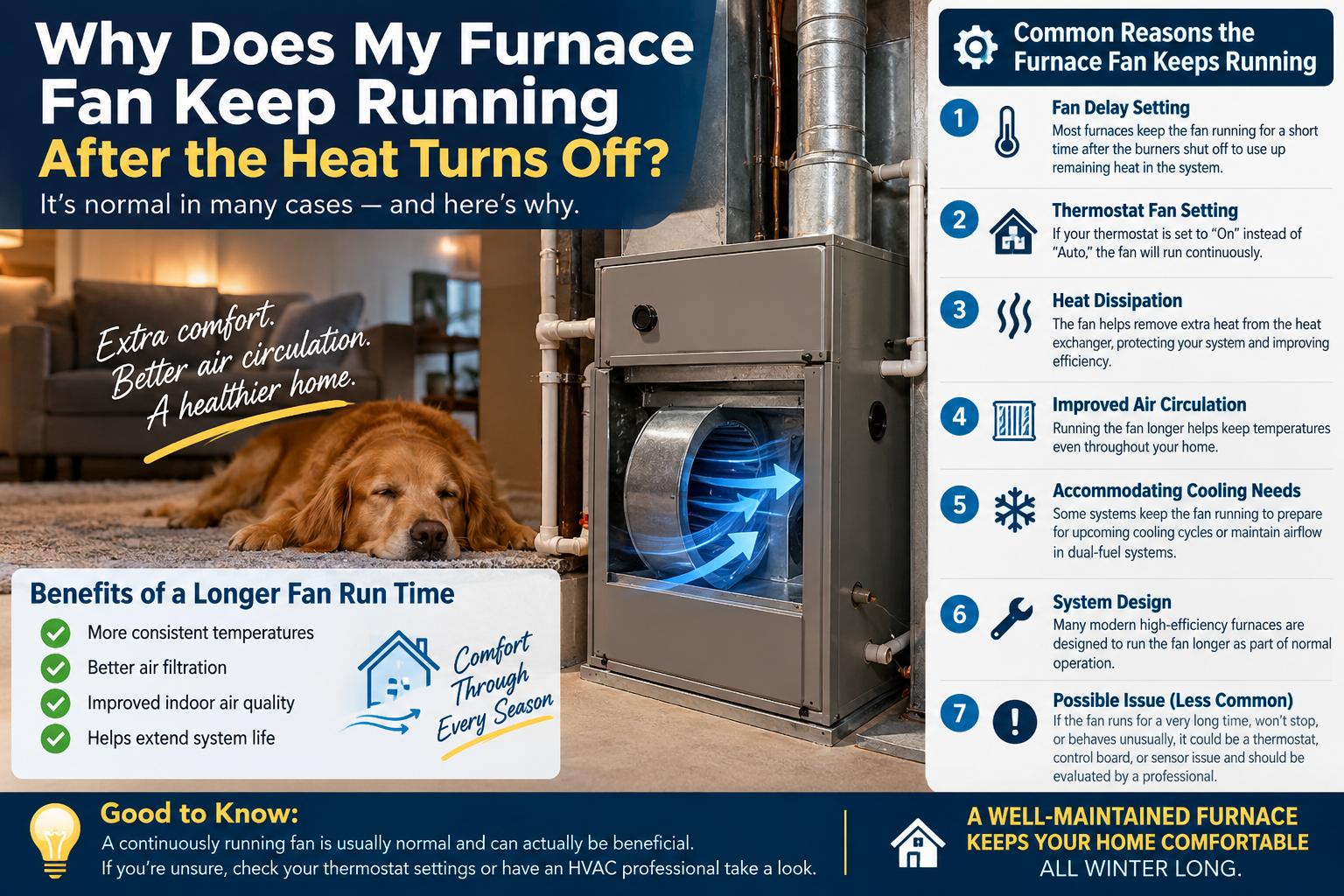
Why Does My Furnace Fan Keep Running After the Heat Turns Off? 8 Possible Causes
Your thermostat reaches the temperature you selected.
The burners shut off.
But you can still hear the furnace fan running.
Is something wrong?
Not necessarily.
It’s normal for a furnace blower to continue operating briefly after the burners shut down. The blower helps move remaining heat from the furnace and ductwork into your home.
But if the blower seems to never shut off, runs much longer than normal, or continues operating even when your home isn’t calling for heat, something else may be happening.
Here are eight possible reasons.
Key Takeaways
- A furnace blower running briefly after the burners shut off is usually normal.
- A thermostat set to FAN ON can make the blower operate continuously.
- Some thermostats and HVAC controls allow extended fan operation.
- An overheating furnace may shut the burners off while keeping the blower running.
- A faulty limit control, thermostat, wiring problem, relay or control board can also cause continuous blower operation.
- Don’t assume the blower motor itself is bad simply because it won’t shut off.
1. The Normal Blower-Off Delay
Let’s start with the most important one.
Your furnace burners and blower don’t necessarily turn off at exactly the same time.
When the thermostat is satisfied, the burners typically shut down first.
The furnace may then keep the blower operating for a short period.
Why?
Because useful heat remains inside the furnace.
Instead of leaving that heat inside the equipment, the blower continues moving air across the heating system and into the home.
After the appropriate delay, the blower shuts off.
A short period of fan operation after the burners stop can therefore be completely normal.
2. Your Thermostat Is Set to FAN ON
Check the thermostat.
Many thermostats have fan settings such as:
- AUTO
- ON
When the fan is set to AUTO, the blower normally operates when the HVAC system calls for heating or cooling, along with any programmed fan operation.
When it’s set to ON, the blower may run continuously whether the furnace burners are operating or not.
This is one of the easiest things homeowners can check.
If your furnace fan suddenly seems to be running constantly, make sure someone didn’t accidentally change the thermostat fan setting.
3. Your Thermostat Has a Circulation Setting
Modern thermostats can be more sophisticated than a simple ON/AUTO switch.
Some models have circulation or minimum-runtime settings that intentionally operate the blower periodically.
For example, the thermostat may be programmed to circulate air for a certain number of minutes each hour.
That can make it seem as though the furnace fan is operating when there is no heating call.
Before assuming something has failed, review the thermostat’s fan and circulation settings.
4. The Furnace May Be Overheating
This is where a continuously running blower can become an important symptom.
A furnace has safety controls designed to protect the equipment from excessive temperature.
If the furnace becomes too hot, a high-temperature safety control can interrupt burner operation.
But the blower may continue running.
Why?
Because moving air through the furnace helps remove heat.
The homeowner may experience something like this:
- The furnace starts.
- The burners operate.
- The burners shut off unexpectedly.
- The blower keeps running.
- The air from the vents gradually becomes cooler.
This can sometimes be mistaken for a blower problem when the real issue is furnace overheating.
Restricted airflow can cause a furnace to overheat and activate its high-limit safety control.
5. A Dirty Filter Is Restricting Airflow
Why would a furnace overheat?
One common possibility is restricted airflow.
A heavily clogged air filter makes it harder for the blower to move the necessary amount of air through the heating system.
Reduced airflow can cause temperatures inside the furnace to increase.
The safety controls may respond by shutting off the burners while allowing the blower to continue operating.
This is another reason changing an HVAC filter isn’t just about dust.
The filter affects airflow and equipment operation.
Heavily clogged filters can reduce airflow and place unnecessary strain on the HVAC system.
Check your filter before assuming there’s a major furnace problem.
If the filter is clean and the problem continues, additional diagnosis may be necessary.
6. The High-Limit Control May Be Involved
The furnace’s high-limit control is an important safety device.
It helps prevent the furnace from operating at excessive temperatures.
If an unsafe temperature condition is detected, the control can shut down burner operation.
A limit-related problem doesn’t automatically mean:
“Replace the limit switch.”
That’s important.
If the furnace is genuinely overheating because of poor airflow, replacing the safety device doesn’t correct the reason the furnace became too hot.
Technicians should determine whether the control is reacting to a real temperature problem or whether there’s an issue with the control or circuit itself.
Limit-switch problems and airflow problems are among the heating conditions that should be properly diagnosed.
7. A Relay or Control Board Could Be Keeping the Blower On
The furnace’s electronic controls tell various components when to start and stop.
The blower is part of that sequence.
If a relay sticks or an electronic control develops a problem, the blower may continue receiving a command to operate even when it should shut down.
This is an electrical diagnosis.
The technician needs to determine whether:
- The blower is being commanded to run
- The blower circuit is staying energized when it shouldn’t
Those are different situations and can point to different causes.
8. A Thermostat or Wiring Problem May Be Sending a Continuous Fan Signal
The thermostat communicates with the HVAC equipment through low-voltage wiring.
If there’s a thermostat malfunction, wiring problem, incorrect installation or another control issue, the furnace may receive a continuous blower signal.
Again, this is why replacing the blower motor simply because the blower won’t stop isn’t good diagnosis.
The blower motor may actually be doing exactly what it’s being told to do.
The real question is:
Why is it being told to keep running?
Does the Furnace Fan Normally Run After the Heat Turns Off?
Yes.
A short blower delay after burner shutdown is normally part of furnace operation.
Here’s a simplified heating cycle:
- Thermostat calls for heat
- Furnace begins startup
- Burners ignite
- Furnace warms
- Blower starts
- Home reaches thermostat setting
- Burners shut off
- Blower continues briefly
- Blower shuts off
So don’t be concerned simply because the fan doesn’t stop the exact second the burners shut down.
The concern is when it operates far longer than expected or continuously.
How Long Should the Furnace Blower Run After the Burners Shut Off?
There isn’t one universal number for every furnace.
Blower timing depends on the equipment and its controls.
Some systems use programmed timing while others may use different control strategies.
Instead of focusing on an exact number from the internet, pay attention to whether the furnace is behaving differently from normal.
If your blower historically stopped shortly after a heating cycle but suddenly begins running continuously, that’s worth investigating.
Why Is Cool Air Coming From My Vents After the Furnace Turns Off?
This can happen during the normal blower-off delay.
Once the burners stop producing heat, the remaining heat inside the furnace is transferred into the airflow.
As that heat is removed, the supply air gradually becomes cooler.
You may therefore feel air that isn’t as warm toward the end of the blower cycle.
That doesn’t necessarily mean the furnace is malfunctioning.
However, if the blower continues indefinitely and eventually circulates room-temperature air throughout the home, investigate why it isn’t shutting down.
Can Closed Vents Cause This Problem?
Closing multiple supply registers can increase resistance within some duct systems.
Similarly, blocking return grilles can restrict the amount of air returning to the furnace.
Restricted airflow can contribute to excessive furnace temperatures.
Instead of closing vents throughout the house in an attempt to redirect heat, HVAC airflow problems should be evaluated properly.
Your furnace, blower, return ducts, supply ducts and registers are designed to operate together.
What Is Static Pressure?
This is a good place to introduce another HVAC term homeowners may hear.
Static pressure is resistance to airflow within the HVAC system.
The blower has to move air against that resistance.
Problems involving filters, duct sizing, restrictions, coils, registers or return-air capacity can affect system resistance.
Technicians can measure static pressure rather than simply guessing whether the furnace has “good airflow.”
That’s especially useful when a furnace is overheating despite having a clean filter.
Does a Furnace Fan Running Constantly Use More Electricity?
A blower motor requires electricity whenever it operates.
How much depends on the motor, blower speed, equipment and runtime.
Some modern variable-speed or electronically commutated motors can operate differently from older blower designs, so there isn’t one universal energy-use number.
But if your blower is running continuously because of a malfunction, correcting the underlying problem is preferable to simply accepting the extra runtime.
Will Running the Furnace Fan Continuously Improve Air Quality?
Continuous circulation can move more household air through the HVAC filter, but whether that’s beneficial depends on the system.
Filter type, blower energy consumption, duct leakage, equipment design and indoor-air-quality goals all matter.
Running the fan continuously also isn’t a substitute for addressing actual air-quality concerns.
Advanced Heating & Air Conditioning offers whole-home air-purification options that work with central HVAC systems; equipment selection should consider the furnace or air handler, filter configuration, and airflow.
Should I Turn the Furnace Off If the Blower Won’t Stop?
Not automatically.
First check the thermostat.
If it’s set to FAN ON, switching it to the appropriate automatic setting may explain the behavior.
But if the blower is running because the furnace is repeatedly overheating, simply forcing the blower off isn’t the solution.
That airflow may be helping cool the equipment.
If you notice:
- Burning odors
- Smoke
- Electrical odors
- Repeated overheating
- Furnace shutdowns
- Unusual noises
- Carbon-monoxide alarm activation
treat those symptoms seriously.
For gas odor, smoke, carbon-monoxide alarms or other immediate safety concerns, follow appropriate emergency and utility guidance.
What Can a Homeowner Check?
Before calling for service, you can safely check a few basics:
- Look at the thermostat fan setting.
- Check thermostat schedules or circulation settings.
- Inspect the HVAC filter.
- Make sure return-air grilles aren’t blocked.
- Make sure supply registers aren’t obstructed.
Then observe what’s actually happening.
- Are the burners operating while the fan runs?
- Did the burners shut off but the blower continue?
- Does the blower run even with no heating call?
That information can be extremely helpful during diagnosis.
Why Proper Diagnosis Matters
A furnace fan that won’t stop can have several very different causes.
It could be:
- A normal blower delay
- A thermostat setting
- A thermostat problem
- A furnace overheating condition
- Restricted airflow
- A safety-control issue
- A relay problem
- A control-board problem
- A wiring problem
That’s why:
“The blower won’t shut off” is a symptom—not a diagnosis.
Advanced Heating & Air Conditioning’s approach emphasizes complete system diagnosis — including blower, wiring, thermostat, safety, and airflow — rather than guessing which component needs replacement.
Frequently Asked Questions
Why does my furnace fan keep running when the heat is off?
Possible causes include a thermostat set to FAN ON, a programmed circulation mode, normal blower-off delay, overheating, thermostat problems or an electrical/control issue.
Is it normal for the furnace fan to keep running after the burners shut off?
Yes, for a short period. The blower typically continues operating to move remaining heat from the furnace into the home.
Why does my furnace fan blow cold air after the heat shuts off?
As the remaining heat is removed from the furnace, supply air becomes cooler. A brief period can be normal. Continuous room-temperature airflow may indicate the blower isn’t shutting down when expected.
Can a dirty filter make my furnace fan run continuously?
A severely restricted filter can contribute to furnace overheating. If a safety limit interrupts burner operation, the blower may continue operating to help remove heat.
Should my thermostat fan be set to AUTO or ON?
AUTO generally allows the HVAC controls to operate the blower with heating and cooling calls. ON typically operates the blower continuously. Some thermostats also offer circulation modes.
Does a continuously running furnace fan mean the blower motor is bad?
No. The blower motor may be operating correctly but receiving a continuous command from the thermostat or furnace controls.
Can a bad thermostat cause the furnace blower to stay on?
Yes. A thermostat or thermostat-circuit problem is one possible cause, although it isn’t the only one.
Why do my furnace burners shut off but the fan stays on?
A normal blower delay is one possibility. If the burners are shutting down prematurely because the furnace is overheating, a safety limit may also be involved.
Furnace & Heating Service in the Temecula Valley
If your furnace blower suddenly runs continuously, your furnace repeatedly overheats, or the heating system isn’t operating the way it normally does, Advanced Heating & Air Conditioning can diagnose the complete system rather than guessing which component needs replacement.
Our heating maintenance evaluates heating performance, safety, airflow, blower components, electrical connections, and safety controls.
Advanced serves homeowners and businesses throughout Temecula, Murrieta, Menifee, Winchester, Wildomar, French Valley, Canyon Lake, Lake Elsinore, Hemet and surrounding communities.
Advanced Heating & Air Conditioning
951-609-9881
California Contractor License #916901
AdvancedHeatingAndAir.com