


Do Heat Pumps Work in Cold Weather?
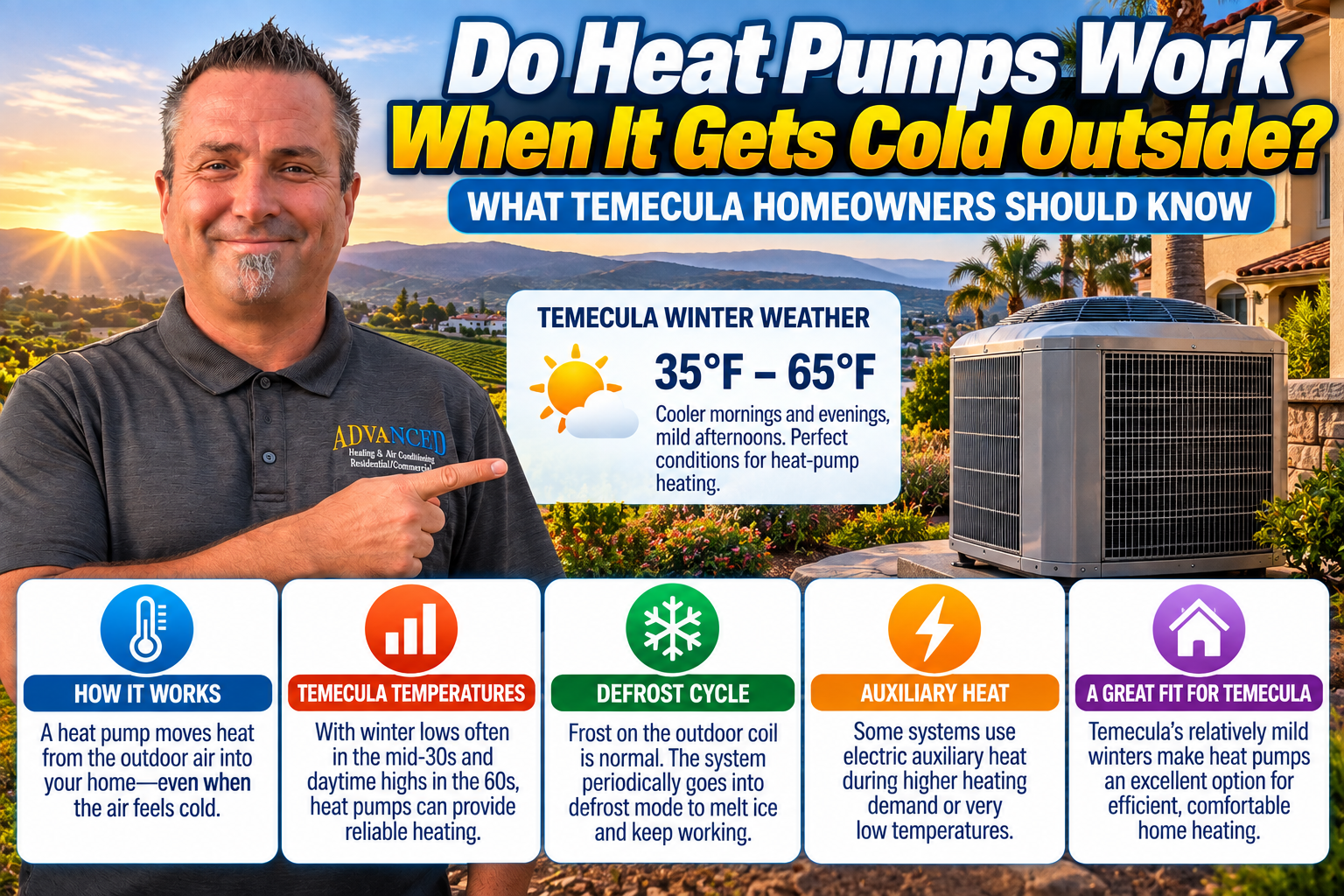
Do Heat Pumps Work When It Gets Cold Outside?
One of the first questions homeowners ask when considering a heat pump is:
“But will it actually keep my house warm when it’s cold outside?”
Yes.
Modern heat pumps can operate in cold weather.
But that answer needs some explanation because heat-pump performance changes as outdoor temperature drops.
A heat pump does not create heat the same way a gas furnace does.
Instead, it moves heat.
Even when the outdoor air feels cold to you, there is still thermal energy available in that air.
A heat pump captures some of that energy and transfers it into your home.
The colder it gets outside, however, the harder the heat pump may have to work.
That’s where concepts such as:
- Heating capacity
- Efficiency
- Defrost
- Auxiliary heat
- Cold-climate equipment
- and dual fuel
become important.
Key Takeaways
- Heat pumps can provide heating even when outdoor temperatures are cold.
- Modern equipment can operate at temperatures far below what many homeowners assume.
- Heating capacity and efficiency generally change as outdoor temperature falls.
- Not every heat pump has the same cold-weather capability.
- Equipment should be selected based on the home’s actual heating load and local climate.
- Heat pumps can run for long periods in winter without something necessarily being wrong.
- Frost on the outdoor coil can be normal; the system periodically uses defrost.
- Some systems use electric auxiliary heat during higher heating demand.
- Dual-fuel systems combine a heat pump with a gas furnace.
- Southern California’s relatively mild winters can make heat pumps particularly attractive.
How Can a Heat Pump Get Heat From Cold Air?
This sounds impossible at first.
If it’s:
40°F outside
how can the heat pump bring heat into a:
70°F house?
Because “cold” air still contains thermal energy.
The refrigerant inside the outdoor coil can operate at a temperature lower than the outdoor air.
That allows heat to transfer:
Outdoor air → refrigerant.
The compressor then raises the refrigerant’s:
- Pressure
- and temperature.
The indoor coil releases that heat into the home’s air.
So the heat pump isn’t trying to find hot outdoor air.
It is transferring available thermal energy.
What Happens as the Outdoor Temperature Drops?
The available heating conditions become more challenging.
Generally, as outdoor temperature falls:
- The home’s heating demand increases
- while the heat pump’s available capacity and efficiency may change.
Think about both sides of that equation.
At 55°F outside:
Your home may need very little heat.
At 40°F:
It needs more.
At 30°F:
It needs even more.
At the same time, the heat pump is extracting heat from colder outdoor air.
That is why equipment selection matters.
At What Temperature Does a Heat Pump Stop Working?
There is no universal temperature.
This is one of the biggest misconceptions about heat pumps.
You may hear someone say:
“Heat pumps don’t work below 40 degrees.”
or:
“Heat pumps don’t work below freezing.”
Those blanket statements are outdated.
Different heat pumps have different:
- Operating ranges
- Heating capacities
- Compressor technology
- and cold-weather performance.
Some modern cold-climate systems are specifically engineered to continue operating at very low outdoor temperatures.
Recent homeowners in genuinely cold climates report modern heat pumps continuing to provide heating well below freezing, although actual capacity, efficiency and backup requirements depend on the equipment and home.
Why Do People Think Heat Pumps Don’t Work in Cold Weather?
Partly because older heat pumps had more limited low-temperature performance.
Someone may have owned a heat pump:
20 or 30 years ago
and remembers electric backup heat running frequently whenever temperatures dropped.
Technology has changed significantly.
Modern equipment may include:
- Inverter-driven compressors
- Variable capacity
- Improved refrigerant controls
- Enhanced vapor injection or other manufacturer-specific technology
- and better low-temperature control strategies.
So you should not judge a modern heat pump solely by someone’s experience with a system installed decades ago.
What Is a Cold-Climate Heat Pump?
A cold-climate heat pump is designed and rated to maintain useful heating performance at lower outdoor temperatures.
These systems often use inverter-driven compressors that can adjust their operating capacity.
Instead of simply being:
ON
or
OFF,
the compressor may ramp up or down.
During mild weather:
Lower capacity.
During greater heating demand:
Higher capacity.
That flexibility can improve both comfort and efficiency when the system is properly selected.
Do We Need Extreme Cold-Climate Heat Pumps in Temecula?
Not necessarily.
And this is where local HVAC design matters.
A system appropriate for:
Minnesota
doesn’t automatically represent the best value for:
Temecula.
Our winters are dramatically milder.
The correct equipment should be selected based on:
- Local design temperatures
- Home heating load
- Home construction
- Ductwork
- Electrical system
- Comfort goals
- and budget.
Buying equipment solely because it can operate at an extremely low temperature you may never experience isn’t automatically better.
Why Are Heat Pumps Such a Good Fit for Southern California?
Because our climate allows heat pumps to spend much of the heating season operating under relatively favorable outdoor conditions.
Temecula Valley homeowners frequently need:
- Cooling during hot weather
- and moderate heating during winter.
A heat pump provides both functions with the same refrigeration system.
Instead of installing:
Air conditioner + separate heating technology
a homeowner can consider:
Heat pump + appropriate indoor equipment.
That makes heat pumps particularly worth discussing when replacing an aging HVAC system.
Will a Heat Pump Keep My Temecula Home Warm in Winter?
When properly:
- Sized
- Installed
- Commissioned
- and paired with appropriate ductwork,
a heat pump can provide excellent winter comfort in the Temecula Valley.
The important word is:
Properly.
A high-quality heat pump connected to:
- Undersized ducts
- Poor airflow
- or an improperly sized system
can still perform poorly.
Equipment alone does not determine comfort.
Why Doesn’t Heat-Pump Air Feel as Hot as Furnace Air?
This causes a lot of unnecessary concern.
Gas furnaces typically deliver noticeably hot supply air.
Heat pumps often provide:
- Warmer-than-room-temperature air
- but at a lower temperature than homeowners accustomed to gas furnaces expect.
So you put your hand over the register and think:
“This air isn’t hot.”
That does not automatically mean the heat pump isn’t heating.
The better question is:
Is the indoor temperature increasing and reaching the thermostat setpoint?
Why Do Heat Pumps Run Longer Than Furnaces?
Because many modern heat pumps are designed to maintain comfort using:
- Longer
- steadier
- lower-capacity operation.
A traditional furnace may:
Blast hot air → shut off → house cools → blast hot air again.
A variable heat pump may operate more continuously.
That can produce:
- More even temperatures
- Less dramatic temperature swing
- and quieter operation.
Long runtime is not automatically a problem.
Does a Heat Pump Running All Night Mean Something Is Wrong?
Not necessarily.
If it is cold outside and the system is maintaining the thermostat setting, long runtime can be normal.
The concern is when:
- The system runs continuously
- AND indoor temperature keeps falling.
That indicates the heat pump may not be meeting the heating load.
What Is Heat-Pump Balance Point?
This is an important concept.
The balance point is roughly where the home’s heating requirement and the heat pump’s available heating capacity intersect.
Above that outdoor temperature:
The heat pump can generally handle the heating load by itself.
Below it:
The home may need additional heating capacity.
The exact balance point depends on:
- The house
- and the equipment.
There isn’t one universal balance-point temperature.
What Determines My Home’s Heating Load?
Many factors.
Not just square footage.
Heating load can be affected by:
- Outdoor temperature
- Home size
- Insulation
- Windows
- Air leakage
- Ceiling height
- Orientation
- Construction
- Duct leakage
- and indoor temperature preference.
This is why proper HVAC sizing should be based on actual load calculations rather than:
“Your old system was four tons, so we’ll install another four-ton system.”
Can Better Insulation Help a Heat Pump in Cold Weather?
Absolutely.
One recent 2026 homeowner with a heat pump struggling around 0°F discovered the attic had only about R-19 insulation. After adding substantial attic insulation, the homeowner reported a noticeable improvement in the home’s ability to maintain the thermostat setting.
That illustrates an important HVAC principle:
Sometimes the answer isn’t:
Buy a bigger heat pump.
Sometimes the answer is:
Reduce how much heat the house loses.
Do Windows Matter?
Yes.
Windows can be a significant source of heat loss.
Factors include:
- Single vs. double pane
- Window size
- Frame condition
- Air leakage
- and orientation.
A properly sized HVAC system takes the building envelope into account.
Does Ductwork Matter in Heating Mode?
Very much.
The heat pump may produce adequate heating capacity at the equipment while the homeowner still experiences poor comfort because the duct system is losing or restricting that heat.
Potential problems include:
- Leaky ducts
- Poor insulation
- Undersized ducts
- Restricted returns
- Crushed flex duct
- and poor room-to-room distribution.
This is why Advanced places so much emphasis on:
- CFM
- Static pressure
- and proper duct design.
Can a Heat Pump Work With Existing Ductwork?
Often, yes.
But existing ductwork should be evaluated.
A new heat pump does not automatically require all-new ducts.
Likewise:
“The old AC worked with these ducts”
doesn’t automatically prove the ducts are ideal for the new equipment.
Airflow should be measured and evaluated.
What Happens When Frost Forms on the Outdoor Unit?
During winter heating, the outdoor coil operates cold.
Moisture in outdoor air can condense and freeze on that coil.
A light layer of frost can be normal.
The heat pump periodically enters:
Defrost mode
to remove it.
What Happens During Defrost?
The system temporarily changes refrigeration operation so the outdoor coil can warm.
You may notice:
- Outdoor fan stopping
- Steam
- Whooshing sounds
- or temporary changes in indoor-air temperature.
Then normal heating resumes.
This does not mean your heat pump is broken.
Is Steam Coming From My Heat Pump Normal?
During defrost:
Yes, it can be.
The warm outdoor coil can rapidly melt frost and create visible water vapor.
Homeowners sometimes see a cloud around the outdoor unit and think:
“My heat pump is smoking!”
If it occurs during a normal defrost cycle and dissipates, it may simply be steam.
Actual:
- Burning smell
- Electrical smoke
- or visible equipment damage
is different and requires immediate attention.
What Is Auxiliary Heat?
Auxiliary heat is a secondary heating source that can assist the heat pump.
Depending on the system, this might be:
- Electric resistance heat
- or another heating source.
The thermostat or system controls determine when additional heat is needed.
Does AUX HEAT Mean My Heat Pump Is Broken?
No.
Auxiliary heat can be a normal part of system design.
It may operate during:
- Higher heating demand
- Large thermostat recovery
- or defrost.
The concern is when auxiliary heat operates far more than expected.
That can significantly increase electricity consumption when electric resistance heat is used.
Why Can Auxiliary Heat Increase My Electric Bill?
A heat pump transfers heat.
Electric resistance heat creates heat directly from electricity.
Resistance heat can be useful backup capacity, but it typically uses considerably more electricity to provide the same amount of heat than an efficiently operating heat pump.
That’s why control strategy matters.
Recent 2026 homeowners continue to ask why backup heat activates more often than expected and how thermostat settings affect the changeover.
What Is Emergency Heat?
Emergency heat is not the same thing as normal auxiliary operation.
Emergency heat generally tells the system to rely on the backup heating source rather than normal heat-pump operation.
It is not intended to be the everyday:
“It’s cold outside”
button.
Do All Heat Pumps Need Electric Backup Heat?
No.
It depends on:
- Equipment
- Climate
- Home heating load
- and system design.
Some installations use electric backup.
Some use:
No supplemental heat.
Others use:
Gas furnace backup.
That brings us to another option Advanced likes installing:
What Is a Dual-Fuel Heat Pump?
A dual-fuel system combines:
- Electric heat pump
- Gas furnace.
During appropriate outdoor conditions, the heat pump provides heating.
When controls determine the furnace should take over:
Gas heat operates.
This gives homeowners two heating technologies in one system.
Why Would Someone Choose Dual Fuel?
Possible reasons include:
- Existing natural gas service
- Cold-weather backup preference
- Utility rates
- Comfort preference
- and desire for flexibility.
It can also be attractive for homeowners who want to use a heat pump for much of the year without completely giving up a gas furnace.
Is Dual Fuel Automatically Better?
No.
It is an option—not a universal answer.
In Temecula, an all-electric heat-pump system may make excellent sense for one homeowner.
Another homeowner may prefer:
Heat pump + gas furnace.
The decision should consider:
- Equipment cost
- Electric rate
- Gas rate
- Solar
- Electrical capacity
- Home load
- and homeowner priorities.
What Is COP?
COP means:
Coefficient of Performance.
It is one way to describe heat-pump efficiency.
A COP of:
3
roughly means the heat pump delivers three units of heat for every unit of electrical energy consumed under those particular operating conditions.
That’s possible because the system is:
Moving heat
rather than creating all of it directly from electricity.
Does COP Stay the Same at Every Temperature?
No.
Heat-pump efficiency changes with operating conditions.
This is extremely important.
Do not look at one efficiency number and assume the system produces that exact efficiency:
- Every hour
- Every day
- At every outdoor temperature.
Recent 2026 homeowner discussions specifically debate how real-world low-temperature efficiency compares with published performance ratings.
The actual equipment performance tables matter.
What Is HSPF2?
HSPF2 is a seasonal heating-efficiency metric used for heat pumps.
Higher numbers generally indicate better seasonal heating efficiency under the rating procedure.
But HSPF2 should not be the only factor used when choosing equipment.
Also consider:
- Heating capacity at design temperature
- System sizing
- Installation quality
- Ductwork
- Noise
- Controls
- and actual local utility costs.
Does Higher Efficiency Always Mean Lower Heating Cost?
No.
This distinction is critical.
Efficiency and operating cost are related, but they are not the same thing.
Operating cost depends on:
Equipment efficiency × amount of heating needed × electricity price
and, when comparing with another heating source:
Gas or propane price and equipment efficiency.
That’s why someone in one part of the country can save substantially with a heat pump while another homeowner with very cheap natural gas may see a different economic result. Current homeowner discussions demonstrate exactly that difference.
What About Solar?
Solar can change the economics.
A homeowner generating some of their own electricity may evaluate heat-pump operating costs differently than a homeowner buying every kWh from the utility.
But solar does not change:
- Proper HVAC sizing
- Airflow requirements
- or equipment performance.
The HVAC system still needs to be designed correctly.
Should I Replace My AC With a Heat Pump?
If your air conditioner needs replacement:
Heat pump should absolutely be one of the options you discuss.
Why?
Because a heat pump can provide:
Cooling
just like an air conditioner,
while also providing:
Heating.
That does not automatically mean every homeowner should choose one.
But in Southern California, it deserves serious consideration.
Is a Heat Pump Still an Air Conditioner?
In cooling mode, a heat pump operates very similarly to a conventional central air conditioner.
The big difference is:
It can reverse operation and provide heating too.
That’s why homeowners replacing an AC should understand the option before automatically installing another cooling-only outdoor unit.
Can I Keep My Gas Furnace and Install a Heat Pump?
Potentially.
That is the:
Dual-fuel approach.
The outdoor heat pump provides:
- Cooling
- and heat-pump heating,
while the gas furnace remains available as another heating source.
Compatibility and controls need to be properly designed.
What About an All-Electric Home?
Heat pumps are particularly important when considering an all-electric HVAC strategy.
An all-electric home might combine:
- Heat-pump HVAC
- Heat-pump water heater
- Induction cooking
- and possibly solar + battery.
But the electrical service and circuit capacity should be evaluated as part of the project.
Do Heat Pumps Need More Electrical Capacity?
It depends on the existing HVAC equipment and whether supplemental electric heat is installed.
A heat pump itself may fit within the home’s available electrical infrastructure.
Large electric resistance backup heat can create additional electrical demand.
That’s something to evaluate before installation, not after.
What Is the Best Heat Pump for Temecula?
There isn’t one universal answer.
The best system depends on:
- Home size
- Heating and cooling load
- Ductwork
- Budget
- Efficiency goals
- Noise requirements
- Electrical system
- Solar
- and comfort preferences.
Advanced installs multiple heat-pump options, which allows the equipment to be selected around the home rather than trying to make every home fit one model.
Should I Buy the Highest-Efficiency Heat Pump Available?
Not automatically.
Higher-efficiency equipment can offer excellent benefits.
But the additional investment should be evaluated against:
- Expected energy savings
- Comfort features
- Variable-capacity operation
- Noise
- Warranty
- and how long you expect to own the home.
Sometimes moving from basic equipment to a good variable-capacity heat pump provides benefits a homeowner will notice every day.
Sometimes the very highest efficiency tier may have a longer financial payback.
What Matters More: Equipment or Installation?
Both matter.
But great equipment cannot compensate for poor installation.
A premium heat pump with:
- Wrong refrigerant charge
- Bad airflow
- Incorrect sizing
- Poor ductwork
- or improperly configured controls
may perform worse than less expensive equipment that is installed correctly.
That is why system design and commissioning matter.
What Should Be Checked Before Installing a Heat Pump?
A quality evaluation should consider:
- Heating load
- Cooling load
- Duct size
- Return airflow
- Supply airflow
- Static pressure
- Electrical requirements
- Thermostat compatibility
- Equipment location
- and homeowner comfort goals.
The goal isn’t merely:
Replace the box.
The goal is:
Design the HVAC system.
Frequently Asked Questions
Do heat pumps work below freezing?
Yes. Many modern heat pumps can operate below freezing. Actual heating capacity and efficiency depend on the specific equipment and outdoor temperature.
At what temperature does a heat pump stop working?
There is no universal cutoff. Manufacturers specify operating ranges and heating capacity for individual models.
Do heat pumps work at 30°F?
Yes, properly selected modern heat pumps can operate at 30°F.
Do heat pumps work at 20°F?
Many modern systems do. Whether the system can carry the entire home heating load depends on equipment capacity and the home’s heat loss.
Are heat pumps good for Southern California?
They can be an excellent fit because Southern California generally has mild winters while also requiring substantial cooling during summer.
Will a heat pump keep my Temecula home warm?
A properly sized and installed heat pump can provide excellent heating comfort in the Temecula Valley.
Why does heat-pump air not feel as hot as furnace air?
Heat pumps often provide lower supply-air temperatures over longer operating periods than gas furnaces.
Is it normal for a heat pump to run a long time when it’s cold?
Yes. Longer runtime can be normal, particularly with variable-capacity equipment.
What is auxiliary heat?
It is supplemental heating that assists the heat pump when additional capacity is needed.
Does AUX HEAT mean something is wrong?
Not necessarily. Occasional auxiliary operation can be normal.
Do I need a gas furnace with a heat pump?
No. Heat pumps can be installed in all-electric systems. A gas furnace can also be paired with a heat pump in a dual-fuel configuration.
Does a heat pump work with solar?
Yes. Solar electricity can offset some household electrical consumption, including heat-pump operation.
Can I replace my AC with a heat pump?
Often, yes. A heat pump provides cooling like an AC while also providing heating.
Are newer heat pumps better in cold weather?
Modern inverter and cold-climate equipment can provide substantially better low-temperature performance than many older heat-pump designs.
The Bigger Question Isn’t “Do Heat Pumps Work in the Cold?”
They do.
The better question is:
How much heating capacity does this particular heat pump produce at the temperatures my home will actually experience?
Then ask:
How much heat does my house need at those temperatures?
When those two pieces are properly matched, you have a real HVAC design.
That’s much better than choosing equipment based on:
- Square footage alone
- or an old rule such as “Heat pumps don’t work when it’s cold.”
For Southern California homeowners, the discussion becomes even more compelling because we typically don’t experience the prolonged extreme winter conditions that drive many cold-climate heat-pump debates.
That makes heat pumps one of the heating-and-cooling options worth discussing with homeowners replacing older HVAC equipment.
Heat Pump Installation in the Temecula Valley
Advanced Heating & Air Conditioning installs, repairs and maintains heat-pump systems throughout Temecula, Murrieta, Menifee, Winchester, Wildomar, French Valley, Canyon Lake, Lake Elsinore, Hemet and surrounding communities.
Whether you’re considering an all-electric heat pump, high-efficiency variable-capacity system, or dual-fuel heat pump paired with a gas furnace, proper sizing, airflow and system design are critical.
Advanced Heating & Air Conditioning
951-609-9881
California Contractor License #916901
REAL PEOPLE. REAL SERVICE. REAL COMFORT.