


Why Is My Upstairs So Much Hotter Than Downstairs? Common HVAC Causes and Solutions
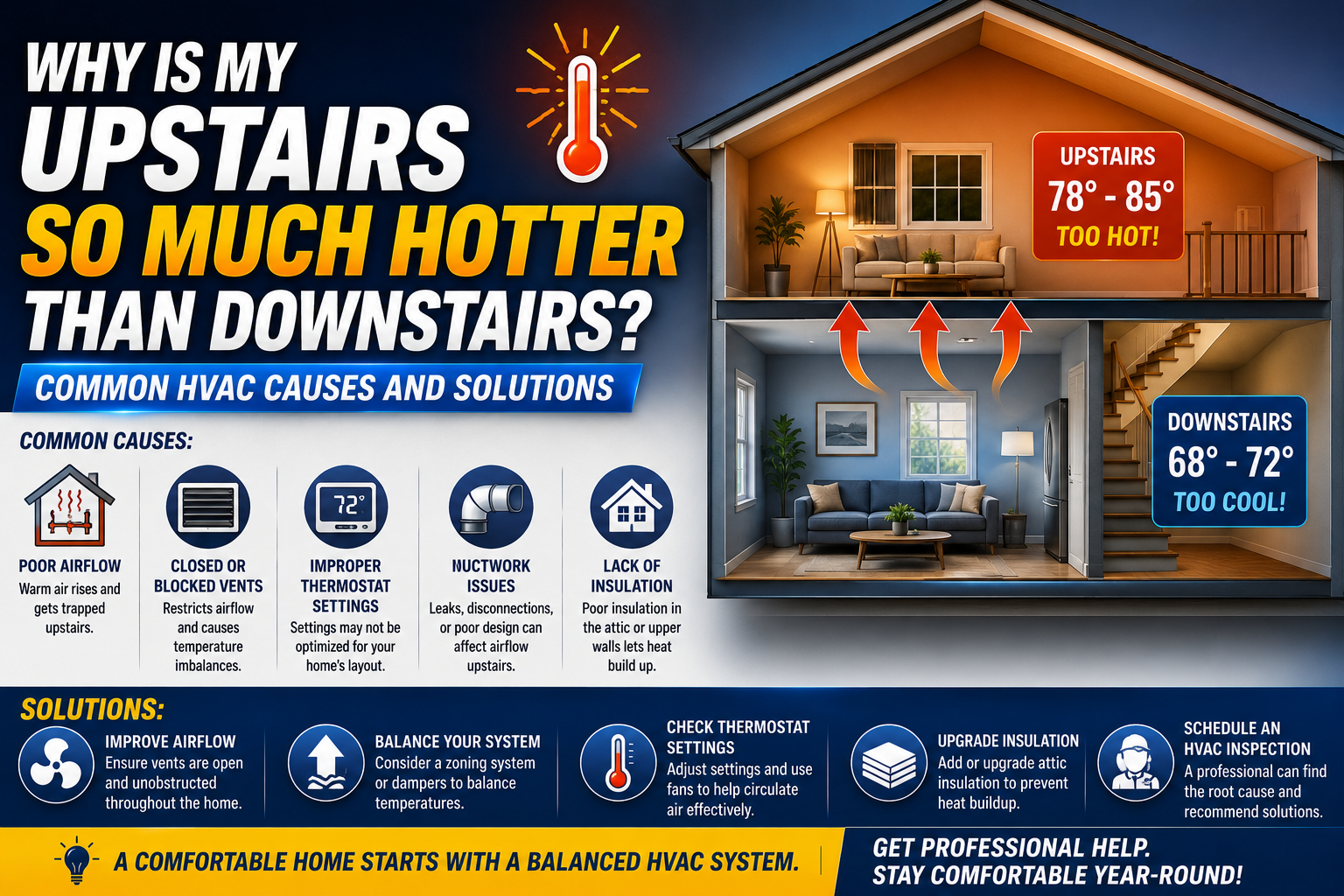
Why Is My Upstairs So Much Hotter Than Downstairs? Common HVAC Causes and Solutions
Key Takeaways
- Warm upstairs rooms are one of the most common comfort complaints homeowners experience.
- The problem is often caused by airflow, insulation, ductwork, or thermostat placement—not necessarily a failing air conditioner.
- Simple maintenance can improve airflow, but some homes require duct modifications or system balancing.
- A professional airflow evaluation can identify the real cause instead of guessing.
Table of Contents
- Why Heat Rises
- Why Your Upstairs Feels Hotter
- The Most Common HVAC Causes
- What Homeowners Can Check
- When It’s Time to Call a Professional
- Frequently Asked Questions
- From the Field
- Summary
Why Is My Upstairs Always Hot?
One of the most common questions we hear during the summer is:
“Why is my downstairs comfortable, but my upstairs feels like an oven?”
If this sounds familiar, you’re not alone.
Many two-story homes throughout Temecula, Murrieta, Menifee, Winchester, Lake Elsinore, Wildomar, French Valley, and Hemet experience this exact problem every summer.
The good news is that it usually doesn’t mean your air conditioner has failed.
The challenge is understanding why the upstairs gets hotter in the first place.
Heat Naturally Rises
Warm air is lighter than cool air.
Throughout the day, heat from windows, walls, and ceilings rises to the upper floor of your home.
At the same time, your roof and attic absorb enormous amounts of solar heat.
During a Southern California summer, attic temperatures can easily exceed 130°F to 150°F.
That heat transfers into ceilings, attic spaces, and second-story rooms.
Your air conditioner now has to remove both:
- Heat entering from outside
- Heat naturally collecting upstairs
This is why the second floor usually has a much larger cooling load.
1. Poor Airflow
If cool air isn’t reaching the upstairs rooms, those rooms simply can’t cool properly.
Poor airflow is one of the first things our technicians evaluate.
Common causes include:
- Dirty air filters
- Closed supply registers
- Blocked return vents
- Dirty blower wheel
- Undersized ductwork
- Flexible ducts that have become kinked or crushed
Even a powerful air conditioner can’t cool rooms that aren’t receiving enough conditioned air.
2. Dirty Air Filter
It’s amazing how many comfort complaints start with a clogged filter.
A dirty filter restricts airflow throughout the home.
Usually the upstairs suffers first because those rooms already require more cooling than the downstairs.
Replacing the filter won’t solve every uneven cooling problem, but it’s always one of the easiest and least expensive things to check.
3. Insufficient Attic Insulation
Your attic acts like a giant heat collector during the summer.
If insulation is:
- Old
- Compressed
- Missing
- Unevenly installed
…heat moves into your living space much faster.
Many homeowners are surprised to learn that improving attic insulation can significantly reduce the temperature difference between floors while also lowering energy bills.
4. Air Duct Leaks
Conditioned air travels through ductwork before it reaches each room.
If those ducts develop leaks in a hot attic, cool air escapes before it ever reaches the upstairs vents.
Instead of cooling your bedrooms, you’re cooling the attic.
This not only reduces comfort but also forces your HVAC system to run longer.
5. Thermostat Location
Most homes have a single thermostat.
Unfortunately, it’s often located downstairs.
Once the downstairs reaches the desired temperature, the thermostat tells the air conditioner to shut off—even though the upstairs may still be several degrees warmer.
The thermostat is simply doing its job based on the temperature where it’s installed.
In some homes, adding a zoning system or a smart thermostat with remote sensors can improve comfort by giving the HVAC system a better picture of temperatures throughout the house.
6. Closed Interior Doors
Air circulation depends on more than supply vents.
Your HVAC system also needs return airflow.
Closing bedroom doors for long periods can trap conditioned air inside the room while reducing the amount of air returning to the system.
This imbalance can affect comfort and airflow.
If you prefer keeping doors closed, ask an HVAC professional whether your home has adequate return air pathways.
7. An Aging Air Conditioner
Sometimes the equipment itself is struggling.
Older systems may:
- Lose efficiency.
- Run longer.
- Deliver less cooling.
- Have reduced airflow due to wear.
If your system is approaching the end of its expected lifespan, it may have trouble keeping up during extreme heat—even if it still operates.
What You Can Check Yourself
Before scheduling service, try these simple steps:
- ✅ Replace the air filter if it’s dirty.
- ✅ Make sure all supply registers are fully open.
- ✅ Ensure furniture isn’t blocking return vents.
- ✅ Check that ceiling fans are rotating counterclockwise during summer to push cool air downward.
- ✅ Keep blinds and curtains closed during the hottest part of the day, especially on west-facing windows.
- ✅ Verify the outdoor condenser is free of leaves, weeds, and debris.
These steps won’t solve every problem, but they can improve airflow and reduce the workload on your HVAC system.
Comparison Table
- Upstairs 5–10° hotter — Possible cause: poor airflow. Professional inspection recommended? Often.
- Weak airflow upstairs — Possible cause: dirty filter or duct issue. Professional inspection recommended? Yes.
- One bedroom always hot — Possible cause: duct balancing issue. Professional inspection recommended? Usually.
- Entire second floor warm — Possible cause: insulation or system capacity. Professional inspection recommended? Yes.
- High electric bills — Possible cause: multiple airflow issues. Professional inspection recommended? Yes.
- Uneven temperatures year-round — Possible cause: HVAC design or zoning issue. Professional inspection recommended? Yes.
From the Field
One of the most common calls we receive during July and August starts with:
“The downstairs is freezing, but nobody wants to sleep upstairs.”
Homeowners often assume they need a larger air conditioner.
In many cases, that’s not the solution.
We’ve found homes where the issue was a severely restricted air filter, disconnected attic ductwork, or insulation that had shifted over time. We’ve also seen second-floor rooms with blocked return air paths that prevented proper circulation.
The key is identifying why the upstairs isn’t cooling before recommending equipment changes. A larger system isn’t always the answer—and in some cases, it can actually make comfort problems worse.
Frequently Asked Questions
Is it normal for upstairs rooms to be warmer?
Yes. Heat naturally rises, and second floors receive additional heat from the attic and roof. A small temperature difference can be normal, but large differences may indicate airflow or insulation issues.
Should I close downstairs vents to force more air upstairs?
Generally, no. Closing multiple vents can increase static pressure and reduce system efficiency. It’s usually better to identify the underlying airflow issue.
Will adding attic insulation help?
In many homes, improving attic insulation can reduce heat transfer into second-story rooms and improve overall comfort.
Can ceiling fans make the upstairs cooler?
Ceiling fans don’t lower the room temperature, but they improve air movement and can make rooms feel more comfortable.
Would a zoning system help?
For some homes, yes. Zoning allows different parts of the home to be cooled independently, which can improve comfort between floors.
In Summary
If your upstairs is consistently hotter than your downstairs, don’t assume your air conditioner needs to be replaced.
Uneven temperatures are often caused by airflow restrictions, duct leaks, insulation problems, thermostat location, or HVAC design—not simply a lack of cooling capacity.
The best solution begins with identifying the root cause instead of guessing. Addressing airflow and insulation issues can often improve comfort, reduce energy use, and help your HVAC system operate more efficiently.
Why Trust Advanced Heating & Air Conditioning?
Since 2008, Advanced Heating & Air Conditioning has helped homeowners throughout Temecula, Murrieta, Menifee, Winchester, Lake Elsinore, Hemet, Wildomar, French Valley, and surrounding communities solve comfort problems with honest recommendations and quality workmanship.
Whether you’re dealing with uneven cooling, rising utility bills, or planning an HVAC upgrade, our team believes in finding the right solution—not the most expensive one. We take the time to evaluate airflow, ductwork, insulation, and equipment performance so you can enjoy consistent comfort throughout your home.
Related Articles
- Why Is My Air Conditioner Running Constantly?
- How Often Should You Change Your HVAC Air Filter?
- Why Is My Electric Bill So High During the Summer?
- Does Closing Air Vents Save Money?
- Why Is My Air Conditioner Freezing Up?
- Should I Repair or Replace My Air Conditioner?
- How Often Should You Have Your HVAC System Serviced?