


What Is AFUE? A Guide to Furnace Efficiency Ratings
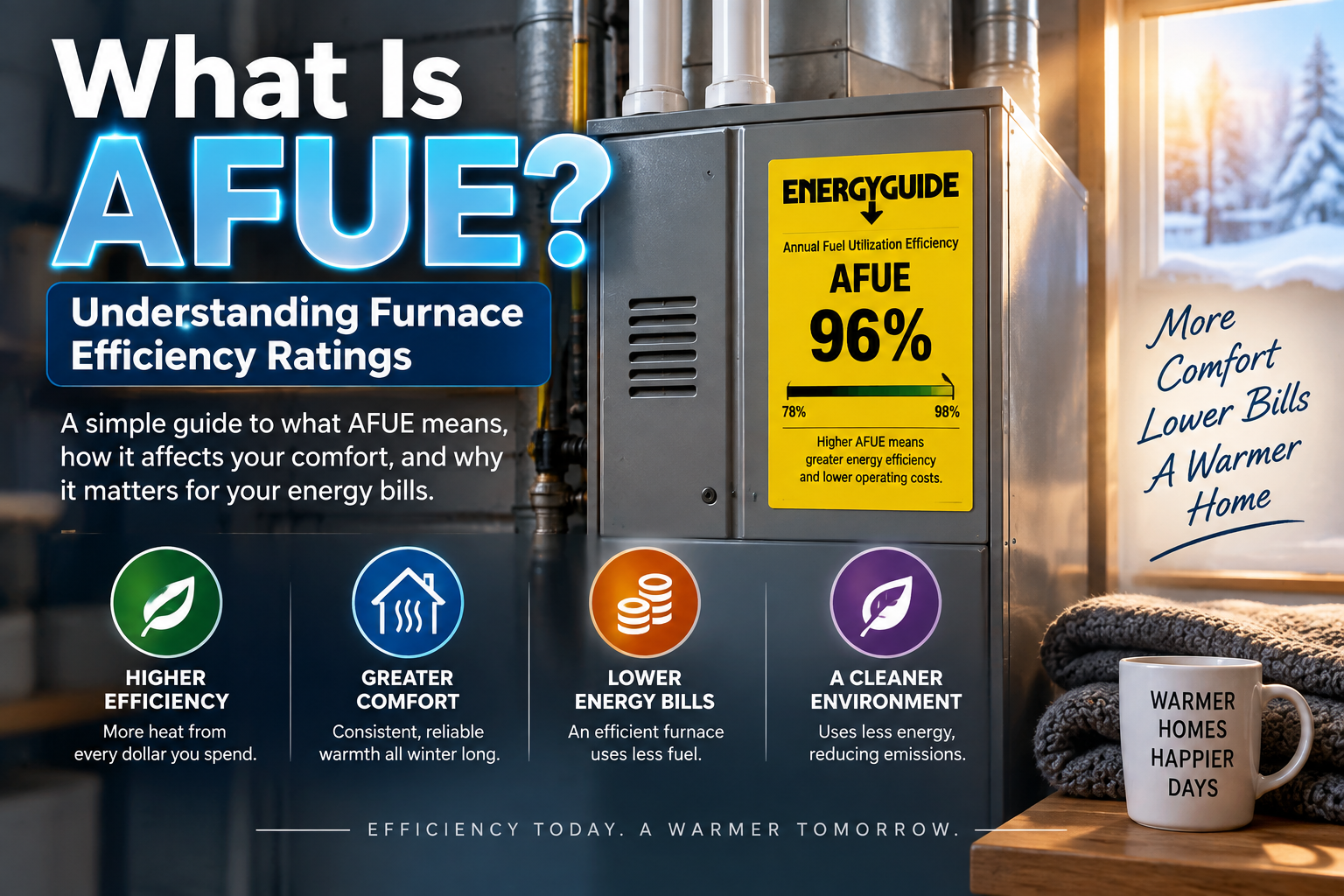
What Is AFUE? Understanding Furnace Efficiency Ratings
If you’re shopping for a new gas furnace, you’ll probably see numbers like:
- 80% AFUE
- 90% AFUE
- 95% AFUE
- 97% AFUE
At first glance, choosing a furnace seems easy.
Higher number = better furnace.
Right?
Not necessarily.
AFUE is an important efficiency rating, but it doesn’t tell you everything about how much your heating system will cost to operate—or how comfortable your house will be.
Understanding what AFUE actually measures can help you make a much smarter furnace decision.
What Does AFUE Mean?
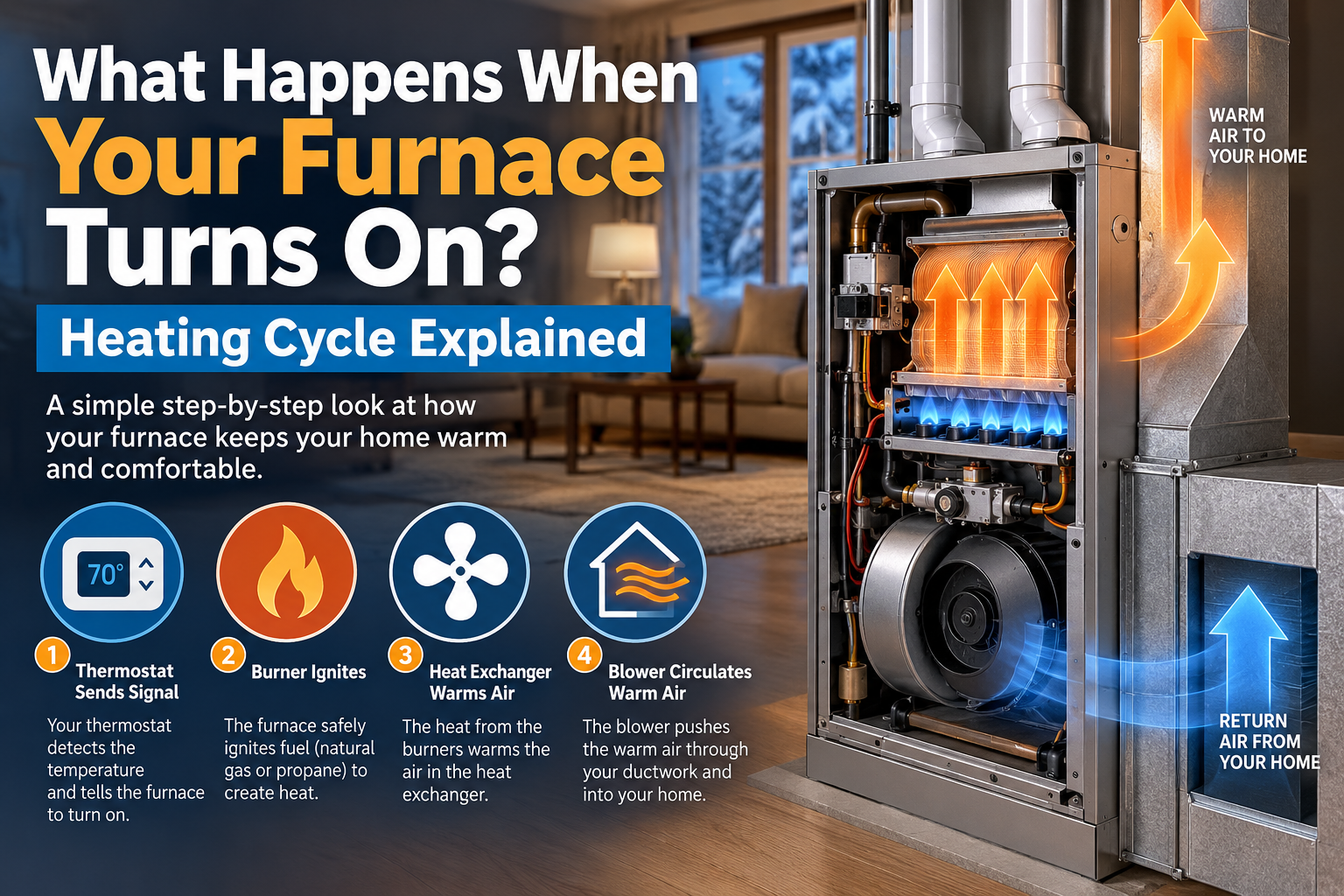
AFUE stands for Annual Fuel Utilization Efficiency.
It’s a measure used to describe how efficiently a furnace converts fuel into useful heat over a typical year of operation.
In simplified terms:
If a furnace has an 80% AFUE rating, approximately 80% of the fuel’s energy is converted into useful heating under the rating methodology, while the remaining portion is associated with losses.
A 95% AFUE furnace converts a greater percentage into useful heat.
So, generally:
Higher AFUE = greater fuel-use efficiency.
But that doesn’t automatically mean the highest-AFUE furnace is the best choice for every home.
What Does an 80% AFUE Furnace Mean?
An 80% AFUE furnace is designed to convert approximately 80% of its fuel energy into useful heat, based on the standardized AFUE calculation.
The remaining portion represents losses, much of which leaves through the venting system.
These furnaces are typically considered non-condensing furnaces.
They commonly use metal venting because their exhaust gases remain relatively hot.
An 80% furnace can still be an appropriate heating system in certain applications.
The important question isn’t simply:
“Is 80% good or bad?”
The better question is:
“Which furnace makes sense for this home, climate, installation and expected heating usage?”
What Does a 95% AFUE Furnace Mean?
A 95% AFUE furnace is designed to convert approximately 95% of its fuel energy into useful heat under the AFUE rating procedure.
To reach those higher efficiency levels, these furnaces extract more heat from the combustion gases.
That additional heat recovery cools the exhaust enough that water vapor can condense.
That’s why many high-efficiency furnaces are called:
Condensing furnaces.
They require a way to manage that condensate.
Why Do High-Efficiency Furnaces Have PVC Vent Pipes?
This is something homeowners frequently notice.
Many conventional furnaces use a metal flue.
High-efficiency condensing furnaces commonly use plastic venting systems approved for the equipment.
Why?
Because a condensing furnace extracts much more heat from the exhaust.
The exhaust temperature and condensate characteristics are therefore different from those of a conventional furnace.
A high-efficiency furnace installation may consequently require changes to:
- Venting
- Combustion-air arrangements
- Condensate drainage
- Gas connections
- Electrical components
and sometimes other parts of the installation.
This is why replacing a furnace isn’t always as simple as sliding the old equipment out and putting a new box in its place.
Furnace installation pricing can depend on the efficiency rating as well as required electrical, gas, and venting updates.
Is a 95% Furnace 15% Cheaper to Operate Than an 80% Furnace?
Not exactly.
This is an easy mistake to make.
You can’t simply subtract:
95 − 80 = 15
and conclude:
“My heating bill will be 15% lower.”
The relationship isn’t that simple.
For an intuitive comparison, imagine the home needs 80 units of useful heat.
At 80% AFUE, the simplified fuel input would be:
80 ÷ 0.80 = 100 units of fuel
At 95% AFUE:
80 ÷ 0.95 ≈ 84.2 units of fuel
That’s about 15.8% less fuel input in this simplified example—not because AFUE points translate directly into bill savings, but because you’re comparing how much fuel is required to deliver the same useful heat.
And your actual utility bill still depends on many other variables.
What Determines My Actual Heating Bill?
AFUE is only one piece of the puzzle.
Your real heating cost can also depend on:
- Outdoor temperature
- Thermostat setting
- Furnace runtime
- Gas rates
- Home size
- Insulation
- Air leakage
- Duct leakage
- Furnace sizing
- Airflow
- Equipment condition
- Occupancy
- Heating habits
This is why two houses with identical furnaces can have very different heating bills.
Insulation, air leakage, duct leakage, and equipment operation can all contribute to higher heating costs.
Does Higher AFUE Mean Better Comfort?
Not necessarily.
AFUE measures fuel efficiency.
It doesn’t directly measure:
- Temperature consistency
- Airflow
- Noise
- Humidity
- Duct performance
- Equipment sizing
- Indoor air quality
A very high-efficiency furnace connected to poorly designed ductwork can still leave homeowners uncomfortable.
Likewise, an oversized high-AFUE furnace can still cycle improperly and produce noticeable temperature swings.
Efficiency and comfort are related—but they’re not the same thing.
Furnace Efficiency vs. Furnace Sizing
This distinction is extremely important.
Suppose you’re choosing between two furnaces.
One is correctly sized for your home’s heating load.
The other has a higher AFUE rating but is substantially oversized.
The higher AFUE number does not erase the problems caused by poor sizing.
Advanced Heating & Air Conditioning’s furnace-installation process evaluates home size, layout, insulation, ductwork, and heating load specifically to avoid oversized or undersized equipment.
Efficiency should never replace proper system design.
Does a Bigger Furnace Heat the House Better?
No.
A bigger furnace isn’t automatically better.
An oversized furnace can heat the home very quickly and shut off.
Then the temperature drops.
Then it starts again.
That can contribute to:
- Shorter cycles
- Temperature swings
- Reduced comfort
- and potentially unnecessary equipment stress.
An undersized furnace creates the opposite problem—it may struggle to maintain the desired temperature during demanding conditions.
The goal is proper capacity, proper airflow, proper ductwork, and appropriate efficiency.
What Is a High-Efficiency Furnace?
People commonly use “high efficiency” to describe furnaces with AFUE ratings in the 90%+ range, especially condensing furnaces.
But homeowners should compare the actual AFUE ratings rather than relying solely on marketing terminology.
For example, you might encounter furnaces rated around:
- 80%
- 92%
- 95%
- 96%
- 97%+
Exact available efficiencies depend on manufacturer and model.
Advanced Heating & Air Conditioning installs gas furnaces and high-efficiency furnaces and helps homeowners select equipment based on comfort, efficiency and long-term operating cost.
Is a 97% AFUE Furnace Worth It in Southern California?
Sometimes.
But this is where local climate matters.
A homeowner in a very cold northern climate may operate their furnace far more hours per year than a homeowner in Temecula.
The more fuel you use for heating, the more opportunity there can be for higher furnace efficiency to reduce fuel consumption.
In Southern California, heating demand is generally different from colder regions.
That doesn’t mean high-efficiency furnaces don’t make sense here.
It means the decision should consider:
- How much you actually heat
- Fuel cost
- Equipment price
- Installation requirements
- Expected ownership period
- Comfort features
- Available equipment
- and the rest of the HVAC system.
Don’t buy a furnace based on AFUE alone.
What About Two-Stage and Variable-Speed Furnaces?
This is another area where homeowners often mix different specifications together.
AFUE tells you about fuel efficiency.
Stages and blower technology describe other aspects of furnace operation.
A furnace may have:
- Single-stage heating
- Two-stage heating
- or modulating operation
The blower may also use different motor and airflow technologies.
These features can influence comfort, noise, airflow and how the system operates during changing heating demands.
They’re important—but they aren’t the same thing as AFUE.
Does AFUE Include Electricity Used by the Furnace?
AFUE primarily describes the furnace’s efficiency in converting fuel into useful heat.
A gas furnace also uses electricity for components such as:
- Blower motor
- Inducer motor
- Ignition system
- Controls
So AFUE shouldn’t be interpreted as a complete measurement of every energy cost associated with operating the furnace.
Does a High-AFUE Furnace Need Less Maintenance?
No.
Higher efficiency doesn’t eliminate maintenance.
A high-efficiency furnace still has:
- Burners
- Blower components
- Controls
- Safety devices
- Airflow requirements
- Filters
and other components that need to operate correctly.
Condensing furnaces also introduce condensate drainage and related components that conventional furnaces may not have.
Advanced Heating & Air Conditioning recommends annual heating maintenance, ideally before heating season, to help identify developing problems and keep the system operating properly.
Can an Old Furnace Lose Efficiency?
Equipment condition can affect real-world performance.
Problems such as:
- Dirty components
- Airflow restrictions
- Improper combustion
- Duct leakage
- Blower problems
and other system issues can influence operating performance and heating costs.
This is why the number printed on the furnace isn’t the only thing that matters.
A properly installed and maintained system matters.
What AFUE Should I Buy?
There isn’t one correct AFUE rating for every homeowner.
Instead, ask:
- How much will I use the furnace?
- How long do I expect to own the home?
- What’s the price difference between the options?
- Will higher efficiency require venting or drainage changes?
- What are my local utility costs?
- Is my ductwork in good condition?
- Is the furnace properly sized?
- What comfort features come with each system?
Then compare the entire package.
That’s much more useful than simply asking:
“What’s the highest AFUE furnace you sell?”
What Is SEER2 vs. AFUE?
Homeowners replacing an entire HVAC system may see both ratings.
They measure different things.
AFUE is associated with fuel-fired furnace heating efficiency.
SEER2 is an efficiency metric associated with air-conditioning and heat-pump cooling performance.
A complete HVAC system may therefore have several different efficiency specifications.
AFUE vs. Heat Pump Efficiency
Heat pumps are different because they move heat rather than creating heat through gas combustion.
That’s why heat pumps aren’t generally compared using AFUE in the same way as gas furnaces.
Depending on the equipment and rating framework, homeowners may see metrics such as HSPF2 for heat-pump heating efficiency and SEER2 for cooling efficiency.
So comparing:
- 95% AFUE furnace
- versus high-efficiency heat pump
isn’t as simple as comparing two percentages.
They’re fundamentally different heating technologies. A dual-fuel system can even combine both.
Frequently Asked Questions
What does AFUE stand for?
AFUE stands for Annual Fuel Utilization Efficiency.
Is a higher AFUE furnace always better?
Higher AFUE means greater fuel-use efficiency under the rating methodology, but the best furnace also depends on installation cost, climate, heating usage, equipment sizing, ductwork and comfort goals.
What does 80% AFUE mean?
In simplified terms, an 80% AFUE furnace converts about 80% of the fuel’s energy into useful heat over the rating period, with the remainder associated with losses.
What does 95% AFUE mean?
A 95% AFUE furnace converts a greater percentage of fuel energy into useful heating. Furnaces in this efficiency range are typically condensing designs.
Will a 95% furnace lower my gas bill?
Potentially, compared with a lower-efficiency furnace providing the same amount of heat. Actual savings depend on fuel prices, heating demand, home efficiency and system operation.
Does AFUE tell me how much my furnace will cost to run?
Not by itself. You also need to consider heating demand, fuel price, thermostat settings, insulation, air leakage, ductwork and other factors.
Is AFUE the same as SEER2?
No. AFUE is used for fuel-fired heating efficiency, while SEER2 is associated with cooling efficiency.
Should I replace an 80% furnace just because a 95% furnace is available?
Not automatically. Equipment age, condition, repair history, energy use, installation requirements and replacement economics should all be considered.
Don’t Shop for a Furnace by One Number
AFUE is valuable.
But it shouldn’t become the only number that determines your furnace purchase.
A successful heating system depends on the complete installation:
- Correct furnace size
- Proper airflow
- Appropriate ductwork
- Correct venting
- Good installation
- Suitable controls
- Appropriate efficiency
- Proper commissioning
A high-efficiency furnace installed incorrectly isn’t a high-performing HVAC system.
That’s why Advanced Heating & Air Conditioning’s furnace-installation process evaluates the home, ductwork, insulation and heating load before recommending equipment, then tests and optimizes the system after installation.
Furnace Installation & Replacement in the Temecula Valley
If you’re comparing furnace efficiency ratings, Advanced Heating & Air Conditioning can help you evaluate the complete system instead of simply selling the furnace with the largest number on the brochure.
Advanced installs gas furnaces, high-efficiency furnaces, electric heating systems, heat pumps and complete HVAC replacement systems, with recommendations based on comfort, efficiency and long-term operating cost.
Advanced serves Temecula, Murrieta, Menifee, Winchester, Wildomar, French Valley, Canyon Lake, Lake Elsinore, Hemet and surrounding Southern California communities.
Advanced Heating & Air Conditioning
951-609-9881
California Contractor License #916901
AdvancedHeatingAndAir.com
REAL PEOPLE. REAL SERVICE. REAL COMFORT.