


Why Is My Heating Bill So High? 12 Reasons Your Energy Costs Keep Increasing
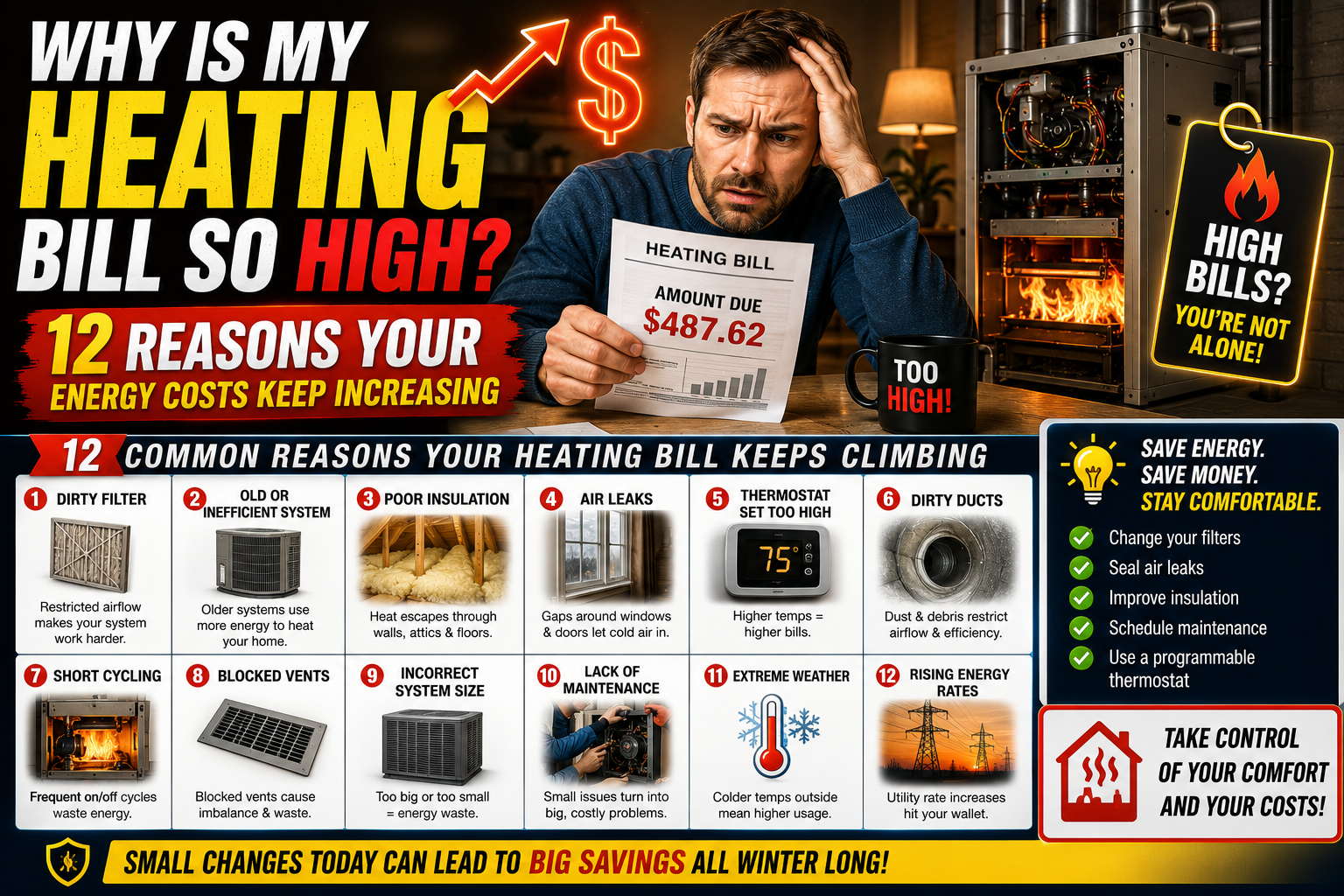
Why Is My Heating Bill So High? 12 Reasons Your Energy Costs Keep Increasing
Key Takeaways
- High heating bills are often caused by airflow restrictions, poor maintenance, aging equipment, or heat loss—not just cold weather.
- Small problems can force your furnace to work much harder than necessary.
- Routine maintenance and proper airflow can improve comfort and reduce operating costs.
- Improving insulation, sealing air leaks, and maintaining your HVAC system often provide the biggest long-term savings.
Table of Contents
- Why Heating Bills Increase
- The Most Common Causes
- What You Can Do Yourself
- When to Schedule a Professional Inspection
- Frequently Asked Questions
- From the Field
- Summary
Why Is My Heating Bill So High?
Every winter, homeowners throughout Temecula, Murrieta, Menifee, Winchester, Lake Elsinore, Wildomar, French Valley, and Hemet ask the same question:
“Why did my gas bill suddenly go up so much?”
The first reaction is usually to blame the furnace.
Sometimes the furnace is the problem.
But more often, your heating system is simply working harder because of something else.
One of the biggest misconceptions is believing there’s only one reason for high heating costs. In reality, your furnace, insulation, ductwork, thermostat settings, air filter, and even your daily habits all work together to determine how much energy your home uses.
Let’s look at the most common reasons your heating bill may be climbing.
1. Dirty Air Filter
If there were one maintenance item every homeowner should stay on top of, it’s the air filter.
When the filter becomes clogged:
- Airflow decreases.
- The blower motor works harder.
- The furnace runs longer.
- Heating efficiency drops.
Replacing a dirty filter is inexpensive and can help your system operate more efficiently.
2. Your Furnace Is Getting Older
Even well-maintained furnaces lose efficiency over time.
As components wear, the system often has to run longer to provide the same level of comfort.
Older furnaces may also have lower efficiency ratings than modern high-efficiency equipment, meaning they use more fuel to produce the same amount of heat.
3. Lack of Annual Maintenance
Think of your furnace like your vehicle.
Skipping maintenance doesn’t always cause an immediate breakdown—but performance gradually declines.
During a professional heating tune-up, technicians typically inspect:
- Burners
- Heat exchanger
- Flame sensor
- Ignition system
- Blower motor
- Airflow
- Safety controls
- Electrical connections
Keeping these components clean and properly adjusted helps your furnace perform at its best.
4. Air Leaks Around Your Home
Your furnace can only heat the air that stays inside your home.
If warm air escapes through:
- Windows
- Doors
- Attic penetrations
- Recessed lighting
- Gaps around plumbing
…the furnace has to keep replacing that lost heat.
Many homeowners are surprised by how much conditioned air can escape through small gaps.
5. Poor Attic Insulation
Heat naturally rises.
Without adequate attic insulation, much of that heat escapes through the ceiling.
During an inspection, we often find older homes where attic insulation has settled over time, reducing its effectiveness.
Improving insulation doesn’t just increase comfort—it can reduce the amount of time your furnace needs to run.
6. Leaky Ductwork
Your duct system carries heated air throughout your home.
If ducts develop leaks in the attic or crawlspace, warm air escapes before it ever reaches your living spaces.
Instead of heating your home, you’re heating unused areas.
Leaky ductwork can also create uneven temperatures and longer heating cycles.
7. Thermostat Settings
A few degrees can make a noticeable difference.
For every degree you raise the thermostat, your heating system generally has to work longer to maintain that temperature.
Many homeowners save energy by:
- Lowering the thermostat while sleeping.
- Adjusting the temperature when away from home.
- Using a programmable or smart thermostat.
The exact savings vary depending on your home and usage habits.
8. Blocked Supply or Return Vents
Your furnace depends on proper airflow.
If furniture, rugs, or storage boxes block vents, airflow becomes restricted.
Reduced airflow can:
- Increase run times.
- Reduce comfort.
- Place additional strain on the blower motor.
Keeping vents open and unobstructed allows your system to distribute heat more effectively.
9. Short Cycling
A furnace that constantly starts and stops never reaches peak efficiency.
Short cycling may be caused by:
- Dirty filters
- Thermostat issues
- Airflow restrictions
- Oversized equipment
- Electrical problems
Frequent starts increase wear while reducing efficiency.
10. Poor Humidity Levels
Dry winter air often feels cooler than air with balanced humidity.
As a result, homeowners sometimes raise the thermostat to compensate.
Adding humidity with a properly maintained whole-home humidifier or portable humidifier can improve comfort, allowing some homeowners to feel comfortable at slightly lower thermostat settings.
11. Dirty Blower Components
Over time, dust builds up on:
- Blower wheels
- Motors
- Internal components
This buildup reduces airflow and forces the blower to work harder.
Professional maintenance includes cleaning and inspecting these critical components.
12. Your Furnace May Be Undersized—or Oversized
Proper equipment sizing is essential.
A furnace that’s too small may struggle to keep up on colder days.
A furnace that’s too large may short cycle, reducing efficiency and comfort.
Correct sizing is determined through a professional load calculation that considers your home’s size, insulation, windows, orientation, and other factors.
What You Can Do Today
Before assuming you need a new furnace, try these simple steps:
- ✔ Replace the air filter.
- ✔ Make sure all vents are open.
- ✔ Check weatherstripping around doors.
- ✔ Seal obvious air leaks.
- ✔ Keep furniture away from return vents.
- ✔ Schedule annual heating maintenance.
- ✔ Consider a programmable thermostat.
These small improvements often add up to noticeable comfort and efficiency gains.
Comparison Table
- Dirty filter — Effect on heating bill: moderate to high. Professional inspection recommended? Usually not initially.
- Poor insulation — Effect on heating bill: high. Professional inspection recommended? Sometimes.
- Leaky ductwork — Effect on heating bill: high. Professional inspection recommended? Yes.
- Aging furnace — Effect on heating bill: moderate. Professional inspection recommended? Yes.
- Short cycling — Effect on heating bill: high. Professional inspection recommended? Yes.
- Blocked vents — Effect on heating bill: moderate. Professional inspection recommended? Homeowner can inspect.
- Dirty blower — Effect on heating bill: moderate. Professional inspection recommended? Yes.
From the Field
One homeowner in Temecula called us because their heating bill had nearly doubled compared to the previous winter. They assumed the furnace needed to be replaced.
After inspecting the system, we found several contributing factors: a heavily clogged air filter, duct leakage in the attic, and insulation that had settled significantly over the years.
Once the airflow issue was corrected and the homeowner addressed the insulation concerns, the furnace no longer had to run nearly as long to maintain the desired temperature.
This is why we rarely assume there’s a single cause for high heating bills. A thorough inspection helps identify where efficiency is being lost so homeowners can make informed decisions.
Frequently Asked Questions
Why is my gas bill higher even though I haven’t changed my thermostat?
Weather conditions, insulation, air leaks, maintenance needs, and furnace efficiency can all affect heating costs even if your thermostat setting stays the same.
Will replacing my air filter lower my heating bill?
A clean filter helps maintain proper airflow and allows your furnace to operate more efficiently. The amount of savings depends on how restricted the previous filter was.
Is an older furnace always expensive to operate?
Not always. Some older furnaces continue to perform well with regular maintenance. However, newer high-efficiency models may use less fuel under similar conditions.
Should I keep raising the thermostat if my home feels cold?
If your home isn’t warming properly, increasing the thermostat may simply cause the furnace to run longer. It’s better to identify why the home isn’t reaching the desired temperature.
In Summary
A high heating bill doesn’t automatically mean your furnace is failing.
More often, it’s a sign that your HVAC system is working harder because of restricted airflow, poor insulation, duct leaks, or deferred maintenance.
By addressing these issues early, homeowners can improve comfort, reduce unnecessary energy use, and help extend the life of their heating system.
Why Trust Advanced Heating & Air Conditioning?
Since 2008, Advanced Heating & Air Conditioning has helped homeowners throughout Temecula, Murrieta, Menifee, Winchester, Lake Elsinore, Hemet, Wildomar, French Valley, and surrounding communities improve home comfort through honest recommendations and quality HVAC service.
Our technicians don’t just look at the furnace—they evaluate the entire heating system, including airflow, ductwork, thermostat performance, and equipment condition. That whole-system approach helps homeowners understand the real causes of high energy bills and choose solutions that make sense for their homes.
Related Articles
- Why Is My Electric Bill So High During the Summer?
- Why Is My Air Conditioner Running Constantly?
- Is It Better to Repair or Replace Your Furnace?
- How Often Should You Have Your HVAC System Serviced?
- How Often Should You Change Your HVAC Air Filter?
- Why Is My Upstairs So Much Hotter Than Downstairs?
- Does Closing Air Vents Save Money?