


Does Closing Air Vents Save Money? HVAC Experts Explain
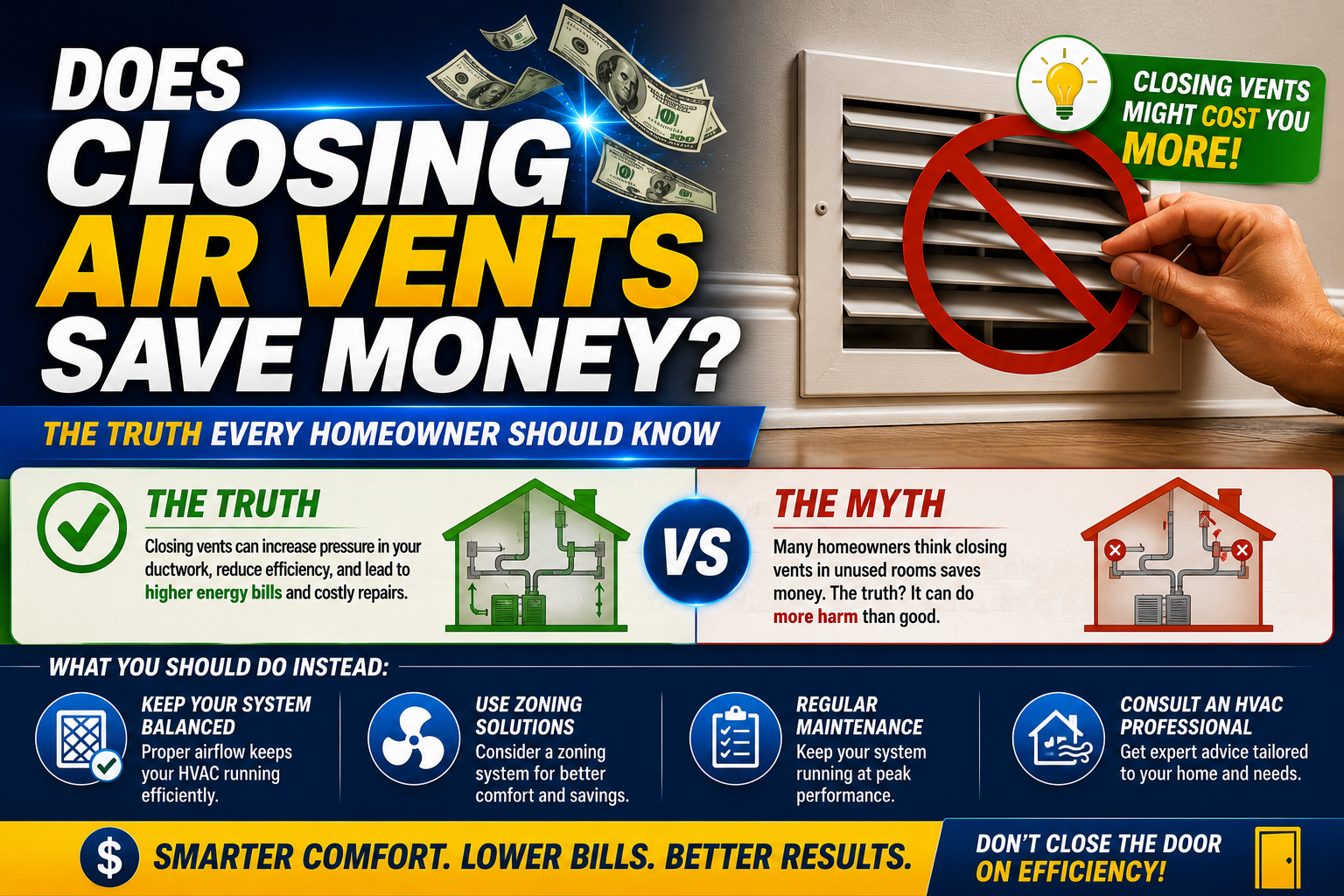
Does Closing Air Vents Save Money? The Truth Every Homeowner Should Know
Key Takeaways
- Closing air vents usually does not reduce energy bills the way many homeowners expect.
- Modern HVAC systems are designed to move a specific amount of air throughout the home.
- Restricting airflow may increase system strain, reduce comfort, and sometimes increase operating costs.
- Uneven temperatures are often caused by airflow or ductwork issues—not by having too many vents open.
- A professional airflow evaluation can identify the real cause of hot and cold spots.
Table of Contents
- Why Homeowners Close Air Vents
- How HVAC Airflow Works
- Does Closing Vents Actually Save Money?
- What Happens Inside Your HVAC System
- Common Problems Caused by Closed Vents
- Better Ways to Reduce Energy Costs
- FAQ
- Summary
Does Closing Air Vents Save Money?
It’s one of the oldest pieces of home advice:
“Close the vents in rooms you don’t use and you’ll save money.”
It sounds logical.
If you’re not using a guest bedroom or spare office, why cool it?
Many homeowners believe that closing those vents forces cool air into the rest of the house while reducing energy use.
Unfortunately…
Modern HVAC systems don’t usually work that way.
In fact, permanently closing multiple supply vents can sometimes reduce efficiency rather than improve it.
Let’s look at why.
Understanding How Your HVAC System Moves Air
Your heating and cooling system is designed to circulate a specific amount of air every minute.
That airflow travels through:
- Return ducts
- Blower motor
- Evaporator coil
- Supply ducts
- Supply registers
Every supply register was included as part of the original airflow design.
When several vents are closed, that airflow doesn’t simply disappear.
Instead, the air has fewer places to go.
The result is increased pressure inside your duct system.
Think of It Like a Garden Hose
Imagine watering your yard with a garden hose.
If you partially block the end with your thumb…
The water pressure increases.
The same principle applies inside your HVAC system.
When airflow is restricted:
- Pressure increases
- Air movement changes
- Components work harder
- Comfort may actually decrease
Your blower motor still attempts to move roughly the same amount of air.
What Is Static Pressure?
One of the most important HVAC terms homeowners rarely hear is static pressure.
Static pressure is the resistance your blower motor experiences as it pushes air through the duct system.
Every HVAC system is designed to operate within a specific range.
Closing vents increases resistance.
Higher resistance means the blower motor must work harder.
Excessive static pressure may contribute to:
- Reduced airflow
- Increased energy consumption
- Noisy ductwork
- Hot and cold spots
- Additional wear on HVAC components
While closing one vent occasionally is unlikely to cause serious issues, closing many vents throughout the home can change how the entire system operates.
What Happens When Too Many Vents Are Closed?
Many homeowners are surprised to learn that closing vents can create several unintended consequences.
Reduced Airflow Across the Evaporator Coil
Your evaporator coil depends on a steady flow of warm indoor air.
If airflow drops too low:
- The coil becomes colder than intended.
- Moisture begins freezing.
- Ice develops.
- Cooling performance decreases.
Eventually, the system may begin blowing warm air.
Longer Cooling Cycles
When airflow decreases, your air conditioner often has to run longer to remove the same amount of heat from your home.
That may result in:
- Higher utility bills
- More equipment wear
- Less consistent temperatures
Ironically…
The attempt to save energy may actually increase operating costs.
Uneven Temperatures
Many homeowners close vents because one room feels too cold.
Unfortunately, this often shifts the problem somewhere else.
Instead of balancing temperatures, it may create:
- Hot bedrooms
- Warm hallways
- Cold living rooms
- Inconsistent comfort throughout the home
The underlying airflow issue remains unresolved.
Additional Wear on Your HVAC System
Every HVAC system experiences normal wear over time.
However, unnecessary airflow restrictions can increase the workload on:
- Blower motor
- Fan assembly
- Compressor
- Duct system
Reducing unnecessary strain helps your equipment operate more efficiently over its lifespan.
Why Some Rooms Stay Hot
This is one of the biggest reasons homeowners begin closing vents.
If one room is always warmer than the rest of the house, the issue is rarely “too much airflow elsewhere.”
More common causes include:
- Poor attic insulation
- Sun exposure
- Leaky ductwork
- Dirty air filter
- Improper system balancing
- Closed return air pathways
- Incorrect equipment sizing
Closing vents usually doesn’t address the actual cause.
Better Ways to Lower Cooling Costs
If your goal is reducing your electric bill, there are often more effective strategies than closing vents.
Examples include:
- Changing air filters regularly
- Scheduling annual HVAC maintenance
- Sealing duct leaks
- Improving attic insulation
- Using a programmable or smart thermostat
- Keeping supply and return vents unobstructed
- Installing ceiling fans to improve air circulation
These steps help your HVAC system operate more efficiently without restricting airflow.