


Why Is My Heat Pump Covered in Frost or Ice?
Why Is My Heat Pump Covered in Frost or Ice?
If you own a heat pump, one winter morning you may walk outside and see:
Frost on the outdoor coil.
Maybe even some ice.
Then the system changes sound.
The outdoor fan may stop.
A cloud of steam appears.
For a homeowner who has never owned a heat pump before, that can look alarming.
But some frost is actually a normal part of heat-pump operation.
The important question is:
Is the heat pump frosting normally and clearing itself—or is ice building up and staying there?
That difference matters.
Key Takeaways
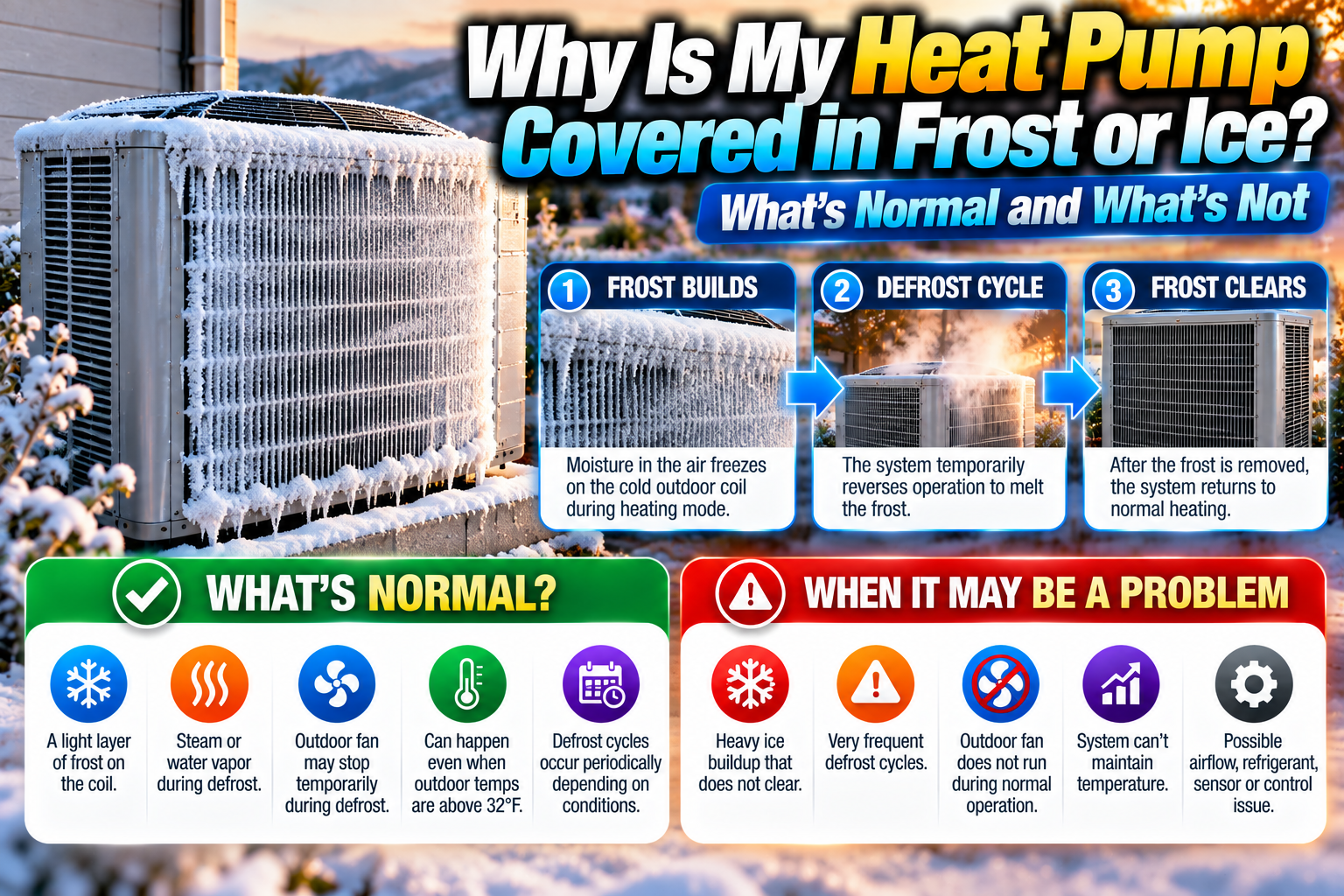
- A light layer of frost on the outdoor coil can be normal during heating operation.
- Heat pumps use a defrost cycle to remove frost from the outdoor coil.
- Steam rising from the outdoor unit during defrost can be normal.
- The outdoor fan may temporarily stop during defrost on some systems.
- Heavy ice that does not clear is not something to ignore.
- Frequent or ineffective defrost cycles can point to an airflow, refrigerant, sensor, control or equipment problem.
- Frost can form even when outdoor air is above 32°F because the coil itself may be colder than the surrounding air.
- Weather conditions such as cool temperatures and high humidity can increase frost formation.
- Heat pumps need clear airflow around the outdoor coil.
- Homeowners should not chip ice off the coil with tools.
Why Does a Heat Pump Get Frosty in the First Place?
During heating mode, the outdoor heat-pump coil becomes cold because the system is absorbing heat from outdoor air.
Moisture in the air can condense on that cold coil.
If the coil surface falls below freezing, that moisture can become frost.
That means frost can sometimes develop even when the outdoor air temperature itself is above freezing.
A California homeowner recently asked exactly this after seeing frost on a newly installed heat pump even though local winter temperatures rarely dropped below about 40°F.
The key point is:
The coil temperature can be lower than the outdoor air temperature.
Is Frost on a Heat Pump Normal?
A light, temporary layer of frost can be normal.
Especially when outdoor conditions are:
Cool
and
Damp.
Heat pumps are designed with a defrost strategy because manufacturers expect frost to occur under certain conditions.
So seeing a little frost does not automatically mean:
“My heat pump is broken.”
What matters is whether the system can remove that frost properly.
What Is a Heat-Pump Defrost Cycle?
A defrost cycle is the system’s way of removing frost from the outdoor coil.
During normal heating, the heat pump moves heat:
Outside → Inside
During defrost, the refrigeration cycle is temporarily altered so the outdoor coil can warm up and melt accumulated frost.
After the frost is cleared, the system returns to normal heating.
That is a normal operating function.
Defrost-cycle repair is one of the heat-pump issues Advanced Heating & Air Conditioning handles.
Why Does My Heat Pump Look Like It’s Smoking?
This is one of the most common homeowner concerns.
During defrost, the warm outdoor coil can melt frost and ice.
That moisture can turn into visible water vapor.
So a cloud around the outdoor unit may look like:
Smoke
when it is actually:
Steam.
That can be perfectly normal.
The distinction matters.
If you see vapor during a defrost cycle and there is:
- No burning odor
- No electrical smell
- No obvious damaged wiring
it may simply be steam.
If you smell actual burning or see smoke from electrical components, shut the system down and call for service.
Why Does the Outdoor Fan Stop During Defrost?
On some systems, the outdoor fan may stop temporarily during the defrost cycle.
That can help the coil warm up more quickly.
Homeowners sometimes think the fan has failed because they see:
Compressor running
but
outdoor fan not spinning.
If this happens briefly during a normal defrost cycle, it may be expected.
If the fan does not operate during normal heating or cooling, that is different and should be checked.
How Often Should a Heat Pump Defrost?
There is no single universal interval.
Defrost frequency depends on:
- Outdoor temperature
- humidity
- equipment design
- control logic
- coil condition
- and how much frost is forming.
Some systems use:
Time-and-temperature logic
while others use more advanced demand-defrost controls.
A recent homeowner discussion asked whether a heat pump going into defrost roughly every half hour was normal, showing how much this varies by equipment and control design.
Another homeowner described defrosting after only about 10 minutes of runtime during cold, wet conditions.
So the question should not be:
“Does it defrost every X minutes?”
The better question is:
“Is it clearing the frost effectively and returning to normal heating?”
What Weather Creates the Most Frost?
Heat pumps often frost most when conditions are:
Cool
and
Moist.
Think of:
- Cold mornings
- Fog
- Rainy winter weather
- High humidity
around freezing or somewhat above freezing.
Extremely dry cold air may actually produce less frost than damp air at slightly warmer temperatures.
That’s because frost formation depends on both:
Temperature
and
Moisture.
Can a Heat Pump Frost Above 32°F?
Yes.
This surprises many homeowners.
The outdoor air might be:
38°F
or
42°F
while the coil surface itself may be colder.
That can allow moisture on the coil to freeze.
So you cannot determine whether frosting is normal solely by checking the weather app.
What Does Normal Frost Look Like?
Normal frost is generally:
- Light
- fairly even
- and
- temporary.
The system should eventually enter defrost and clear it.
After a successful defrost cycle, the coil should largely return to a clear condition.
What Does Abnormal Ice Buildup Look Like?
More concerning signs include:
- Thick solid ice
- Ice covering large portions of the coil for long periods
- Ice that keeps building after multiple defrost cycles
- Ice around the fan area
- Ice that blocks airflow
- or
- A coil that never fully clears.
That is different from ordinary light frost.
Why Is My Heat Pump Turning Into a Block of Ice?
Several things can contribute.
1. Defrost Control Problem
If the system fails to recognize when frost should be removed, ice may continue building.
Possible causes may involve:
- Sensors
- control board
- wiring
- or other defrost-control components.
2. Refrigerant Problem
A refrigerant-related issue can affect coil temperatures and system performance.
Low refrigerant or another refrigeration-system problem may contribute to abnormal icing.
A homeowner should not simply have refrigerant added repeatedly without finding out why the system is low.
3. Outdoor Coil Is Dirty
A dirty outdoor coil can restrict airflow and interfere with heat transfer.
That can change how the system operates and contribute to icing issues.
4. Outdoor Fan Problem
If the outdoor fan is not moving air properly during normal heating operation, the system may not exchange heat as intended.
That can contribute to poor performance and icing.
5. Defrost Sensor Problem
The system uses temperature information to determine when defrost is needed.
If a sensor is inaccurate or failed, defrost may occur:
- Too often
- Too late
- or
- Not at all.
6. Control-Board Problem
The control system coordinates heat-pump operation.
A fault in the control board or logic can interfere with proper defrost.
7. Installation Issue
New equipment can still have problems if installation is incorrect.
Examples might involve:
- Refrigerant charge
- wiring
- airflow
- sensor placement
- or equipment setup.
A new heat pump should not automatically be assumed perfect simply because it is new.
Can Low Refrigerant Cause Frost or Ice?
It can contribute to abnormal system temperatures and performance.
But ice alone does not prove low refrigerant.
This is important.
Homeowners sometimes see ice and immediately assume:
“It needs Freon.”
That is not a diagnosis.
A technician should evaluate the refrigeration system properly rather than guessing from appearance.
Can a Dirty Filter Cause Outdoor Ice?
A severely restricted indoor air filter can reduce airflow through the indoor coil.
That affects system operation and can create performance problems.
Whether it directly causes outdoor frosting depends on operating conditions and system design, but airflow should always be checked when heat-pump performance changes.
Can Blocked Airflow Around the Outdoor Unit Cause Problems?
Yes.
The outdoor unit needs clear airflow.
Keep the area around it free from:
- Leaves
- weeds
- debris
- stored items
- and other obstructions.
In colder climates, snow can also block airflow.
In Southern California, snow is generally not the concern, but leaves, landscaping and debris certainly can be.
Should I Cover My Heat Pump in Winter?
Generally, no.
A heat pump needs to operate during winter heating.
Covering it can block airflow and interfere with operation.
Do not treat a heat pump like an AC condenser that is shut down for the entire winter.
It is actively working during heating season.
Can Water Around My Heat Pump Be Normal?
Yes.
During defrost, frost and ice melt into water.
That water has to go somewhere.
So seeing water around the outdoor unit after defrost can be normal.
The key is whether the installation allows water to drain away properly.
Why Is There Ice Under My Heat Pump?
Meltwater from repeated defrost cycles can refreeze if outdoor conditions are cold enough.
That can create ice beneath the unit.
In very cold climates, installers often need to consider:
- Unit elevation
- drainage
- and clearance underneath the heat pump.
A 2026 homeowner found that a unit installed too close to the ground allowed defrost water to accumulate and refreeze underneath it.
Southern California usually sees far less extreme winter icing, but drainage still matters.
Does a Heat Pump Need to Be Elevated?
Installation requirements vary by equipment and climate.
The outdoor unit should be installed according to:
- Manufacturer requirements
- local code
- site drainage
- and expected environmental conditions.
The important point is that defrost water should not create a recurring problem around the base of the unit.
Why Does My Heat Pump Blow Cooler Air During Defrost?
During defrost, the refrigeration cycle temporarily changes.
That can affect the temperature of air being delivered indoors.
Some systems use auxiliary heat during defrost to reduce the chance of cool air entering the home.
If auxiliary heat is not available or not operating, the homeowner may notice cooler supply air temporarily.
Is a Little Cool Air During Defrost Normal?
It can be.
What is more concerning is:
- Cold air continuing for a long period
- or
- the house losing temperature significantly because the system never returns to normal heating.
One 2026 homeowner experienced prolonged cold air and later found the outdoor coil was heavily frozen, causing repeated defrost behavior.
How Long Should Defrost Last?
Usually, a defrost cycle is temporary.
The exact time depends on the equipment and conditions.
Homeowners should be less concerned about the exact number of minutes and more concerned with whether the system:
- Clears the frost
- returns to heating
- and
- maintains indoor comfort.
A defrost cycle that never seems to finish or does not clear the coil deserves investigation.
What If My Heat Pump Defrosts Constantly?
Frequent defrost can have several explanations.
It may simply be:
Very cold and damp outside.
But it can also involve:
- Dirty coil
- sensor problem
- control problem
- refrigerant issue
- or other equipment concerns.
Frequent defrost should be evaluated in context.
Does Frequent Defrost Waste Energy?
Defrost does temporarily interrupt normal heating.
So excessive unnecessary defrost can reduce efficiency.
But a properly controlled defrost cycle is necessary because a heavily frosted coil also reduces heat transfer.
In other words:
Not defrosting is not more efficient.
The goal is:
Defrost when needed—not constantly and not never.
Why Does Ice Hurt Heat-Pump Performance?
The outdoor coil needs air to move across it.
A layer of ice acts like a barrier.
As ice grows:
- Airflow decreases
- heat transfer decreases
- and
- the system may struggle to absorb heat.
That can lead to:
- Longer runtime
- poorer comfort
- and potentially more backup-heat operation.
Can Heavy Ice Damage the Heat Pump?
Severe ice buildup can create mechanical problems.
It may interfere with:
- Fan blades
- coil airflow
- cabinet components
- and drainage.
That’s why a unit that remains heavily iced should not simply be ignored.
Should I Pour Hot Water on My Heat Pump?
Generally, homeowners should avoid trying to manually “repair” the system by pouring boiling water on components.
Rapid temperature changes can potentially damage equipment, and water near electrical components creates unnecessary risk.
If the system is not defrosting properly, address the cause.
Should I Break the Ice Off?
No.
Do not use:
- Screwdrivers
- hammers
- ice picks
- or other tools on the coil.
The coil contains delicate fins and refrigerant tubing.
Physical damage can turn a service problem into a much more expensive repair.
Should I Turn the Heat Pump Off if It Is Frozen Solid?
If the unit is severely iced and the fan cannot operate properly, shutting the system down and calling for service may be appropriate.
Do not allow the outdoor fan to repeatedly strike ice.
If you have a safe backup heating source, use it according to the equipment and thermostat instructions while service is arranged.
Could the Defrost Board Be Bad?
Yes, depending on system design.
Older and simpler heat pumps may use a dedicated defrost board.
Newer equipment may integrate defrost logic into a broader control system.
The technician should determine whether the actual problem is:
- Sensor
- wiring
- board
- refrigeration
- fan
- or something else.
Do not replace a control board simply because icing exists.
Could the Reversing Valve Cause Defrost Problems?
Potentially.
The reversing valve changes the direction of refrigerant flow between heating and cooling modes.
Defrost relies on the system being able to alter refrigeration operation properly.
A reversing-valve problem can therefore affect heat-pump heating and defrost behavior.
What If the Outdoor Unit Is Completely White With Frost?
Look at whether it is:
Light frost
or
Solid thick ice.
A thin white coating can occur before a normal defrost.
A solid frozen block that remains for hours is not the same thing.
That should be checked.
Is Steam Every Time the Heat Pump Defrosts Normal?
Visible steam can occur when frost melts rapidly during defrost.
The amount you see depends on:
- Humidity
- temperature
- and how much frost was present.
It can look dramatic even when the system is functioning normally.
Why Do Heat Pumps Need Defrost but Furnaces Don’t?
A gas furnace does not collect outdoor heat through a cold outdoor coil.
A heat pump does.
That means the outdoor heat exchanger can operate at temperatures that allow moisture to freeze on it.
Defrost is therefore part of the refrigeration-based heating process.
Does Every Heat Pump Defrost the Same Way?
No.
Different manufacturers use different:
- Sensors
- algorithms
- timing strategies
- and control logic.
That is why one homeowner’s system may defrost differently from another’s even under similar weather.
Comparing your heat pump to a random online video is not always useful.
Can Variable-Speed Heat Pumps Defrost Differently?
Yes.
Variable-capacity systems may use more advanced control strategies that take into account operating conditions, coil temperature, compressor operation and other information.
The exact process is manufacturer-specific.
Is Frost Common in Temecula?
It can happen.
Temecula winters are mild compared with colder parts of the country, but we still experience:
- Cold overnight temperatures
- Moist mornings
- fog
- and seasonal humidity.
The coil itself may also be colder than outdoor air.
So frost on a heat pump in the Temecula Valley is possible even without extreme freezing weather.
Should a Heat Pump in Southern California Need Defrost?
Yes, when conditions create frost.
Defrost is not just a “snow country” function.
Even heat pumps in relatively mild climates can frost.
The California homeowner discussion mentioned earlier is a good example: frost occurred despite outdoor conditions often staying around the 40s.
What Can Homeowners Safely Check?
You can look for:
- How much frost is present
- Whether the system eventually clears it
- Whether the outdoor fan runs normally outside defrost
- Whether airflow around the unit is blocked
- Whether the thermostat is maintaining temperature
- Whether auxiliary heat is running constantly
- and
- Whether the problem is getting worse.
Those observations are very useful when calling for service.
When Should I Call an HVAC Technician?
Schedule service if:
- The heat pump becomes heavily iced
- The ice does not clear
- Defrost seems to happen constantly
- The outdoor fan hits ice
- The system cannot maintain indoor temperature
- The house receives cold air for long periods
- The outdoor fan is not operating normally
- Energy use suddenly increases
- or
- The system repeatedly relies on backup heat.
Advanced Heating & Air Conditioning lists heat-pump defrost-cycle repair, frozen-coil repair, fan repair and refrigerant diagnostics among its heat-pump services.
Frequently Asked Questions
Is frost on my heat pump normal?
A light layer of temporary frost can be normal during heating operation, especially in cool, humid weather.
Why does my heat pump frost when it is 40°F outside?
The outdoor coil can be colder than the surrounding air, allowing moisture on the coil to freeze.
What is a heat-pump defrost cycle?
It is a temporary operating mode that warms the outdoor coil so accumulated frost can melt.
Why is steam coming from my heat pump?
Steam or water vapor can appear during defrost as frost and ice melt from the outdoor coil.
Why does the outdoor fan stop during defrost?
Some heat pumps stop the outdoor fan temporarily during defrost. That can be normal depending on the equipment.
How often should my heat pump defrost?
There is no universal interval. Frequency depends on equipment design and outdoor temperature and humidity.
Is a heat pump covered in solid ice normal?
No. Heavy ice that does not clear should be investigated.
Can low refrigerant cause ice?
A refrigeration-system problem can contribute to abnormal icing, but ice alone does not prove the system is low on refrigerant.
Can a dirty outdoor coil cause icing?
A dirty or restricted coil can interfere with normal heat transfer and contribute to performance problems.
Should I break ice off my heat pump?
No. Using tools can damage the coil and refrigerant tubing.
Should I cover my heat pump in winter?
Generally no. The unit needs airflow because it operates during heating season.
Why is there water under my heat pump?
Defrost melts frost into water, so some water around the unit can be normal if it drains properly.
The Simple Rule
Remember this:
Light frost that clears = often normal.
Heavy ice that stays = investigate.
A properly operating heat pump is designed to manage frost through its defrost cycle.
But the system should not remain buried in ice.
Knowing that difference can keep homeowners from panicking over normal heat-pump behavior while also helping them recognize when the equipment actually needs service.
Heat Pump Service & Installation in the Temecula Valley
Advanced Heating & Air Conditioning provides heat-pump installation, repair and maintenance throughout Temecula, Murrieta, Menifee, Winchester, Wildomar, French Valley, Canyon Lake, Lake Elsinore, Hemet and surrounding communities.
Advanced’s current heat-pump service pages include defrost-cycle repair, frozen-coil repair, fan-motor service and refrigerant diagnostics.
Advanced Heating & Air Conditioning
951-609-9881
California Contractor License #916901
REAL PEOPLE. REAL SERVICE. REAL COMFORT.