


R-32 vs. R-454B: New HVAC Refrigerants Explained
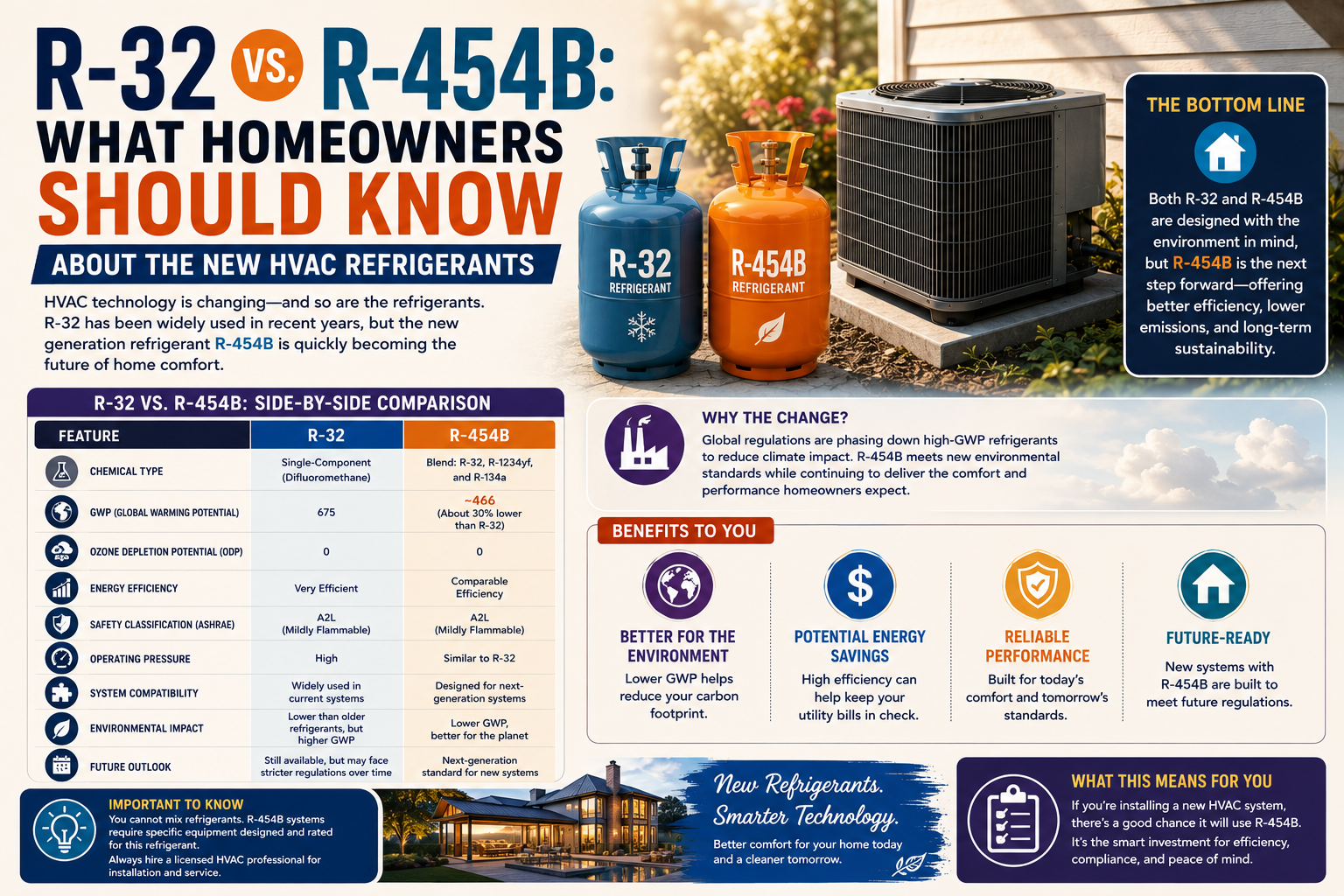
Shopping for a New Air Conditioner? You’re Probably Going to Hear Some New Refrigerant Names
For years, many homeowners didn’t think much about the refrigerant inside their air conditioner.
You bought an HVAC system.
The technician installed it.
And unless there was a refrigerant-related problem, you probably never thought about it again.
That’s changing.
Homeowners shopping for new air conditioners and heat pumps are increasingly hearing terms such as:
- R-454B
- R-32
- A2L refrigerant
- Low-GWP refrigerant
- R-410A transition
So what does all of this actually mean?
And more importantly:
If you’re replacing your HVAC system, should you care whether it uses R-32 or R-454B?
Yes—but probably not for the reasons you think.
Let’s break it down without turning this into a chemistry lesson.
First: What Does Refrigerant Actually Do?
Refrigerant is the substance circulating through your air conditioning or heat pump system that allows the equipment to transfer heat.
During cooling operation, the HVAC system absorbs heat from inside your home and releases it outdoors.
Refrigerant moves through components such as the:
- Evaporator coil
- Compressor
- Condenser coil
- Metering device
and changes pressure and temperature as part of the refrigeration cycle.
Without the correct refrigerant operating under the correct conditions, your air conditioner can’t perform as designed.
What Is R-410A?
R-410A became one of the dominant refrigerants used in residential air conditioning and heat-pump systems after the transition away from R-22.
If your central air conditioner was installed during roughly the last couple of decades, there’s a good chance it may use R-410A.
For years, R-410A was considered the modern replacement for older R-22 equipment.
Now the industry is going through another transition.
Why Is the HVAC Industry Moving Away From R-410A?
This transition is primarily about the refrigerant’s global warming potential, commonly called GWP.
Federal rules under the American Innovation and Manufacturing Act are reducing the use of higher-GWP hydrofluorocarbon refrigerants.
EPA’s current rules limit new residential and light-commercial air-conditioning and heat-pump systems to refrigerants below the applicable GWP threshold. The market has consequently shifted toward refrigerants such as R-454B and R-32.
This doesn’t mean millions of existing R-410A systems suddenly became illegal.
We’ll explain that distinction shortly.
What Is R-454B?
R-454B is one of the lower-GWP refrigerants being used in newer residential HVAC equipment.
It’s a refrigerant blend specifically selected by several HVAC manufacturers as part of the industry’s transition away from R-410A.
If you’re receiving estimates for a new central air conditioner or heat pump, there’s a good chance you’ll encounter equipment designed for R-454B.
What Is R-32?
R-32 is another lower-GWP refrigerant being used in new HVAC equipment.
Unlike R-454B, which is a blend, R-32 is a single-component refrigerant.
Some manufacturers have chosen R-32 for their new generation of residential heating and cooling equipment.
Both R-32 and R-454B meet the lower-GWP direction driving today’s residential HVAC transition.
So Which Refrigerant Replaced R-410A?
There’s no single universal replacement.
That’s one of the biggest differences homeowners may notice during this transition.
Some HVAC manufacturers are using:
R-454B
while others are using:
R-32.
That means the refrigerant in your next HVAC system may depend partly on the manufacturer and equipment you select.
What Does A2L Mean?
You’re going to hear this term frequently.
Both R-32 and R-454B fall into the A2L refrigerant safety classification.
In simplified terms:
A relates to lower toxicity classification.
2L identifies refrigerants with lower flammability characteristics and a relatively low burning velocity compared with more flammable refrigerant classifications.
This is why you’ll sometimes hear A2L refrigerants described as:
“mildly flammable.”
That doesn’t mean homeowners should panic.
It means the equipment, installation procedures, service tools, training, and safety requirements need to account for the characteristics of the refrigerant.
EPA notes that mildly flammable refrigerants such as R-32 and R-454B must be used in systems designed for them.
Are New A2L HVAC Systems Safe?
HVAC equipment using these refrigerants is specifically designed around the refrigerant’s properties and applicable safety standards.
Depending on the equipment and application, new systems may incorporate additional design features and controls.
The important point for homeowners is:
Use equipment designed for the refrigerant and have it installed and serviced by professionals trained for that equipment.
EPA specifically advises that technicians working with substitute refrigerants should be trained in the installation and service techniques required for those refrigerants.
Can You Put R-454B Into an R-410A Air Conditioner?
No.
Do not think of these refrigerants as interchangeable fluids.
An R-410A system was designed for R-410A.
An R-454B system is designed for R-454B.
An R-32 system is designed for R-32.
EPA notes that safety standards prohibit using mildly flammable refrigerants such as R-32 or R-454B in systems that weren’t designed for them.
You cannot simply drain an older air conditioner and convert it to whichever new refrigerant happens to be available.
Can You Put R-32 Into an R-454B System?
Again, no.
The equipment should use the refrigerant specified by the manufacturer.
Even though both are part of the new generation of lower-GWP refrigerants, they’re different refrigerants with different properties.
Your HVAC system should always be serviced according to its equipment specifications.
Do I Have to Replace My R-410A Air Conditioner?
No.
This is probably the most important part of this entire article.
If your existing R-410A air conditioner is operating properly:
You don’t need to replace it simply because refrigerant standards changed.
EPA allows R-410A components to continue being manufactured and sold for servicing existing R-410A systems, subject to applicable labeling and use requirements.
The refrigerant transition is primarily changing the requirements for new systems, not forcing homeowners to remove functioning equipment.
Can My Existing R-410A System Still Be Repaired?
Yes.
Existing R-410A systems can continue to be serviced.
EPA specifically allows components such as R-410A condensing units, compressors, evaporators and other parts to continue being available for servicing existing equipment under the applicable rules.
Whether repairing a particular system makes financial sense is a separate question.
That depends on:
- Equipment age
- Type of failure
- Repair cost
- Overall condition
- Parts availability
- Efficiency
- Future reliability
But the existence of new refrigerants doesn’t automatically mean an R-410A system is unrepairable.
What Happens If My R-410A System Develops a Refrigerant Leak?
The system can still be evaluated and repaired when appropriate.
The technician should determine:
- Where the leak is located
- Whether the component can be repaired
- Whether replacement components are available
- How much the repair will cost
- Overall equipment condition
A refrigerant transition shouldn’t be used as an automatic reason to sell every homeowner a complete HVAC replacement.
Sometimes repair makes sense.
Sometimes replacement makes sense.
The entire situation should be considered.
What If Only My R-410A Outdoor Unit Fails?
This gets more technical.
EPA distinguishes between repairing an existing system and installing an entirely new system.
R-410A components can continue to be manufactured for servicing existing R-410A equipment, but those service components can’t simply be used to construct a new R-410A system after the applicable compliance date.
Compatibility, equipment matching, availability and the condition of the remaining HVAC components all need to be evaluated.
This is a situation where homeowners should get a professional recommendation based on their actual equipment.
What Counts as a “New System”?
For residential split air conditioners, EPA explains that replacing both the condensing unit and indoor evaporator coil constitutes installation of a new system for purposes of its Technology Transitions rules—even when the existing refrigerant lines remain in place.
This distinction matters because repair rules and new-system requirements aren’t necessarily the same.
Will My New HVAC System Probably Use R-32 or R-454B?
Increasingly, yes.
The bulk of new residential equipment being produced has transitioned toward lower-GWP refrigerants, particularly R-454B and R-32. EPA documentation indicates that these refrigerants have become the primary choices in the U.S. residential market.
Your actual refrigerant will depend on the manufacturer and equipment selected.
Is R-32 Better Than R-454B?
Homeowners naturally want a winner.
“Just tell me which one is better.”
But refrigerant alone shouldn’t determine your entire HVAC purchase.
Consider the complete system:
- Equipment quality
- Efficiency
- Compressor technology
- Warranty
- Parts availability
- Contractor support
- Installation quality
- Duct compatibility
- Comfort features
- Maintenance
- Manufacturer support
An excellent HVAC system professionally installed and commissioned shouldn’t automatically be rejected simply because it uses one of these two refrigerants instead of the other.
Should I Choose My HVAC Brand Based on Refrigerant?
Refrigerant is worth understanding.
But it should be one factor, not the only factor.
Imagine choosing an HVAC system solely because you prefer its refrigerant while ignoring:
- Poor equipment sizing
- Bad ductwork
- Improper installation
- Weak warranty support
- Incorrect airflow
You haven’t necessarily made a better purchase.
The complete installation matters far more than the refrigerant name printed on the equipment label.
Will R-454B or R-32 Make My House Colder?
Don’t expect the refrigerant transition itself to create dramatically different comfort.
Cooling performance depends on the complete HVAC system.
That includes:
- Equipment capacity
- Efficiency
- Compressor operation
- Indoor coil
- Outdoor coil
- Airflow
- Ductwork
- Thermostat
- Home heat load
- Installation
The reason for this refrigerant transition is largely environmental and regulatory—not because R-410A suddenly stopped being capable of cooling houses.
Does the New Refrigerant Mean My HVAC System Will Be More Efficient?
Not automatically.
Refrigerant choice and HVAC efficiency aren’t the same thing.
New equipment may certainly be more efficient than an older system, especially when replacing equipment that’s many years old.
But efficiency depends on the specific equipment rating and system design.
Don’t assume:
“New refrigerant = automatically lower electric bill.”
Compare the actual HVAC equipment.
Will New Refrigerant Systems Cost More?
Equipment pricing depends on many factors.
The transition requires manufacturers, distributors and contractors to work with newly designed equipment, components, tools, training and refrigerant handling requirements.
There were also R-454B supply-chain challenges during the industry’s early transition period in 2025, according to EPA documentation.
For homeowners, the best approach is to compare complete HVAC proposals rather than trying to isolate the cost of the refrigerant itself.
Will R-410A Disappear Tomorrow?
No.
This is another misunderstanding that can lead homeowners to make rushed decisions.
The United States is phasing down HFC production and consumption over time.
That’s different from someone flipping a switch and making every existing R-410A system obsolete overnight.
EPA continues to permit R-410A components for servicing legacy equipment.
Existing systems will remain in homes for years.
Should I Replace My R-410A System Before It Breaks?
That depends on the system—not simply the refrigerant.
Consider proactive replacement when factors such as these begin stacking up:
- Older equipment
- Frequent repairs
- Major component problems
- Poor efficiency
- High operating costs
- Comfort problems
- Expensive refrigerant-related repairs
- Upcoming remodeling
- Desire for a heat pump or newer technology
A well-operating R-410A system may still have useful service life.
Don’t replace functioning equipment purely out of fear of the refrigerant transition.
What If I Have an Older R-22 System?
That’s a different situation.
R-22 predates R-410A and has already undergone its own major phaseout.
Older R-22 systems can become increasingly challenging and expensive to repair depending on the failure.
If you still have an R-22 system and face a significant repair, it can be worthwhile to compare repair costs with replacement rather than automatically investing heavily in aging equipment.
How Do I Know Which Refrigerant My Current AC Uses?
Look at the equipment data plate.
The outdoor condenser’s label typically identifies the refrigerant type.
You may see something such as:
- R-22
- R-410A
- R-32
- R-454B
Don’t remove equipment panels or open refrigerant components.
The manufacturer’s data label should provide the basic information you need.
What Should I Ask When Getting an HVAC Replacement Estimate?
When comparing new systems, ask your contractor:
What refrigerant does this system use?
Know what you’re purchasing.
Why did this manufacturer choose that refrigerant?
A knowledgeable contractor should be able to explain the equipment.
Is your installation team trained for this refrigerant?
New refrigerant technology requires appropriate installation and service practices.
Does this system require additional safety controls?
Understand how the equipment is designed.
What is the equipment warranty?
Refrigerant is only one part of long-term ownership.
How available are replacement parts?
Parts support matters.
What efficiency level am I buying?
Compare the actual equipment.
Is my ductwork compatible with the new system?
Never forget the air-distribution system.
Don’t Let Refrigerant Confusion Distract You From Installation Quality
This deserves its own section.
Homeowners may spend hours researching:
R-32 vs. R-454B.
Then choose the cheapest installer.
That’s backwards.
Even excellent equipment can perform poorly if installation is poor.
Your HVAC contractor still needs to get the fundamentals right:
- Equipment sizing
- Refrigerant piping
- Evacuation procedures
- Electrical installation
- Drainage
- Airflow
- Ductwork
- Thermostat setup
- Equipment commissioning
The refrigerant may be changing.
The importance of good workmanship isn’t.
Is This Like the R-22 to R-410A Transition?
In some ways, yes.
The HVAC industry has gone through major refrigerant transitions before.
Many homeowners remember when R-22 equipment was common.
Then R-410A became the dominant refrigerant in newer residential systems.
Now another generation of lower-GWP refrigerants is entering the market.
Transitions can create confusion because old and new equipment coexist for many years.
That’s exactly what’s happening now.
Should Homeowners Be Nervous About Buying New HVAC Equipment Right Now?
There’s no need to avoid replacing a failing HVAC system simply because refrigerant technology has changed.
The industry is already producing and installing equipment designed around the new refrigerants, and EPA advises homeowners to use dealers trained in the installation and service techniques required for the specific substitute refrigerant.
The better approach is to become an informed buyer.
Understand:
- What equipment you’re purchasing.
- What refrigerant it uses.
- Who is installing it.
- What warranty you’re receiving.
- How the system is being designed for your home.
That’s much more useful than simply being afraid of something new.
Frequently Asked Questions About R-32, R-454B and R-410A
What refrigerant is replacing R-410A?
There isn’t one universal replacement. R-454B and R-32 are two major lower-GWP refrigerants being used in newer residential HVAC equipment.
Is R-410A banned?
Existing R-410A systems aren’t banned from operating or being serviced. EPA continues to allow R-410A components for servicing legacy equipment, while new-system rules are transitioning the market toward lower-GWP refrigerants.
Do I need to replace my R-410A air conditioner?
No. A functioning R-410A system doesn’t need replacement solely because of the refrigerant transition.
Can I put R-454B into my R-410A system?
No. Equipment must be designed for the refrigerant being used.
Can R-32 go into an R-410A system?
No. R-32 equipment is specifically designed for R-32.
Are R-32 and R-454B flammable?
They’re classified as A2L refrigerants, a category with lower flammability characteristics than more highly flammable refrigerant classifications. Equipment and installation requirements account for these characteristics.
Which is better, R-32 or R-454B?
Neither refrigerant alone determines which HVAC system is best for your home. Equipment quality, installation, efficiency, warranty, support and system design should all be considered.
Can R-410A systems still be repaired?
Yes. EPA rules allow continued servicing of existing R-410A equipment and the sale of components for that purpose.
What This Means for Temecula Valley Homeowners
Homeowners throughout Temecula, Murrieta, Menifee, Lake Elsinore, Winchester, Hemet, Anza, and surrounding Southern California communities will increasingly encounter R-32 and R-454B equipment when requesting HVAC replacement estimates.
That’s normal.
We’re in the middle of another major HVAC technology transition.
If your existing R-410A system is working properly, don’t panic.
If it needs a minor repair, evaluate the repair.
If it needs an expensive repair and the equipment is aging, compare your options.
And if you’re purchasing a completely new HVAC system, make sure you understand what you’re buying.
The Bottom Line
The HVAC industry is moving from R-410A toward lower-GWP refrigerants, with R-32 and R-454B among the major options used in new residential equipment.
But homeowners should remember:
- R-410A systems don’t suddenly need to be replaced.
- Existing R-410A equipment can still be serviced.
- R-32 and R-454B aren’t interchangeable.
- New equipment is specifically designed for its refrigerant.
- Refrigerant choice is only one part of choosing a new HVAC system.
And perhaps most importantly:
A new refrigerant doesn’t replace the need for excellent HVAC design and installation.
Choose the right equipment.
Choose the right contractor.
Make sure the system is sized, installed, tested, and commissioned correctly.
That’s what ultimately determines how well your HVAC investment serves your home.
Considering a New HVAC System?
If you’re comparing a new R-32 or R-454B air conditioner or heat pump, Advanced Heating & Air Conditioning can help explain your equipment options and what the new refrigerant transition means for your home.
We provide professional HVAC replacement, installation, and air conditioning services throughout Temecula, Murrieta, Menifee, Lake Elsinore, Winchester, Hemet, Anza, and surrounding Southern California communities.
Contact Advanced Heating & Air Conditioning to schedule an HVAC replacement evaluation and learn which system is right for your home.