


Can a Heat Pump Cool Your Home in 100°F Weather?
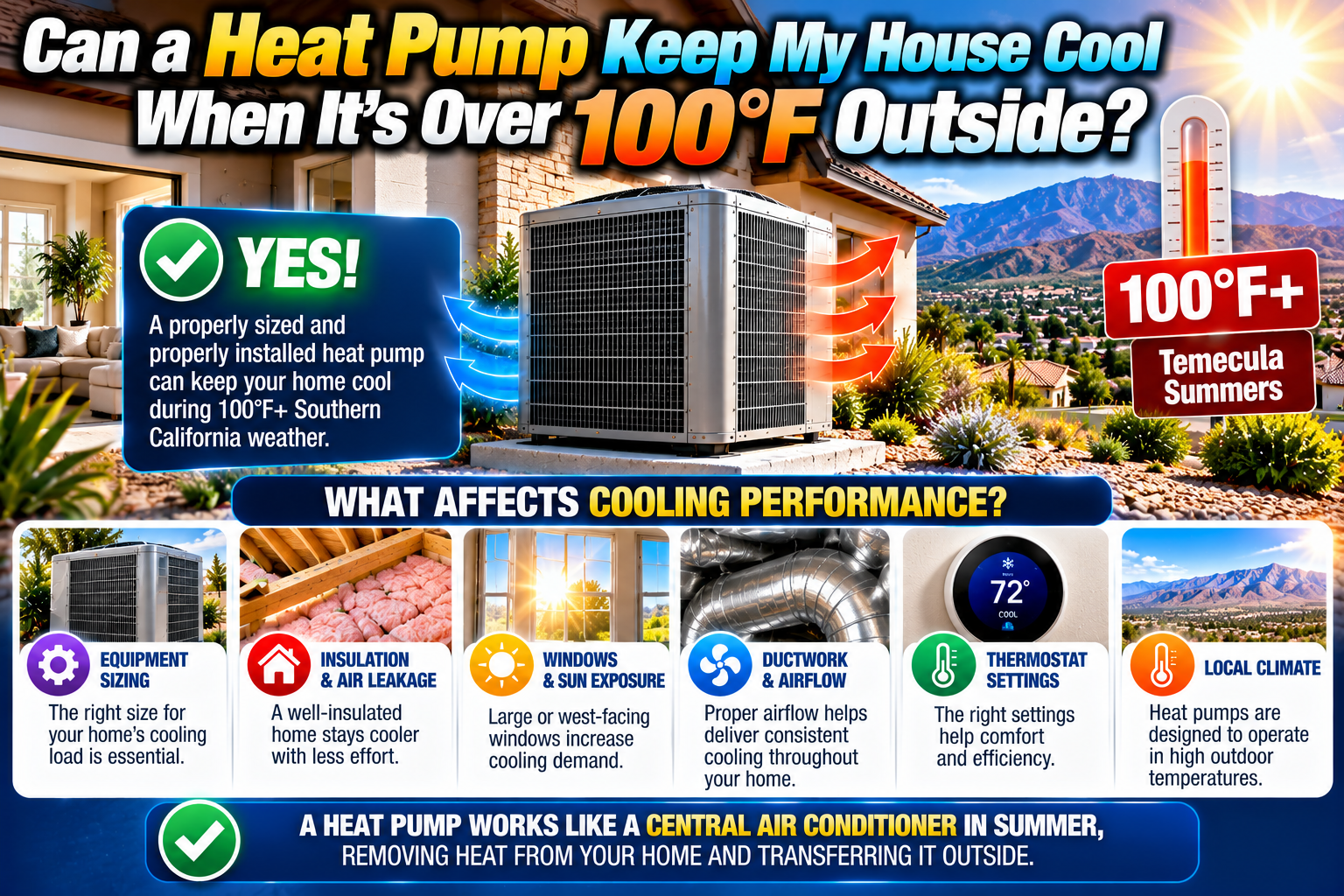
Can a Heat Pump Keep My House Cool When It’s Over 100°F Outside?
When Southern California summer temperatures climb past:
95°F
100°F
or even higher,
homeowners considering a heat pump often ask:
“Will it actually keep my house cool?”
That’s a fair question.
The name heat pump makes some people assume the equipment is designed primarily for heating.
But during summer:
A heat pump operates very much like a central air conditioner.
It removes heat from your home and transfers that heat outdoors.
So yes:
A properly selected and properly installed heat pump can cool a home during triple-digit Southern California weather.
But there is an important second part to that answer.
How well it performs depends on:
- Equipment sizing
- actual cooling capacity
- outdoor design temperature
- ductwork
- airflow
- insulation
- windows
- air leakage
- and installation quality.
The label heat pump does not determine whether your house stays comfortable.
The entire system does.
Key Takeaways
- A heat pump provides air conditioning as well as heating.
- In cooling mode, its refrigeration process is essentially the same basic process used by a conventional central AC system.
- Heat pumps can operate in temperatures above 100°F when the equipment is designed and selected for those conditions.
- Proper cooling-load calculations are especially important in the Temecula Valley.
- Long runtime during extreme heat does not automatically mean the heat pump is failing.
- A system that runs continuously and cannot maintain a reasonable indoor temperature deserves evaluation.
- Ductwork and airflow can dramatically affect cooling performance.
- Attic insulation, windows, solar gain and air leakage also affect how hard the equipment must work.
- Variable-speed heat pumps may run for long periods at lower capacity and ramp up as outdoor temperatures rise.
- Bigger is not automatically better.
- Heat-pump performance should be evaluated using actual manufacturer performance data—not assumptions.
First: Is a Heat Pump Also an Air Conditioner?
Yes.
This is one of the most important things homeowners should understand.
A traditional central air conditioner transfers heat:
Inside → Outside.
A heat pump does the same thing during summer.
It uses:
- A compressor
- refrigerant
- indoor coil
- outdoor coil
- and fans
to move heat out of the house.
The major difference is that a heat pump also has the ability to reverse the refrigeration cycle during winter.
That allows it to provide heating.
So during a 100°F Temecula afternoon, your heat pump is essentially doing the job you expect from a central AC system.
Why Do People Think Heat Pumps Cannot Handle Hot Weather?
Much of the public conversation around heat pumps focuses on:
“Will they work when it gets cold?”
That’s understandable because heating performance has historically been one of the biggest questions.
But that can accidentally make people think:
Heat pump = heating appliance.
It isn’t.
A heat pump is a:
Heating AND cooling system.
In fact, homeowners in warm climates are increasingly considering heat pumps precisely because the equipment can provide normal air conditioning while also handling the relatively mild winter heating season. A 2026 discussion about U.S. heat-pump adoption specifically noted that in warmer climates, heat pumps function much like traditional AC systems during most of the cooling season.
Can a Heat Pump Run When It Is 100°F Outside?
Yes.
Modern heat pumps and air conditioners are designed to operate during high outdoor temperatures, subject to the specific equipment’s operating limits.
The important question is not simply:
“Is it 100 degrees?”
It is:
“How much cooling capacity does this specific system produce at the outdoor temperatures expected at my home?”
That information is available from manufacturer performance data.
A contractor should select equipment based on the actual conditions where it will be installed.
What About 105°F or 110°F?
Again, specific equipment matters.
Some systems are designed to continue operating at very high outdoor temperatures.
But cooling capacity and efficiency can change as outdoor temperature rises.
That means a contractor should not merely say:
“It’s a 4-ton heat pump.”
You want to know whether the equipment can deliver the needed capacity under your local summer design conditions.
California homeowners are asking exactly this. One Sacramento homeowner with temperatures around 100–110°F reported that the heat pump could maintain roughly the mid-70s indoors during extreme heat but could not pull the house down as low as they expected.
That does not automatically mean the heat pump technology is inadequate.
It means the entire home and system need to be considered.
What Is Cooling Capacity?
Cooling capacity describes how much heat the HVAC system can remove from the home over time.
It is commonly expressed in:
BTUs per hour
or
tons.
One ton is approximately:
12,000 BTU per hour.
So a nominal:
- 3-ton system ≈ 36,000 BTU/h
- 4-ton system ≈ 48,000 BTU/h
- 5-ton system ≈ 60,000 BTU/h
But those are nominal numbers.
Actual capacity can vary with operating conditions.
Why Does Cooling Capacity Change in Extreme Heat?
Air conditioners and heat pumps reject indoor heat to the outdoors.
As outdoor temperature rises, that process becomes more demanding.
The equipment still operates, but its actual performance can change.
This is why certified performance data and proper equipment selection matter.
A contractor should not size equipment using only:
Square footage
or
the size of your old AC.
What Is the Summer Design Temperature?
HVAC systems are typically selected around recognized outdoor design conditions for the local area.
This is different from:
The hottest temperature ever recorded.
The goal is to select equipment that can handle normal peak conditions without being dramatically oversized during the rest of the year.
That balance matters.
If equipment were sized for an extremely rare record-breaking temperature, it could be oversized almost every other day.
Does a Heat Pump Have to Maintain 68°F Indoors When It’s 110°F Outside?
Not necessarily.
This is an important distinction.
A properly designed HVAC system should provide reasonable indoor comfort under expected design conditions.
But homeowners sometimes test their equipment by setting:
65°F
or
68°F
during an extreme heat wave and conclude something is wrong if the home does not reach that unusually low temperature.
The ability to maintain:
74°F indoors at 108°F outdoors
is very different from:
The system cannot cool below 85°F.
Context matters.
Is the “20-Degree Rule” True?
Homeowners often hear:
“Your AC can only cool 20 degrees below the outdoor temperature.”
That statement is misleading.
A properly designed HVAC system is not governed by a universal rule saying:
100°F outside = minimum 80°F indoors.
Indoor temperature depends on:
- System capacity
- building heat gain
- insulation
- air leakage
- ductwork
- solar exposure
- and design conditions.
There is a separate HVAC concept involving the temperature difference between return air and supply air across the system.
That is not the same thing as saying the house can only be 20 degrees cooler than outdoors.
This misunderstanding came up directly in a homeowner discussion where a contractor reportedly used the “20-degree difference” explanation for poor performance during a 100°F day.
Can a Heat Pump Keep a Temecula Home at 75°F When It’s 105°F Outside?
A properly designed system may be capable of doing that, depending on the home and equipment.
But nobody should promise a specific indoor temperature without evaluating:
- Cooling load
- equipment capacity
- house construction
- and local design conditions.
Two neighboring homes can perform very differently.
Why Would Two Similar Homes Cool Differently?
Consider two 2,500-square-foot homes.
Home A
- newer windows
- good attic insulation
- sealed ducts
- shaded west side
- limited air leakage.
Home B
- old single-pane windows
- poor insulation
- leaking attic ducts
- large west-facing glass
- significant air leakage.
Even with identical heat pumps, the cooling results could be very different.
The equipment removes heat.
The house determines how quickly heat enters.
Why Is Attic Insulation Important During 100°F Weather?
The roof receives intense solar radiation.
Attic temperatures can become extremely high.
If attic insulation is poor, heat transfers into the living space more quickly.
Now the heat pump must continuously remove that additional heat.
Improving insulation does not increase the heat pump’s rated capacity.
It reduces the amount of heat the equipment has to fight.
Why Does Ductwork Matter So Much?
Many Southern California homes have ductwork located in:
Hot attics.
That creates two potential problems.
Duct Leakage
Conditioned air may leak into the attic.
Heat Gain
Even sealed ducts can absorb heat through their surfaces if insulation is poor.
Imagine your heat pump produces cool air.
Then the duct system:
- Leaks part of it
- and
- warms another portion before it reaches the room.
The homeowner may think:
“My new heat pump isn’t working.”
The outdoor equipment may be doing its job perfectly.
The distribution system is losing the battle.
Can Bad Ductwork Make a Heat Pump Look Undersized?
Absolutely.
If duct leakage, restrictions or undersized returns reduce effective airflow, the system may appear unable to keep up.
Before installing larger equipment:
Check the airflow system.
Does Return-Air Size Affect Cooling During Extreme Heat?
Yes.
The blower needs to pull enough air through the indoor equipment.
If return airflow is severely restricted, overall system airflow can suffer.
Potential problems include:
- Undersized return ducts
- small return grilles
- restrictive filters
- blocked returns
- and high static pressure.
The heat pump cannot distribute its rated cooling effectively if airflow is inadequate.
Can a Dirty Filter Cause Poor Cooling in Hot Weather?
Yes.
A dirty filter creates additional airflow resistance.
On a mild day, the homeowner may not notice much.
During a 105°F afternoon, however, the HVAC system is already working near peak demand.
An airflow restriction can become much more noticeable.
Filter condition is one of the easiest things homeowners can safely check.
Can a Dirty Outdoor Coil Affect High-Temperature Performance?
Yes.
The outdoor coil needs to reject heat.
If it becomes heavily coated with:
- Dirt
- dust
- cottonwood
- debris
- or other material,
heat transfer can suffer.
That can reduce performance precisely when the system needs to work hardest.
Should I Spray My Outdoor Heat Pump With Water on Hot Days?
You generally should not need to continuously spray a properly operating system with a garden hose to make it work.
The equipment should be installed and maintained to operate within its intended conditions.
Occasional manufacturer-approved cleaning is different from trying to artificially cool the condenser all afternoon.
If the heat pump cannot perform without being sprayed continuously:
Find the underlying problem.
Can Refrigerant Problems Show Up More During Extreme Heat?
Yes.
A system with:
- Incorrect refrigerant charge
- a refrigerant leak
- or other refrigeration issue
may struggle more noticeably under high-load conditions.
That is why a system may appear “fine” on an 80°F day and fail to maintain comfort at 102°F.
Peak weather can expose weaknesses.
Can a Weak Compressor Cause Poor Extreme-Heat Performance?
Potentially.
The compressor is central to the refrigeration cycle.
A compressor problem, electrical issue or control problem can reduce system capacity.
But poor cooling does not automatically mean:
Bad compressor.
Airflow, ductwork, coils, refrigerant, controls and building load should all be evaluated.
Can a Heat Pump Be Too Small for Triple-Digit Weather?
Yes.
If the home’s actual cooling load exceeds what the heat pump can deliver under those conditions, indoor temperature may rise.
An undersized system may:
- Run continuously
- and
- still lose ground.
Should I Install a Bigger Heat Pump Because Temecula Gets Hot?
Not automatically.
This is one of the easiest mistakes to make.
You might think:
“We hit 105°F. Give me the biggest unit possible.”
But excessive capacity can create:
- Short cycling during mild weather
- noise
- comfort problems
- and potentially poorer humidity management.
Proper sizing should account for local summer conditions without wildly oversizing the equipment.
How Do Variable-Speed Heat Pumps Handle Hot Weather?
Variable-speed systems can increase compressor output as cooling demand rises.
During milder conditions, they can operate at lower output.
During a hot afternoon:
They ramp up.
This ability to modulate can provide excellent comfort across changing conditions.
Does Variable Speed Mean Unlimited Cooling?
No.
Every system still has a:
Maximum capacity.
Once a variable heat pump reaches maximum output, it cannot continue increasing indefinitely.
If the home’s cooling load exceeds that maximum capacity, indoor temperature may begin rising.
Variable speed provides flexibility.
It does not override physics.
Is It Normal for a Heat Pump to Run All Day During a Heat Wave?
It can be.
During extreme heat, long runtime may indicate that the system is closely matching the home’s cooling load.
A system running continuously while maintaining:
74°F
may be working normally.
A system running continuously while the house rises:
74 → 78 → 82 → 86°F
is a different situation.
Is Long Runtime Bad for the Equipment?
Not automatically.
HVAC equipment is designed to run.
Variable-capacity systems especially may intentionally operate for long stretches.
Constant starting and stopping isn’t inherently better.
Again, evaluate:
- Comfort
- capacity
- energy use
- and system operation,
not runtime alone.
Why Is My Upstairs So Hot Even With a New Heat Pump?
That’s not necessarily an equipment-capacity problem.
Possible causes include:
- Heat rising
- attic heat gain
- poor upstairs duct distribution
- insufficient return air
- sun exposure
- window heat gain
- insulation
- or zoning issues.
Installing a larger outdoor unit does not automatically fix poor air distribution.
Does Closing Downstairs Vents Push More Air Upstairs?
This is usually not the right solution.
Closing multiple registers increases resistance in the duct system and can raise static pressure.
It does not guarantee proper redistribution.
If one floor consistently struggles, evaluate:
- Duct sizing
- balancing
- return pathways
- zoning
- and building load.
Can Zoning Help a Two-Story Home?
Potentially.
Proper HVAC zoning can direct conditioning to different areas based on demand.
But zoning must be designed carefully to manage:
- Airflow
- static pressure
- and equipment capacity.
Variable-capacity heat pumps can pair particularly well with properly designed zoning because they can reduce output when fewer zones are calling.
Does Window Tint Help During Extreme Heat?
Reducing solar heat gain can reduce cooling load.
Depending on the home, strategies might include:
- Shading
- window coverings
- high-performance windows
- solar-control films
- or exterior shading.
But window modifications should be evaluated based on actual solar exposure and homeowner goals.
Does Keeping Blinds Closed Help?
Yes, especially on windows receiving strong direct sun.
Reducing solar gain can reduce the amount of heat entering the room.
That doesn’t replace an appropriately sized HVAC system.
But it can help lower peak cooling demand.
Should I Set My Thermostat Lower Before the Afternoon Heat?
Some homeowners use pre-cooling strategies.
For example:
Cool the home somewhat earlier when outdoor temperatures are lower, then allow temperature to drift slightly during peak afternoon hours.
Whether that saves money depends on:
- Rate structure
- home thermal mass
- equipment efficiency
- and thermostat strategy.
With time-of-use electricity rates, the economics can become even more complicated.
Does Solar Make a Heat Pump Better for Hot Climates?
Solar does not change the heat pump’s physical cooling capacity.
But it may offset some electricity consumption during sunny periods.
Because solar generation often peaks during daylight hours when cooling demand is also high, some homeowners find that attractive.
But equipment still needs to be correctly sized and installed.
What Is SEER2?
SEER2 is a seasonal cooling-efficiency metric used for residential HVAC equipment.
Generally:
Higher SEER2 = higher seasonal cooling efficiency under the test procedure.
But SEER2 does not tell you everything about extreme-weather performance.
You also need to consider:
- Actual capacity
- equipment staging
- installation
- ductwork
- and the home’s cooling load.
Does Higher SEER2 Mean Better Cooling?
Not necessarily.
Higher efficiency does not automatically mean:
More capacity.
A high-efficiency system can still be undersized.
A lower-efficiency system can still have adequate capacity.
Think of:
Efficiency
and
Capacity
as separate characteristics.
Both matter.
What Is EER2?
EER2 is another cooling-efficiency metric measured under a particular test condition.
It can be useful when considering performance during hotter conditions because it reflects efficiency at a specific operating point rather than an entire season.
However, homeowners shouldn’t choose equipment from one rating alone.
The matched system’s complete performance data matters.
What Should I Ask a Contractor Before Buying a Heat Pump for Temecula?
Ask:
- What is my home’s calculated cooling load?
- What outdoor summer design temperature are you using?
- What is this heat pump’s cooling capacity at that temperature?
- Is the equipment single-stage, two-stage or variable-speed?
- Can my existing ductwork handle the required airflow?
- What is the return-air capacity?
- Have you checked static pressure?
- What SEER2 rating does this matched system have?
- How does it perform above 100°F?
- What indoor temperature was the system designed around?
- Did you simply copy the size of my existing equipment?
Those questions lead to a much better installation discussion.
Can My Old AC Cool Better Than a New Heat Pump?
A properly selected heat pump should not inherently be worse at cooling simply because it is a heat pump.
If an old AC appears to cool better than a new heat pump, investigate:
- Equipment size
- system setup
- refrigerant charge
- airflow
- ductwork
- thermostat configuration
- and actual performance.
Do not assume:
“Heat pumps just don’t cool as well.”
Are Mini-Split Heat Pumps Good in High Heat?
Many ductless mini splits are heat pumps.
Their performance depends on the model, sizing and application.
Because they deliver conditioned air directly into a room without central duct losses, they can be very effective in certain spaces.
Advanced Heating & Air Conditioning installs ductless heat-pump systems for rooms, additions, garages and properties where extending central ductwork may not be practical.
What If My Heat Pump Cannot Keep Up Only on the Hottest Few Days?
That deserves context.
If the home remains comfortable most of the year but drifts slightly during an exceptionally rare heat event, the system may still be reasonably designed.
Oversizing equipment for a handful of extreme hours can create problems during thousands of milder operating hours.
But if the system consistently loses temperature every normal summer afternoon:
Something should be evaluated.
What If My Heat Pump Cannot Keep Up at 95°F?
In the Temecula Valley, that’s a more concerning sign if the equipment was designed for local summer conditions.
Possible causes include:
- Incorrect sizing
- duct leakage
- restricted airflow
- dirty coils
- refrigerant problem
- equipment malfunction
- or significant building heat gain.
The answer should come from testing—not simply installing a larger system.
What Measurements Can a Technician Take?
A proper diagnosis may include:
- Indoor and outdoor temperatures
- Supply-air temperature
- Return-air temperature
- Static pressure
- Airflow
- Refrigeration-system measurements
- Electrical measurements
- Coil condition
- and equipment performance compared with manufacturer data.
That provides much better information than:
“It feels warm.”
When Should I Call for Service?
Call if the heat pump:
- Runs continuously but indoor temperature keeps climbing
- Blows warm air in cooling mode
- Has weak airflow
- Freezes up
- Trips breakers
- Makes new unusual noises
- Stops operating during peak heat
- or shows a sudden major change in performance.
Advanced Heating & Air Conditioning’s maintenance and diagnostics address conditions such as not cooling, blowing warm air, freezing up and failing during hot Temecula weather.
Frequently Asked Questions
Can a heat pump cool a house when it’s 100°F outside?
Yes. Properly selected heat pumps can provide cooling during triple-digit weather. Actual performance depends on equipment specifications, home load and installation.
Do heat pumps cool as well as air conditioners?
In cooling mode, a heat pump uses the same basic refrigeration process as a central AC system. A properly designed heat pump can provide effective central cooling.
Can a heat pump work at 110°F?
Some equipment is designed to operate at very high outdoor temperatures. Check the specific manufacturer’s operating limits and performance data.
Why does my heat pump run nonstop when it’s hot?
The cooling load increases as outdoor temperature rises. Long runtime can be normal if the system is maintaining indoor temperature.
Why is my house getting hotter even though the heat pump is running?
Possible causes include insufficient capacity, airflow restrictions, duct leakage, dirty coils, refrigerant problems or unusually high building heat gain.
Is a heat pump weaker than an AC?
Not inherently. Heat pumps and conventional AC systems use similar cooling technology. Equipment capacity and system design determine cooling performance.
Should I buy a bigger heat pump because Temecula gets over 100°F?
Not automatically. Equipment should be selected from a proper cooling-load calculation and local design conditions.
Does variable speed help during extreme heat?
A variable-speed system can ramp up toward maximum capacity as cooling demand increases and reduce output during milder conditions.
Can bad ductwork make a heat pump struggle?
Yes. Leaky or restrictive ducts can significantly reduce delivered cooling.
Does attic insulation matter?
Absolutely. Poor insulation can increase summer heat gain and make the HVAC system work harder.
Does higher SEER2 mean the heat pump will cool more?
No. SEER2 is an efficiency metric, not a direct measure of maximum cooling capacity.
Is it normal for indoor temperature to rise a degree or two during an extreme heat wave?
It can be, depending on how extreme the conditions are and what the system was designed to handle. A substantial or continuing temperature rise deserves investigation.
Don’t Judge a Heat Pump by Its Name
This is the big takeaway.
A heat pump isn’t:
A heater that sort of provides air conditioning.
It is an HVAC system capable of:
Heating
and
Cooling.
During summer, it performs the same fundamental job as a central air conditioner:
Removing heat from your home and rejecting it outdoors.
The real question isn’t:
“Can heat pumps handle Temecula summers?”
It’s:
“Was this particular heat pump properly selected and installed for this particular Temecula home?”
That’s where:
- Load calculation
- equipment performance
- ductwork
- airflow
- and professional installation
make the difference.
Heat Pump Installation in the Temecula Valley
Advanced Heating & Air Conditioning installs heat pumps designed to provide both heating and cooling through Southern California’s changing seasons. The installation process evaluates property size and layout, insulation, windows, existing ductwork, airflow, indoor comfort concerns, electrical requirements, equipment location, and actual heating and cooling demand before recommending equipment.
Advanced serves Temecula, Murrieta, Menifee, Winchester, Wildomar, French Valley, Canyon Lake, Lake Elsinore, Hemet and surrounding communities.
Advanced Heating & Air Conditioning
951-609-9881
California Contractor License #916901
REAL PEOPLE. REAL SERVICE. REAL COMFORT.