


Why Is My AC Not Cooling My House? 10 Common Reasons
Your AC Is Running — So Why Isn’t Your House Getting Cool?
Few things are more frustrating during a Southern California summer than hearing your air conditioner running while watching the temperature inside your home continue to climb.
You lower the thermostat.
The AC keeps running.
But the house still doesn’t feel comfortable.
So what’s going on?
An air conditioner that runs but can’t properly cool your home may have an airflow problem, dirty equipment, thermostat issue, refrigerant problem, mechanical failure, duct issue, or another condition affecting system performance.
Sometimes the solution is simple.
Other times, professional diagnosis is necessary.
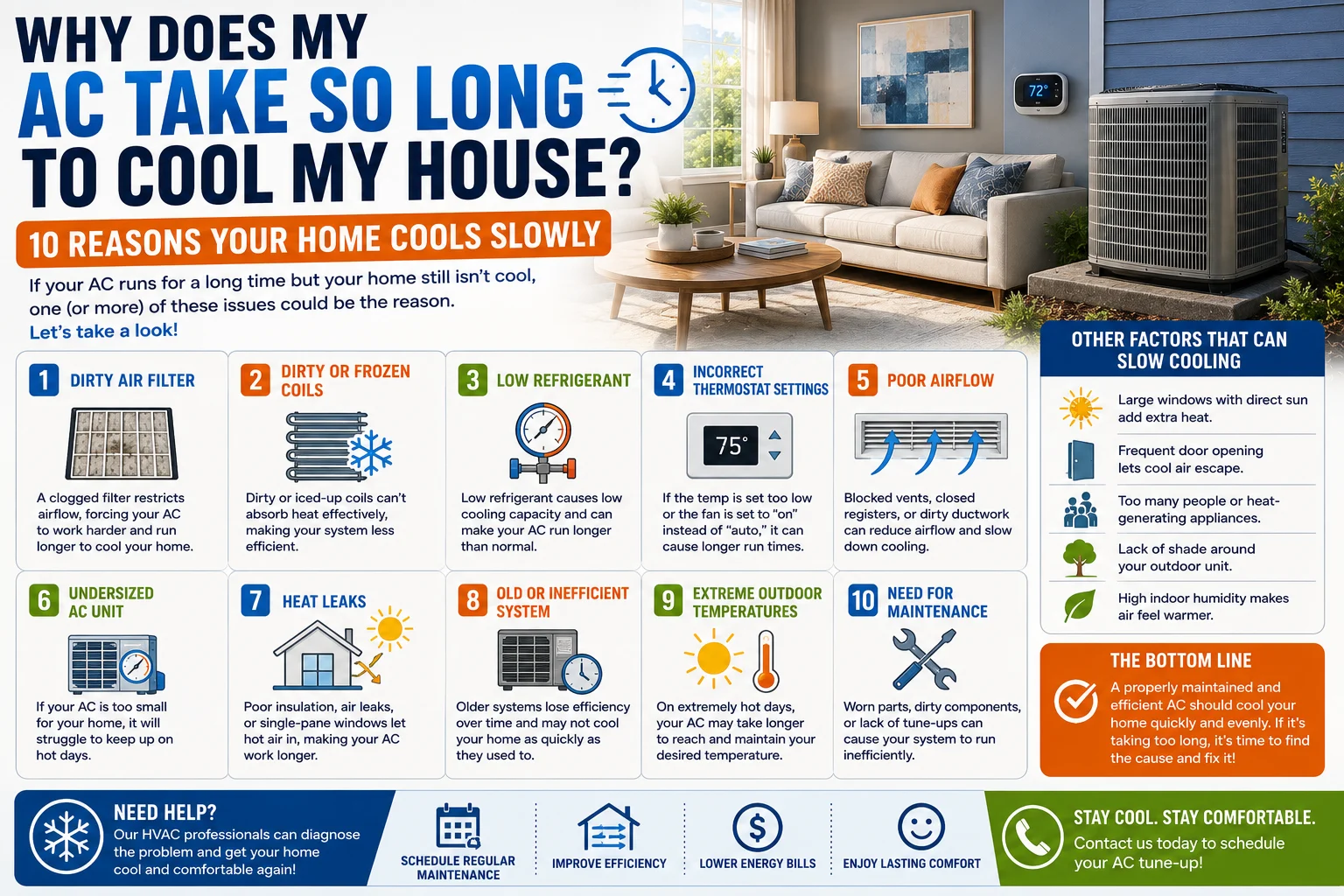
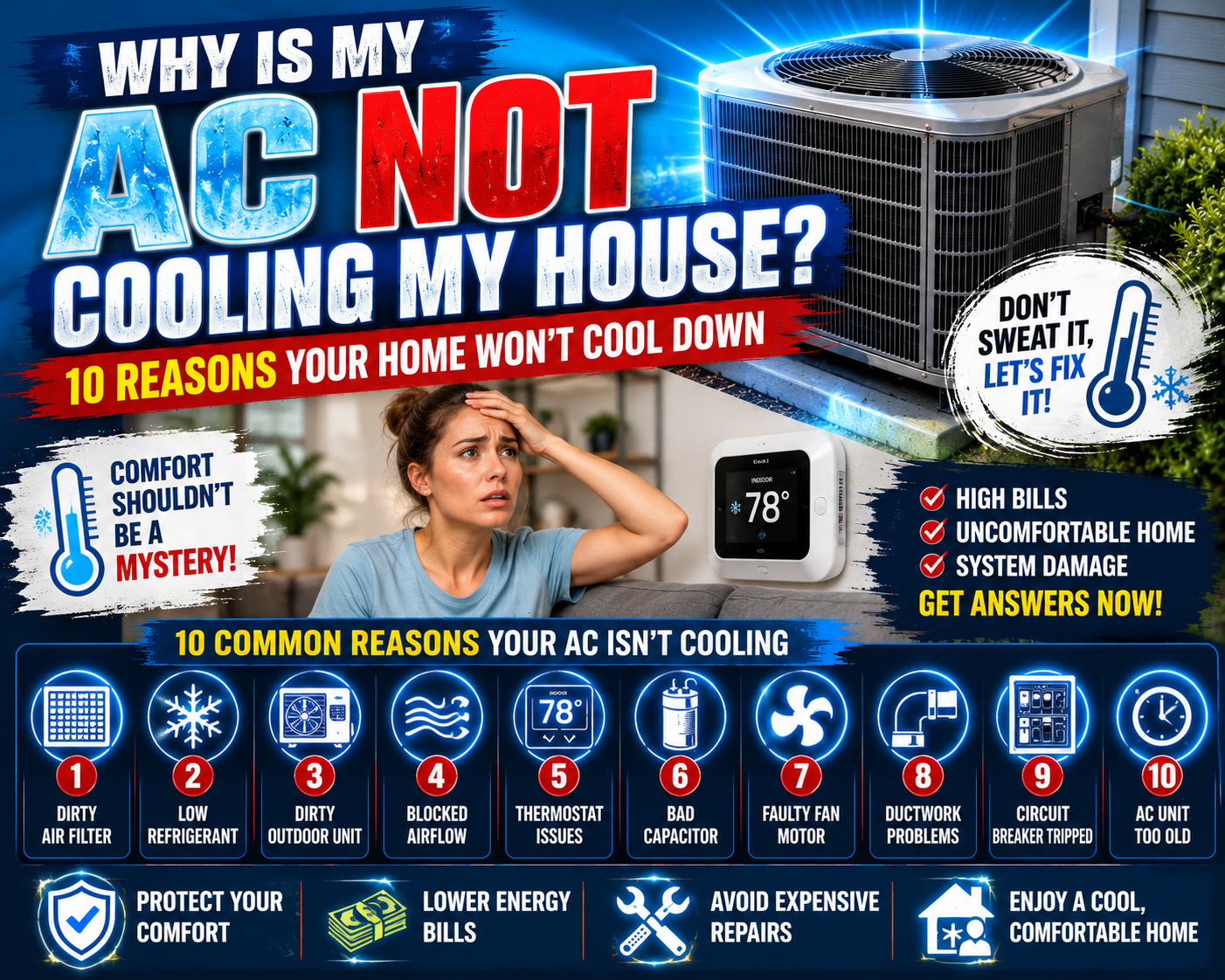
Here are 10 common reasons your AC may be running but your home isn’t cooling properly.
1. Your Air Filter Is Dirty
Before assuming you have a major air conditioning failure, check the filter.
Your HVAC system needs adequate airflow.
As an air filter collects dust, dirt, pet hair, and other particles, it becomes more restrictive.
If the filter becomes excessively dirty, airflow through the HVAC system can decrease.
Possible symptoms include:
- Weak airflow from vents
- Longer AC cycles
- Uneven temperatures
- Reduced cooling performance
- Increased system strain
Check your filter and replace or clean it as appropriate for your HVAC system.
If cooling performance doesn’t improve, another problem may be present.
2. Your Thermostat Isn’t Set Correctly
It sounds simple, but thermostat settings should always be checked before assuming the AC has failed.
Make sure your thermostat is:
- Set to COOL
- Set below the current indoor temperature
- Displaying normally
- Not accidentally set to HEAT
- Not operating under an unexpected schedule
Also check the fan setting.
If the fan is set to ON, the blower may continue circulating air even when the air conditioner isn’t actively cooling.
This can sometimes make homeowners think the AC is running continuously when they’re actually hearing only the indoor fan.
For normal operation, many homeowners use the AUTO fan setting.
3. The Outdoor Condenser Is Dirty
Your outdoor AC unit plays a major role in removing heat from your home.
As the system operates, heat collected indoors must be released outside.
The outdoor condenser coil can become covered with:
- Dirt
- Dust
- Grass
- Leaves
- Landscaping debris
- Other outdoor contaminants
When heat transfer becomes restricted, the air conditioner may have difficulty operating efficiently.
Keep vegetation and obvious debris away from the outdoor equipment.
Professional maintenance can determine whether the condenser coil needs proper cleaning.
4. Your AC May Have a Refrigerant Problem
Refrigerant is essential to the cooling process.
Your air conditioner uses refrigerant to absorb heat indoors and release it outside.
If the system has an incorrect refrigerant charge or a refrigerant leak, cooling performance can suffer.
Possible signs can include:
- AC running but not cooling adequately
- Longer operating cycles
- Warm or insufficiently cool air
- Ice on HVAC components
- Unusual hissing sounds
- Increasing energy usage
Refrigerant doesn’t normally get “used up” like gasoline.
If a system is low because refrigerant has escaped, the reason should be investigated.
Refrigerant work should be performed by appropriately qualified HVAC professionals.
5. Your Evaporator Coil May Be Frozen
Ice on an air conditioner may seem strange.
After all, isn’t the system supposed to get cold?
But a frozen evaporator coil can actually prevent your home from cooling properly.
Possible contributors include:
- Restricted airflow
- Dirty air filter
- Blower problems
- Refrigerant-related issues
- Dirty coil
- Other system problems
If you see ice on the refrigerant line or indoor HVAC equipment, don’t simply continue lowering the thermostat.
The underlying cause needs to be identified.
6. Your Ductwork May Be Leaking
Your air conditioner may be producing cool air correctly — but that doesn’t necessarily mean all of that conditioned air is reaching your rooms.
Ductwork distributes conditioned air throughout the home.
If ducts are:
- Disconnected
- Damaged
- Poorly sealed
- Leaking
- Improperly designed
some conditioned air may be lost before reaching the living space.
Possible signs of duct problems include:
- One room much hotter than another
- Weak airflow from certain vents
- Excessive dust
- Long cooling cycles
- Difficulty maintaining temperature
Ductwork is an important part of the complete HVAC system and shouldn’t be overlooked when diagnosing comfort problems.
7. The Outdoor Fan Isn’t Working
Take a look at your outdoor AC unit while the system is supposed to be cooling.
Is the fan operating?
The condenser fan helps move outdoor air across the condenser coil so the system can release heat.
If the fan isn’t operating correctly, possible causes may include:
- Fan motor problems
- Capacitor failure
- Electrical issues
- Control problems
- Damaged fan components
Don’t reach inside the condenser or attempt to manually start the fan.
HVAC equipment contains high-voltage electrical components.
If the outdoor unit isn’t operating properly, turn the system off and schedule professional service.
8. The AC Compressor May Have a Problem
The compressor is a critical part of the refrigeration system.
If the compressor isn’t operating properly, your air conditioner may run without providing adequate cooling.
Compressor problems can sometimes involve:
- Electrical failures
- Mechanical wear
- Starting problems
- Overheating
- Internal damage
A compressor issue requires professional diagnosis.
And importantly:
A compressor problem doesn’t automatically mean you need an entirely new HVAC system.
The age and condition of the equipment, repair cost, warranty coverage, and overall system health should all be considered before making a repair-or-replacement decision.
9. Your Air Conditioner May Be Improperly Sized
HVAC equipment needs to be appropriately matched to the home’s cooling requirements.
A system that’s too small may struggle during high outdoor temperatures.
It may:
- Run almost constantly
- Have difficulty reaching the thermostat setting
- Leave certain rooms uncomfortable
- Experience excessive operating demand
But bigger isn’t always better either.
An oversized system can create its own comfort and operating problems.
Proper HVAC sizing considers more than square footage.
Factors can include:
- Home size
- Insulation
- Windows
- Orientation
- Air leakage
- Ceiling height
- Ductwork
- Local climate
- Building characteristics
This is why equipment replacement should involve a professional evaluation rather than simply replacing the old unit with whatever size happens to be available.
10. Your HVAC System May Be Getting Old
Air conditioners don’t last forever.
As equipment ages, components experience wear and system performance can decline.
An older AC may begin experiencing:
- Frequent repairs
- Longer cooling cycles
- Increasing energy consumption
- Reduced comfort
- More noise
- Difficulty maintaining temperature
- Component failures
Age alone doesn’t determine whether an air conditioner needs replacement.
A well-maintained older system may still have useful service life.
But when an aging AC repeatedly struggles to cool the home and requires frequent repairs, it may be time to compare repair costs with replacement options.
Why Can’t My AC Keep Up on Extremely Hot Days?
This is an especially important question for homeowners in the Temecula Valley.
When outdoor temperatures become extremely high, air conditioners experience greater cooling demand.
Your system may run longer than usual during the hottest part of the day.
That doesn’t automatically mean something is wrong.
However, if your home becomes increasingly hot, the system runs continuously without making progress, or cooling performance is dramatically worse than normal, the equipment should be evaluated.
Possible contributing factors include:
- Dirty equipment
- Restricted airflow
- Duct leakage
- Insulation problems
- Refrigerant issues
- Aging components
- Equipment sizing
- Mechanical problems
The important thing is to determine why the system isn’t keeping up.
Could My Home Be Part of the Problem?
Yes.
Your HVAC system isn’t the only factor affecting indoor temperature.
The home’s building envelope plays an important role.
Cooling demand can be affected by:
- Poor attic insulation
- Air leaks
- Large sun-exposed windows
- Duct leakage
- Attic temperatures
- Window coverings
- Door openings
- Building orientation
If an HVAC system appears to be operating correctly but the home still struggles to stay comfortable, evaluating the entire house can sometimes reveal opportunities for improvement.
Why Is One Room Hotter Than the Rest of the House?
Uneven temperatures don’t always mean the air conditioner itself has failed.
One hot room may be caused by:
- Airflow imbalance
- Duct problems
- Insufficient return airflow
- Closed or blocked registers
- Sun exposure
- Insulation differences
- Window heat gain
- Duct leakage
If one area of your home is consistently uncomfortable while the rest of the house feels fine, the airflow and duct system should be evaluated.
Should I Keep Lowering the Thermostat?
If your AC isn’t cooling properly, setting the thermostat dramatically lower won’t necessarily make the air coming from the system colder.
For example, changing the thermostat from 76°F to 65°F doesn’t normally cause a standard central air conditioner to suddenly produce “extra cold” air.
It simply tells the system to continue trying to reach the lower temperature.
If the AC is already struggling because of a mechanical or airflow problem, lowering the thermostat won’t fix it.
What Can I Check Before Calling for AC Repair?
Homeowners can safely perform a few basic checks.
Check the Thermostat
Confirm it’s set to COOL and the temperature setting is appropriate.
Check the Air Filter
Replace or clean an excessively dirty filter.
Check the Vents
Make sure supply and return vents aren’t accidentally blocked by furniture, rugs, boxes, or other objects.
Look at the Outdoor Unit
Check for obvious leaves, weeds, or debris around the condenser.
Check the Electrical Breaker
If the breaker has tripped repeatedly, don’t continue resetting it.
Repeated breaker trips require diagnosis.
When Should You Call an HVAC Professional?
Schedule professional AC service if:
- Your AC runs but doesn’t cool
- The house keeps getting warmer
- Airflow is weak
- Ice appears on the equipment
- The outdoor fan isn’t operating
- The system makes unusual noises
- The breaker repeatedly trips
- You notice a burning smell
- The system continuously runs without reaching the thermostat setting
The sooner the underlying problem is identified, the better chance you have of addressing it before additional damage occurs.
Can Regular HVAC Maintenance Help Prevent Cooling Problems?
Routine maintenance can help keep your system operating properly and identify certain developing issues.
A professional maintenance visit may include evaluating:
- Airflow
- Electrical components
- Motors
- Capacitors
- Indoor equipment
- Outdoor equipment
- Drainage
- System operation
- Filters
- Overall cooling performance
Maintenance can’t prevent every breakdown.
But finding a worn or failing component before the hottest day of summer can save you from an inconvenient surprise.
Frequently Asked Questions
Why is my AC running but not cooling my house?
Possible causes include a dirty filter, airflow restriction, dirty condenser, refrigerant problem, frozen evaporator coil, duct leakage, fan failure, compressor issue, or another mechanical problem.
Why is my AC blowing cool air but the house isn’t getting cooler?
The system may not be producing enough cooling for the home’s current heat load, or conditioned air may not be reaching the rooms properly. Duct leakage, airflow problems, insulation, equipment performance, and outdoor temperature can all play a role.
How do I know if my AC is low on refrigerant?
Poor cooling, longer operating cycles, icing, and certain unusual sounds can be associated with refrigerant problems, but these symptoms can have other causes. Proper testing is necessary to determine whether the refrigerant charge is actually incorrect.
Should my AC run all day when it’s hot outside?
Longer operating cycles can occur during very hot weather. However, if your system runs continuously while the indoor temperature continues rising, it may be worth having the equipment evaluated.
Does a dirty filter really affect cooling?
Yes. An excessively dirty air filter can restrict airflow and reduce HVAC performance.
Does poor insulation make my AC work harder?
It can. Insulation and air sealing help reduce heat transfer into the home. Poor insulation or excessive air leakage can increase the amount of cooling your HVAC system needs to provide.
Does an AC that can’t keep up need to be replaced?
Not necessarily. The problem could be repairable. The system should be diagnosed before deciding whether replacement is necessary.
AC Not Cooling in Temecula or Murrieta?
Southern California summers can put air conditioning equipment to the test.
If your home isn’t cooling properly, Advanced Heating & Air Conditioning provides professional HVAC service throughout:
- Temecula
- Murrieta
- Menifee
- Lake Elsinore
- Winchester
- Hemet
- Anza
- And surrounding communities
Our technicians can evaluate the equipment, diagnose the cooling problem, and explain your options.
The Bottom Line
If your AC is running but your house isn’t getting cool, don’t automatically assume you need a new air conditioner.
Start with the basics.
Check the thermostat.
Check the filter.
Make sure vents aren’t blocked.
Look for obvious problems around the outdoor equipment.
If the system still can’t cool your home, professional diagnosis is the next step.
The problem could be as simple as restricted airflow or as significant as a compressor issue.
The key is finding the actual cause instead of guessing.
AC Running but Your House Still Isn’t Cool? We Can Help.
If your air conditioner is struggling to keep your home comfortable, Advanced Heating & Air Conditioning can help determine why.
We provide professional:
- AC repair
- HVAC maintenance
- Air conditioning replacement
- Heat pump services
- Ductwork services
- Indoor comfort solutions
throughout the Temecula Valley and surrounding communities.
Our goal is to diagnose the problem, explain what we find, and give you clear options for your home.
Contact Advanced Heating & Air Conditioning to schedule AC service or request an HVAC evaluation.