


Why Does My Heat Pump Run Constantly? Is It Normal?
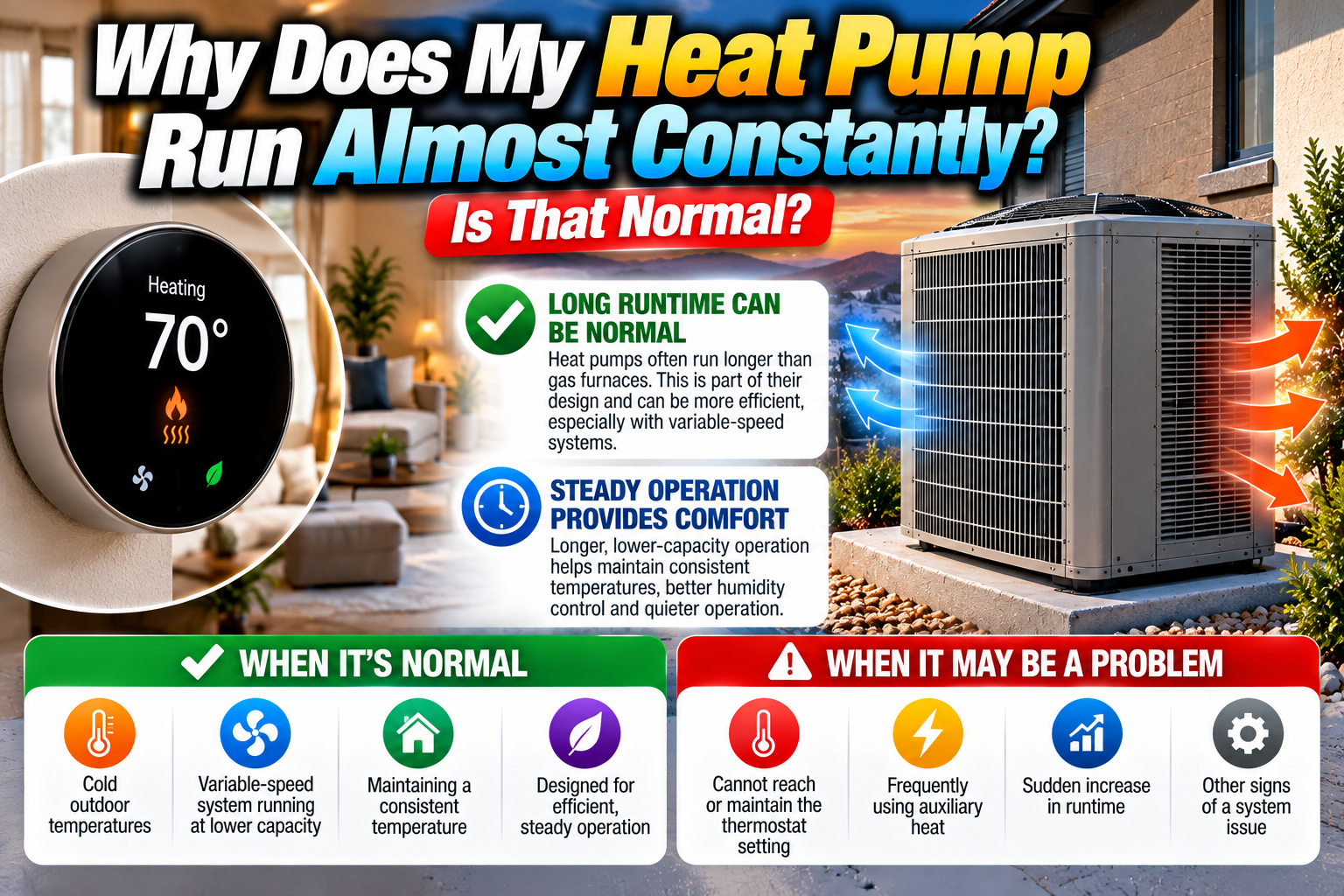
Why Does My Heat Pump Run Almost Constantly? Is That Normal?
One of the first things homeowners notice after switching from a gas furnace to a heat pump is that the system may seem to run:
A lot.
Sometimes for long stretches.
Sometimes for hours.
And with certain variable-capacity systems, it may seem like the heat pump is operating almost all day.
That can make a homeowner wonder:
“Is something wrong?”
Not necessarily.
Heat pumps often operate differently from traditional gas furnaces.
A furnace may deliver a strong burst of hot air, satisfy the thermostat relatively quickly, shut off, then repeat the cycle later.
A heat pump can be designed to deliver heat more gradually and steadily.
Especially with modern variable-speed equipment, longer runtime can actually be part of normal efficient operation.
The important question is not simply:
“How long is my heat pump running?”
The better questions are:
- Is the home reaching the thermostat setting?
- Is the temperature staying comfortable?
- Is the system using auxiliary heat excessively?
- Has the runtime suddenly changed?
- Is the outdoor unit operating normally?
Those details help separate normal heat-pump behavior from an actual problem.
Key Takeaways
- Heat pumps can normally run longer than gas furnaces.
- Long runtime alone does not prove something is wrong.
- Variable-speed heat pumps may intentionally run for extended periods at lower capacity.
- Runtime usually increases when outdoor temperatures become more extreme.
- A heat pump that runs continuously but maintains the thermostat setting may be operating normally.
- A heat pump that runs constantly and cannot maintain temperature deserves attention.
- Dirty filters, airflow restrictions, duct leakage, refrigerant problems, thermostat issues and equipment sizing can all contribute to excessive runtime.
- Frequent auxiliary-heat operation can increase electricity use.
- A sudden change in runtime is often more important than the absolute number of hours the system operates.
- Proper sizing matters: bigger equipment is not automatically better.
Why Do Heat Pumps Run Longer Than Furnaces?
A traditional gas furnace creates heat by burning fuel.
When the furnace operates, supply air can become quite warm.
That allows the system to deliver a relatively large amount of heat during a shorter cycle.
A heat pump works differently.
Instead of creating most of its heat through combustion, it transfers heat from one place to another.
During heating mode, it collects available heat from outside and moves it indoors.
That heating can be delivered in a steadier, less intense way.
So comparing heat-pump runtime directly with gas-furnace runtime can be misleading.
A homeowner may think:
“My old furnace only ran 15 minutes at a time, but this heat pump runs for an hour.”
That does not automatically mean the heat pump is wasting energy.
They are different technologies.
Can Long Runtime Actually Be Good?
Yes.
One of the least intuitive things about modern HVAC equipment is that:
Short runtime is not always better.
A properly operating variable-capacity system may intentionally run longer at reduced output.
Think of it like driving a car.
You could repeatedly accelerate hard, stop, accelerate hard again and stop again.
Or you could maintain a steady speed.
Modern HVAC equipment often tries to do something closer to the second example.
Longer, steadier operation can support:
- More stable indoor temperatures
- better air circulation
- quieter operation
and, depending on the equipment and conditions,
efficient part-load operation.
What Is a Variable-Speed Heat Pump?
A variable-speed heat pump can adjust its heating or cooling output rather than operating at only one fixed capacity.
Instead of being simply:
100% ON
or
OFF,
it may operate at lower output when the home needs only a small amount of heating or cooling.
As demand increases, the system can increase capacity.
This can result in long operating periods where the equipment is doing exactly what it was designed to do.
Advanced Heating & Air Conditioning offers single-stage, multi-stage and variable-speed heat-pump options and evaluates system size, airflow and heating/cooling demand before installation.
Does Running Longer Mean the Heat Pump Uses More Electricity?
Not automatically.
Runtime alone doesn’t tell you how much electricity the equipment is consuming.
A variable-speed compressor operating at reduced capacity for a long period may draw very differently from a single-stage compressor operating at full capacity.
That’s why:
Hours running ≠ total energy use by itself.
Actual energy consumption depends on:
- Compressor speed
- outdoor temperature
- indoor load
- equipment efficiency
- auxiliary heat
- blower operation
- and the home’s characteristics.
When Is Long Heat-Pump Runtime Normal?
Several situations can cause normal extended operation.
1. Cold Weather
As outdoor temperature falls, the house loses heat more quickly.
At the same time, a heat pump may have to work harder to transfer enough heat indoors.
That means longer cycles can be expected during colder weather.
2. Hot Summer Weather
Remember:
A heat pump is also your air conditioner.
During very hot afternoons, the system may run for extended periods while removing heat from the house.
A 2026 homeowner with a variable-speed heat pump reported exactly this concern: the system ran continuously through the hottest part of the afternoon while indoor temperature remained close to the thermostat setting.
That can be very different from a genuine failure where indoor temperature continues climbing rapidly.
3. Variable-Speed Operation
This is one of the most common reasons.
Instead of repeatedly starting and stopping at full power, the system may run steadily at lower capacity.
Long runtime may therefore be intentional.
4. The System Is Maintaining a Tight Temperature
Suppose your thermostat is set to:
70°F
and your home stays around:
69–70°F
while the heat pump runs steadily.
That is very different from:
Thermostat set to 70°F
house falls to 64°F
heat pump runs nonstop
The second situation suggests that the system isn’t keeping up.
5. Recovering From a Large Thermostat Change
If you increase the thermostat several degrees at once, the system may need a long period to bring the house back to temperature.
This is especially true with heat pumps because they often heat more gradually than gas furnaces.
How Long Should a Heat Pump Run?
There is no universal “correct” cycle length.
Runtime depends on:
- Outdoor temperature
- thermostat setting
- house construction
- insulation
- air leakage
- equipment capacity
- system type
- ductwork
- and many other factors.
That’s why statements such as:
“A heat pump should only run 20 minutes at a time”
are too simplistic.
A modern variable-capacity heat pump may run much longer than that and be operating perfectly normally.
Can a Heat Pump Run All Day?
It can under certain conditions.
The more important question is what happens while it runs.
If the heat pump:
- Maintains temperature
- keeps the home comfortable
- isn’t relying excessively on backup heat
and
- is operating within manufacturer specifications,
extended runtime may not be concerning.
Homeowners online frequently ask whether near-continuous heat-pump operation is normal specifically because it behaves so differently from their previous furnace.
When Should Constant Runtime Concern Me?
There are several warning signs.
The House Never Reaches the Thermostat Setting
This is one of the biggest ones.
If the heat pump operates continuously but indoor temperature keeps drifting away from the setpoint, something deserves investigation.
Possible causes include:
- Equipment sizing
- refrigerant issue
- airflow problem
- duct leakage
- dirty coils
- thermostat issue
- building heat loss
- or equipment malfunction.
The Heat Pump Suddenly Runs Much Longer Than Before
Changes matter.
If your heat pump normally maintained the house comfortably and then suddenly begins operating nearly nonstop under similar weather conditions, investigate what changed.
Possible causes include:
- Dirty filter
- blocked airflow
- coil problem
- refrigerant-related problem
- thermostat setting
- equipment fault
- or unusual weather.
Your Electric Bill Suddenly Increases
Long runtime combined with a major increase in electricity consumption deserves attention.
One possibility is excessive auxiliary heat.
Another is reduced heat-pump performance.
But also check:
- Weather
- utility rates
- other household electric loads
- and changes in thermostat use.
Don’t automatically blame the heat pump without looking at the whole picture.
The Outdoor Unit Never Turns Off
This requires some clarification.
With variable-speed systems, long compressor operation may be intentional.
But if the outdoor unit literally operates when there is no heating or cooling call, that may indicate a controls, wiring or equipment issue.
A recent homeowner with a new dual-fuel system reported the outdoor heat pump continuing to run even after thermostat calls ended and other HVAC controls were shut down—an example where “constant operation” was clearly different from normal long cycling.
The System Is Running but the House Is Getting Colder
That is not normal operation.
If the heat pump is supposedly heating but indoor temperature continues falling significantly, the system may not be producing enough heat.
Potential causes include:
- Refrigerant problem
- reversing-valve issue
- outdoor-unit problem
- airflow restriction
- backup heat problem
- equipment sizing
- or another fault.
Can a Dirty Air Filter Make a Heat Pump Run Constantly?
Yes.
A dirty or overly restrictive air filter can reduce airflow.
When airflow falls, the system may struggle to deliver heating or cooling properly.
The heat pump may then run longer trying to satisfy the thermostat.
This is one of the easiest things homeowners can check before calling for service.
Can Closed Vents Cause Long Runtime?
They can contribute to airflow problems.
Closing multiple supply registers does not necessarily save energy.
It can increase resistance in the duct system and alter airflow.
Instead of closing vents to “force” air somewhere else, persistent room-to-room comfort problems should be properly evaluated.
Can Dirty Coils Cause Long Runtime?
Yes.
Both indoor and outdoor coils participate in heat transfer.
When a coil becomes heavily dirty or restricted, system performance can decline.
The system may compensate by running longer.
Advanced Heating & Air Conditioning’s heat-pump repair checks indoor and outdoor coil condition along with airflow, refrigerant and controls when diagnosing performance problems.
Can Low Refrigerant Make a Heat Pump Run Constantly?
A refrigerant-related problem can reduce heating or cooling capacity.
If capacity drops, the system may operate longer while trying to maintain the thermostat setting.
But refrigerant should not simply be “topped off” without determining why the system is low.
A sealed refrigeration system does not normally consume refrigerant like gasoline.
If refrigerant is missing, there may be a leak or another issue that deserves diagnosis.
Can Leaky Ducts Cause Constant Runtime?
Absolutely.
Imagine the heat pump produces conditioned air.
Then a portion of that air leaks into:
- The attic
- garage
- crawlspace
- or another unconditioned area.
The equipment has already used electricity to heat or cool that air.
But the living space never receives all of it.
Now the heat pump runs longer trying to satisfy the thermostat.
Can an Undersized Heat Pump Run Constantly?
Yes.
If the heat pump is too small for the home’s actual heating or cooling load, it may struggle during more extreme weather.
It may:
- Run continuously
and
- still fail to reach the thermostat setting.
That is one reason proper load calculations matter.
An undersized system may struggle to maintain comfort.
Does That Mean I Should Install a Bigger Heat Pump?
Not automatically.
This is where homeowners can get into trouble.
If undersized equipment is bad, it is tempting to assume:
Bigger is safer.
But oversized systems can create their own problems.
Oversized equipment can cycle too frequently and produce uneven comfort.
Correct sizing is the goal.
Not:
Biggest possible.
Can Poor Insulation Make My Heat Pump Run Constantly?
Yes.
HVAC equipment can only replace the heat your house loses—or remove the heat your house gains.
If the building loses heat quickly through:
- Attic
- walls
- windows
- doors
- and air leaks,
the heating system has more work to do.
The same principle applies to summer cooling.
A house with high solar gain, poor insulation and major air leakage can require much longer HVAC runtime.
Does Duct Size Affect Heat-Pump Runtime?
Yes.
If the duct system cannot move the airflow required by the equipment, performance can suffer.
Potential issues include:
- Undersized return
- restrictive supply duct
- crushed flex duct
- dirty coil
- restrictive filter
- and high static pressure.
Duct capacity is a big enough topic that it deserves its own evaluation.
Can My Thermostat Cause Constant Heat-Pump Operation?
Yes.
Thermostat problems can involve:
- Incorrect setup
- incorrect staging
- sensor location
- wiring problems
- temperature calibration
- or compatibility issues.
A thermostat located in an unusually cold or hot area may also cause the system to behave differently from what the homeowner expects.
What If My Thermostat Says 70°F and the House Is 70°F but the Heat Pump Keeps Running?
That may be normal depending on the equipment.
A variable-capacity system may continue operating at low output to maintain the temperature rather than shutting off immediately.
There can also be programmed temperature differentials and staging logic.
The equipment and thermostat should be evaluated as one control system.
What If the Indoor Fan Keeps Running?
That is not necessarily the same thing as the heat pump compressor running.
The thermostat may be set to:
rather than:
AUTO.
Some systems also use periodic or continuous fan circulation.
So first determine:
Is the outdoor compressor operating?
or
Is only the indoor blower running?
Those are different situations.
Does Defrost Make My Heat Pump Run Longer?
It can affect operation temporarily.
During heating mode, frost may develop on the outdoor coil under certain weather conditions.
The heat pump can periodically enter defrost to clear the coil.
That is normal system behavior.
A heat pump entering occasional defrost should not automatically be mistaken for a system running incorrectly.
What About Auxiliary Heat?
If the heat pump cannot meet heating demand alone—or if the controls decide additional heat is needed—auxiliary heat may operate.
This is why a homeowner should not evaluate runtime alone.
You also want to know:
- Is the compressor running?
- Is AUX heat running?
- Is the house maintaining temperature?
Does Turning the Thermostat Way Up Make the Heat Pump Heat Faster?
Generally, setting the thermostat much higher does not make the heat pump’s compressor suddenly produce unlimited additional heat.
Depending on the controls, a large temperature increase may instead bring on:
- Higher stages
- or
- Auxiliary heat.
That can increase energy use.
A steadier thermostat strategy often makes more sense with a heat pump.
Should I Turn My Heat Pump Off to Give It a Break?
Normally, no.
HVAC equipment is designed to operate when needed.
If the heat pump is functioning correctly and maintaining comfort, you don’t need to periodically shut it down merely because it has been running for a long time.
If you’re concerned about abnormal operation, have the system checked rather than manually cycling power as a routine strategy.
Is It Bad for a Heat Pump to Run Continuously?
Not inherently.
Heat pumps are designed to run.
Variable-speed systems in particular can operate for long periods at reduced capacity.
What can indicate a problem is when the system:
- Runs constantly
AND
- fails to maintain temperature
or shows another symptom such as:
- high auxiliary-heat use
- ice buildup
- unusual noises
- breaker trips
- weak airflow
- or a sudden jump in energy usage.
Why Does My Heat Pump Run More at Night?
In heating season, outdoor temperature commonly falls overnight.
As outdoor temperature drops:
- The house may lose heat faster
and
- the heat pump may need to operate longer.
That’s normal physics.
A system that runs longer during colder nighttime hours isn’t automatically malfunctioning.
Why Does My Heat Pump Run More in the Afternoon?
During summer, afternoon outdoor temperatures and solar heat gain are often highest.
The roof, windows and walls absorb heat.
The cooling load rises.
The heat pump may therefore operate for long periods through the hottest portion of the day.
Again:
If the home remains close to setpoint, that is different from a system that cannot keep up.
What Is Design Temperature?
HVAC systems are sized around expected local outdoor design conditions rather than the mildest day of the year.
There may still be occasional unusually hot or cold conditions when the system operates for extended periods.
Long runtime near design conditions can be expected.
That does not automatically mean the equipment needs to be larger.
Is 24/7 Operation Normal?
It can occur during demanding conditions or with certain modulating systems.
But true 24/7 operation deserves context.
Ask:
- Is it maintaining temperature?
- What is the outdoor weather?
- Is compressor speed modulating?
- Is auxiliary heat involved?
- Is this normal for the equipment?
- Has anything recently changed?
Those answers matter far more than the clock alone.
How Do I Know Whether My Heat Pump Is Actually Keeping Up?
Look for trends.
If thermostat is set to:
70°F
and the home consistently remains:
69–71°F
while the system operates for long stretches, that may indicate the heat pump is matching the heating load.
If thermostat is:
70°F
and indoor temperature keeps declining:
68 → 67 → 66 → 65°F
while the system runs nonstop, something deserves attention.
That distinction is extremely useful.
What Can Homeowners Check First?
Before scheduling service, you can safely look at a few basic things:
- Check the filter.
- Make sure return grilles aren’t blocked.
- Make sure supply registers aren’t accidentally closed.
- Confirm thermostat settings.
- Look for obvious ice buildup on the outdoor unit.
- Notice whether the outdoor unit is actually running.
- Compare indoor temperature with the thermostat setpoint.
Do not remove electrical panels or attempt refrigeration repairs yourself.
When Should I Call an HVAC Technician?
Have the heat pump evaluated if:
- It runs constantly but cannot maintain temperature
- runtime suddenly becomes much longer than normal
- electricity use increases dramatically without an obvious weather explanation
- auxiliary heat runs excessively
- the outdoor unit remains heavily iced
- airflow becomes weak
- the system trips breakers
- the outdoor unit does not operate correctly
- or you hear new or unusual noises.
Advanced Heating & Air Conditioning lists running constantly, not heating, not cooling, weak airflow, frozen coils, breaker trips and higher energy bills among the heat-pump symptoms that should be diagnosed.
Frequently Asked Questions
Is it normal for a heat pump to run all the time?
It can be, especially during extreme weather or with variable-capacity equipment. Whether it is normal depends on comfort, thermostat performance and system operation.
Why does my heat pump run longer than my furnace did?
Heat pumps often deliver heat more gradually than gas furnaces, so longer operating cycles are common.
Is long runtime inefficient?
Not necessarily. A variable-speed heat pump may run for long periods at reduced capacity.
Why does my heat pump run continuously when it’s cold?
The home’s heating demand increases as outdoor temperatures fall, so the heat pump may need to operate longer.
Why does my heat pump run all afternoon in summer?
Peak outdoor temperature and solar heat gain can create a high cooling load, causing extended runtime.
Should my heat pump shut off when it reaches the thermostat temperature?
Some systems may shut off, while variable-capacity systems may continue operating at reduced output to maintain temperature.
Can a dirty filter make my heat pump run longer?
Yes. Restricted airflow can reduce system performance and increase runtime.
Can low refrigerant cause constant operation?
A refrigerant-related problem can reduce heating or cooling capacity and cause extended runtime.
Can bad ductwork make my heat pump run constantly?
Yes. Leakage, restrictions and poor airflow can cause the system to work longer to maintain comfort.
Can an undersized heat pump run all day?
Yes. An undersized system may operate continuously during high-demand conditions and still struggle to reach the thermostat setting.
Should I replace it with a bigger heat pump?
Not automatically. Oversized equipment creates different problems. Proper load calculations and equipment selection are more important than simply increasing size.
Does a variable-speed heat pump run more often?
Often, yes. Longer operation at reduced capacity can be part of its normal design.
The Best Question Isn’t “How Long Is It Running?”
Ask instead:
Is it maintaining comfort?
That single question changes the diagnosis.
A heat pump that runs for hours and holds the home steadily at the thermostat setting may be doing exactly what it was designed to do.
A heat pump that runs for hours while the house becomes progressively colder or hotter:
Needs attention.
Understand the difference before assuming long runtime means something is wrong.
Heat Pump Installation & Repair in the Temecula Valley
Advanced Heating & Air Conditioning installs, repairs and maintains heat-pump systems throughout the Temecula Valley.
Before recommending a new system, Advanced evaluates factors including property layout, insulation, windows, existing ductwork, airflow, electrical requirements, equipment location and heating/cooling demand.
For existing equipment, heat-pump diagnostics can include the thermostat, airflow, coils, refrigerant system, electrical components, blower, outdoor fan, reversing valve and controls.
Advanced serves Temecula, Murrieta, Menifee, Winchester, Wildomar, French Valley, Canyon Lake, Lake Elsinore, Hemet and surrounding communities.
Advanced Heating & Air Conditioning
951-609-9881
California Contractor License #916901
REAL PEOPLE. REAL SERVICE. REAL COMFORT.