


Can a Heat Pump Completely Replace a Gas Furnace?
Can a Heat Pump Completely Replace a Gas Furnace?
If your furnace and air conditioner are getting older, you may be considering replacing both.
Then someone recommends a heat pump.
That usually leads to one of the first questions homeowners ask:
“Can a heat pump really replace my gas furnace?”
For many homes, the answer is:
Yes.
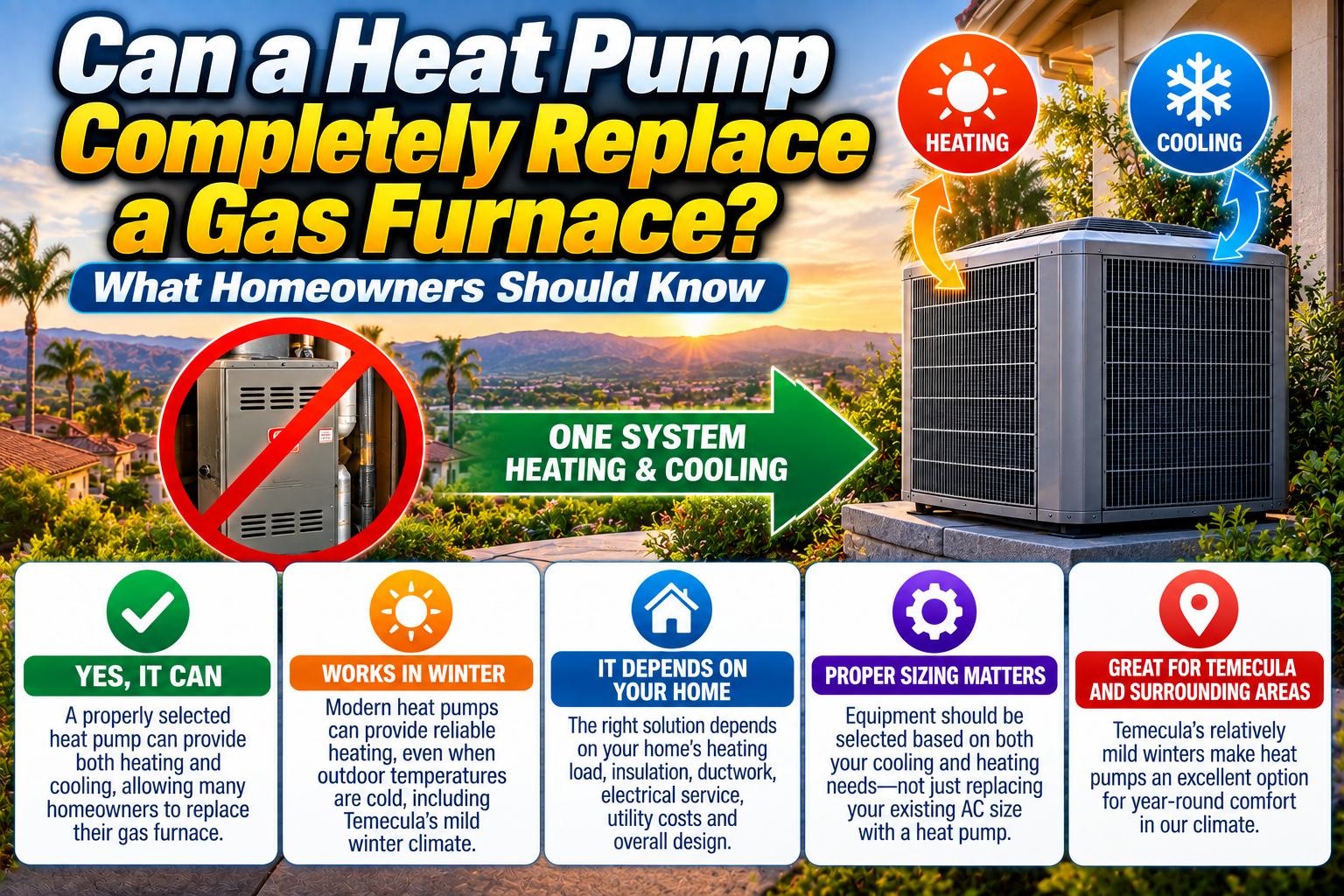
A properly selected and installed heat pump can provide both:
- Heating in winter
- and cooling in summer.
That means some homeowners can replace the traditional:
Air conditioner + gas furnace
combination with a heat-pump system.
But that does not mean every house should automatically remove its furnace.
The right answer depends on:
- Climate
- Home heating load
- Heat-pump capacity
- Insulation
- Ductwork
- Electrical service
- Utility costs
- and how the homeowner wants the system designed.
For homeowners in Temecula and the surrounding Southern California communities, this is an especially important conversation because our winters are generally much milder than those in colder parts of the country.
How Can a Heat Pump Replace a Furnace?
A furnace creates heat.
A gas furnace does this by burning natural gas and transferring combustion heat into the home’s air.
A heat pump operates differently.
It primarily:
Moves heat.
During winter, the heat pump extracts available heat from outdoor air and transfers it into the house.
Even when the outdoor air feels cold to us, it still contains thermal energy that a heat pump can use.
That’s why a heat pump can provide heating without a traditional gas burner.
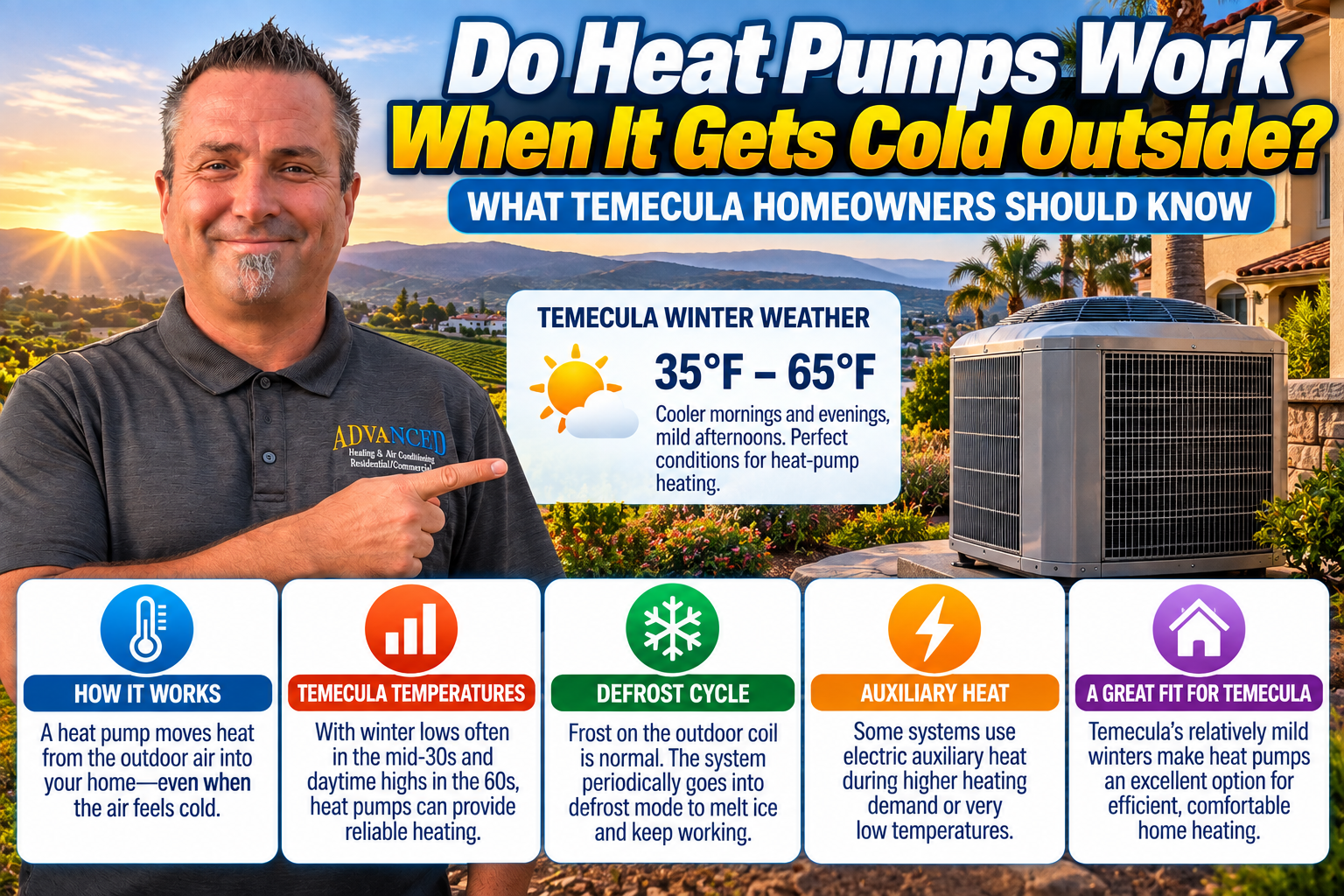
Does a Heat Pump Work When It’s Cold Outside?
Yes.
This is one of the biggest misconceptions about heat pumps.
Modern heat pumps can continue operating at temperatures well below what we normally experience during a Temecula Valley winter.
Current homeowners in significantly colder climates are discussing successful heat-pump operation during freezing and even single-digit temperatures.
However, heat-pump performance changes as outdoor temperature drops.
The important question is not simply:
“Does it still run?”
The better question is:
“How much heating capacity does this specific heat pump have at the outdoor temperature my home is likely to experience?”
Why Does Outdoor Temperature Matter?
As outdoor temperature drops, the home’s heating requirement generally increases.
At the same time, the heating capacity and efficiency of many heat pumps can change.
Think of those as two lines.
As it gets colder:
The house needs more heat.
Meanwhile:
The heat pump’s available capacity may change.
Eventually, depending on the system and home, those two can meet.
That concept is important when designing an all-electric heat-pump system.
What Is the Heating Load of a House?
Heating load is the amount of heat the home needs to maintain the desired indoor temperature under specific outdoor conditions.
It depends on much more than square footage.
Important factors include:
- Insulation
- Windows
- Air leakage
- Ceiling height
- Home orientation
- Wall construction
- Duct losses
- Outdoor design temperature
- and overall building construction.
Two 2,000-square-foot homes can have very different heating loads.
Why Can’t You Just Replace a 4-Ton AC With a 4-Ton Heat Pump?
Because cooling capacity alone doesn’t tell us whether the equipment can meet the home’s heating requirements.
A contractor should consider both:
- Cooling load
- and heating load.
This is particularly important if the homeowner plans to remove the gas furnace completely.
Can a Heat Pump Heat a Temecula Home Without a Furnace?
For many properly designed installations:
Yes.
Temecula’s relatively mild winter climate can make heat pumps particularly attractive.
Advanced Heating & Air Conditioning installs heat pumps as systems capable of providing both heating and cooling—year-round comfort equipment for Temecula properties.
The actual home still needs to be evaluated.
Don’t choose equipment based only on the climate.
What About Murrieta?
The same general principle applies.
A properly selected heat pump can potentially provide full heating and cooling for homes throughout much of Southwest Riverside County.
That includes areas such as:
- Murrieta
- Menifee
- Winchester
- Wildomar
- French Valley
- Lake Elsinore
- and surrounding communities.
Advanced currently provides heat-pump services throughout these areas.
Does a Heat Pump Feel Different From a Gas Furnace?
Yes.
This is important to explain before installation.
A traditional gas furnace can deliver very warm supply air in relatively strong heating cycles.
A heat pump often provides:
- Lower-temperature supply air
- for longer periods.
That does not necessarily mean the house is colder.
The heating style is simply different.
Why Doesn’t Heat-Pump Air Feel As Hot?
Because a heat pump usually does not need to produce the same extremely hot supply air as a combustion furnace.
Instead, it can provide steady heat over longer cycles.
Homeowners switching from gas sometimes put their hand over the register and say:
“This doesn’t feel hot.”
But the better question is:
Is the room temperature increasing and staying comfortable?
Vent temperature alone does not determine heating performance.
Will a Heat Pump Run Longer Than My Furnace?
Often, yes.
And that can be completely normal.
A furnace may operate:
High output → shorter cycle → off.
A variable-capacity heat pump may operate:
Lower output → longer cycle → steady comfort.
Long runtime is not automatically inefficient.
In fact, longer low-capacity operation can be part of how modern inverter heat pumps maintain stable indoor temperatures.
Can a Heat Pump Run All Night?
Yes.
During colder weather, a properly operating heat pump may run for long periods.
The important questions are:
- Is the house maintaining temperature?
- Is the equipment operating within its designed range?
- Is backup heat operating appropriately?
A long heating cycle by itself does not prove anything is wrong.
Does a Heat Pump Need Backup Heat?
Not necessarily.
This is where system design becomes important.
Some homes use:
Heat pump only.
Others use:
Heat pump + electric auxiliary heat.
Others use:
Heat pump + gas furnace.
That last configuration is called:
Dual fuel.
There is no universal answer that is best for every home.
What Is Electric Backup Heat?
Some heat-pump systems include electric resistance heating elements in the indoor equipment.
These can provide additional heating when necessary.
They may assist during:
- High heating demand
- Defrost
- or certain system conditions.
But resistance heat generally uses substantially more electricity per unit of delivered heat than a heat pump operating efficiently.
That is why the system’s controls matter.
Does Backup Heat Mean the Heat Pump Is Too Small?
Not automatically.
A system may intentionally be designed with supplemental heat for extreme conditions.
The goal is not necessarily to size the heat pump for the absolute worst theoretical moment if doing so would create problems during the rest of the year.
System design involves balancing:
- Heating capacity
- Cooling capacity
- Comfort
- Efficiency
- and equipment operation.
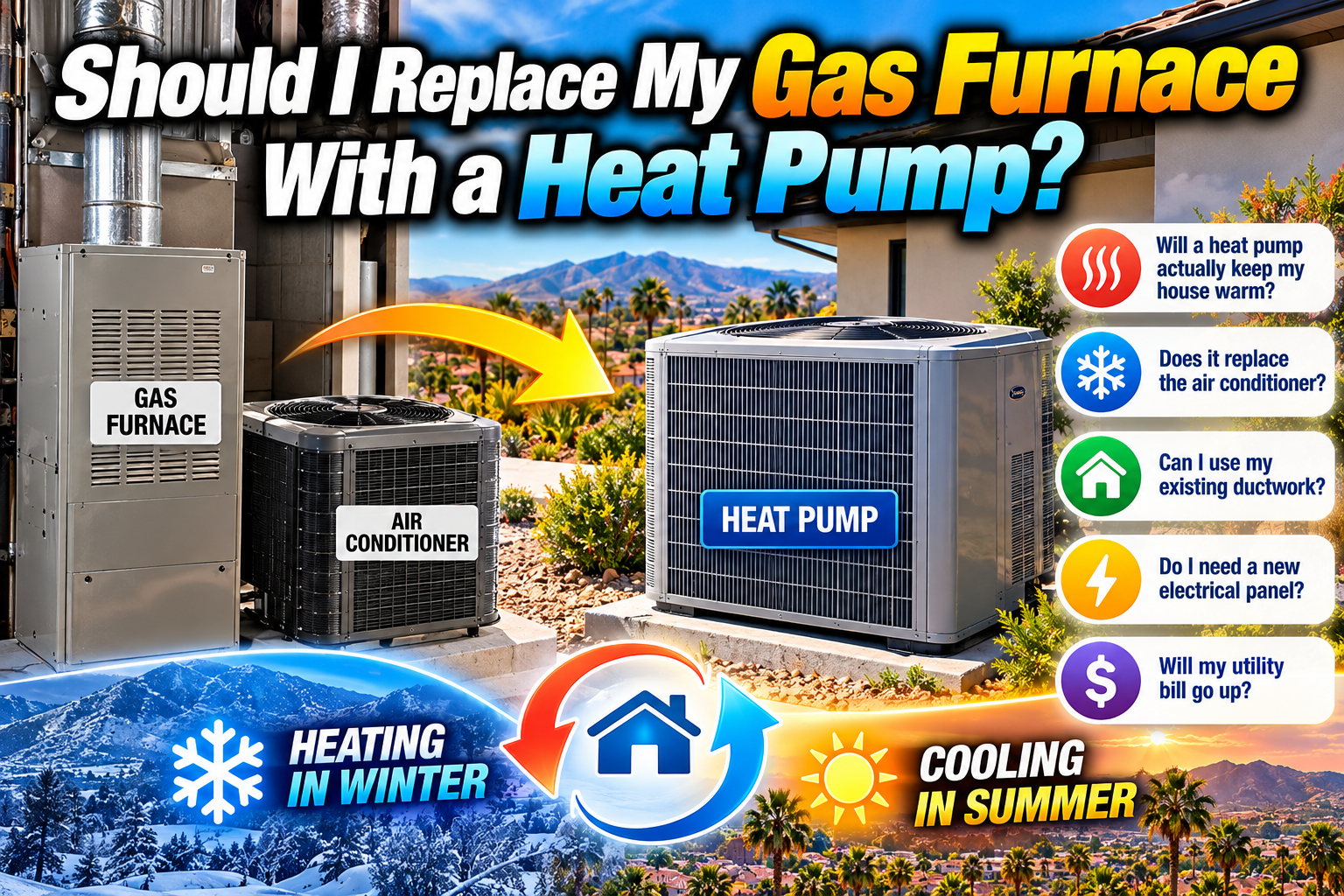
Can I Keep My Gas Furnace and Add a Heat Pump?
Yes.
That’s the basis of a:
The heat pump can provide heating during conditions where it makes sense, while the gas furnace can take over under predetermined conditions.
Why Would Someone Keep the Furnace?
Possible reasons include:
- Preference for gas heat
- Existing furnace is relatively new
- Backup-heating strategy
- Utility-rate economics
- Very high heating load
- or simply wanting two heating sources.
A homeowner may also prefer the feel of furnace heat during colder weather.
Why Would Someone Remove the Furnace?
Other homeowners may want:
- One electric heating/cooling system
- No onsite gas combustion for HVAC
- No furnace venting
- Compatibility with solar
- Modern inverter technology
- or fewer separate heating and cooling appliances.
Neither decision should be made based on a slogan.
Evaluate the actual house.
Is a Heat Pump More Efficient Than a Gas Furnace?
The technologies measure efficiency differently.
A furnace is commonly rated using:
AFUE.
A heat pump is evaluated using measures including:
- HSPF2
- and performance data at different conditions.
The major difference is that a furnace creates heat from fuel while a heat pump primarily transfers existing heat.
Under suitable conditions, a heat pump can deliver multiple units of heat for each unit of electricity consumed.
What Is COP?
COP means:
Coefficient of Performance.
For example, a COP of 3 means the heat pump is delivering approximately:
3 units of heat
for every:
1 unit of electrical energy
used by the refrigeration process.
COP changes with operating conditions.
It is not one fixed number throughout the winter.
Does COP Drop When It Gets Colder?
Generally, heat-pump efficiency can decline as outdoor conditions become more challenging.
That’s one reason homeowners should not evaluate a heat pump based on a single efficiency number.
Ask about:
Performance at relevant outdoor temperatures.
What Is HSPF2?
HSPF2 is a seasonal heating-efficiency rating used for heat pumps.
Higher ratings generally indicate better seasonal heating efficiency under the standardized test procedure.
But HSPF2 alone does not tell you:
How much heat the system produces at a particular outdoor temperature.
For replacement decisions, homeowners should consider both:
- Efficiency
- and capacity.
What Is a Cold-Climate Heat Pump?
Cold-climate heat pumps are designed to maintain useful heating performance at lower outdoor temperatures.
They are particularly important in places that experience severe winter weather.
Current 2026 homeowner discussions show people in Pennsylvania, Massachusetts, Michigan and other colder regions specifically comparing cold-climate heat pumps, backup heat, capacity and winter operating costs.
Southern California presents a different design environment.
We usually don’t need to solve the same heating challenge as a home in Minnesota or Massachusetts.
Do I Need a Cold-Climate Heat Pump in Temecula?
Not automatically.
The correct equipment should be selected based on:
- Actual design conditions
- Home heating load
- Efficiency goals
- Equipment performance
- and budget.
Buying equipment designed for extreme cold simply because it sounds better is not necessarily the best system-design decision.
Is an Inverter Heat Pump Better for Replacing a Furnace?
It can be an excellent option.
An inverter-driven heat pump can adjust compressor output instead of operating only:
100% ON
or
OFF.
That allows the system to better match changing heating and cooling demand.
Potential benefits can include:
- Longer cycles
- More stable temperatures
- Quieter operation
- Better part-load efficiency
- and improved comfort.
But proper sizing still matters.
Does Variable Speed Mean the Heat Pump Never Turns Off?
No.
Variable-capacity systems still shut down when appropriate.
The advantage is that they can often reduce output rather than immediately turning off when the home needs less heating or cooling.
Can My Existing Ductwork Be Used?
Possibly.
This is an important part of a furnace-to-heat-pump conversion.
The existing ducts should be evaluated for:
- Size
- Airflow capacity
- Leakage
- Return-air capacity
- Insulation
- Condition
- and layout.
Advanced already evaluates existing ductwork and airflow when recommending heat-pump equipment.
Why Does Ductwork Matter More Than Homeowners Think?
Because the heat pump can only deliver heating if the air can actually move through the house properly.
You can buy excellent equipment and still have poor comfort if the duct system has:
- High static pressure
- Undersized returns
- Crushed flex duct
- Disconnected ducts
- or major leakage.
Equipment efficiency does not repair bad ductwork.
Do I Need New Ductwork to Install a Heat Pump?
Not automatically.
Good existing ductwork may be reusable.
What About Homes Without Ductwork?
Ductless heat pumps can be another option.
Mini-split systems use individual indoor units rather than a traditional central duct system.
That can be useful for:
- Additions
- Garages
- Older homes
- Individual zones
- or buildings without practical central ductwork.
Can One Heat Pump Heat the Whole House?
Yes, if it is a central heat pump that is correctly sized and connected to an appropriately designed distribution system.
But some houses may benefit from:
- Multiple systems
- Zoning
- or ductless equipment.
Large homes and unusual layouts need individualized design.
What If My House Has Two HVAC Systems?
You don’t necessarily need to make the same decision for both.
For example, a homeowner might install:
Heat pump downstairs
and
Heat pump upstairs.
Or they could have different equipment strategies based on each zone’s load.
Each system should be evaluated separately.
Can Solar Make a Heat Pump More Attractive?
Potentially.
A heat pump shifts heating energy toward electricity.
For homeowners with:
- Solar
- or plans for solar,
that may influence the economics.
But don’t assume:
Solar = free heating.
You still need to consider:
- Solar production
- Electricity consumption
- Utility rate structure
- Battery storage
- and seasonal production.
Does a Heat Pump Require a Bigger Electrical Panel?
Sometimes.
An all-electric conversion may change electrical requirements.
Important factors can include:
- Heat-pump electrical demand
- Air-handler requirements
- Electric auxiliary heat
- Existing panel capacity
- and other household loads.
Advanced currently evaluates electrical requirements before recommending heat-pump equipment.
Could Removing a Gas Furnace Require Electrical Upgrades?
Yes.
This is especially important if the replacement includes substantial:
Electric resistance backup heat.
The HVAC contractor and, when necessary, electrician should determine whether the existing electrical system can support the new equipment.
Do I Have to Remove My Gas Meter?
No.
Replacing the HVAC furnace does not necessarily mean eliminating natural gas from the entire property.
You may still have:
- Gas water heater
- Range
- Fireplace
- Pool equipment
- or other appliances.
Whole-home electrification is a separate decision.
What Happens to the Furnace Vent?
If a gas furnace is permanently removed, its venting should be properly addressed according to the remaining appliances and applicable requirements.
Never simply assume an old flue can be abandoned without evaluation.
Other appliances may share or depend on venting arrangements.
What About Carbon Monoxide?
A heat pump itself does not create heat through onsite combustion.
So the heat-pump refrigeration system does not produce carbon monoxide from burning fuel.
However, if the home still has:
- Gas appliances
- Fireplace
- Attached garage
- or other combustion sources,
carbon-monoxide alarms remain important.
Is Heat-Pump Heating Safer Than a Gas Furnace?
They have different safety considerations.
A heat pump eliminates furnace combustion-related issues such as:
- Burners
- Gas valve
- Flame
- and furnace combustion venting.
But heat pumps still contain:
- High-voltage electricity
- Motors
- Electronics
- and pressurized refrigerant.
No HVAC equipment should be treated as risk-free.
Will My House Be Comfortable?
If the heat pump is:
- Properly sized
- Properly installed
- Correctly commissioned
- and connected to a good distribution system,
it can provide excellent comfort.
The biggest adjustment for some former gas-furnace owners is the style of heat.
Instead of:
Very hot bursts
they may experience:
Longer, gentler heating cycles.
Will My Bedrooms Still Stay Warm?
That depends heavily on airflow and the building.
If bedrooms are already uncomfortable because of:
- Poor duct design
- Insulation
- Air leakage
- or inadequate returns,
simply installing a heat pump may not fix the underlying problem.
Address the comfort problem during the replacement design.
Will a Heat Pump Save Me Money?
Maybe.
Be careful with anyone promising universal savings.
Operating cost depends on:
- Electric rate
- Gas rate
- Equipment efficiency
- Weather
- Home load
- Thermostat settings
- Backup heat use
- and solar, if applicable.
Current homeowner discussions show dramatically different experiences depending on climate, insulation, equipment and utility rates.
The right analysis should use your home and your utility situation.
Why Does Insulation Matter?
Because every BTU the house loses must be replaced by the heating system.
Better:
- Attic insulation
- Air sealing
- Windows
- and building-envelope performance
can reduce heating demand.
A 2026 homeowner reported a major improvement in cold-weather comfort after increasing inadequate attic insulation while using a heat pump.
That is a good reminder:
HVAC equipment and the house work together.
Should I Improve Insulation Before Installing a Heat Pump?
If the home has obvious deficiencies, it may make sense to address them before final equipment sizing.
Reducing the home’s heating and cooling load can sometimes allow:
- Smaller equipment
- Longer cycles
- Lower energy use
- and improved comfort.
What About Windows?
Windows affect heat loss and heat gain.
But replacing every window is not automatically necessary before installing a heat pump.
The important thing is that the home’s actual characteristics are included in the load calculation.
Should I Replace My Furnace Before It Breaks?
If your furnace and AC are both approaching replacement age, planning ahead gives you more options.
Instead of being forced into:
“Whatever equipment can be installed tomorrow,”
you can compare:
- Gas furnace + AC
- All-electric heat pump
- Dual fuel
- Single-stage
- Two-stage
- and variable-capacity heat pumps.
That is a much better position for a homeowner.
What If My Furnace Still Works?
You can still consider a heat pump.
One current 2026 homeowner specifically asked whether adding a heat pump to an existing furnace made sense as a way to reduce furnace use.
That can lead to a dual-fuel discussion rather than automatically removing good equipment.
What If My Furnace Is 20 Years Old?
Then it is worth evaluating the entire HVAC system rather than automatically replacing only one component.
Consider:
- Current AC condition
- Furnace condition
- Ductwork
- Electrical system
- Efficiency goals
- and how long you expect to remain in the home.
Can I Replace My AC With a Heat Pump and Keep the Furnace?
Often, yes, depending on equipment compatibility and system design.
That creates a heat-pump/furnace combination.
Again:
Dual fuel.
This can be an attractive option for homeowners who want heat-pump technology but prefer to retain gas backup.
Which Is Better: Heat Pump Only or Dual Fuel?
There isn’t a universal winner.
Heat pump only may make sense when:
- Climate is favorable
- Heating load is manageable
- Electrical system supports it
- and the homeowner wants an all-electric HVAC solution.
Dual fuel may make sense when:
- The homeowner wants gas backup
- Existing furnace is useful
- or operating economics favor switching heat sources under certain conditions.
What Should I Ask My HVAC Contractor?
Before replacing a furnace with a heat pump, ask:
- What is my home’s heating load?
- What is the heat pump’s heating capacity at our local design temperature?
- Will I need backup heat? What type?
- Will my existing ductwork handle the required airflow?
- What is the static pressure?
- Does my electrical service need modification?
- What thermostat/control strategy will be used?
- Is the system single-stage, two-stage or variable-capacity?
- What happens during defrost?
- How will the system be commissioned after installation?
Those questions tell you far more than:
“What tonnage are you installing?”
Frequently Asked Questions
Can a heat pump completely replace a furnace?
Yes. In many homes, a properly sized heat pump can provide the entire heating load without a gas furnace.
Can a heat pump replace a furnace in Temecula?
Potentially, yes. Temecula’s mild winter climate can make heat pumps an excellent option, but the home and equipment should still be properly evaluated.
Do heat pumps work below 40°F?
Yes. Modern heat pumps can operate well below 40°F. Performance depends on the specific equipment.
Do heat pumps work below freezing?
Many modern heat pumps do. The amount of heating capacity available at low temperature varies by model.
Does a heat pump need emergency heat?
Not every installation requires the same backup strategy. Some systems include electric auxiliary heat, some use gas backup, and some are designed around the heat pump itself.
Will a heat pump feel as warm as a furnace?
The house can be equally comfortable, but supply air often feels less intensely hot because heat pumps tend to provide gentler heat for longer periods.
Will a heat pump run longer than a furnace?
Often, yes. Longer runtime can be completely normal, particularly with variable-capacity equipment.
Can I keep my existing gas furnace?
Potentially. A compatible heat pump can sometimes be paired with a gas furnace in a dual-fuel system.
Can I use my existing ducts?
Possibly. The duct system should be inspected for size, condition, leakage, airflow and return capacity.
Will I need a larger electrical panel?
Possibly. Electrical requirements depend on the heat pump, indoor equipment, backup heat and existing electrical service.
Is a heat pump cheaper to operate than natural gas?
Sometimes, but not always. Utility rates, equipment efficiency, weather and backup-heat use all affect operating cost.
Is a heat pump a good choice with solar?
It can be, because heating becomes electrically powered, but the actual economics depend on solar production, household usage and utility rates.
Should I install a heat pump if my furnace still works?
It can still be worth evaluating, especially if the AC is also approaching replacement age or you are interested in dual fuel.
The Question Isn’t Simply “Can It Replace My Furnace?”
Technically, many heat pumps absolutely can.
The better question is:
Can this specific heat pump properly heat this specific house?
That requires looking at:
The home → heating load → local climate → equipment capacity → ductwork → electrical requirements → backup strategy → controls → installation and commissioning.
When those pieces are properly matched, a heat pump can be much more than an air conditioner that happens to provide a little heat.
It can become the home’s primary heating and cooling system.
Heat Pump Installation in the Temecula Valley
Advanced Heating & Air Conditioning installs heat pumps for homeowners who want heating and cooling from one system. Advanced evaluates property size and layout, insulation, windows, ductwork and airflow, electrical requirements, equipment location, heating and cooling demand, efficiency preferences and thermostat compatibility before recommending equipment.
Advanced serves Temecula, Murrieta, Menifee, Winchester, Wildomar, French Valley, Canyon Lake, Lake Elsinore, Hemet and surrounding communities.
Advanced Heating & Air Conditioning
951-609-9881
California Contractor License #916901
REAL PEOPLE. REAL SERVICE. REAL COMFORT.