


Should I Turn My Heat Pump Down at Night or Leave It Alone?
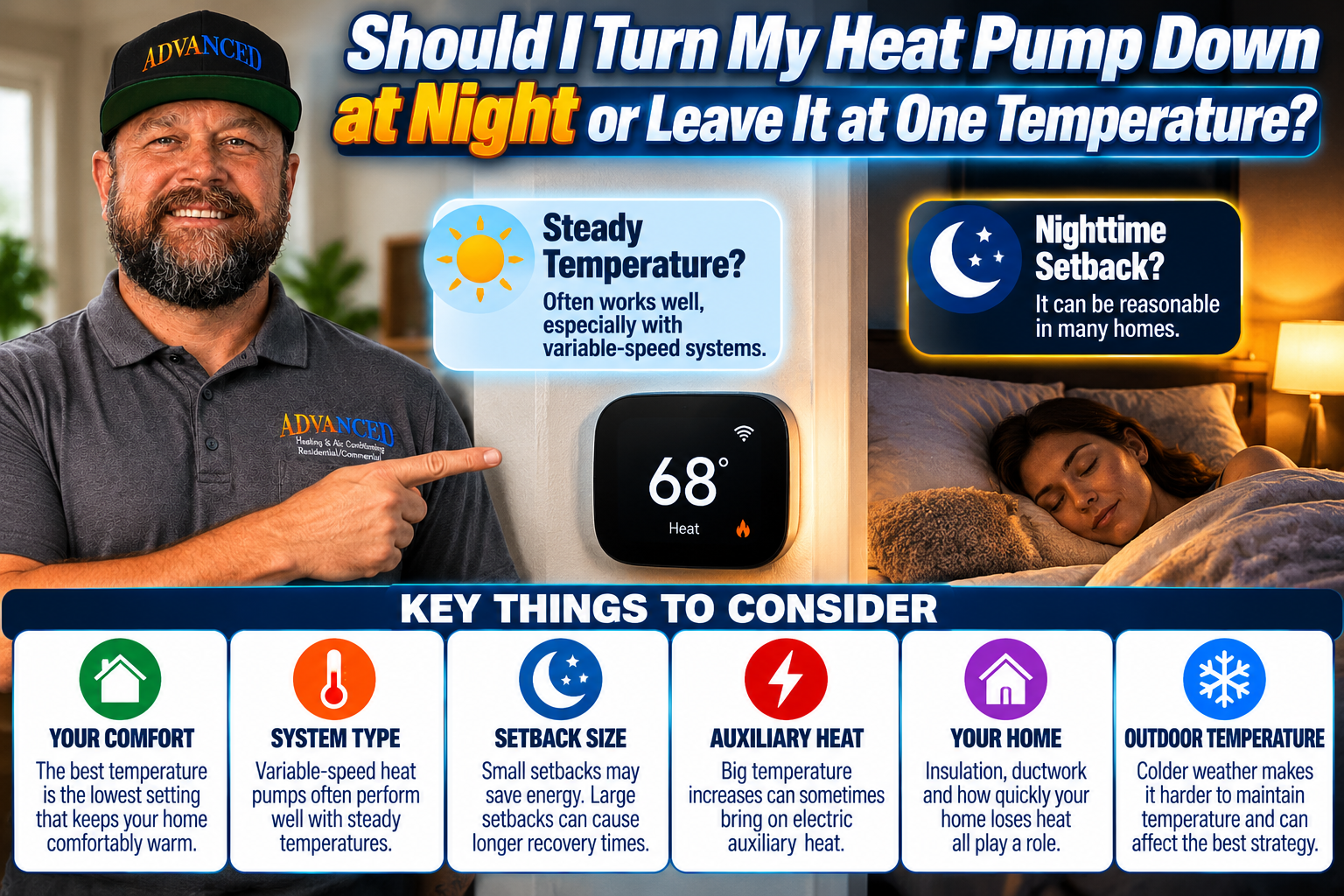
Should I Turn My Heat Pump Down at Night or Leave It at One Temperature?
If you grew up with a gas furnace, you may have been taught:
Turn the thermostat down when you go to bed.
Then:
Turn it back up in the morning.
That strategy can make sense with many heating systems.
But when homeowners switch to a heat pump, they often hear completely different advice:
- “Never change the thermostat.”
- “Set it and forget it.”
- “Heat pumps should run constantly.”
- “Turning it down will actually cost more.”
So what’s true?
The answer is more nuanced.
A heat pump does not automatically waste energy simply because you lower the thermostat.
Reducing the indoor temperature generally reduces heat loss from the home while the temperature is lower.
However, the way your system recovers from that setback can matter.
A large temperature increase in the morning may cause some systems to use:
- Higher compressor capacity
- or auxiliary electric heat.
That can change the economics considerably.
The best thermostat strategy depends on:
- Your heat pump
- Your backup heat
- Your thermostat controls
- Your home’s insulation
- Your utility rates
- and how large a setback you’re using.
Key Takeaways
- You do not necessarily need to keep a heat pump at exactly one temperature 24/7.
- Moderate setbacks can save energy in some homes.
- Large setbacks can create long recovery periods.
- Some thermostats may activate auxiliary heat during aggressive recovery.
- Electric resistance auxiliary heat can use considerably more electricity than normal heat-pump operation.
- Variable-speed heat pumps often perform well maintaining temperature at low capacity.
- Thermostat configuration matters almost as much as the temperature you choose.
- Southern California’s relatively mild winter climate changes the calculation.
- Comfort should be considered along with energy savings.
- There is no universal “perfect” heat-pump thermostat temperature.
Why Do People Say “Set It and Forget It” With a Heat Pump?
Because heat pumps operate differently from traditional furnaces.
A gas furnace commonly produces a large amount of heat relatively quickly.
A modern heat pump may instead operate:
- Longer
- at lower output
to maintain a steady indoor temperature.
This is especially true with:
- Variable-speed
- and inverter-driven heat pumps.
Rather than:
Full blast → OFF → Full blast → OFF
the equipment may continually adjust its capacity to match the home’s heating demand.
That can produce:
- Steadier temperatures
- Lower noise
- and excellent efficiency.
So repeatedly making large thermostat changes can work against some of the advantages of variable-capacity operation.
Does Turning the Thermostat Down at Night Save Energy?
Potentially, yes.
Here’s the basic building-science principle.
Your home loses heat partly because there is a temperature difference between:
- Inside
- and outside.
Imagine:
- Outside temperature: 45°F
- House temperature: 72°F
- Temperature difference: 27°F
Now lower the house to:
66°F
The difference becomes:
21°F
All else equal, the house generally loses heat more slowly while it is maintained at the lower indoor temperature.
So the idea that:
“A heat pump always uses more energy if you turn it down”
is too simplistic.
The important question becomes:
What happens when you turn it back up?
Why Can Morning Recovery Be a Problem?
Imagine your normal temperature is:
70°F.
At bedtime you lower it to:
62°F.
At 6:00 AM, the thermostat suddenly changes back to:
70°F.
Now the system sees an:
8-degree difference.
Depending on the thermostat and equipment, it may decide:
“We need a lot of heat quickly.”
That could cause:
- Higher compressor capacity
- and possibly auxiliary heat.
If the auxiliary source is electric resistance heat, the recovery period may use considerably more electricity.
This is exactly the type of issue homeowners are asking about online when trying to determine whether nighttime setbacks make sense with heat pumps.
What Is Auxiliary Heat?
Some heat pumps have a secondary heat source.
This may be:
- Electric resistance heat strips
- or, in a dual-fuel system, a gas furnace.
The thermostat may bring backup heat on when:
- Outdoor temperature becomes very low
- The heat pump cannot keep up
- or the thermostat wants the house heated more quickly.
Why Can Electric Auxiliary Heat Be Expensive?
A heat pump doesn’t create most of its heat directly from electricity.
It uses electricity to:
Move heat.
That’s one reason heat pumps can be highly efficient.
Electric resistance heat works differently.
It converts electricity directly into heat.
So if a thermostat strategy causes electric heat strips to operate unnecessarily, the energy savings expected from a nighttime setback can be reduced.
A 2026 homeowner discussing cold-weather heat-pump operation specifically found that auxiliary-heat settings appeared to be a major factor in a very high electric bill.
Does Every Heat Pump Have Electric Heat Strips?
No.
Heat-pump configurations vary.
You may have:
- Heat pump only
- Heat pump + electric auxiliary heat
- Heat pump + gas furnace
- or another configuration.
This matters tremendously when deciding how aggressively to change thermostat settings.
What About Dual Fuel?
A dual-fuel system combines:
- Electric heat pump
- Gas furnace.
Instead of electric resistance heat being the backup source, the controls may transition to the gas furnace under certain conditions.
That creates a different cost calculation.
The best switchover strategy can depend on:
- Electricity rate
- Natural-gas rate
- Heat-pump efficiency
- Outdoor temperature
- and equipment performance.
So don’t copy thermostat settings from someone online who has completely different equipment and utility rates.
How Much Should I Lower My Heat Pump at Night?
There is no universal number.
For many homeowners, a moderate setback is worth testing rather than making a dramatic temperature change.
For example:
Normal evening temperature:
70°F
Night temperature:
67–68°F
may create a much easier morning recovery than:
70°F → 60°F → 70°F.
The idea is to balance:
- Energy savings
- Comfort
- and recovery behavior.
Is a 10-Degree Setback Too Much?
It can be aggressive for a heat-pump system.
That doesn’t mean it is universally wrong.
But a large setback increases the amount of heat the house needs during recovery.
If the thermostat responds by activating:
- Auxiliary heat
- or high compressor capacity,
the system may behave very differently than it would while maintaining a steady temperature.
What About Only Lowering It 2 or 3 Degrees?
That can be a reasonable strategy to test.
A small setback reduces the temperature difference overnight without requiring a huge morning recovery.
The result depends on the house and system.
The best way to know is to observe:
- Runtime
- Auxiliary heat use
- Comfort
- and energy consumption.
Should I Turn the Heat Pump Completely Off at Night?
Generally, that’s not necessary.
If the house becomes substantially colder overnight, the heat pump will have a much larger recovery load in the morning.
There may also be concerns involving:
- Comfort
- Indoor humidity
- Pets
- Pipes
- and other household conditions.
A controlled thermostat setback is usually more practical than simply shutting the HVAC system off.
What If I Like Sleeping in a Cold Room?
Comfort matters.
If you sleep better at:
65°F
there is no HVAC rule saying you must sleep at:
70°F
just because you own a heat pump.
The question is how to return the house to your preferred daytime temperature efficiently.
That is where thermostat programming can help.
What Is Smart Recovery?
Many modern thermostats have features sometimes called:
- Smart Recovery
- Adaptive Recovery
- or similar names.
Instead of waiting until:
6:00 AM
to begin heating,
the thermostat learns that the house needs time to reach:
70°F by 6:00 AM.
So it might begin gradually warming the house earlier.
That can sometimes allow the heat pump to recover more smoothly.
Why Can Gradual Recovery Be Better?
Suppose the house needs to increase:
4°F.
One strategy is:
Demand all 4°F immediately.
Another is:
Allow the heat pump time to recover gradually.
A variable-speed heat pump may be able to operate efficiently at moderate capacity rather than immediately requiring maximum output or backup heat.
The actual behavior depends on the thermostat and heat pump.
Does My Thermostat Decide When Auxiliary Heat Comes On?
Often, yes—at least partially.
Settings can include factors such as:
- Indoor temperature difference
- Outdoor temperature
- Compressor runtime
- and equipment-specific logic.
This is why professional thermostat setup matters.
A homeowner can have excellent heat-pump equipment and still experience disappointing electricity use if the control strategy is poorly configured.
What Is Temperature Differential?
Suppose your thermostat is set to:
70°F.
Depending on configuration, the system might begin heating when the room falls to:
69°F
or at another threshold.
That difference is sometimes called:
- Differential
- or deadband.
Very tight settings may cause more frequent cycling.
Very wide settings may produce greater temperature swings.
The proper setting depends on the equipment and controls.
What Is Auxiliary-Heat Differential?
This determines how far indoor temperature may fall below the setpoint before backup heat becomes eligible to operate.
For example:
- Setpoint: 70°F
- Auxiliary differential: 3°F
The thermostat may allow the heat pump to work alone until indoor temperature reaches a certain threshold.
The exact behavior varies by thermostat.
Do not blindly copy another homeowner’s setting.
Why Not?
Because their home might have:
- Different heat loss
- Different heat pump
- Different heat strips
- Different climate
- and different electricity rates.
A setting that works beautifully in one home can perform poorly in another.
Can I Disable Auxiliary Heat?
Sometimes thermostat controls allow homeowners or technicians to limit auxiliary operation.
But completely disabling backup heat without understanding the system is not automatically a good idea.
There may be conditions where auxiliary heat is legitimately needed.
A better strategy is:
Make sure it is configured appropriately.
Can I Set an Outdoor-Temperature Lockout?
Some systems allow auxiliary heat to be prevented above a selected outdoor temperature.
For example, if the heat pump can easily carry the home’s heating load at:
45°F
there may be no reason for electric backup heat to operate simply because the thermostat wants rapid recovery.
The correct lockout temperature is equipment- and home-specific.
How Do I Know How Low My Heat Pump Can Operate?
Look at the actual equipment’s:
Manufacturer performance data.
Heat-pump capacity changes with outdoor temperature.
Some systems maintain substantial heating capacity at very low outdoor temperatures.
Others lose capacity more quickly.
Here in the Temecula Valley, our winter design conditions are dramatically different from places such as:
- Minnesota
- Massachusetts
- or Northern Michigan.
That makes heat pumps particularly attractive for many Southern California homes.
The Temecula area’s moderate winters can make heat pumps a strong option.
Do Heat Pumps Work When It’s Cold Outside?
Yes.
Outdoor air still contains thermal energy at temperatures that feel cold to us.
Modern heat pumps can extract that heat.
But performance depends on:
- Equipment
- Outdoor temperature
- Sizing
- Installation
- and the home’s heating load.
Current homeowners continue asking this question online, including people considering whether a heat pump can replace an older furnace. The cold-weather myth is one of the most common misunderstandings.
What Temperature Should I Set My Heat Pump in Winter?
There isn’t one magic number.
Choose a temperature that is comfortable for your household.
Then evaluate:
- Energy use
- Runtime
- and backup heat operation.
For one family that may be:
68°F.
For another:
70°F.
For another:
72°F.
The thermostat number itself is not what determines whether the system is efficient.
The entire:
House + equipment + controls
matters.
Does Setting My Heat Pump to 75°F Make It Work Harder Than 70°F?
Generally, maintaining a higher indoor temperature when it is colder outside increases the home’s heat loss.
That means the heating system will typically need to provide more heat.
So yes:
Higher indoor temperature generally means greater heating demand.
That does not mean you shouldn’t choose 75°F if that is what makes you comfortable.
It simply means comfort has an energy cost.
Does Turning the Thermostat Up Higher Heat the House Faster?
Usually not in the way homeowners imagine.
If the house is:
65°F
and you want:
70°F,
setting the thermostat to:
80°F
doesn’t necessarily make the heat pump produce heat faster.
Depending on controls, however, a large setpoint difference could cause:
- Higher staging
- or auxiliary heat.
That can actually increase energy use.
Set the thermostat to the temperature you actually want.
What About Variable-Speed Heat Pumps?
This is where steady temperatures can become especially attractive.
Variable-speed heat pumps can adjust capacity.
Instead of repeatedly running at full output, they may operate:
- Low
- Medium
- or higher capacity
depending on demand.
When maintaining a relatively stable indoor temperature, the system may spend long periods operating quietly at lower capacity.
That’s not necessarily wasting electricity.
It can be exactly how the equipment was designed to operate.
Is It Bad If My Heat Pump Runs for Hours?
Not necessarily.
This is another furnace mindset that can confuse homeowners.
A properly operating variable heat pump may run for:
- Long periods
- at relatively low output.
Long runtime does not automatically mean:
- High electricity consumption
- or equipment failure.
A homeowner recently asked about a heat pump running roughly ten hours overnight during colder conditions while trying to determine whether auxiliary-heat settings should be changed.
The better question is:
How much power is it using while it runs, and is the house maintaining temperature?
Should I Turn My Heat Pump Down When I Leave for Work?
A moderate setback may make sense if the home will be empty for many hours.
But again:
Avoid unnecessarily aggressive recovery.
For example:
- 70°F occupied
- to 67°F away
may be worth testing.
Dropping the home dramatically for a short absence may provide little practical benefit if the system then has to recover aggressively just before you return.
What If I’m Gone All Day?
The longer the house stays at a reduced temperature, the more opportunity there can be for reduced heat loss.
Smart thermostats can be useful here.
You could schedule:
Comfort temperature before leaving → moderate setback while away → gradual recovery before returning.
What If I’m Leaving for Vacation?
A larger setback may be reasonable during a long absence because there is no need to maintain normal occupied comfort.
But don’t shut heating off without considering:
- Weather
- Plumbing
- Pets
- Plants
- and other property concerns.
A vacation setting can often handle this more intelligently.
Should I Change My Thermostat Every Time I Leave for 30 Minutes?
Probably not worth micromanaging.
Heat pumps perform well with stable control.
Constant manual changes can create unnecessary:
- Recovery
- Staging
- and comfort swings.
Use schedules or occupancy features if appropriate.
What About Southern California Time-of-Use Electricity Rates?
This can change the strategy.
If electricity costs significantly more during certain hours, a homeowner may choose to:
- Preheat
- or precool
before expensive periods.
Then allow indoor temperature to drift slightly during peak pricing.
That is different from simply trying to minimize total electricity consumption.
Now the goal is:
Minimize cost.
Those are not always identical.
Can Solar Change My Heat-Pump Strategy?
Absolutely.
A homeowner with solar may prefer to use more heating or cooling while the solar system is producing electricity.
For example:
Warm the home slightly during solar-production hours
then
Reduce heating demand after sunset.
Whether this makes financial sense depends on:
- Utility rate plan
- Solar agreement
- Battery storage
- and home characteristics.
Can a Home Battery Change It Again?
Yes.
A battery can allow daytime solar energy to be used later.
Now thermostat optimization may involve:
- Solar production
- Battery state
- Utility peak pricing
- and HVAC demand.
There is no universal thermostat schedule for every electrified home.
Why Is This Especially Important for Heat Pumps?
Because heat pumps can become one of the home’s largest electrical loads.
If you’re moving from:
Gas furnace
to
Electric heat pump,
your:
- Gas usage may decrease
- while electric usage increases.
That does not automatically mean the heat pump is costing more overall.
You need to compare:
Total energy cost
rather than only one utility bill.
Should I Compare My Electric Bill to Last Winter?
Yes—but carefully.
Compare:
- Weather
- Electric rates
- Gas rates
- Thermostat settings
- Solar production
- and household usage.
A colder winter can make any heating system run more.
What If My Electric Bill Suddenly Doubles?
Investigate.
Possible causes include:
- Auxiliary heat running excessively
- Thermostat misconfiguration
- Heat-pump problem
- Duct leakage
- Dirty filter
- Poor airflow
- Building heat loss
- or simply much colder weather.
Do not automatically assume:
“Heat pumps are expensive.”
Find out where the energy is actually going.
Can Insulation Affect the Best Thermostat Strategy?
Absolutely.
A well-insulated home may lose temperature slowly overnight.
That means a thermostat setback may result in the heat pump barely running.
A poorly insulated home may lose temperature quickly and require substantial recovery.
One 2026 homeowner with a heat pump reported a major comfort difference after increasing inadequate attic insulation during cold weather.
The HVAC system and building envelope work together.
What About Air Leakage?
Drafts around:
- Doors
- Windows
- Attic penetrations
- and other building openings
increase heating load.
Before assuming the heat pump is inefficient, consider whether the home itself is losing conditioned air.
Can Duct Leakage Affect Runtime?
Yes.
If heated air escapes through duct leakage before reaching the rooms, the heat pump has to produce more heat to maintain the same indoor temperature.
That’s one reason Advanced evaluates:
- Ductwork
- Airflow
- and equipment sizing
when recommending heat-pump systems.
Should I Change the Temperature Based on Outdoor Weather?
You shouldn’t need to constantly manually chase outdoor temperature.
A properly designed HVAC system and thermostat should manage changing conditions.
But outdoor temperature can influence:
- Heat-pump capacity
- Auxiliary heat strategy
- and dual-fuel switchover.
The controls can often manage those decisions automatically when configured correctly.
What Should New Heat-Pump Owners Do?
For the first few weeks:
Observe the system.
Pay attention to:
- How long it runs
- Whether auxiliary heat appears
- How quickly the home recovers
- Electricity consumption
- and comfort.
Then make small adjustments.
Don’t change five thermostat settings at once.
Otherwise you won’t know which change actually helped.
A Simple Heat-Pump Thermostat Experiment
Try this:
For several similar-weather days:
Maintain a relatively steady temperature.
Record:
- Energy use
- Runtime
- Comfort
- and auxiliary heat operation.
Then try a modest:
2–3°F nighttime setback.
Compare the results.
Your actual house can tell you more than a generic internet rule.
Frequently Asked Questions
Should I leave my heat pump at one temperature all winter?
You can, and many variable-speed systems perform very well that way. But a modest setback may also make sense depending on your home and backup-heating configuration.
Does turning a heat pump down at night save money?
It can reduce heat loss while the house is cooler, but aggressive recovery may activate auxiliary heat and affect the savings.
How many degrees should I lower my heat pump at night?
There is no universal amount. A modest 2–3°F setback is a reasonable starting point for homeowners who want to experiment without creating a large recovery load.
Should I turn my heat pump off at night?
Generally no. A thermostat setback is usually more practical than shutting the heating system completely off.
Does a heat pump use more electricity when recovering?
It may operate at higher capacity, and some thermostat configurations can activate auxiliary heat during a large recovery.
Why does AUX HEAT come on when I turn the thermostat up?
The thermostat may determine that the heat pump needs assistance to reach the new setpoint quickly.
Is auxiliary heat expensive?
Electric resistance auxiliary heat can consume considerably more electricity than normal heat-pump operation.
Is it normal for a heat pump to run all night?
It can be, especially during colder weather or with variable-capacity equipment. Long runtime alone does not prove there is a problem.
Should I use a programmable thermostat with a heat pump?
Yes, provided the thermostat is compatible with the equipment and configured correctly.
Are smart thermostats good for heat pumps?
They can be. Compatibility and proper configuration are more important than simply choosing a thermostat because it has Wi-Fi.
Should I lower my heat pump when I go to work?
A modest setback during a long absence can make sense. Avoid unnecessary large temperature swings for short absences.
What temperature should I set my heat pump in winter?
Choose a comfortable temperature and evaluate system performance and energy use. There is no single temperature that is best for every household.
Is 72°F too high for a heat pump?
No. The heat pump can be set to 72°F if that is your preferred comfort level, although a higher indoor temperature generally increases heating demand.
Should I turn my thermostat way up to warm the house faster?
No. Set it to the temperature you actually want. A large setpoint increase may cause higher staging or auxiliary heat without providing a meaningful comfort advantage.
The Bottom Line
The old rule:
“Always turn the thermostat way down at night”
isn’t perfect.
Neither is:
“Never change the temperature on a heat pump.”
A better heat-pump strategy is:
Avoid unnecessary large temperature swings → understand how your auxiliary heat operates → use moderate setbacks if they fit your lifestyle → allow gradual recovery when possible → take advantage of variable-speed operation → watch actual energy use → adjust based on your home.
Here in Southern California, heat pumps are especially attractive because our relatively moderate winter conditions can allow them to provide efficient heating for much of the season.
Heat Pump Installation & Service in the Temecula Valley
Advanced Heating & Air Conditioning installs and services heat-pump systems throughout Temecula, Murrieta, Menifee, Winchester, Wildomar, French Valley, Canyon Lake, Lake Elsinore, Hemet and surrounding communities.
A properly designed heat-pump system is about more than choosing the outdoor unit. Equipment sizing, ductwork, airflow, thermostat compatibility, controls and backup-heating strategy all affect comfort and operating cost.
Advanced Heating & Air Conditioning
951-609-9881
California Contractor License #916901
REAL PEOPLE. REAL SERVICE. REAL COMFORT.