


Does My Furnace Need Fresh Air? Combustion Air Explained
Does My Furnace Need Fresh Air? Understanding Furnace Combustion Air
Your furnace sits in a garage, attic, closet or utility room.
You probably don’t think much about the air surrounding it.
But if you have a gas furnace, air isn’t only important for heating your house.
It’s also important for combustion.
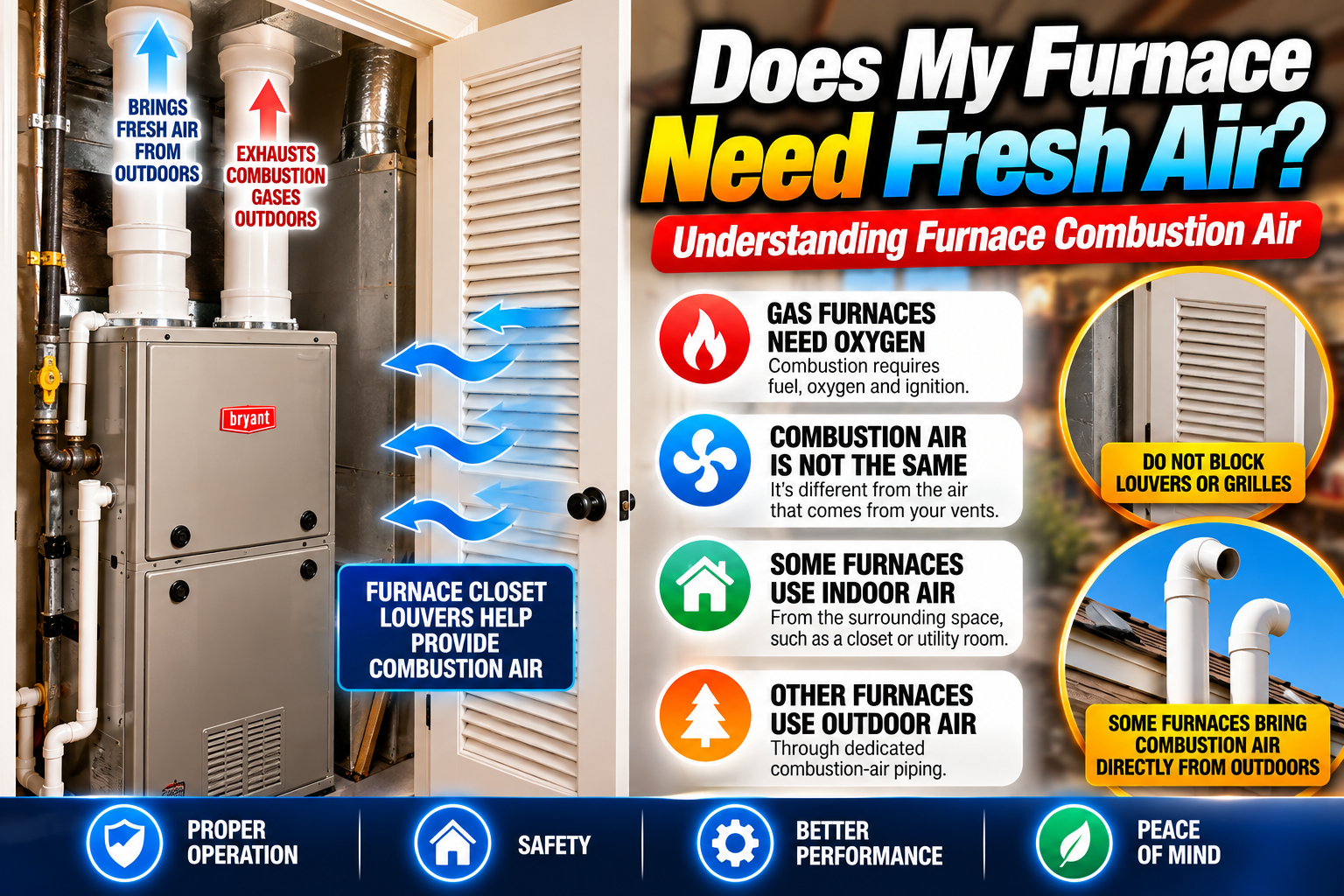
Gas furnaces need an appropriate supply of combustion air, although exactly where that air comes from depends on the furnace and how the system was installed.
Some furnaces use air from the surrounding space.
Others bring combustion air directly from outdoors.
That’s why vents, grilles, louvers and pipes around a furnace shouldn’t be blocked without first understanding what they do.
Here’s what homeowners need to know.
Key Takeaways
- Gas combustion requires oxygen.
- Some furnaces obtain combustion air from the surrounding indoor space.
- Other furnaces use dedicated outdoor combustion-air piping.
- Furnace closet louvers or grilles may serve an important purpose and shouldn’t automatically be covered.
- Boxes and stored belongings can interfere with required furnace clearances or openings.
- Supply/return airflow and combustion air are not the same thing.
- Restricted combustion air can affect furnace operation and safety.
- Furnace venting and combustion-air requirements depend on the equipment and installation.
What Is Furnace Combustion Air?
A gas furnace burns fuel to produce heat.
Combustion requires:
Fuel + oxygen + ignition.
The furnace receives fuel from the gas supply.
The ignition system initiates combustion.
But the furnace also needs an appropriate source of air containing oxygen.
That air is commonly referred to as:
Combustion air.
Without the proper conditions for combustion, the burners may not operate as intended.
Is Combustion Air the Same as the Air Coming From My Vents?
No.
This distinction is extremely important.
Your furnace deals with different air pathways.
Household HVAC Air
This is the air that circulates through your home.
Return ducts bring household air back to the HVAC system.
The blower moves that air across the heating equipment.
Then supply ducts distribute heated air throughout the house.
Combustion Air
This is air used by the furnace’s combustion process.
They’re related to the same piece of HVAC equipment, but they’re not the same airflow system.
A dirty return-air filter and a blocked combustion-air opening are therefore two different problems.
Where Does a Furnace Get Combustion Air?
It depends on the furnace design and installation.
Broadly, a gas furnace may obtain combustion air from:
The space surrounding the furnace
or
A dedicated source connected to the outdoors.
This is one reason homeowners shouldn’t assume that every furnace installation should look identical.
Equipment design matters.
Why Does My Furnace Closet Have Vents?
Have you ever noticed a furnace closet door with:
- Louvers
- Grilles
- or openings near the top and bottom?
Those openings may be part of the installation’s ventilation or combustion-air strategy.
That means covering them because they’re noisy or because you don’t like how they look can potentially create a problem.
Don’t assume:
“It’s just a vent in the door, so I can cover it.”
Find out what purpose it serves first.
Can I Replace a Louvered Furnace Door With a Solid Door?
Not automatically.
This is a surprisingly important homeowner question.
A louvered furnace closet door may be providing necessary airflow to the space.
Replacing it with a solid door without evaluating the installation could change the amount of air available to the furnace.
Whether a solid door is appropriate depends on factors including:
- Furnace type
- Combustion-air source
- Closet configuration
- Venting
- Equipment requirements
and applicable installation requirements.
Before changing the door, have the furnace installation evaluated.
Why Do Some Furnaces Have Two PVC Pipes?
Many high-efficiency condensing furnaces use plastic piping.
Depending on the installation, one pipe can be used for exhaust while another provides combustion air from outdoors.
This is commonly called a direct-vent configuration.
The furnace isn’t depending entirely on air from the surrounding room for combustion.
Instead, combustion air can be brought directly to the furnace.
That can be one reason two apparently similar homes have very different furnace-closet arrangements.
What If My Furnace Has Only One Vent Pipe?
Don’t diagnose the installation based solely on the number of visible pipes.
Furnace venting and combustion-air arrangements vary by:
- Equipment type
- Manufacturer
- Furnace efficiency
- Installation
- Building configuration
and other requirements.
If you’re unsure where your furnace obtains combustion air, an HVAC technician can identify the equipment and explain the installation.
Can I Store Boxes Around My Furnace?
This is where homeowners can unintentionally create problems.
A furnace closet often becomes convenient storage space.
Before long, there may be:
- Cardboard boxes
- Holiday decorations
- Clothing
- Paper products
- Cleaning supplies
and miscellaneous household items surrounding the equipment.
That’s not a good habit.
Stored items can interfere with:
- Equipment clearances
- Service access
- Combustion-air openings
- Ventilation
and potentially create combustible-material concerns.
Storage blocking equipment clearances is one potential source of restricted combustion air.
Keep the area around heating equipment clean and accessible.
Can I Store Paint or Chemicals Near My Furnace?
It’s better to keep potentially flammable or volatile materials away from gas-fired heating equipment.
Examples include certain:
- Paints
- Solvents
- Gasoline
- Aerosols
- Cleaning chemicals
and other combustible products.
Follow product storage instructions and furnace-clearance requirements.
A furnace or mechanical room shouldn’t automatically become a general-purpose chemical storage closet.
What Happens If a Furnace Doesn’t Get Enough Combustion Air?
Restricted combustion air can interfere with proper burner operation.
Potential symptoms can include:
- Abnormal flame appearance
- Ignition problems
- Burner problems
- Furnace shutdown
- Combustion issues
- Safety-control activation
But these symptoms don’t prove restricted combustion air.
Several furnace problems can produce similar symptoms.
That’s why the system should be diagnosed rather than assuming:
Yellow flame = blocked combustion air.
Restricted combustion air is one possible cause of abnormal flame appearance, but dirty burners, mechanical problems, and venting issues can also be involved.
Why Is My Furnace Flame Yellow Instead of Blue?
A properly operating gas furnace generally has a predominantly blue burner flame, although exact appearance varies with equipment and operating conditions.
An abnormal yellow flame can indicate that the combustion process deserves professional inspection.
Potential contributing conditions can include:
- Dirty burners
- Incorrect air-to-fuel conditions
- Restricted combustion air
- Venting problems
and other mechanical issues.
Is Combustion Air Related to Carbon Monoxide?
Proper combustion and venting are important parts of safe gas-furnace operation.
Carbon monoxide can be produced when fuels burn, which is why combustion, venting and properly operating fuel-burning appliances deserve attention.
But don’t use furnace appearance or smell to determine whether carbon monoxide is present.
Carbon monoxide is colorless and odorless.
Working carbon-monoxide alarms are essential.
A CO alarm should never be ignored, and the furnace isn’t automatically the source.
What’s the Difference Between Combustion Air and Venting?
Another important distinction:
Combustion air comes IN to support combustion.
Flue/exhaust gases need an appropriate path OUT.
The furnace’s combustion and venting systems have to work together.
A problem on either side can affect furnace operation.
This is why homeowners shouldn’t modify:
- Furnace vent pipes
- Combustion-air pipes
- Mechanical-room openings
- or furnace closet ventilation
without understanding the installation.
Can I Cover My Furnace Intake Pipe Outside?
No.
Outdoor furnace intake and exhaust terminations need to remain unobstructed according to the equipment and installation requirements.
Depending on the property, potential obstructions can include:
- Leaves
- Debris
- Vegetation
- Pest nests
- or objects placed near the termination.
Southern California homeowners don’t usually have to worry about deep snow blocking furnace vents like homeowners in colder climates, but outdoor terminations should still remain clear.
Can Birds or Animals Block a Furnace Vent?
It’s possible for outdoor openings to be affected by debris, insects, birds, rodents or other pests depending on the installation.
But don’t install random screens, mesh or covers over furnace venting.
Adding something that wasn’t approved for the system could restrict airflow or interfere with proper operation.
If pest intrusion is a concern, use an appropriate solution compatible with the furnace manufacturer’s requirements.
Why Does My Furnace Have an Inducer Motor?
Many modern gas furnaces use a draft inducer motor during the startup sequence.
The inducer helps establish the proper conditions for moving combustion gases through the furnace and venting system.
That’s why you may hear a small motor start before the burners ignite.
The startup sequence works like this:
Thermostat calls for heat → inducer starts → igniter operates → burners ignite → heat exchanger warms → blower starts.
The inducer is therefore different from the main furnace blower.
What Is a Furnace Pressure Switch?
Many furnaces use a pressure switch as part of the safety and startup sequence.
Its role is associated with confirming appropriate draft/venting conditions before burner operation continues.
If the furnace controls don’t receive the expected pressure-switch response, the furnace may prevent ignition or shut down.
That doesn’t automatically mean:
“The pressure switch is bad.”
The switch could be responding to another problem.
Potential conditions can involve:
- Venting
- Drainage on condensing furnaces
- Inducer operation
- Tubing
- Restrictions
- or the pressure switch itself.
Proper diagnosis matters.
Why You Shouldn’t Bypass Furnace Safety Switches
This is an important homeowner warning.
If a furnace refuses to ignite because a safety control isn’t satisfied, bypassing that control isn’t a repair.
Safety controls exist for a reason.
The correct question is:
Why isn’t the furnace satisfying the safety circuit?
A qualified technician should identify the cause before replacing or bypassing components.
Does Opening the Furnace Closet Door Help?
If opening a closet door appears to change how the furnace operates, that is useful diagnostic information—but it isn’t a permanent repair.
Don’t solve a suspected combustion-air problem by simply leaving doors open indefinitely.
The installation should provide the combustion air required for the furnace under normal operating conditions.
If changing the door position significantly affects operation, have the system evaluated.
What About Furnaces Installed in the Garage?
Garage furnaces can have different installation considerations than furnaces located inside a house.
The equipment still requires proper:
- Combustion
- Venting
- Clearances
- Airflow
and safe installation.
Don’t stack storage around a garage furnace simply because the surrounding area seems large.
Maintain appropriate access and clearance around the equipment.
Can Remodeling Affect Furnace Combustion Air?
Absolutely.
This is an overlooked issue.
Imagine a furnace originally installed in a relatively open utility area.
Years later, someone remodels the home and builds walls around the furnace.
Or they replace a louvered door with a solid decorative door.
The furnace itself hasn’t changed.
But the environment around it has.
Changes involving walls, doors, closets and mechanical rooms can potentially alter airflow available to combustion equipment.
HVAC considerations should therefore be part of remodeling plans involving the furnace area.
Should a Furnace Closet Be Airtight?
Not simply because you want to reduce furnace noise.
Whether and how the space can be enclosed depends on the equipment’s combustion-air and venting design.
Before sealing openings, adding insulation, replacing doors or modifying the closet, determine how the furnace was designed to receive combustion air.
What Can Homeowners Safely Check?
You don’t need to disassemble the furnace.
You can visually check that:
- The area around the furnace isn’t packed with storage.
- Visible furnace closet louvers aren’t covered.
- Outdoor intake/exhaust terminations aren’t obviously obstructed.
- Nothing has recently been changed around the furnace closet.
- You aren’t storing flammable products next to the equipment.
Then leave internal combustion adjustments to a qualified technician.
When Should I Call an HVAC Professional?
Schedule an inspection if you notice:
- Repeated ignition failure
- Abnormal burner flame
- Furnace shutdowns
- Unusual combustion sounds
- Venting concerns
- Recent remodeling around the furnace
- A damaged vent pipe
- Furnace operation that changes when doors are opened or closed
- Any concern about safe combustion
Advanced Heating & Air Conditioning’s furnace-repair service includes diagnosing ignition, airflow, and safety-related furnace problems, while heating maintenance is intended to identify developing heating issues before a breakdown.
Frequently Asked Questions
Does a gas furnace need fresh air?
Yes. Gas combustion requires an appropriate supply of combustion air. Where that air comes from depends on the furnace and installation.
Why does my furnace closet door have vents?
The louvers or grilles may provide ventilation or combustion air. Don’t cover or remove them without determining their purpose.
Can I replace my louvered furnace door with a solid door?
Not automatically. If the existing door is part of the furnace’s combustion-air strategy, changing it could affect operation.
Why does my furnace have two PVC pipes?
On many high-efficiency direct-vent furnaces, one pipe provides combustion air while another carries exhaust gases outdoors.
Can I store things in my furnace closet?
Avoid crowding the furnace. Maintain required clearances, service access and combustion-air openings, and keep combustible or flammable materials away from heating equipment.
Is return air the same as combustion air?
No. Return air is household air circulated by the HVAC system. Combustion air supplies oxygen for the fuel-burning process.
Can restricted combustion air cause a yellow furnace flame?
It can be one contributing factor, but a yellow flame can have several causes and should be professionally evaluated.
Can a blocked furnace vent stop the furnace from starting?
Depending on the furnace, venting or draft problems can prevent the startup sequence from completing because safety controls may not be satisfied.
Can I bypass a furnace pressure switch?
No. A safety device should not be bypassed to force the furnace to operate. Determine why the safety circuit isn’t being satisfied.
Should I keep my furnace closet clean?
Yes. Keeping the area accessible and free from clutter helps maintain equipment clearances and makes inspection and service easier.
Your Furnace Needs More Than Gas and Electricity
When homeowners think about furnace operation, they usually think about:
Gas
and
electricity.
But there’s another essential ingredient:
Air.
And there are multiple types of airflow involved in a heating system.
Your furnace needs proper household airflow to transfer heat.
A gas furnace also needs appropriate combustion air.
And the combustion products need a properly functioning venting path.
All three matter.
That’s why good furnace diagnosis looks at the entire heating system, not simply the burner.
Furnace Safety & Heating Service in the Temecula Valley
If you’re concerned about furnace combustion, venting, ignition or the way your furnace closet is configured, Advanced Heating & Air Conditioning can evaluate the heating system and explain how it’s designed to operate.
Advanced has served the Temecula Valley since 2008 and provides furnace repair, installation and heating maintenance throughout Temecula, Murrieta, Menifee, Winchester, Wildomar, French Valley, Canyon Lake, Lake Elsinore, Hemet and surrounding communities.
Advanced Heating & Air Conditioning
951-609-9881
California Contractor License #916901
AdvancedHeatingAndAir.com
REAL PEOPLE. REAL SERVICE. REAL COMFORT.