


Why Won’t My Heat Pump Switch From Cooling to Heating?
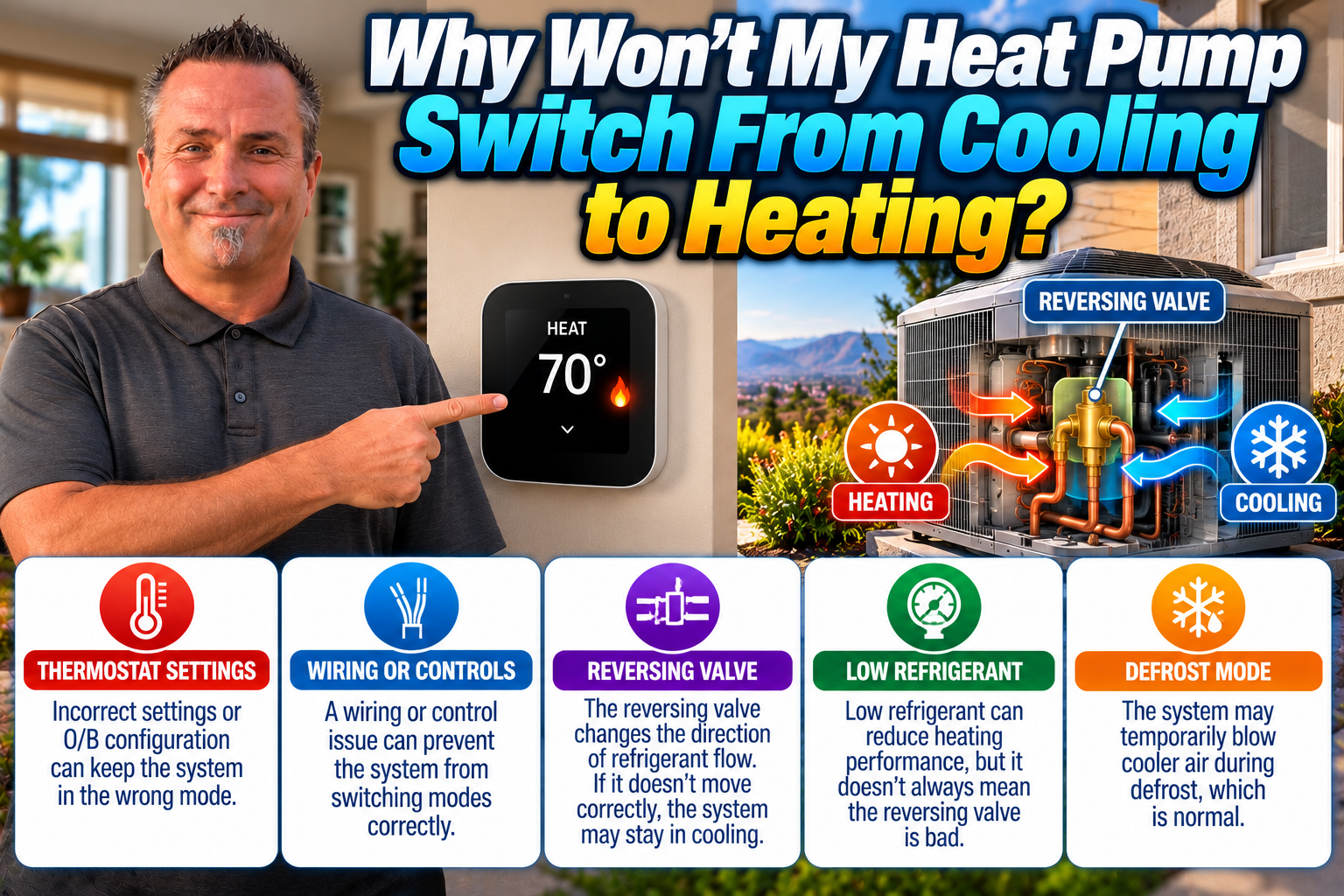
Why Won’t My Heat Pump Switch From Cooling to Heating?
One of the biggest advantages of a heat pump is that one system can provide:
Air conditioning in summer
and
Heating in winter.
But what happens when fall arrives, you change the thermostat from COOL to HEAT, and the house still feels like the air conditioner is running?
Homeowners commonly describe the problem as:
“My heat pump is stuck in cooling mode.”
Sometimes the thermostat is the issue.
Sometimes there is a control or wiring problem.
Sometimes the system’s reversing valve is not changing position correctly.
And sometimes the air only feels cool even though the heat pump is actually heating normally.
The important thing is to determine what the system is truly doing before replacing parts.
Key Takeaways
- A heat pump uses the same refrigeration system for heating and cooling.
- A reversing valve changes the direction of refrigerant flow.
- Thermostat wiring or configuration can prevent the heat pump from switching modes correctly.
- A reversing-valve electrical problem is different from a mechanically stuck reversing valve.
- Low refrigerant can reduce heating performance but does not automatically mean the reversing valve is bad.
- Heat-pump supply air can feel cooler than gas-furnace air even when the system is heating normally.
- Defrost mode can temporarily produce cooler indoor air.
- A system that works in cooling but not heating provides useful diagnostic information.
- A system that blows truly cold air while indoor temperature falls should be checked.
- Do not repeatedly cycle power or attempt to force a reversing valve yourself.
How Does a Heat Pump Switch Between Heating and Cooling?
A heat pump uses a refrigeration circuit.
During cooling mode, it moves heat:
From your house → outdoors.
During heating mode, it changes the direction of refrigerant flow and moves heat:
From outdoors → into your house.
The component responsible for changing that flow is called the:
Reversing Valve
Without it, a standard heat pump could not switch between heating and cooling.
What Is a Reversing Valve?
The reversing valve is a refrigerant-control valve located in the heat-pump system.
It directs high-pressure refrigerant to different parts of the refrigeration circuit depending on whether the system is operating in:
Heating
or
Cooling.
You can think of it like a traffic switch for refrigerant.
In one position:
The indoor coil operates as the cooling coil.
In the other:
The indoor coil becomes the heating coil.
That single change allows the same HVAC system to serve both seasons.
What Tells the Reversing Valve to Move?
Usually:
The thermostat and system controls.
The thermostat sends a low-voltage signal to the reversing-valve solenoid.
Depending on the manufacturer, the valve may be energized in:
Cooling
or
Heating.
This is why thermostat configuration matters so much. Incorrect O/B configuration can cause the system to operate in the wrong mode.
What Does O/B Mean on My Thermostat?
The:
O/B terminal
controls the heat-pump reversing valve.
Different manufacturers can use different reversing-valve logic.
That means a thermostat may need to be configured for:
O
or
B
operation.
If it is configured incorrectly, you may request:
HEAT
while the outdoor system operates as though you requested:
COOL.
This is one of the first things worth checking after a thermostat replacement.
Why Would This Happen After Installing a New Thermostat?
Because the thermostat needs to know:
That the system is a heat pump
and
how the reversing valve operates.
A thermostat installed with the wrong equipment type or reversing-valve setting can create symptoms such as:
Cooling when heat is requested
or
Heating when cooling is requested.
This is why thermostat replacement on a heat pump should include testing of both modes.
What If Nobody Changed the Thermostat?
Then there are other possibilities.
A heat pump that worked correctly last season but suddenly cannot change modes may have a problem involving:
- Reversing-valve solenoid
- Wiring
- Control board
- Thermostat signal
- Refrigeration system
- or the valve itself.
What Is the Reversing-Valve Solenoid?
The solenoid is an electrical coil that helps control the reversing valve.
When energized, it creates a magnetic force that helps the pilot portion of the valve change position.
The solenoid can fail electrically even when the mechanical valve itself is still capable of moving.
That distinction is important.
A technician should determine whether the issue is:
Electrical
or
Mechanical.
Can a Reversing Valve Get Stuck?
Yes.
A reversing valve is a mechanical component.
It can sometimes fail to shift properly.
Possible causes may include:
- Internal wear
- Mechanical sticking
- Pressure-related problems
- Contamination
- or damage.
But technicians should not automatically diagnose:
“Bad reversing valve”
simply because the heat pump is not heating.
Other causes should be checked first.
Why Does That Matter?
Because replacing a reversing valve can be a substantial refrigeration repair.
The refrigerant circuit may need to be:
- Recovered
- opened
- brazed
- pressure-tested
- evacuated
- and
- recharged.
So you want a confident diagnosis before performing that work.
Could It Just Be the Thermostat?
Absolutely.
Possible thermostat-related issues include:
- Incorrect system type
- Wrong O/B setting
- Loose wiring
- Failed thermostat output
- Incorrect staging configuration
- or thermostat malfunction.
A heat-pump repair visit should check thermostat settings, calibration and wiring, along with heating/cooling mode operation and the reversing valve.
Could a Broken Wire Cause the Problem?
Yes.
A damaged or loose low-voltage conductor can prevent the reversing-valve signal from reaching the outdoor unit.
This can happen because of:
- Loose terminal connections
- damaged thermostat cable
- splices
- rodent damage
- or previous service work.
Electrical diagnosis should verify whether the correct signal is reaching the equipment.
Could the Control Board Cause It?
Yes.
Modern heat pumps use electronic controls to coordinate system operation.
A board problem can potentially interfere with:
- Mode changes
- Reversing-valve signal
- Compressor operation
- Defrost
- or other functions.
But once again:
A system stuck in one mode does not automatically prove the board is bad.
Verify inputs and outputs.
Could Low Refrigerant Make It Seem Like the Heat Pump Is Stuck in Cooling?
It can create poor heating performance.
Suppose the reversing valve changes correctly but the refrigeration system does not have the capacity to provide adequate heat.
The homeowner may say:
“It feels like the AC is still on.”
Possible refrigeration causes include:
- Low charge
- Leak
- Restriction
- or compressor performance problems.
How Can I Tell Whether It Is Actually Heating?
Do not judge only by putting your hand over the vent.
Heat pumps often produce supply air that feels much less intense than gas-furnace air.
A gas furnace might deliver air that feels:
Very hot.
A heat pump may deliver:
Moderately warm air for a longer period.
If your skin is approximately 90°F+, air that is warmer than the room but cooler than your skin can sometimes feel cool.
So ask:
Is the indoor temperature actually rising?
That is more useful than:
“Does the vent feel hot?”
What If My Thermostat Is Set to 70°F and the House Keeps Getting Colder?
That is a different situation.
If:
Thermostat = HEAT
Setpoint = 70°F
and indoor temperature continues falling:
68 → 67 → 66°F
while the heat pump runs,
then the system may not be providing adequate heating.
Possible causes include:
- Wrong operating mode
- Reversing-valve issue
- Refrigerant problem
- Compressor problem
- Airflow issue
- or another fault.
That deserves service.
What If Cooling Works Perfectly but Heating Does Not?
That is useful diagnostic information.
It tells the technician that several parts of the system are at least capable of operating in cooling mode.
The problem may be more focused around:
- Mode control
- Reversing valve
- Heating-specific controls
- Defrost
- or heating performance.
A good diagnostic process distinguishes cooling complaints from heating-mode complaints and includes reversing-valve checks.
What If Heating Works but Cooling Does Not?
The same general principle applies.
If the heat pump is effectively stuck in heating mode during summer, possible causes include:
- Thermostat configuration
- O/B signal
- Reversing-valve solenoid
- Valve problem
- or control issues.
A system that is actually heating the house when cooling is requested should be turned off and serviced.
Can the Reversing Valve Be Energized in Cooling Instead of Heating?
Yes.
This is a very important heat-pump detail.
Some manufacturers energize the reversing valve in:
Cooling mode.
Others use the opposite strategy.
That is exactly why the thermostat needs to be configured for the equipment rather than assuming one universal setting.
Does That Mean the Reversing Valve Is Always Powered?
Depending on equipment design, the solenoid may remain energized whenever the system is operating in whichever mode requires that valve position.
That is normal.
A solenoid being energized does not itself mean something is wrong.
Why Do I Hear a Whoosh When the Heat Pump Changes Modes?
When refrigerant pressures and flow direction change, you may hear a brief:
- Whoosh
- hiss
- or pressure-change sound.
This can occur when:
Switching modes
or
Entering/exiting defrost.
A short mode-change sound can be normal.
A continuous severe hissing sound is different and should be evaluated.
Can the Heat Pump Switch Between Heating and Cooling Automatically?
Some thermostats have:
AUTO CHANGEOVER
mode.
In that setting, the thermostat can automatically choose heating or cooling based on indoor temperature and programmed thresholds.
That is different from the heat pump itself randomly switching modes.
The thermostat is making the decision.
Can Auto Changeover Cause Confusion?
Yes.
Suppose your thermostat is configured with:
Heating setpoint
and
Cooling setpoint
close together.
The system may change between modes more frequently than expected.
Proper thermostat deadband and settings matter.
Should I Use Auto Changeover?
It can be convenient during shoulder seasons when mornings are cool and afternoons are warm.
Southern California can experience exactly that type of weather.
For example:
Cool Temecula morning
followed by
Warm afternoon.
But homeowners should understand the thermostat settings so the system is not unnecessarily switching back and forth.
Can a Heat Pump Change From Heating to Cooling Too Quickly?
Controls may include delays to protect the compressor from rapid cycling and pressure imbalance.
So after changing modes, the system may not respond instantly.
A short delay can be normal.
Do not repeatedly move the thermostat between:
HEAT
and
COOL
trying to force an immediate response.
What Is Compressor Protection Delay?
Many thermostats or control boards intentionally delay compressor startup after:
- Power interruption
- Shutdown
- or
- Mode change.
This may last several minutes.
The purpose is to reduce compressor stress.
So if you switch from cooling to heating and nothing happens immediately:
Wait a few minutes before assuming the system failed.
Can Defrost Make It Look Like My Heat Pump Switched Back to Cooling?
Yes.
During heating operation, the outdoor coil can frost.
To remove that frost, the heat pump temporarily changes refrigeration operation during:
Defrost mode.
This can look like the system briefly switched toward cooling operation.
The indoor system may use auxiliary heat during this time to maintain comfort.
Why Does My Heat Pump Blow Cooler Air During Defrost?
During defrost, the refrigeration cycle temporarily changes.
Without supplemental heat, the indoor coil may not deliver normal warm air for that short period.
Some systems activate auxiliary heat to reduce the comfort impact.
Once defrost ends:
Normal heating should resume.
How Long Does It Take to Switch Back After Defrost?
The exact sequence depends on the equipment and controls.
But defrost should be temporary.
If the system enters a condition where it:
- Never returns to normal heating
- or
- Continues blowing cold air for an extended period,
service is appropriate.
Can a Bad Defrost Board Cause Mode Problems?
Potentially.
Depending on system design, defrost controls participate in reversing-valve operation during defrost.
A control problem could affect the normal sequence.
Newer systems may integrate defrost functions into a larger electronic control board rather than using a separate defrost board.
What Is a Reversing-Valve Coil Resistance Test?
A technician may use electrical measurements to evaluate whether the solenoid coil is:
- Open
- shorted
- or has a reasonable electrical resistance.
That helps determine whether the electrical portion of the valve control is functioning.
Homeowners do not need to perform this test.
Can a Technician Check Whether the Valve Is Receiving Voltage?
Yes.
Part of diagnosis can involve verifying whether the control signal actually reaches the reversing-valve solenoid when the system calls for the appropriate mode.
That helps separate:
Control problem
from
Mechanical valve problem.
Can a Reversing Valve Be Freed Without Replacing It?
There are diagnostic and service techniques technicians may sometimes use to determine whether a valve is stuck.
But homeowners should not:
- Strike the valve
- apply voltage manually
- or try to force it.
The reversing valve is connected to a high-pressure refrigerant system.
This is professional service work.
Can a Bad Compressor Look Like a Reversing-Valve Problem?
Potentially.
A compressor that cannot create adequate pressure difference may produce poor heating and cooling performance.
A technician may need to evaluate:
- System pressures
- temperatures
- compressor amperage
- and refrigerant circuit behavior.
This is why full refrigeration diagnostics matter.
Can an Expansion Valve Cause Heating Problems?
Yes.
Heat pumps use refrigerant-metering devices to control refrigerant flow.
Depending on equipment design, there may be different metering arrangements for heating and cooling.
A restriction or metering problem could affect performance differently by mode.
That can sometimes mimic other faults.
Can a Clogged Filter Make My Heat Pump Seem Like It Won’t Heat?
Yes.
Restricted airflow can reduce delivered heat and overall system performance.
Always check the simplest safe things first:
- Filter
- thermostat mode
- setpoint
- registers
- and whether the outdoor unit is operating.
Can Closed Vents Cause This?
Closed registers do not make the reversing valve stick.
But closing many vents can contribute to poor airflow and comfort.
That can make it harder to tell whether the equipment itself is producing adequate heat.
Keep normal supply and return pathways open unless the system was specifically designed otherwise.
Can a Dirty Outdoor Coil Cause Poor Heating?
Yes.
During heating mode, the outdoor coil needs to absorb heat from the outdoor air.
Heavy dirt or airflow restriction can reduce heat transfer.
That can make the heat pump struggle even though the reversing valve is functioning correctly.
Can a Frozen Outdoor Coil Cause the Same Symptom?
Yes.
A heavily iced outdoor coil cannot absorb heat properly.
The system may run but fail to warm the house.
A frozen unit should be diagnosed separately from a reversing-valve problem.
Could Auxiliary Heat Hide the Problem?
Absolutely.
This is an important one.
Imagine the heat pump is not providing normal heating.
But the electric auxiliary heat turns on.
The house may still get warm.
The homeowner thinks:
“Everything is fine.”
Meanwhile:
The heat pump itself is not doing the heating.
That can lead to significantly higher electricity use.
If your outdoor unit is not operating normally but the house is still warm, backup heat may be carrying the load.
Why Would My Electric Bill Suddenly Increase?
If the heat pump fails to operate correctly in heating mode and backup electric heat takes over, electricity use can increase substantially.
That is why a sudden bill increase can sometimes be an early clue that:
The primary heat pump isn’t doing its share.
Don’t evaluate only whether the house is warm.
Also pay attention to:
How the system is producing that heat.
Can Dual Fuel Have a Similar Problem?
A dual-fuel system combines:
- Heat pump
- and
- Gas furnace.
If the heat pump cannot switch or operate properly, the system may fall back to gas depending on control logic.
The homeowner may stay comfortable while the heat-pump portion has a fault.
That is another reason system diagnostics should verify operation in each mode.
Can a Smart Thermostat Cause This After a Software Update?
Potentially, though it is not the first assumption to make.
Modern thermostats can receive software updates or have configuration changes.
If the heat-pump behavior changes immediately afterward, thermostat setup deserves investigation.
But wiring, equipment and controls should still be checked objectively.
Can a Power Outage Cause the Heat Pump to Get Confused?
A short power interruption can sometimes cause controls to reset or enter protective delays.
Normally the system should recover.
If strange behavior begins after an outage:
- Turn the system off normally
- allow the manufacturer’s appropriate reset period
- and schedule service if the problem remains.
Do not repeatedly cycle breakers.
Should I Reset My Heat Pump?
A single reset may sometimes clear a temporary control issue.
But if the heat pump repeatedly requires resetting to switch modes:
That is a symptom.
Do not make repeated resets the permanent solution.
The underlying cause should be found.
Can a Reversing Valve Be Repaired?
Sometimes the issue is an external component such as:
- Solenoid
- wiring
- or control.
A mechanically failed valve itself may require valve replacement.
Whether that is practical depends on:
- Equipment age
- system condition
- repair cost
- refrigerant type
- and warranty.
Do I Need a New Heat Pump If the Reversing Valve Fails?
Not automatically.
A reversing-valve problem can be repairable.
But because replacing the valve can involve significant refrigeration work, it makes sense to compare:
- Repair cost
- with
- Equipment age
- Warranty status
- Other known problems
- and replacement options.
A five-year-old premium system and an eighteen-year-old system are very different decisions.
Is a Reversing Valve Covered Under Warranty?
It may be covered by the equipment’s parts warranty depending on:
- Manufacturer
- registration
- equipment age
- and warranty terms.
Labor and refrigerant may be treated separately.
Check the actual warranty before assuming all costs are covered.
Can Heat-Pump Maintenance Prevent a Reversing-Valve Failure?
Maintenance cannot prevent every mechanical failure.
But routine service can identify issues involving:
- Electrical connections
- Controls
- refrigerant performance
- coil condition
- and abnormal operation.
It also gives technicians a better history of how the equipment has been performing.
What Can Homeowners Safely Check?
Before calling for service, you can safely verify:
- Thermostat is actually set to HEAT
- Setpoint is above indoor temperature
- Filter is reasonably clean
- Supply and return vents are open
- Outdoor unit starts
- Indoor temperature is rising or falling
- Whether the thermostat was recently replaced
- Whether the problem began after a power outage
Those observations can help the technician tremendously.
What Should You Not Do?
Do not:
- Open refrigerant lines
- Remove energized electrical panels
- Force the reversing valve
- Jump thermostat wires
- or repeatedly cycle breakers.
The system contains:
High voltage
and
Pressurized refrigerant.
Leave those diagnostics to a trained technician.
When Should I Call for Service?
Schedule service if:
- Thermostat says HEAT but the house keeps cooling
- Cooling works but heating does not
- Heating works but cooling does not
- The system changed behavior after thermostat replacement
- Auxiliary heat runs constantly
- The outdoor unit does not respond correctly to mode changes
- The heat pump never returns to normal heating after defrost
- or
- The system repeatedly needs resetting.
Advanced Heating & Air Conditioning diagnoses heat pumps that will not switch properly between heating and cooling and checks thermostat wiring, controls and reversing-valve operation during repair visits.
Frequently Asked Questions
Why is my heat pump still blowing cold air when the thermostat says HEAT?
Possible causes include normal lower-temperature heat-pump air, defrost operation, thermostat setup, reversing-valve control problems, refrigerant issues or an equipment fault.
What makes a heat pump switch from cooling to heating?
A reversing valve changes the direction of refrigerant flow, controlled by the thermostat and system electronics.
What is the O/B wire?
It is the thermostat signal used to control the heat pump’s reversing valve.
Can the wrong thermostat setting make my heat pump cool instead of heat?
Yes. Incorrect O/B or equipment-type configuration can cause the heat pump to operate in the wrong mode.
Can a reversing valve get stuck?
Yes. Mechanical failure can occur, although electrical and control problems should also be checked before condemning the valve.
Does a reversing valve always mean an expensive repair?
No. The problem may be the solenoid, wiring or thermostat rather than the valve itself.
Why does my heat pump switch modes during defrost?
The refrigeration cycle temporarily changes so the outdoor coil can warm and remove frost.
Why does cooling work but heating doesn’t?
Possible causes include thermostat configuration, reversing-valve operation, heating controls, defrost issues or refrigeration problems.
Can low refrigerant stop a heat pump from heating?
Low refrigerant can reduce heating capacity, but it does not necessarily prevent the reversing valve from switching.
Can auxiliary heat make it look like my heat pump is working?
Yes. Backup electric heat can warm the house even when the primary heat pump has a problem.
Should I keep resetting my heat pump?
No. If it repeatedly requires resetting, the underlying problem should be diagnosed.
Do I need a new system if the reversing valve fails?
Not automatically. Repair-versus-replacement depends on equipment age, condition, warranty and repair cost.
The Most Important Diagnostic Question
When a homeowner says:
“My heat pump won’t switch to heat,”
don’t immediately assume:
Bad reversing valve.
First determine:
Is the thermostat asking for the correct mode?
↓
Is the reversing-valve signal present?
↓
Is the solenoid working?
↓
Did the valve actually change position?
↓
Is the refrigeration system producing proper heating afterward?
That process separates a:
$50 wiring/configuration-type problem
from a much larger refrigeration repair.
Good diagnosis matters.
Heat Pump Repair in the Temecula Valley
Advanced Heating & Air Conditioning services heat pumps throughout Temecula, Murrieta, Menifee, Winchester, Wildomar, French Valley, Canyon Lake, Lake Elsinore, Hemet and surrounding communities.
Advanced’s diagnostic process checks thermostat settings and wiring, heating and cooling mode operation, refrigerant performance, electrical controls and reversing-valve operation when a heat pump is not switching modes correctly.
Advanced Heating & Air Conditioning
951-609-9881
California Contractor License #916901
REAL PEOPLE. REAL SERVICE. REAL COMFORT.