


Why Does My Furnace Keep Turning On and Off? 10 Common Reasons Your Heater Is Short Cycling
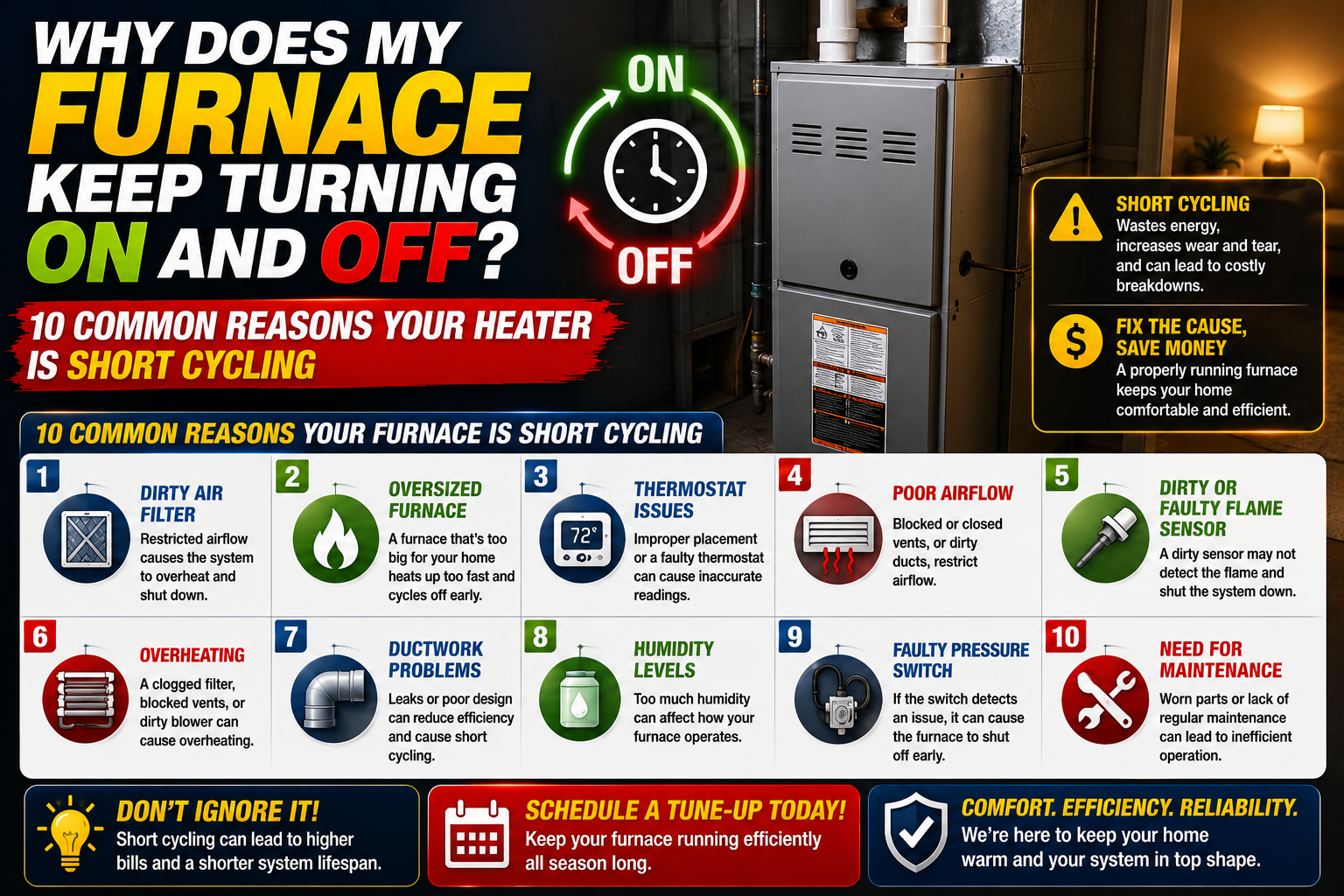
Why Does My Furnace Keep Turning On and Off? 10 Common Reasons Your Heater Is Short Cycling
Key Takeaways
- A furnace that constantly turns on and off is experiencing short cycling.
- Short cycling increases energy bills and places unnecessary wear on your heating system.
- Dirty air filters, thermostat issues, overheating, and airflow problems are common causes.
- Addressing the problem early can prevent expensive repairs and extend the life of your furnace.
Table of Contents
- What Is Furnace Short Cycling?
- Why It Happens
- The 10 Most Common Causes
- What Homeowners Can Check
- When to Call an HVAC Professional
- Frequently Asked Questions
- From the Field
- Summary
What Is Furnace Short Cycling?
A properly operating furnace follows a fairly simple process.
- The thermostat senses the temperature has dropped.
- The furnace starts.
- The burners ignite.
- The blower distributes warm air.
- The home reaches the desired temperature.
- The system shuts off until heat is needed again.
When a furnace starts, runs for only a few minutes, shuts off, and then starts again shortly afterward, it’s called short cycling.
Instead of completing normal heating cycles, the furnace repeatedly turns on and off.
Besides being annoying, short cycling can:
- Increase utility bills
- Reduce comfort
- Wear out components faster
- Shorten the life of your furnace
Why Short Cycling Shouldn’t Be Ignored
Many homeowners assume:
“At least it’s still making heat.”
While that may be true, short cycling often signals that something isn’t operating correctly.
The longer the issue continues, the harder your furnace has to work.
Small problems that are inexpensive to correct today can eventually lead to larger repairs if ignored.
1. Dirty Air Filter
This is the first thing our technicians check.
A clogged air filter restricts airflow.
As airflow decreases:
- The furnace overheats.
- Safety controls shut it down.
- The furnace cools.
- It starts again.
The cycle repeats over and over.
Fortunately, replacing the filter is one of the easiest maintenance tasks homeowners can perform.
2. Overheating Furnace
Modern furnaces contain safety devices called limit switches.
If internal temperatures become too high, the limit switch shuts the burners off to protect the equipment.
Common reasons include:
- Dirty filter
- Blocked vents
- Dirty blower
- Airflow restrictions
The furnace cools, resets, and starts again.
3. Thermostat Problems
Sometimes the furnace isn’t the problem at all.
The thermostat may:
- Be located near a heat source.
- Receive direct sunlight.
- Have loose wiring.
- Need replacement.
- Be improperly programmed.
If the thermostat incorrectly senses room temperature, it may cause frequent cycling.
4. Blocked Supply or Return Vents
Closing multiple vents or blocking return air with furniture can reduce airflow.
Reduced airflow makes the furnace work harder and may contribute to overheating.
Many homeowners unknowingly create this problem while trying to redirect airflow to other rooms.
5. Dirty Flame Sensor
The flame sensor confirms that the burners have successfully ignited.
If the sensor becomes dirty:
- It may not detect the flame.
- The gas valve shuts off.
- The furnace restarts.
- The cycle repeats.
A dirty flame sensor is one of the more common heating service calls during winter.
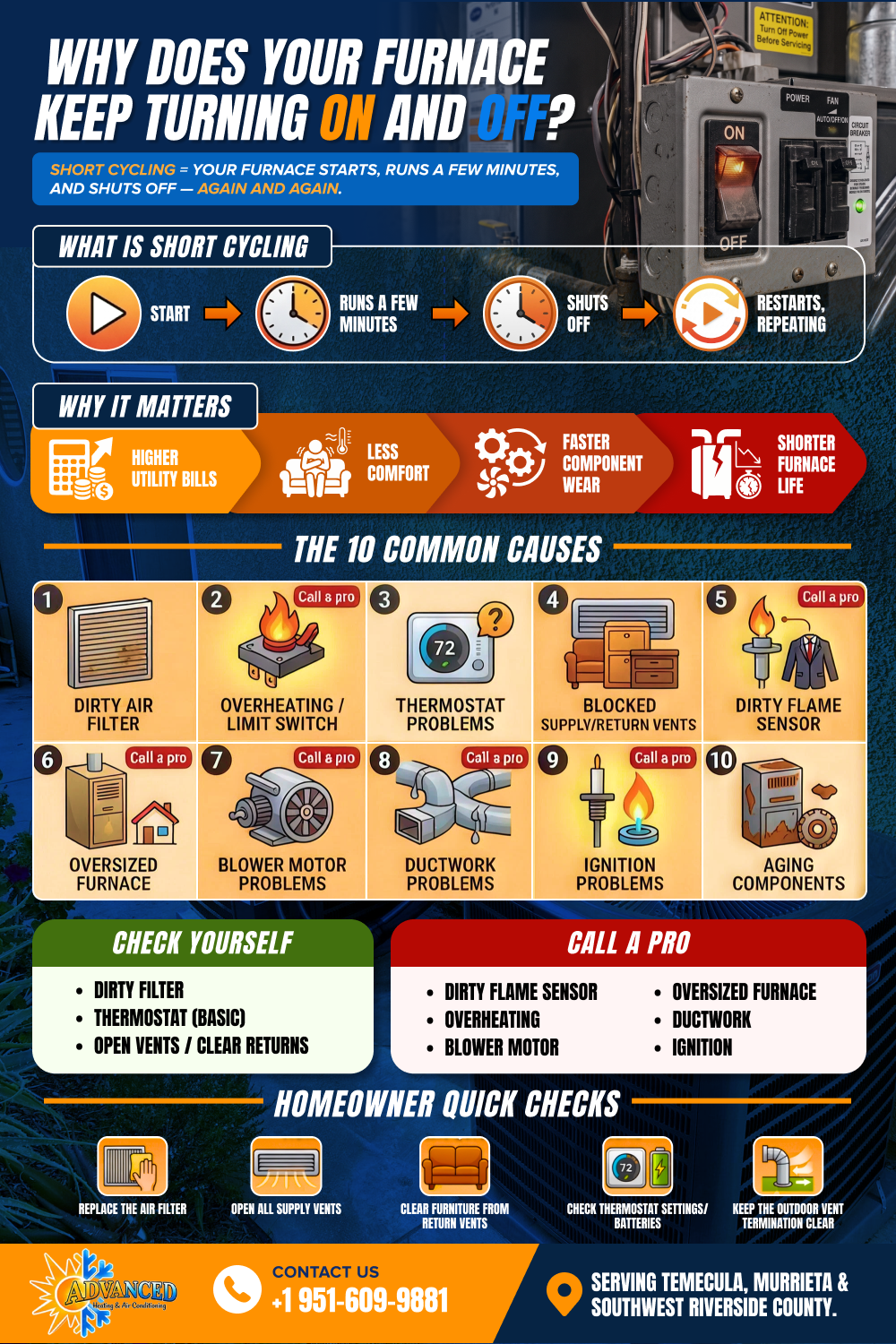
6. Oversized Furnace
Bigger isn’t always better.
An oversized furnace heats the thermostat area too quickly.
The thermostat becomes satisfied before the rest of the home reaches the desired temperature.
The furnace shuts off…
Then starts again shortly afterward.
Proper equipment sizing is one of the most important parts of HVAC design.
7. Blower Motor Problems
If the blower isn’t moving enough air, the furnace may overheat.
Potential causes include:
- Motor wear
- Capacitor problems
- Dirty blower wheel
- Electrical issues
Professional testing helps identify the exact cause.
8. Ductwork Problems
Leaky, undersized, or poorly designed ductwork affects airflow throughout the home.
The furnace depends on proper airflow to operate safely and efficiently.
When airflow is restricted, short cycling can occur.
9. Ignition Problems
If the burners don’t ignite properly, the furnace may repeatedly attempt to start.
Possible causes include:
- Hot surface igniter
- Control board
- Gas valve
- Electrical connections
Because these involve combustion and electrical components, professional diagnosis is recommended.
10. Aging Components
As furnaces age, multiple components naturally wear over time.
Sometimes several small issues combine to create short cycling.
A professional inspection evaluates the entire heating system rather than focusing on just one component.
What Homeowners Can Check
Before scheduling service, safely inspect these items:
- ✔ Replace the air filter.
- ✔ Make sure all supply vents are open.
- ✔ Remove furniture blocking return vents.
- ✔ Check thermostat settings.
- ✔ Replace thermostat batteries if applicable.
- ✔ Verify nothing is blocking the outdoor vent termination (for high-efficiency furnaces).
If short cycling continues after these basic checks, it’s time for a professional evaluation.
Comparison Table
- Dirty Filter — Homeowner can check? Yes. Professional service recommended? Usually not.
- Thermostat — Homeowner can check? Basic check. Professional service recommended? Sometimes.
- Dirty Flame Sensor — Homeowner can check? No. Professional service recommended? Yes.
- Overheating — Homeowner can check? Limited. Professional service recommended? Yes.
- Blower Motor — Homeowner can check? No. Professional service recommended? Yes.
- Oversized Furnace — Homeowner can check? No. Professional service recommended? Yes.
- Ductwork Issues — Homeowner can check? Limited. Professional service recommended? Yes.
- Ignition Problems — Homeowner can check? No. Professional service recommended? Yes.
From the Field
One homeowner in Menifee called us because their furnace was running for only three or four minutes before shutting off. They were convinced they needed a new furnace because the system was over 15 years old.
When we arrived, we found an extremely dirty air filter that had severely restricted airflow. The furnace was overheating and repeatedly tripping its high-limit safety switch.
After replacing the filter and inspecting the rest of the system, the furnace completed normal heating cycles again.
Not every short cycling problem has such a simple solution, but this service call is a great reminder that basic maintenance can make a big difference.
Frequently Asked Questions
Is short cycling bad for my furnace?
Yes. Frequent starts and stops increase wear on motors, igniters, and other components while reducing efficiency.
Can a dirty air filter really cause short cycling?
Absolutely. Restricted airflow can cause the furnace to overheat, triggering the high-limit safety switch.
Should I keep running my furnace if it’s short cycling?
If replacing the air filter doesn’t solve the problem and the furnace continues to short cycle, it’s best to have it inspected before additional wear occurs.
Will replacing my thermostat fix short cycling?
Only if the thermostat is the cause. Many short cycling problems originate elsewhere in the HVAC system.
In Summary
A furnace that constantly turns on and off isn’t operating normally.
While the cause may be something simple like a dirty air filter, it could also involve airflow restrictions, overheating, thermostat issues, ignition problems, or aging components.
The sooner the cause is identified, the easier—and often less expensive—it is to correct.
Why Trust Advanced Heating & Air Conditioning?
Since 2008, Advanced Heating & Air Conditioning has proudly served homeowners throughout Temecula, Murrieta, Menifee, Winchester, Lake Elsinore, Hemet, Wildomar, French Valley, and surrounding communities.
Our technicians take a comprehensive approach to diagnosing heating issues. Rather than replacing parts based on guesswork, we evaluate airflow, safety controls, thermostat operation, electrical components, and overall system performance to identify the true cause of the problem. Our goal is to help homeowners make informed decisions with honest recommendations and reliable repairs.
Related Articles
- Why Is My Furnace Blowing Cold Air?
- Why Is My Furnace Making Loud Noises?
- Why Is My Heating Bill So High?
- Is It Better to Repair or Replace Your Furnace?
- How Often Should You Have Your HVAC System Serviced?
- How Often Should You Change Your HVAC Air Filter?
- Why Does My Air Conditioner Keep Turning On and Off?