


Why Is My AC Buzzing or Humming? 10 Possible Causes
Your Air Conditioner Is Talking to You — What Does That Noise Mean?
Air conditioners aren’t completely silent.
When your cooling system starts, you may normally hear:
- The outdoor fan
- Air moving through the vents
- The indoor blower
- The compressor operating
- A click when equipment starts or stops
After living with the same HVAC system for years, most homeowners become familiar with its normal sounds.
That’s why a new buzzing or humming noise gets your attention.
Maybe the outdoor unit is humming but the fan isn’t spinning.
Maybe you hear a loud electrical buzz when the AC tries to start.
Or perhaps the system is still cooling, but the sound has suddenly become much louder than before.
A new HVAC noise doesn’t automatically mean you need a new air conditioner.
But it can be an early warning that something needs attention.
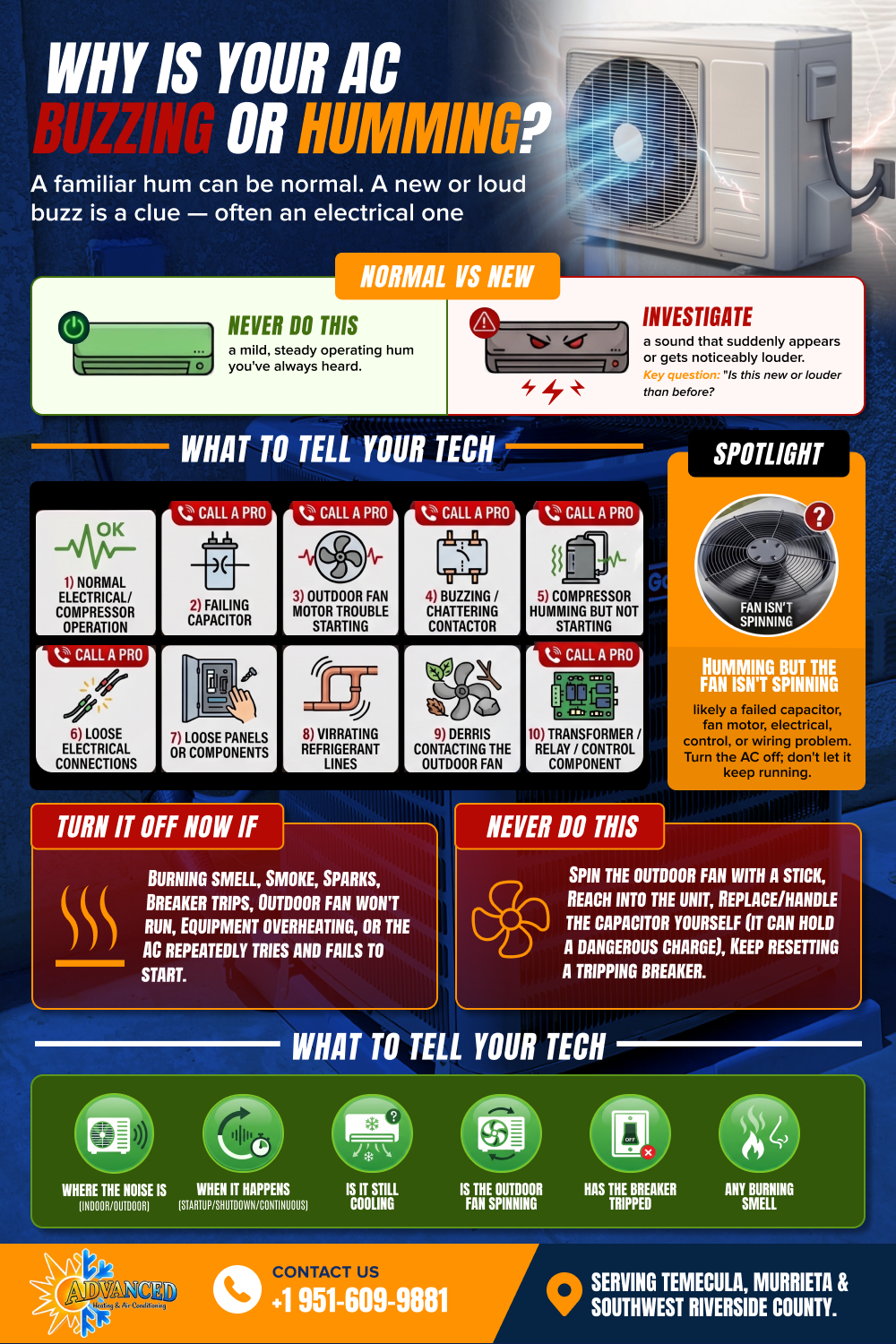
Here are 10 possible causes.
1. Normal Electrical and Compressor Operation
First, not every hum means something is wrong.
HVAC equipment contains motors, electrical components, and a compressor.
A mild, steady operating hum may simply be part of normal equipment operation.
The key question is:
Is this noise new or significantly louder than it used to be?
A sound that has always been present may be normal.
A sound that suddenly appears or becomes noticeably louder deserves investigation.
2. A Failing Capacitor
Capacitors are electrical components used in many air conditioning systems to help motors and compressors operate.
When a capacitor weakens or fails, the equipment may have difficulty starting.
Possible symptoms can include:
- Humming outdoor unit
- Fan not starting
- Compressor struggling to start
- AC intermittently operating
- System shutting down
- Breaker trips
A capacitor cannot be accurately diagnosed just by listening to it.
It needs to be tested.
Homeowners should also avoid attempting DIY capacitor replacement because capacitors can retain dangerous electrical energy even when power has been disconnected.
3. The Outdoor Fan Motor Is Having Trouble Starting
Your outdoor condenser fan helps move air across the condenser coil.
If the fan motor develops a problem, you may hear the equipment humming even though the fan isn’t operating correctly.
Possible signs include:
- Outdoor unit humming
- Fan blade not spinning
- Fan starting slowly
- Fan stopping unexpectedly
- Outdoor unit becoming unusually hot
- Poor cooling
If the outdoor fan isn’t operating while the system is trying to cool, turn the AC off and have it inspected.
Continuing to operate equipment with a failed condenser fan can create additional problems.
4. A Contactor May Be Buzzing
The contactor is an electrical component inside many outdoor HVAC units.
It helps control power to major equipment when the thermostat calls for cooling.
Over time, contactors can wear.
Electrical contacts may become:
- Pitted
- Burned
- Worn
- Contaminated
In some situations, a failing or improperly operating contactor may produce a buzzing or chattering sound.
Electrical testing can determine whether the contactor is operating correctly.
5. The Compressor Is Humming but Not Starting
The compressor is one of the most important components in your air conditioning system.
When the thermostat calls for cooling, the compressor should start and circulate refrigerant through the system.
If you hear a strong humming sound but the compressor isn’t starting properly, the system may have a startup problem.
Possible causes can involve:
- Capacitor
- Electrical supply
- Wiring
- Compressor
- Other electrical components
Compressor problems should be professionally diagnosed before assuming the compressor itself has failed.
6. Loose Electrical Connections
HVAC equipment repeatedly starts and stops throughout its service life.
It also experiences:
- Heat
- Vibration
- Outdoor weather
- Electrical load
Over time, electrical connections can loosen or deteriorate.
Loose connections can sometimes produce buzzing, arcing, overheating, or intermittent equipment operation.
Electrical problems can become dangerous.
If a buzzing sound is accompanied by:
- Burning smell
- Smoke
- Melted insulation
- Sparks
turn the system off and seek professional service immediately.
7. Loose Panels or Components
Not every buzzing noise is electrical.
Sometimes vibration from normal HVAC operation causes a loose panel, screw, bracket, or other component to vibrate.
This can produce sounds that homeowners describe as:
- Buzzing
- Rattling
- Vibrating
- Humming
The noise may change depending on compressor or fan speed.
A technician can inspect the equipment and determine whether the noise is simply mechanical vibration or something more significant.
8. Refrigerant Lines May Be Vibrating
Refrigerant lines connect the indoor and outdoor portions of the HVAC system.
If piping is positioned against:
- A wall
- Framing
- Metal
- Equipment cabinet
- Another pipe
normal compressor vibration may create a buzzing or rattling sound.
The noise may travel through the structure, making it difficult to determine exactly where it originates.
Proper support and isolation can sometimes correct vibration-related noise.
9. Debris May Be Contacting the Outdoor Fan
Outdoor HVAC equipment is exposed to the environment.
Leaves, twigs, landscaping material, or other debris may enter or collect around the outdoor unit.
If debris contacts the fan blade, you may hear:
- Buzzing
- Clicking
- Ticking
- Rattling
Keep the area around outdoor equipment reasonably clear.
However, always shut off power before approaching internal moving components, and don’t reach into operating equipment.
10. A Transformer, Relay, or Control Component May Be Making Noise
HVAC systems contain several electrical controls.
Depending on the equipment, components such as transformers, relays, circuit boards, or other controls may produce noise when energized or when developing problems.
Determining which component is responsible usually requires removing equipment panels and performing electrical testing.
That’s a job for a qualified technician.
Why Is My Outside AC Unit Humming but the Fan Isn’t Spinning?
This is one of the most common versions of the complaint.
You walk outside and hear a steady hum, but the fan on top of the outdoor unit isn’t moving.
Possible causes can include:
- Failed capacitor
- Fan motor problem
- Electrical problem
- Control problem
- Wiring issue
Turn the air conditioner off rather than allowing the outdoor unit to continue operating abnormally.
The exact cause needs to be diagnosed.
Why Is My AC Humming but Not Cooling?
A humming sound combined with no cooling suggests that part of the HVAC system may be receiving power while another part isn’t operating correctly.
Potential problems may involve:
- Compressor
- Fan motor
- Capacitor
- Electrical controls
- Refrigeration system
- Indoor blower
Check whether air is coming from the vents and whether the outdoor unit is operating.
Those observations can help your HVAC technician diagnose the problem.
Why Does My AC Buzz When It First Starts?
A brief startup sound can be normal.
But a loud buzzing noise every time the equipment tries to start can indicate that a component is struggling.
Pay attention to what happens immediately afterward.
Does the AC:
- Start normally?
- Struggle for several seconds?
- Shut back off?
- Trip the breaker?
- Fail to start?
The behavior accompanying the sound is often just as important as the sound itself.
Why Is My AC Making a Loud Buzz and Tripping the Breaker?
This combination deserves prompt professional attention.
If the system buzzes and then trips the breaker, there may be an electrical or mechanical problem causing abnormal current draw.
Possible areas requiring evaluation include:
- Compressor
- Motor
- Capacitor
- Wiring
- Electrical controls
- Circuit
Do not repeatedly reset the breaker and continue operating the system.
Is a Buzzing AC Dangerous?
It depends on the cause.
A loose cabinet panel isn’t the same level of concern as overheated electrical wiring.
That’s why homeowners should pay attention to additional symptoms.
Turn the system off if the buzzing is accompanied by:
- Burning smell
- Smoke
- Sparks
- Breaker trips
- Outdoor fan failure
- Equipment overheating
- AC repeatedly trying and failing to start
When electrical safety is involved, don’t continue experimenting with the equipment.
Should I Try Spinning the Outdoor Fan With a Stick?
No.
This is sometimes suggested online as a way to diagnose a capacitor or fan motor problem.
Don’t place objects or hands near HVAC fan blades.
The fan may start unexpectedly, and energized HVAC equipment contains dangerous electrical components.
A technician can safely test the motor and capacitor with appropriate instruments.
Can I Replace an AC Capacitor Myself?
This isn’t a recommended homeowner repair.
Even after power is disconnected, a capacitor can retain an electrical charge.
HVAC electrical diagnosis also requires determining why the equipment isn’t operating rather than simply replacing a component based on symptoms.
A humming outdoor unit doesn’t automatically mean the capacitor is bad.
Does a Buzzing Noise Mean My Compressor Is Bad?
Not necessarily.
Several components can produce buzzing or humming sounds.
Before condemning a compressor, a technician may evaluate:
- Voltage
- Current
- Capacitors
- Contactor
- Wiring
- Motor operation
- Compressor electrical condition
Compressors are expensive components.
Accurate diagnosis matters.
Can HVAC Maintenance Help Catch Noisy Components?
Routine maintenance provides an opportunity to inspect equipment before the hottest part of the season.
Depending on the system, maintenance may include checking:
- Electrical connections
- Capacitors
- Contactors
- Motors
- Outdoor coil
- Indoor airflow
- Refrigerant system performance
- Overall equipment operation
Not every future failure can be predicted.
But maintenance can identify some components that are already showing signs of deterioration.
When Should I Call for AC Service?
Schedule professional service when:
- A new buzzing sound appears
- The sound becomes significantly louder
- The outdoor fan isn’t running
- The AC isn’t cooling
- The system struggles to start
- The breaker trips
- The equipment repeatedly starts and stops
- You notice an electrical smell
- The outdoor unit becomes unusually hot
You don’t need to identify the failed component yourself.
Describe what you’re hearing and what the equipment is doing.
What Information Should I Give My HVAC Technician?
When calling for service, provide details such as:
- Where is the noise coming from — indoor unit or outdoor unit?
- When does it happen — startup, shutdown, or continuously?
- Is the AC still cooling?
- Is the outdoor fan spinning?
- Has the breaker tripped?
- Is there a burning smell?
These details can help the technician understand what they’re walking into.
Frequently Asked Questions About AC Buzzing
Why is my outside AC unit buzzing?
Possible causes include normal equipment operation, capacitor problems, contactor issues, fan motor problems, compressor startup problems, loose components, or electrical issues.
Why is my AC humming but the fan isn’t moving?
A capacitor, fan motor, electrical component, or control problem may be preventing the outdoor fan from starting.
Can a bad capacitor make an AC buzz?
Yes, a failing capacitor can contribute to startup problems that may be accompanied by humming or buzzing.
Is it safe to run an AC that’s buzzing?
If the noise is new, loud, or accompanied by poor cooling, fan failure, breaker trips, burning odors, or other abnormal symptoms, shut the system off and have it inspected.
Why does my AC buzz and then shut off?
The system may be experiencing an electrical, motor, compressor, control, or safety-related problem. Testing is required to identify the cause.
Can loose parts cause AC buzzing?
Yes. Panels, fasteners, refrigerant lines, and other components can vibrate and create buzzing or rattling noises.
Does a buzzing AC mean I need a new system?
No. Many causes can be repaired. Equipment age, repair cost, overall condition, and the specific failure should be considered before discussing replacement.
Should an air conditioner make any humming noise?
Some normal electrical and mechanical humming is expected. The concern is usually a new, unusually loud, or changing sound.
AC Noise Problems in Temecula Valley Homes
During summer, air conditioners throughout Temecula, Murrieta, Menifee, Lake Elsinore, Winchester, Hemet, Anza, and surrounding Southern California communities can operate for many hours.
That makes summer the time when weak electrical and mechanical components often begin showing symptoms.
One of those symptoms can be a new sound.
Don’t ignore what your equipment is telling you.
A buzzing noise caught early may lead to a straightforward repair.
Waiting until the system stops completely can leave you without cooling on one of the hottest days of the year.
The Bottom Line
A slight, familiar HVAC hum may be normal.
A new or unusually loud buzzing sound isn’t something to automatically ignore.
Possible causes range from simple vibration to problems involving:
- Capacitors
- Fan motors
- Contactors
- Wiring
- Compressors
- Electrical controls
- Loose components
The sound itself is only a clue.
Proper diagnosis determines what’s actually happening.
And if the buzzing is accompanied by a burning smell, smoke, sparks, breaker trips, or a fan that won’t operate, turn the system off and have it professionally inspected.
Is Your Air Conditioner Making a New Noise?
If your AC is buzzing, humming, struggling to start, or no longer cooling properly, Advanced Heating & Air Conditioning can diagnose the problem and explain your repair options.
Our team provides professional air conditioning repair, maintenance, and HVAC services throughout Temecula, Murrieta, Menifee, Lake Elsinore, Winchester, Hemet, Anza, and surrounding communities.
Contact Advanced Heating & Air Conditioning to schedule professional AC service and get your system operating properly again.