


Can I Use Any Smart Thermostat With a Heat Pump?
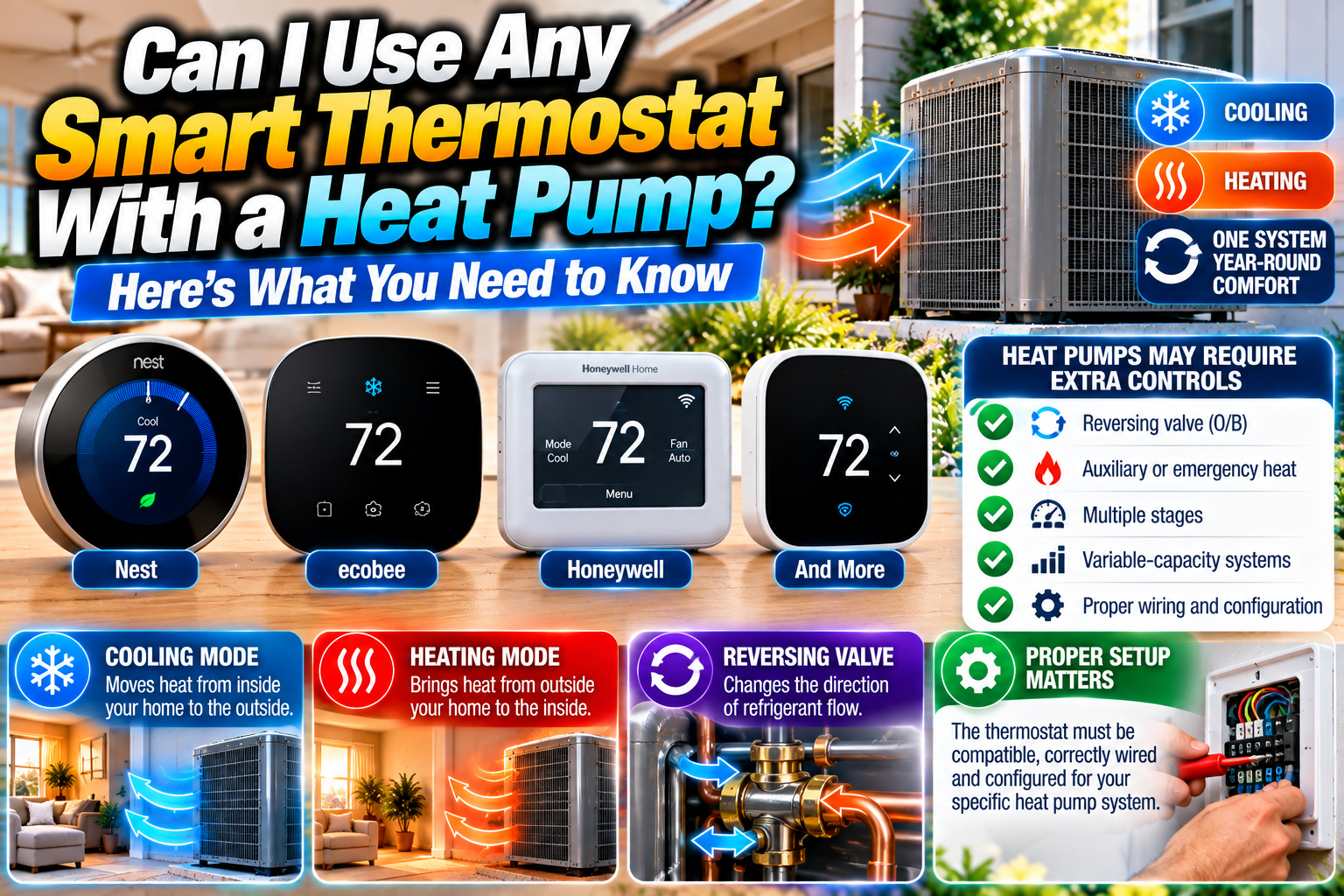
Can I Use Any Smart Thermostat With a Heat Pump?
A thermostat seems simple.
You set a temperature.
The HVAC system turns on.
The house gets comfortable.
So when homeowners install a new heat pump, it is natural to assume:
“I’ll just use whatever smart thermostat I want.”
Sometimes that works perfectly.
Sometimes it does not.
A heat-pump thermostat may need to control more than basic heating and cooling.
Depending on the system, it may need to manage:
- The compressor
- Heating and cooling modes
- The reversing valve
- Multiple stages
- Auxiliary heat
- Emergency heat
- A gas furnace in a dual-fuel system
- or communication with variable-capacity equipment.
That’s why the better question is not:
“Is this thermostat smart?”
It is:
“Is this thermostat fully compatible with this exact heat-pump system?”
Key Takeaways
- Not every thermostat is compatible with every heat pump.
- Heat pumps may require different wiring and control functions than conventional AC/furnace systems.
- The thermostat may need to control a reversing valve.
- Systems with auxiliary or emergency heat require additional control capability.
- Two-stage and variable-capacity systems can require more sophisticated thermostat controls.
- Some advanced heat pumps use proprietary communicating controllers.
- A thermostat may turn the system on and off while still not providing full equipment functionality.
- C-wire requirements vary.
- Incorrect thermostat setup can cause inefficient operation or incorrect heating/cooling behavior.
- Dual-fuel heat pumps need controls capable of coordinating the heat pump and gas furnace.
- Compatibility should be checked using the exact indoor and outdoor equipment model numbers.
Why Is a Heat-Pump Thermostat Different?
A traditional HVAC thermostat may control:
Cooling
and
A furnace.
The thermostat asks the AC for cooling and the furnace for heating.
A heat pump is different because the refrigeration system itself provides:
Cooling
and
Heating.
To switch between the two, the system uses a component called a:
Reversing valve.
The thermostat may need to control that valve correctly.
It may also need to manage backup heating.
That adds more complexity.
What Is the Reversing Valve?
The reversing valve changes the direction of refrigerant flow.
During cooling:
Heat moves from inside to outside.
During heating:
Heat is transferred from outside to inside.
The thermostat typically sends a signal that determines which mode the reversing valve uses.
This is commonly associated with an:
O/B terminal.
What Does O/B Mean on a Thermostat?
The O/B terminal controls the heat pump’s reversing valve.
But different equipment may energize that valve in different modes.
Some systems energize it during:
Cooling.
Others may energize it during:
Heating.
That means the thermostat must be configured correctly.
If it is not, a homeowner can experience a situation where:
Heat is requested but cold air comes out
or
Cooling is requested but the system heats.
A homeowner who tried replacing a conventional thermostat with a smart thermostat described exactly this type of behavior: the heat pump blew cold air in both modes even though the wiring appeared similar.
Does That Mean the Thermostat Is Bad?
Not necessarily.
The problem may be:
- Compatibility
- Wiring
- Configuration
- Reversing-valve setup
- or equipment-specific control requirements.
This is why thermostat replacement should not always be treated like swapping a light switch.
Can Nest Work With a Heat Pump?
Some Nest thermostats can work with many heat-pump systems.
But compatibility depends on:
- Number of stages
- Auxiliary heat
- Dual-fuel configuration
- Wiring
- and whether the equipment uses conventional or communicating controls.
So the correct answer is:
Maybe. Check the exact equipment and thermostat.
Can ecobee Work With a Heat Pump?
Many ecobee models support heat pumps, including systems with auxiliary heat.
But again:
Compatibility is not universal.
A thermostat can be technically capable of turning a system on while still not controlling all stages or advanced modulation in the way the manufacturer intended.
That distinction becomes important with premium variable-capacity systems.
Can Honeywell Smart Thermostats Work With Heat Pumps?
Many can.
The Honeywell/Resideo lineup includes thermostats designed for heat-pump configurations.
But model selection still matters.
A thermostat designed for a simple single-stage conventional system may not support a:
- Multi-stage heat pump
- dual-fuel system
- or the control requirements of advanced equipment.
Why Do Variable-Speed Heat Pumps Complicate Thermostat Choice?
Because some variable-capacity systems depend on more detailed communication between components.
A basic thermostat often uses simple commands such as:
- Heating ON
- Cooling ON
- Stage 2 ON.
A communicating system may exchange much more information.
That can include:
- Compressor capacity
- Blower speed
- Outdoor temperature
- equipment status
- fault information
- and other data.
A recent homeowner comparing a Carrier heat pump with third-party thermostats specifically worried that a non-communicating thermostat might cause the modulating equipment to operate less effectively.
That is a legitimate concern.
What Is a Communicating Thermostat?
A communicating thermostat is part of a control system where:
- Thermostat
- indoor equipment
- and
- outdoor equipment
exchange digital information.
Rather than using only traditional on/off wires, the components can coordinate system operation more precisely.
Depending on the manufacturer, this can help control:
- Variable compressor capacity
- Variable blower speed
- Heating stages
- Cooling stages
- Humidity functions
- Diagnostics
- and equipment configuration.
Does Every Variable-Speed Heat Pump Require a Communicating Thermostat?
No.
This is important.
Some inverter-driven heat pumps can modulate internally while receiving relatively conventional thermostat signals.
Others rely much more heavily on a matched communicating control.
So:
Variable speed does not automatically equal proprietary thermostat.
But you need to check the specific model.
Can I Lose Features by Using a Third-Party Thermostat?
Potentially.
Suppose the manufacturer-designed controller can command:
Many compressor speeds
while a conventional thermostat only provides:
Stage 1
and
Stage 2.
The heat pump may still operate.
But the control strategy may differ from the manufacturer’s fully integrated system.
Depending on equipment design, you could lose:
- Certain modulation features
- Advanced diagnostics
- Humidity control
- system status information
- or other functions.
Does That Mean Manufacturer Thermostats Are Always Better?
Not automatically.
A proprietary controller may provide deeper equipment integration.
A third-party thermostat may provide features homeowners value, such as:
- Familiar app
- Home automation
- Remote sensors
- Utility programs
- or a preferred user interface.
The right choice depends on compatibility and what features matter most.
What Should I Ask Before Replacing My Heat-Pump Thermostat?
Ask:
- What exact heat pump do I have?
- What exact indoor equipment do I have?
- How many compressor stages are there?
- Do I have auxiliary heat?
- Do I have a gas furnace for dual fuel?
- Does the system use communicating controls?
- What thermostat does the manufacturer recommend?
- Will I lose any equipment features with a third-party thermostat?
Those questions are much better than:
“Will this thermostat fit on my wall?”
What Is a C-Wire?
The:
C-wire
or
Common wire
provides continuous low-voltage power to many thermostats.
Smart thermostats often need continuous power for:
- Wi-Fi
- Display
- Processors
- Sensors
- and communication.
Older thermostats may have operated without a C-wire because they required much less power.
Does Every Smart Thermostat Need a C-Wire?
Not every model in every installation.
Some use:
- Power extender kits
- Adapters
- or other methods.
But heat-pump systems can have more complicated wiring than simple furnace/AC systems.
Before using an adapter, verify that it is appropriate for:
Your equipment
and
The thermostat.
Can I Just Use the Existing Thermostat Wires?
Maybe.
That depends on how many conductors are available and what the new system requires.
A simple installation may need connections such as:
- R
- C
- Y
- G
- O/B
and possibly:
AUX/W
or additional staging terminals.
Advanced systems may use fewer traditional wires because they communicate digitally.
Again:
Count the functions, not just the wires.
What Is AUX on a Heat-Pump Thermostat?
AUX refers to:
Auxiliary heat.
This is a secondary heating source that can help the heat pump.
Depending on the system, that might be:
Electric resistance heat
or another backup source.
What Is EM HEAT?
EM HEAT means:
Emergency Heat.
It is generally a manual backup-heating mode.
The thermostat needs to understand and control this function if the equipment includes it.
A thermostat that does not properly support the backup heat configuration may not be appropriate for the system.
Can the Wrong Thermostat Make Auxiliary Heat Run Too Much?
Yes.
Poor configuration can cause supplemental heat to operate:
- Earlier
- Longer
- or
- More often
than necessary.
That can be especially expensive when the backup source is electric resistance heat.
This is one of the reasons thermostat setup matters so much on heat pumps.
Can Thermostat Settings Affect My Electric Bill?
Absolutely.
Imagine a heat pump capable of efficiently heating the house.
But the thermostat brings electric auxiliary heat on every time indoor temperature is only slightly below setpoint.
Now the homeowner may see:
without realizing that the control settings are responsible.
Equipment efficiency is only part of the equation.
Controls matter too.
What Is Compressor Lockout?
Some thermostats allow a temperature setting below which the heat pump compressor is prevented from operating.
This may be used in certain:
- Dual-fuel
- or backup-heating strategies.
The correct setting depends on:
- Heat-pump performance
- backup heat
- utility costs
- and system design.
Do not simply copy someone else’s lockout temperature from the internet.
What Is Auxiliary Heat Lockout?
This can prevent auxiliary heat from operating above a selected outdoor temperature.
The goal may be to avoid unnecessary backup heat when the heat pump can handle the heating load by itself.
Again, this is system-specific.
Can a Thermostat Use Outdoor Temperature?
Yes.
Some thermostats obtain outdoor temperature from:
- An outdoor sensor
- or
- Internet weather data.
That information may be used for staging or lockout decisions.
But the control strategy depends on the thermostat and HVAC equipment.
Is Internet Weather Accurate Enough for Heat-Pump Controls?
It may be sufficient for some thermostat functions.
But an actual outdoor sensor measures temperature at the property.
Internet weather may come from:
- An airport
- weather station
- or another nearby location.
For controls where a few degrees matter significantly, equipment-specific recommendations should be followed.
What Is Heat-Pump Staging?
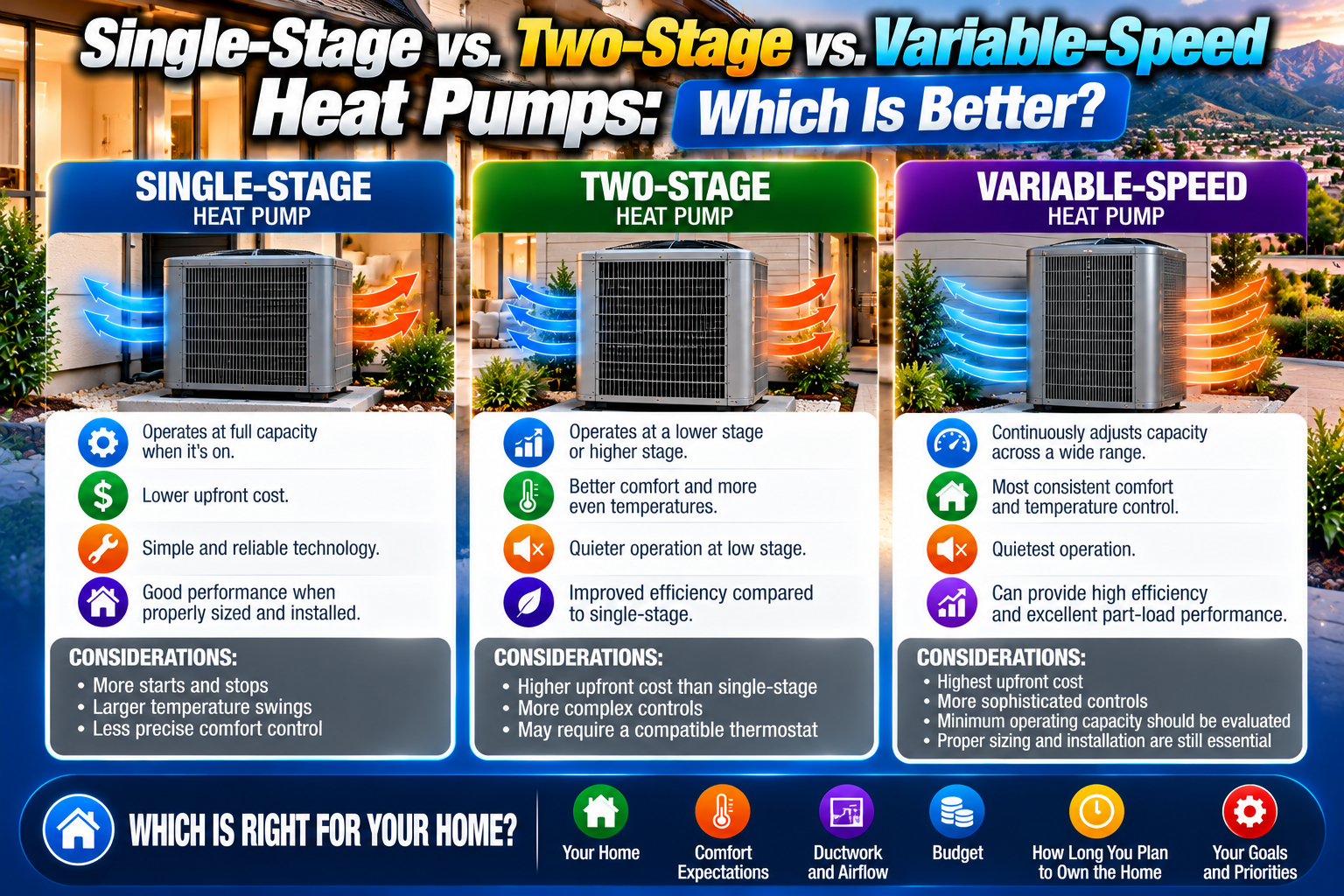
A heat pump may have:
- One stage
- Two stages
- or variable capacity.
The thermostat can determine when additional capacity is requested.
For a two-stage system, for example:
Stage 1 may operate first.
If the home is not recovering quickly enough:
Stage 2 may be called.
A thermostat configured incorrectly could bring on Stage 2 too quickly—or potentially fail to use it properly.
Can a Thermostat Turn a Variable-Speed Heat Pump Into a Two-Stage System?
On some equipment, using conventional controls may limit how the system responds to thermostat calls.
On other equipment, the outdoor unit may still modulate internally.
This is completely model-specific.
That is why no one should make a universal claim such as:
“Any thermostat works with variable-speed heat pumps.”
It simply isn’t true.
What About Dual Fuel?
Dual fuel adds another layer.
A dual-fuel system combines:
- Heat pump
- Gas furnace.
The controls need to determine when:
The heat pump operates
and
The gas furnace operates.
The system may need to prevent both from operating at the wrong time.
Homeowners continue to ask online which thermostats can correctly control a heat pump/gas-furnace combination.
Can Nest or ecobee Control Dual Fuel?
Some models can support dual-fuel configurations.
But compatibility still depends on:
- Equipment
- Stages
- Wiring
- and control strategy.
For complicated systems, professional setup can prevent costly mistakes.
Can the Wrong Thermostat Make My Heat Pump Blow Cold Air?
Potentially.
If the:
- O/B setting
- equipment type
- or wiring is wrong,
the heat pump may operate in the incorrect mode.
That can lead to the homeowner requesting:
HEAT
while the refrigeration circuit is behaving like:
COOLING.
Again, the real homeowner case mentioned earlier involved this exact problem after a smart-thermostat replacement.
Can the Wrong Thermostat Cause Short Cycling?
It can contribute.
Potential thermostat-related causes include:
- Incorrect differential
- Bad sensor location
- Poor wiring connection
- Incorrect staging
- or configuration problems.
But short cycling can have many other causes.
Can Thermostat Location Affect Heat-Pump Performance?
Yes.
The thermostat measures temperature where it is installed.
If it sits:
- In direct sunlight
- Near a hot kitchen
- Beside an exterior door
- Near a supply register
- or in another unrepresentative location,
the system may heat or cool based on a temperature that does not represent the rest of the home.
Can Remote Sensors Help?
They can.
Some smart thermostats use remote sensors to:
- Average temperatures
- Prioritize occupied rooms
- or manage comfort schedules.
That can be valuable in homes with:
- Two stories
- Hot bedrooms
- Large floorplans
- or major room-to-room differences.
But sensors cannot repair:
- Bad duct design
- Insulation problems
- or fundamentally incorrect system sizing.
Can a Smart Thermostat Make a Heat Pump More Efficient?
It can help reduce unnecessary heating and cooling through:
- Scheduling
- occupancy features
- remote control
- and better system management.
But it does not increase the physical efficiency rating of the heat pump.
A smart thermostat connected to a poorly installed system does not suddenly fix:
- Duct leakage
- incorrect refrigerant charge
- or poor airflow.
Are Large Temperature Setbacks Good for Heat Pumps?
Not always.
Suppose you reduce the thermostat significantly overnight.
Then in the morning you request a large temperature increase.
Depending on thermostat settings, that may trigger:
- Higher compressor stages
- or
- Auxiliary heat.
That can reduce some of the energy savings you expected from the setback.
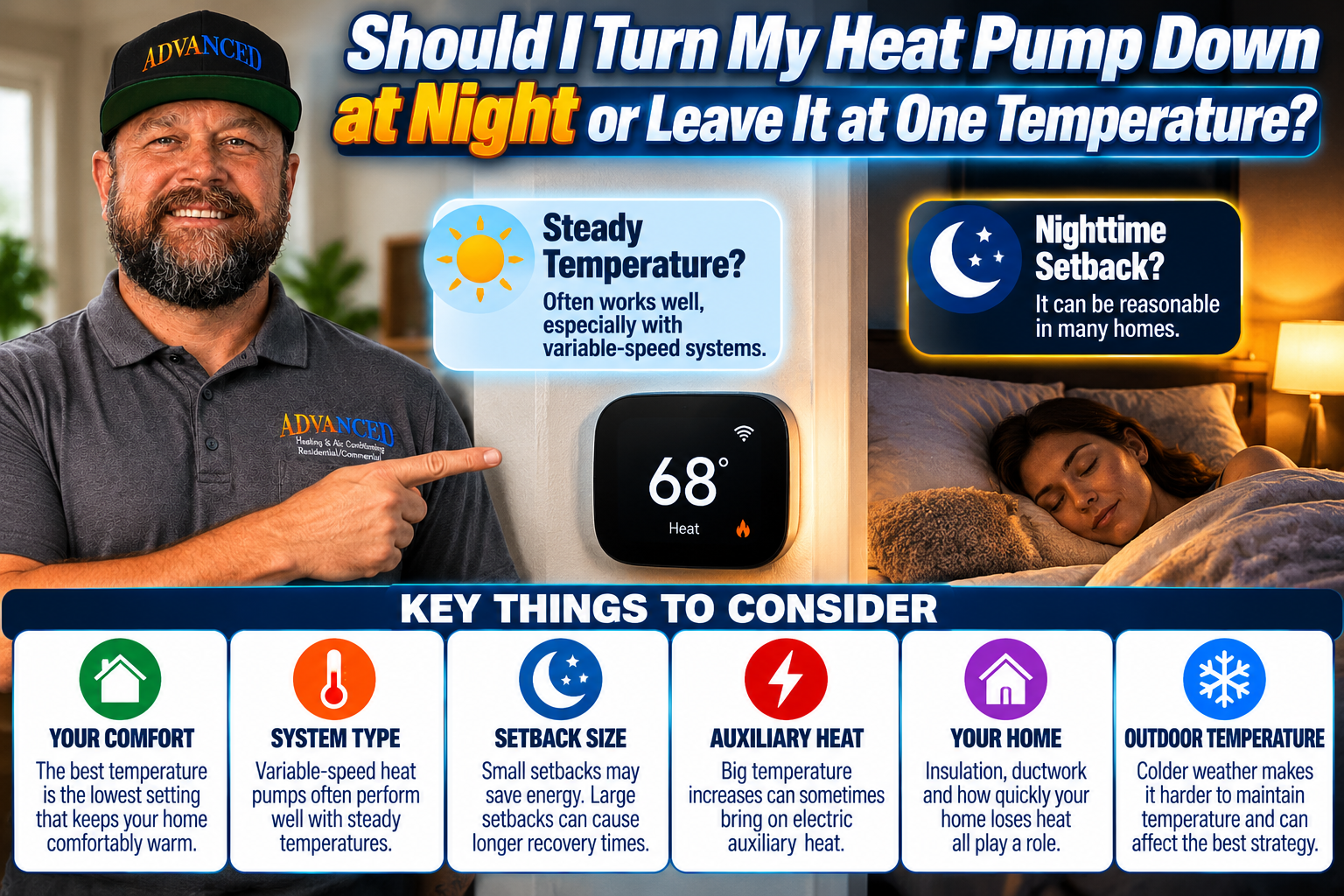
Heat pumps often perform well with more moderate temperature changes.
Should I Leave My Heat Pump at One Temperature All Day?
Not necessarily exactly one temperature.
But extreme setbacks may be less useful on some heat-pump systems than homeowners expect.
A moderate schedule can often provide a better balance between:
Comfort
and
Energy use.
The best strategy depends on:
- Equipment
- backup heat
- house characteristics
- and utility rates.
Can Smart Recovery Help?
Some thermostats use:
- Smart recovery
- or
- Adaptive recovery.
Instead of waiting until 7:00 AM to start heating, the thermostat may begin earlier so the home reaches the desired temperature by 7:00.
This can reduce the need for a sudden aggressive recovery.
Whether that is useful depends on the system.
Should I Buy the Thermostat Before the Heat Pump?
If you’re replacing the entire HVAC system:
Usually, choose the equipment first.
Then select a thermostat or controller that supports the equipment properly.
Buying a thermostat first can unnecessarily limit your equipment options.
Should My HVAC Contractor Supply the Thermostat?
There can be an advantage.
If the contractor supplies and commissions the control with the system, there is clear responsibility for:
- Compatibility
- Wiring
- Configuration
- and proper operation.
That can be particularly helpful with:
- Variable-speed
- multi-stage
- and
- dual-fuel systems.
Can I Install a Smart Thermostat Myself?
Some simple systems are homeowner-friendly.
Heat pumps can be less forgiving.
An error with:
- O/B wiring
- auxiliary heat
- equipment configuration
- or staging
can cause incorrect operation.
If the wiring doesn’t match the thermostat instructions clearly, professional installation is worth considering.
Should I Take a Picture of My Old Thermostat Wiring?
Yes.
Before disconnecting anything:
Turn HVAC power off
and take clear photos showing:
- Each wire
- Each terminal
- and any jumpers.
That can be extremely helpful if questions arise.
But note:
Matching wire colors is not enough.
Wire color is not a guarantee of function.
The terminal connection is what matters.
Why Isn’t Wire Color Reliable?
Because installers can use available conductors differently.
A blue wire may commonly be used as:
C
but that does not guarantee your blue wire is actually common.
Always verify terminal function.
What If My New Thermostat Has Fewer Terminals?
Stop before guessing.
The old thermostat may be controlling:
- Additional heating stages
- auxiliary heat
- reversing valve
- or another function that the replacement does not support.
This can be an indication that the thermostat is not appropriate for the system.
Can Thermostat Compatibility Affect Warranty?
Potentially, depending on the manufacturer and equipment.
Some systems may require:
Matched controls
for specific features, commissioning or warranty-related functionality.
Homeowners should check the actual manufacturer’s requirements before substituting controls.
Why Does My New Heat Pump Have Its Own Thermostat?
Premium systems may include a manufacturer controller because it is designed to communicate directly with that equipment.
Instead of thinking:
“They gave me a weird thermostat,”
ask:
“What does this controller do that a generic thermostat doesn’t?”
There may be a legitimate technical reason.
Is a Proprietary Thermostat a Bad Thing?
Not automatically.
Possible advantages include:
- Better system integration
- More diagnostics
- Advanced modulation
- Manufacturer-specific features.
Possible disadvantages can include:
- Higher replacement cost
- Fewer third-party choices
- and dependence on the manufacturer’s ecosystem.
That’s a tradeoff worth understanding before buying.
What If I Want Alexa, Google Home or Apple Home Integration?
Ask before the system is installed.
Smart-home compatibility should be considered alongside HVAC compatibility.
The priority should be:
Control the HVAC equipment correctly first.
Then evaluate smart-home features.
A thermostat that works beautifully with your phone but controls the heat pump incorrectly is not a good upgrade.
What If I Have Solar or a Home Battery?
A smart thermostat may be able to participate in:
- Energy management
- time-of-use strategies
- or other home automation.
But those features are separate from basic heat-pump compatibility.
Make sure the thermostat can first correctly control:
- Heating
- Cooling
- Stages
- and
- Backup heat.
What If the Power Blinks?
Advanced electronic HVAC equipment can sometimes react differently to very short power interruptions.
A current 2026 homeowner with a two-stage heat pump and whole-home battery reported that brief outages caused the heat pump to remain stuck in low stage until power was manually reset.
That isn’t purely a thermostat issue, but it illustrates how modern HVAC controls, power quality and connected home systems can interact.
If odd system behavior begins after outages:
Tell the technician.
Should I Install Surge Protection?
Modern HVAC systems contain sensitive electronics.
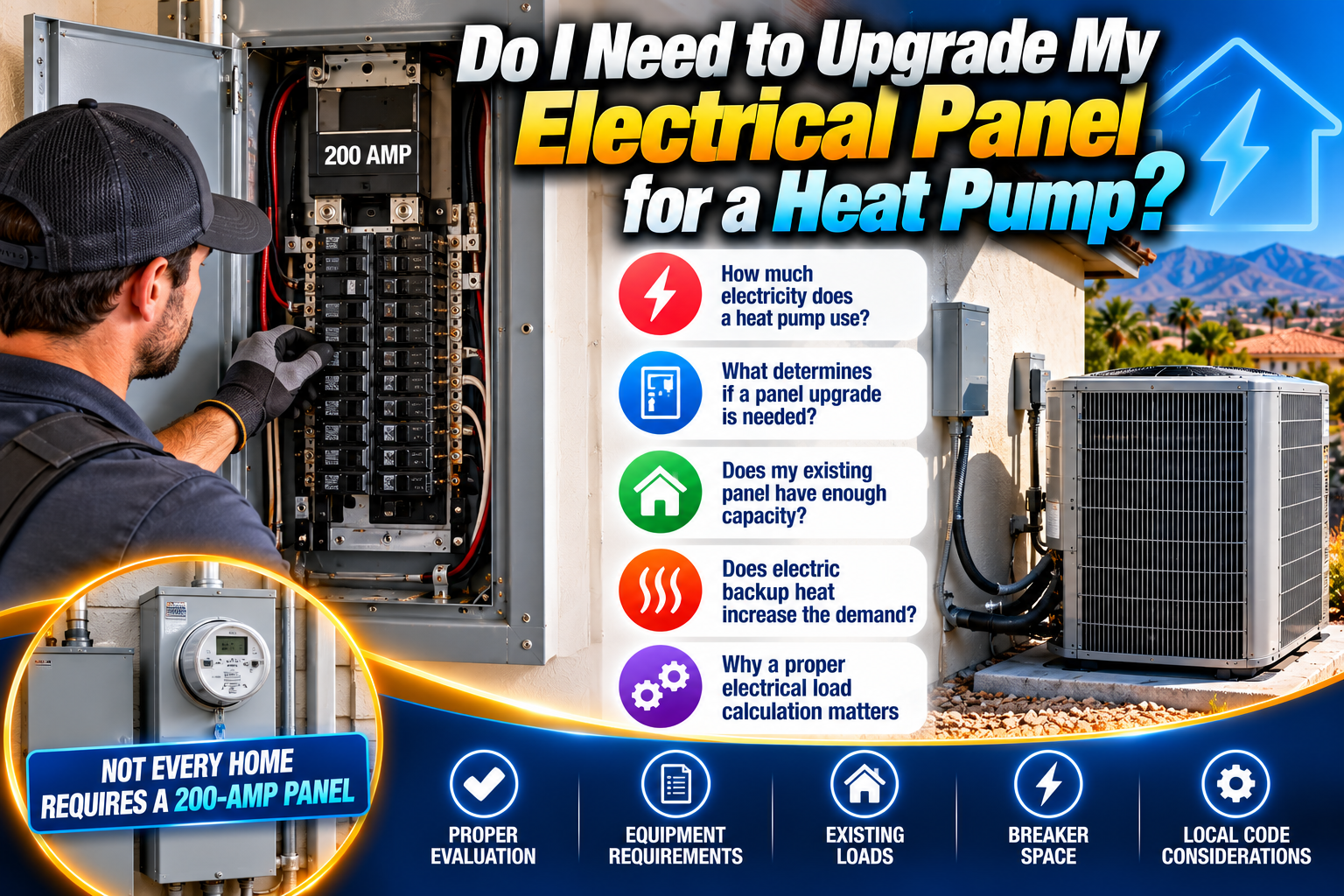
Whole-home or equipment-level surge protection may be worth discussing with your HVAC contractor and electrician, particularly with inverter-driven and communicating equipment.
The appropriate solution depends on the home’s electrical system.
What Should Be Tested After Installing a New Thermostat?
Do not stop after seeing the thermostat screen turn on.
Verify:
- Cooling operation
- Heating operation
- Reversing valve
- Stage 1
- Stage 2 if applicable
- Auxiliary heat
- Emergency heat if applicable
- Blower operation
- and thermostat temperature sensing.
For dual fuel, verify that the transition between:
Heat pump
and
Furnace
works correctly.
Advanced Heating & Air Conditioning’s heat-pump installation includes thermostat setup and calibration as part of its heat-pump services.
Frequently Asked Questions
Can any thermostat work with a heat pump?
No. The thermostat must support the heat pump’s stages, reversing valve, backup heat and control architecture.
Can I use a Nest with a heat pump?
Many heat-pump configurations are compatible with certain Nest thermostats, but compatibility depends on the specific HVAC equipment and wiring.
Can I use ecobee with a heat pump?
Many ecobee thermostats support heat pumps, but verify the number of stages, auxiliary heat and whether the system requires communicating controls.
Can Honeywell thermostats control heat pumps?
Many Honeywell/Resideo models are designed for heat pumps. The specific thermostat still needs to match the equipment.
What is the O/B wire?
It controls the heat pump’s reversing valve, which changes the refrigeration cycle between heating and cooling.
Why does my heat pump blow cold air after changing thermostats?
Incorrect O/B configuration, wiring or equipment setup can cause the system to operate in the wrong mode.
Do I need a C-wire?
Many smart thermostats require continuous power through a C-wire or an approved alternative power method.
Can a thermostat make auxiliary heat run too often?
Yes. Incorrect staging or backup-heat settings can cause excessive auxiliary heating.
Do variable-speed heat pumps need special thermostats?
Some do; others can modulate internally. Always check the exact manufacturer’s equipment requirements.
Will a basic thermostat reduce my variable-speed heat pump’s performance?
It can on some systems if it limits the control functions available. On others, the heat pump handles modulation internally. This is model-specific.
Can a smart thermostat control dual fuel?
Some can, provided they support the equipment stages and heat-pump/furnace control strategy.
Should I keep the thermostat that comes with my new heat pump?
If it is the manufacturer’s communicating control, it may provide functions that a generic thermostat cannot. Ask the installer exactly what features would be lost before changing it.
Don’t Choose the Thermostat by the App
This is the biggest takeaway.
Homeowners often shop for thermostats by asking:
- Which one has the best screen?
- Which app do I like?
- Which works with Alexa?
Those are reasonable questions.
But they should come after:
Will it properly control my heat pump?
For a basic single-stage heat pump, you may have many thermostat choices.
For a:
- Two-stage
- Variable-capacity
- Communicating
- or
- Dual-fuel
system,
the control decision becomes much more important.
The thermostat is not just a wall accessory.
It is part of the HVAC system.
Heat Pump Installation & Thermostat Setup in the Temecula Valley
Advanced Heating & Air Conditioning installs and services heat-pump systems throughout the Temecula Valley and includes thermostat setup and calibration as part of its heat-pump services. Its installation guidance also considers thermostat compatibility when helping homeowners choose a system.
Advanced serves Temecula, Murrieta, Menifee, Winchester, Wildomar, French Valley, Canyon Lake, Lake Elsinore, Hemet and surrounding communities.
Advanced Heating & Air Conditioning
951-609-9881
California Contractor License #916901
REAL PEOPLE. REAL SERVICE. REAL COMFORT.