


Do I Need to Upgrade My Electrical Panel for a Heat Pump?
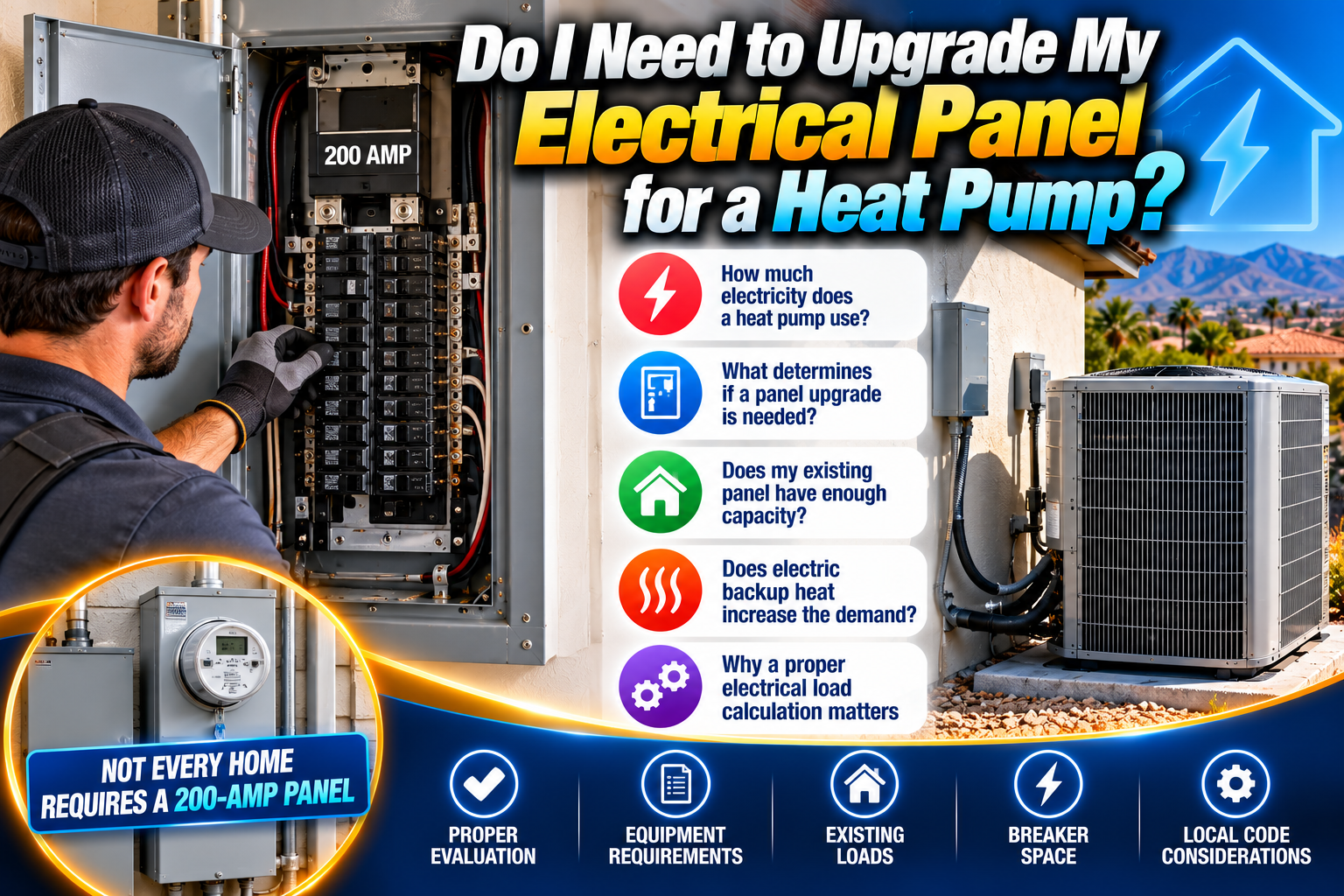
Do I Need to Upgrade My Electrical Panel for a Heat Pump?
You’re thinking about installing a heat pump.
Then someone looks at your electrical panel and says:
“You’ll need to upgrade to 200 amps first.”
That can be a major surprise.
A panel or service upgrade can add significant cost to an HVAC project, so homeowners naturally want to know:
Is that really necessary?
The answer is:
Sometimes yes. Sometimes no.
A heat pump does not automatically require every home to have a 200-amp electrical service.
The correct answer depends on:
- The heat pump’s electrical requirements
- Your existing service size
- The loads already in the home
- Whether electric backup heat is being installed
- Available breaker space
- and a proper electrical load evaluation.
Key Takeaways
- A heat pump does not automatically require a 200-amp panel.
- Some homes can install a heat pump using their existing electrical service.
- Other homes may need circuit, panel, or service upgrades.
- Existing central AC can sometimes mean part of the electrical infrastructure is already available.
- Electric resistance backup heat can significantly increase electrical demand.
- Panel size alone does not determine whether capacity is adequate.
- Available breaker spaces and electrical capacity are two different issues.
- A proper electrical load calculation should be performed before recommending a major service upgrade.
- Heat-pump equipment should be selected before final electrical requirements are determined.
- The HVAC and electrical portions of the project should be coordinated.
Why Do Heat Pumps Need Electricity?
A heat pump uses electricity to power several components.
Depending on the system, these can include:
- Compressor
- Outdoor fan
- Indoor blower
- Controls
- Crankcase or equipment heaters where applicable
and potentially:
Supplemental electric resistance heat.
The exact electrical requirements vary significantly by equipment.
That’s why there isn’t one universal breaker size for every heat pump.
Does a Heat Pump Use More Electricity Than an Air Conditioner?
In cooling mode, a heat pump operates very similarly to a central air conditioner.
Both use:
- A compressor
- outdoor fan
- indoor blower
- and refrigeration cycle.
The major difference is that a heat pump can also reverse operation and provide heating.
So if your home already has central AC, you may already have a dedicated high-voltage circuit serving outdoor HVAC equipment.
That does not guarantee the existing circuit is correct for the new heat pump.
But it means the project isn’t necessarily starting from zero.
Why Are Some Homeowners Told They Need 200 Amps?
There are several possible reasons.
1. The Home Has a Small Existing Electrical Service
Older homes may have:
- 60-amp
- 100-amp
- or other smaller electrical services.
Modern houses often contain far more electrical loads than homes did decades ago.
That can include:
- Electric range
- dryer
- pool equipment
- spa
- EV charger
- electric water heater
- solar equipment
- and other loads.
Adding a heat pump may push the calculated electrical demand beyond what the existing service can support.
2. Electric Backup Heat May Be Included
This is one of the biggest factors.
Some heat-pump systems use electric resistance heating as:
- Supplemental heat
- or
- Emergency heat.
These electric heat strips can draw substantial current.
A homeowner may have enough capacity for the heat pump compressor itself but not enough for a large auxiliary heat package.
This exact issue comes up repeatedly in homeowner discussions about panel upgrades. One homeowner was told a 150-amp service had to be upgraded specifically because of backup electric resistance heat.
That’s why homeowners should ask:
Is the panel upgrade required for the heat pump itself—or for the proposed backup heat?
That’s an important distinction.
3. There May Not Be Enough Breaker Space
This is different from insufficient electrical service capacity.
Imagine a panel rated for adequate electrical load but with every breaker position occupied.
The issue may be:
Physical breaker space.
Depending on the electrical system and code requirements, possible solutions may involve:
- Panel changes
- approved breaker configurations
- subpanels
- or other electrical work.
That doesn’t automatically mean the utility service itself must increase.
4. The Existing Circuit May Be Too Small
Your old AC may already have an electrical circuit.
But the new heat pump may require a different:
- Breaker size
- wire size
- disconnect
- or other electrical configuration.
That can mean electrical modifications without requiring a complete panel or service upgrade.
Advanced Heating & Air Conditioning’s heat-pump installation already identifies electrical modifications as one factor that can affect installation scope and cost.
5. The House May Already Be Near Its Electrical Capacity
This is why the complete home matters.
A house with:
- Gas range
- gas water heater
- gas dryer
- and no EV charger
may have a very different electrical-load profile from a house with:
- Induction range
- electric water heater
- electric dryer
- two EV chargers
- pool heater
- and other large loads.
The label on the front of the panel doesn’t tell the whole story.
What Is an Electrical Load Calculation?
An electrical load calculation estimates the expected electrical demand on the home’s service.
It considers the types and sizes of electrical loads in the house and applies the applicable calculation methodology.
This helps determine whether the service has capacity for additional equipment.
Homeowners are increasingly asking for this before agreeing to expensive upgrades. A 2026 heat-pump discussion specifically centered on whether installers actually check service capacity before telling a homeowner to replace the panel.
That’s exactly the right question.
Do I Automatically Need a 200-Amp Panel?
No.
A 200-amp service is common and can provide useful capacity for modern electrification.
But the statement:
“Heat pumps require 200 amps.”
is too broad.
Some heat pumps can be installed in homes with smaller electrical services if the load calculation, equipment requirements, and existing loads allow it.
A recent homeowner with a 100-amp service specifically asked whether it made sense to upgrade in advance of a future heat-pump installation; the discussion correctly emphasized checking the proposed equipment and household load before assuming the upgrade was necessary.
Can a Heat Pump Work on a 100-Amp Service?
Potentially.
But there is no universal yes or no.
It depends on:
- Heat-pump size
- electrical specifications
- backup heat
- other household electrical loads
- and the home’s electrical system.
A smaller house with several gas appliances and no large electrical loads may have a very different result from an all-electric house with an EV charger.
This should be calculated—not guessed.
Can a Heat Pump Work on a 125-Amp or 150-Amp Service?
Again:
Possibly.
The important number is not simply the service rating.
You need to know:
How much capacity is already being used or allocated?
and
What will the new equipment require?
A homeowner with a 150-amp service recently faced this exact question when an estimator said backup resistance heat required an upgrade to 200 amps.
That’s why system design matters.
Why Backup Electric Heat Changes the Conversation
Imagine the heat pump itself has manageable electrical demand.
Then the proposed air handler includes a large electric resistance heater.
Now the system’s maximum electrical load can rise significantly.
This doesn’t mean backup heat is bad.
It means it has to be accounted for.
Questions to ask include:
- How much backup heat is being proposed?
- Why is that capacity needed?
- How often is it expected to operate?
- Is there another system configuration available?
These are especially good questions in a mild climate such as the Temecula Valley.
Do Heat Pumps in Southern California Always Need Backup Heat?
Not necessarily.
The correct configuration depends on:
- Heat-pump performance
- home heating load
- local design conditions
- equipment capacity
- and system design.
Some systems may use electric supplemental heat.
Others may not require the same amount.
A dual-fuel system can use a gas furnace as the alternate heating source instead of electric resistance heat.
The right design should be based on the home rather than a blanket rule.
Can Dual Fuel Reduce Electrical Requirements?
Potentially.
A dual-fuel setup combines:
Heat pump
with
Gas furnace.
Because the gas furnace can provide backup or alternate heating, the system may not require the same large electric resistance heat package that an all-electric air handler might use.
That doesn’t mean dual fuel is always the right choice.
But for a homeowner who already has natural gas and limited electrical capacity, it’s worth comparing.
Do I Need an Electrician Before Calling an HVAC Company?
Usually, it makes sense to identify the proposed HVAC equipment first—or coordinate the two together.
A recent homeowner asked this exact “chicken or egg” question:
Do I call the electrician first, or choose the heat pump first?
The challenge is that the electrician needs to know the electrical requirements of the equipment.
But the HVAC contractor needs to know what electrical capacity is available.
The best process is coordinated.
A Better Heat-Pump Installation Process
A strong process looks more like this:
- Evaluate the home’s heating and cooling needs.
- Select appropriate heat-pump options.
- Review the equipment electrical specifications.
- Evaluate the existing panel/service and household loads.
- Determine whether electrical modifications are required.
- Finalize the installation scope and price.
This is much better than:
“You have a 100-amp panel, so you automatically need 200 amps.”
What Should an HVAC Contractor Look at?
Before finalizing a heat-pump proposal, the contractor should consider:
- Existing HVAC equipment
- Existing AC electrical circuit
- Electrical panel
- Equipment location
- Available electrical access
- Heat-pump specifications
- Indoor equipment
- Supplemental heat requirements
- and the overall installation.
Advanced Heating & Air Conditioning’s heat-pump process includes a property evaluation covering electrical access, along with ductwork, airflow, layout, and heating/cooling needs.
Is Panel Size the Same as Service Size?
Not always.
This can get confusing.
The rating on a panel, the main breaker size, and the actual electrical service configuration all matter.
That’s why homeowners shouldn’t make expensive decisions based solely on:
“I looked at the sticker and it says 200A.”
An electrician can verify what the home actually has.
Can I Just Install a Bigger Breaker?
No.
Breaker size must be appropriate for:
- The circuit
- wire
- equipment
- and applicable electrical requirements.
Installing a larger breaker simply to stop tripping can create a serious safety issue if the wiring or equipment is not designed for it.
The equipment nameplate and installation requirements matter.
What Are MCA and MOCP?
Homeowners comparing heat pumps may see specifications such as:
MCA
and
MOCP.
MCA — Minimum Circuit Ampacity
This helps determine the minimum conductor ampacity required for the equipment circuit.
MOCP — Maximum Overcurrent Protection
This identifies the maximum allowable overcurrent-protection size for the equipment.
These are more useful than guessing circuit size based only on the heat pump’s tonnage.
Electrical design should follow the actual equipment data.
Does a 3-Ton Heat Pump Always Need the Same Breaker?
No.
Two heat pumps with the same nominal capacity can have different electrical characteristics.
Equipment technology, efficiency, compressor design, and manufacturer specifications can differ.
So:
3 tons ≠ one universal breaker size.
Always use the actual equipment specifications.
Do Variable-Speed Heat Pumps Need Less Electricity?
Variable-speed equipment can modulate output during operation, which can reduce power draw under many part-load conditions.
But electrical circuit sizing is still based on the equipment’s required electrical specifications—not simply its typical runtime power.
Don’t assume:
“Variable speed means I can use a smaller breaker.”
The manufacturer’s nameplate requirements still control the electrical installation.
Can I Avoid a Panel Upgrade With a Different Heat Pump?
Sometimes equipment selection can affect electrical requirements.
That’s worth discussing if the proposed electrical work is significant.
For example, two appropriate heat-pump configurations may have different:
- Electrical requirements
- backup heat
- or indoor equipment designs.
But you should not select undersized or inappropriate HVAC equipment solely to avoid electrical work.
The system still needs to properly heat and cool the home.
Can I Avoid a Service Upgrade With Load Management?
There are situations where electrical load-management technologies can help manage large household loads.
Examples may include systems that coordinate:
- EV charging
- water heating
- and other electrical loads.
Whether those solutions are appropriate depends on the home’s electrical design, local requirements, equipment, and installation.
This should be evaluated by a qualified electrical professional.
What If I Have an EV Charger?
Now electrical planning becomes even more important.
An EV charger can be a significant household load.
If you’re planning:
- Heat pump
- EV charger
- electric water heater
- electric dryer
- and
- induction range
you should think about the home’s electrical system strategically rather than adding each load independently.
A panel or service upgrade may make more sense when it’s supporting a broader electrification plan.
What If I Have Solar?
Solar doesn’t automatically mean the electrical panel has unlimited capacity.
Solar production and service capacity are separate considerations.
The home still needs an electrical system designed to safely support connected loads.
However, solar may affect the homeowner’s financial decision about switching more appliances to electricity.
What If I Have a Battery Backup?
Home batteries can add another layer to system design.
Not every household load may be connected to the backed-up portion of the electrical system.
A heat pump’s electrical requirements and startup behavior should be considered if the homeowner expects HVAC operation during an outage.
The HVAC installer, electrician, and battery installer may need to coordinate.
Does a Heat Pump Need 240 Volts?
Many central residential heat pumps operate on 208/230-volt electrical power.
Exact requirements depend on the equipment.
Indoor components may have separate electrical requirements as well.
Never assume the outdoor and indoor equipment use the same circuit.
Does the Air Handler Need Its Own Circuit?
Often, yes, depending on the equipment.
The outdoor heat pump and indoor air handler may have separate electrical requirements.
If electric heat strips are included, that can add additional circuit requirements.
This is why heat-pump conversion from a gas furnace can involve more indoor electrical work than simply replacing an AC condenser outside.
Why Can Replacing a Gas Furnace Change Indoor Electrical Requirements?
A gas furnace uses electricity for:
- Blower
- controls
- inducer
- and ignition components,
but much of its heating energy comes from natural gas.
If the gas furnace is replaced with an electric air handler containing resistance heat, the indoor electrical load can increase substantially.
That’s often the part homeowners aren’t expecting.
What If I’m Keeping My Gas Furnace?
Then you’re discussing a heat-pump/dual-fuel configuration.
The furnace remains indoors and the heat pump replaces or functions in place of the cooling-only outdoor unit.
Electrical requirements still need to be checked, but the indoor heating configuration is different from an all-electric air-handler setup.
Is a Panel Upgrade a Bad Thing?
Not necessarily.
If the home’s electrical equipment is outdated, damaged, undersized, or already due for modernization, a panel or service upgrade can be a worthwhile improvement.
The problem is not:
Panel upgrades are bad.
The problem is:
Automatically assuming one is required without evaluating the actual load and equipment.
Should I Upgrade to 200 Amps for Future Needs?
That is a broader home-planning decision.
It may make sense if you anticipate adding:
- EV charging
- electric water heating
- induction cooking
- spa
- additional HVAC
- or other large electrical loads.
A homeowner in a 2026 discussion was considering doing exactly this ahead of an eventual heat-pump replacement so they would not face an emergency upgrade if the old system failed.
That’s reasonable planning—but it is different from saying the heat pump itself requires 200 amps.
How Much Does a Panel Upgrade Cost?
Costs vary significantly based on:
- Existing service
- utility requirements
- panel location
- meter configuration
- trenching
- permits
- local labor
- and other electrical work.
Homeowners online report substantial variations in quotes, which is another reason to get the requirement confirmed before adding a panel upgrade to an HVAC project.
Questions to Ask Before Approving a Panel Upgrade
If someone says your heat pump requires a new electrical panel, ask:
- What electrical requirement of the proposed heat pump exceeds my existing capacity?
- Was a household load calculation performed?
- Is the problem service capacity or just breaker space?
- Does the proposed system include electric resistance backup heat?
- How much backup heat is being proposed?
- Could a different appropriate equipment configuration change the electrical requirements?
- Can my existing AC circuit be reused or modified?
- Does the indoor equipment require additional circuits?
- Is the utility service itself being upgraded, or only the panel?
Those questions can save homeowners from making assumptions.
Frequently Asked Questions
Do all heat pumps require a 200-amp electrical panel?
No. Electrical requirements depend on the equipment, home’s existing electrical loads, supplemental heat, and available service capacity.
Can I install a heat pump with a 100-amp panel?
Possibly. A proper electrical load evaluation is needed to determine whether the existing service can support the proposed system.
Can I install a heat pump with a 150-amp panel?
Possibly. The same principle applies: the complete load and equipment requirements matter more than the panel rating alone.
Does my heat pump need a new circuit?
It may. The required circuit depends on the equipment specifications and existing electrical infrastructure.
Can my existing AC circuit be used?
Sometimes it can be reused or modified, depending on the new heat pump’s requirements. It should be verified against the proposed equipment.
Do electric heat strips require more electrical capacity?
Yes. Supplemental electric resistance heat can significantly increase electrical demand.
Do I need backup heat in Southern California?
Not every system needs the same backup configuration. It depends on the equipment, heating load, local conditions, and system design.
Does dual fuel reduce electrical load?
It can avoid the need for large electric resistance backup heat because the gas furnace provides the alternate heating source.
Should I call an electrician before getting heat-pump quotes?
You can start with an HVAC evaluation, but electrical requirements should be verified before the project is finalized. Coordination between HVAC and electrical professionals is often best.
What is an electrical load calculation?
It is a method used to estimate the electrical demand on the home’s service and determine whether additional loads can be safely supported.
Does having an empty breaker space mean I have enough capacity?
No. Physical breaker space and electrical service capacity are different things.
Does having solar mean I don’t need an electrical upgrade?
Not necessarily. Solar generation does not automatically increase the electrical service capacity available for connected loads.
Don’t Let the Panel Decide the Heat Pump Before the House Is Evaluated
The correct order matters.
You shouldn’t begin with:
“I have 100 amps, so I can’t get a heat pump.”
And you shouldn’t begin with:
“Heat pumps never require panel upgrades.”
Both statements are too broad.
Instead:
- Evaluate the home.
- Determine the heating and cooling load.
- Choose appropriate equipment options.
- Review the equipment’s electrical requirements.
- Evaluate the home’s existing electrical capacity.
- Then determine what electrical work is actually necessary.
That is a far more accurate way to design a heat-pump project.
Heat Pump Installation in the Temecula Valley
Advanced Heating & Air Conditioning evaluates the property, existing HVAC equipment, ductwork, airflow, electrical access, and heating and cooling needs before recommending a heat-pump system. The company’s current heat-pump installation page also identifies electrical modifications as one factor that can affect the final installation scope.
For homeowners in Temecula, Murrieta, Menifee, Winchester, Wildomar, French Valley, Canyon Lake, Lake Elsinore, Hemet, and surrounding communities, this is especially important when considering conversion from a gas furnace to an all-electric heat-pump system.
Advanced Heating & Air Conditioning
951-609-9881
California Contractor License #916901
REAL PEOPLE. REAL SERVICE. REAL COMFORT.