


Single-Stage vs. Two-Stage vs. Variable-Speed Heat Pumps
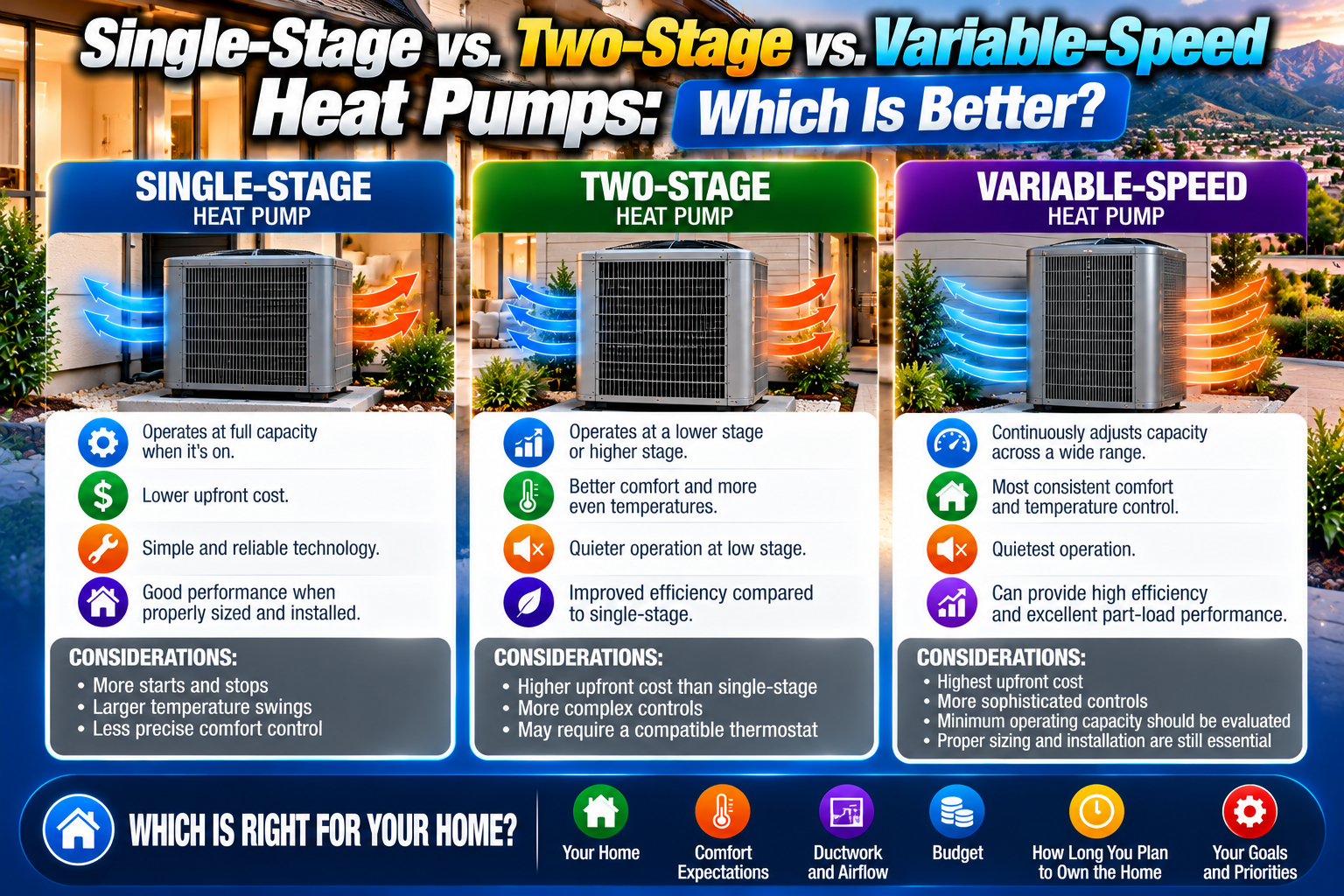
Single-Stage vs. Two-Stage vs. Variable-Speed Heat Pumps: Which Is Better?
If you’re comparing quotes for a new heat pump, you may see three very different options:
Single-stage
Two-stage
and
Variable-speed.
Then comes the obvious question:
Which one should I buy?
The answer isn’t simply:
“Variable-speed is always best.”
Nor is it:
“Single-stage is just as good.”
Each system operates differently.
And the best choice depends on:
- Your house
- comfort expectations
- ductwork
- budget
- how long you plan to own the home
- and what you expect from the HVAC system.
Understanding those differences can make comparing heat-pump proposals much easier.
Key Takeaways
- A single-stage heat pump generally operates at full capacity whenever the compressor is on.
- A two-stage heat pump can operate at a lower stage and a higher stage.
- A variable-speed or inverter-driven heat pump can adjust capacity across a much wider range.
- Variable-speed equipment can provide longer, steadier operation and tighter temperature control.
- Higher technology does not automatically mean it will produce enough utility savings to justify any price difference.
- More advanced equipment can involve more sophisticated controls and replacement components.
- Ductwork, sizing and installation quality matter regardless of equipment level.
- A properly installed single-stage system can be better than a poorly designed premium system.
- Minimum operating capacity is important when evaluating variable-speed equipment.
- Southern California’s long cooling season and many mild heating days can make modulation especially useful.
- The best system is the one that fits both the house and the homeowner’s priorities.
What Is a Single-Stage Heat Pump?
A single-stage heat pump has a compressor that essentially operates in one main capacity when called.
Think:
OFF
or
FULL OUTPUT.
When the thermostat calls for heating or cooling:
The heat pump starts.
It runs at its designed capacity.
When the thermostat is satisfied:
It shuts off.
This is the traditional HVAC operating style many homeowners are familiar with.
What Are the Advantages of a Single-Stage Heat Pump?
Single-stage equipment can have several advantages.
Lower Initial Cost
It is generally the most basic equipment category, so upfront equipment cost may be lower.
Simpler Operation
There are fewer capacity levels and generally less sophisticated control logic.
Familiar Technology
Single-stage equipment has been used for decades.
Good Performance When Properly Designed
A correctly sized and installed single-stage heat pump can provide excellent heating and cooling.
Basic does not mean bad.
What Are the Disadvantages of Single-Stage?
Because the compressor generally operates at full capacity whenever it runs, the system cannot closely adjust output to smaller heating or cooling demands.
Imagine the home currently needs:
40% of the system’s maximum capacity.
A single-stage system cannot normally say:
“I’ll provide exactly 40%.”
Instead it runs near full output until the thermostat is satisfied, then shuts off.
This can create:
- More starts and stops
- larger temperature swings
- more noticeable airflow changes
- and potentially more sound during operation.
What Is a Two-Stage Heat Pump?
A two-stage heat pump adds another operating level.
Instead of:
OFF / 100%
it can typically operate something like:
Lower capacity
or
Higher capacity.
Exact percentages vary by equipment.
The important concept is that the heat pump does not have to run at maximum output every time it operates.
How Does Two-Stage Operation Help?
Suppose the home needs moderate cooling on a warm spring afternoon.
The heat pump may be able to operate in:
Stage 1
instead of immediately running at full output.
Then during a very hot afternoon when the cooling load rises, the system can move into:
Stage 2.
This allows the equipment to better match the home’s changing needs.
What Are the Benefits of Two-Stage?
Potential advantages include:
- Longer operating cycles
- More even temperatures
- Quieter low-stage operation
- Better part-load comfort
- and potentially improved efficiency compared with basic single-stage operation.
It provides a middle ground between simple single-stage equipment and fully variable equipment.
What Is a Variable-Speed Heat Pump?
A variable-speed heat pump can adjust compressor output across a much broader range.
Many modern variable-capacity heat pumps use:
Inverter-driven compressors.
Instead of operating at only:
One speed
or
Two stages,
the compressor can increase or decrease output based on system demand.
Think of it less like:
OFF → FULL
and more like:
Cruising.
The system can provide lower output when demand is small and increase output as conditions become more demanding.
Why Do Variable-Speed Heat Pumps Run So Much?
Because they’re often designed to.
A variable-speed system may intentionally operate for long periods at low output.
Instead of:
Start
blast full capacity
stop
start again
it may provide a steady amount of heating or cooling.
That can be completely normal.
Is Variable Speed the Same as a Variable-Speed Blower?
No.
This is a very important distinction.
A homeowner may be quoted:
Single-stage heat pump + variable-speed air handler.
That does not automatically make the heat pump itself variable capacity.
There are two different components:
Outdoor compressor capacity
and
Indoor blower speed.
A variable-speed indoor blower can adjust airflow.
But if the outdoor compressor is single-stage, the refrigeration system may still be essentially:
Full capacity or off.
Homeowners ask about this distinction frequently because proposals sometimes use the phrase “variable speed” without making clear which component is actually variable.
What Is an Inverter?
An inverter is electronic technology used to control compressor motor speed.
Rather than running the compressor at one fixed speed, inverter controls can change compressor operation to match demand.
That’s what enables many modern heat pumps to modulate capacity.
You may therefore see terms such as:
- Variable-speed
- Variable-capacity
- Inverter
- or
- Modulating heat pump.
The exact design differs between manufacturers, so homeowners should ask what the equipment actually does rather than relying only on the marketing label.
Which System Gives the Best Temperature Control?
Generally, equipment with more capacity modulation can maintain temperature more steadily.
Imagine your thermostat is set to:
72°F.
A single-stage system may allow temperature to drift slightly, run at full capacity, satisfy the thermostat and shut off.
A variable-speed system may instead reduce output and continue operating near the home’s current load.
That can mean:
- Smaller temperature swings
- and
- more consistent comfort.
This is one of the main reasons homeowners consider variable-capacity equipment.
Which Is Quieter?
Variable-speed equipment can often operate more quietly during lower-demand periods because:
The compressor may run at reduced capacity
and
The indoor blower may operate at lower airflow.
Two-stage equipment may also be quieter during first-stage operation.
But maximum sound ratings still vary by model.
A homeowner specifically comparing single-stage, two-stage and variable-speed equipment in 2026 said quieter operation was one of the main reasons they were considering moving beyond single-stage equipment.
Which Is More Efficient?
Variable-capacity equipment is often capable of higher efficiency ratings because it can adjust output instead of repeatedly cycling at full capacity.
But equipment type alone does not determine your utility bill.
Actual energy use depends on:
- Equipment efficiency
- system size
- ductwork
- airflow
- thermostat settings
- outdoor temperature
- house insulation
- air leakage
- and installation quality.
Advanced Heating & Air Conditioning’s installation process evaluates the property, ductwork, airflow, electrical access and heating/cooling needs before recommending equipment.
Will Variable Speed Save Enough Money to Pay for Itself?
Maybe.
But homeowners should be careful with blanket promises.
Suppose the variable-speed option costs several thousand dollars more.
The energy savings may be meaningful.
But whether the upgrade fully pays for itself depends on:
- Price difference
- electricity rates
- annual runtime
- efficiency difference
- climate
- and how long you own the system.
One Southern California homeowner asking this question said their existing single-stage system already kept the house comfortable, so their main concern was whether the more expensive staging technology would actually save enough money before they moved.
That’s a very reasonable way to think about it.
Is Variable Speed Mainly About Saving Energy?
No.
This is important.
A lot of the value can be in:
- Comfort
- temperature stability
- noise reduction
- longer lower-output operation
- and improved system control.
Energy efficiency can be part of the benefit.
But a homeowner who expects:
“I’ll pay $5,000 extra and get all of it back immediately through utility savings”
may be disappointed.
Evaluate the complete value.
Is Variable Speed Worth It in Temecula?
It can be very appealing.
The Temecula Valley experiences:
Very hot summer afternoons
but also
many hours of moderate temperatures.
During a mild morning, your house may need only a small amount of cooling.
Later, when afternoon temperatures rise substantially, it may need much more.
A variable-capacity heat pump can adjust to those changing conditions.
Instead of operating at maximum output every time, it can run at lower output when the house doesn’t need full capacity.
Why Is This Useful During Southern California Winters?
Winter heating demand in Southern California also changes throughout the day.
Early morning may be relatively cold.
By afternoon, outdoor temperature may rise significantly.
A heat pump capable of modulation can adjust heating output as the load changes.
That can be particularly useful in a climate with:
Large daily temperature swings.
Is Two-Stage a Good Middle Ground?
For many homeowners:
Yes.
Two-stage equipment can provide more flexibility than single-stage without moving all the way into a premium fully variable system.
That can mean:
- Better comfort
- longer low-stage operation
- and potentially quieter performance
without the same equipment cost as some high-end variable-capacity systems.
This is why homeowners frequently compare whether spending another few thousand dollars for two-stage or variable equipment is actually worthwhile.
Is Single-Stage Still a Good Choice?
Absolutely.
A homeowner with:
- Good ductwork
- correct equipment sizing
- reasonable comfort expectations
- and a tighter budget
may be perfectly satisfied with a quality single-stage system.
Don’t let anyone convince you that:
Single-stage = bad HVAC.
The design and installation matter enormously.
What Matters More: Equipment Type or Installation?
In many cases:
Installation quality.
A premium variable-speed system connected to:
- Poor ductwork
- undersized returns
- high static pressure
- or incorrect equipment sizing
can still perform poorly.
Meanwhile, a properly sized and installed simpler system can perform very well.
Equipment technology cannot compensate for every design problem.
Does Ductwork Matter More With Variable-Speed Equipment?
It still matters greatly.
Variable-speed technology can adapt airflow and capacity.
But it cannot magically eliminate:
- Crushed ducts
- major leakage
- undersized returns
- or poor air distribution.
Before investing in premium equipment, make sure the duct system is capable of supporting it.
Does Heat-Pump Sizing Still Matter With Variable Speed?
Absolutely.
Variable-speed equipment gives the system a wider operating range.
But it still has:
Minimum capacity
and
maximum capacity.
If equipment is badly oversized, even its minimum output may be too high during mild weather.
If it’s badly undersized, maximum output may not meet peak demand.
Modulation gives flexibility.
It does not eliminate engineering.
What Is Minimum Capacity?
This is one of the most overlooked specifications.
Suppose a variable heat pump can operate between:
25% and 100% capacity.
When the house only needs a small amount of heating or cooling, the system can operate near the lower end.
Another heat pump might only be able to reduce to:
50% capacity.
Both are called variable-capacity systems.
But their ability to match mild-weather loads may be very different.
That’s why:
Turn-down capability
can be worth comparing.
Is a Wider Capacity Range Better?
Often, it can support better part-load performance.
A wide modulation range lets the system operate at low capacity during mild conditions and ramp up when needed.
But equipment should still be matched to the house.
A huge system with a broad modulation range isn’t automatically better than a properly sized smaller system.
What About Compressor Startups?
Traditional single-stage compressors repeatedly:
Start
and
Stop.
Variable-capacity systems may operate for longer periods and have fewer full shutdown/start cycles.
That can produce smoother comfort.
However, homeowners should not assume that fewer starts automatically guarantees longer equipment life.
Modern systems have different components and electronics, so longevity depends on:
- Equipment design
- installation
- maintenance
- electrical conditions
- and usage.
Is Variable-Speed Equipment More Complicated?
Yes.
Generally, a variable-capacity system has more advanced:
- Electronics
- controls
- inverter technology
- and communication between components.
That sophistication enables its benefits.
But it can also mean that some components may be more specialized than those in simpler equipment.
A recent homeowner comparing a variable-speed heat pump with a single-stage alternative specifically worried about future repair costs and complexity, even though the variable system offered better comfort and efficiency.
That’s a legitimate consideration.
Are Variable-Speed Repairs More Expensive?
They can be.
Some inverter-driven compressors, control boards and communicating components can cost more than basic single-stage components.
But repair cost depends heavily on:
- Manufacturer
- model
- warranty
- failed component
- and labor requirements.
Instead of assuming:
“Variable speed will be expensive to fix,”
ask:
- What parts warranty does this equipment have?
- What labor warranty is included?
- How available are replacement parts?
Those are much better questions.
Should Warranty Influence My Decision?
Absolutely.
When comparing equipment, ask about:
- Parts warranty
- compressor warranty
- labor warranty
- and any registration requirements.
Two systems with similar efficiency can have very different warranty coverage.
The best comparison is not simply:
Price today.
Consider:
Total ownership experience.
Does Variable Speed Require a Special Thermostat?
Sometimes.
Some variable-capacity equipment uses:
Communicating controls
that allow the thermostat, indoor equipment and outdoor equipment to share information.
Other inverter heat pumps can operate using more conventional thermostat signals while internally modulating capacity.
The answer depends on the manufacturer and system design.
Never assume your existing thermostat will fully control every advanced feature of a new system.
What Is a Communicating HVAC System?
A communicating system allows HVAC components to exchange more detailed operational information.
Depending on the system, this can allow coordinated control of:
- Compressor capacity
- blower speed
- heating stages
- cooling stages
- system diagnostics
- and other functions.
This can improve integration.
But proprietary communicating controls can also mean you have fewer thermostat choices.
That’s worth understanding before installation.
Does a Variable-Speed Heat Pump Work With a Gas Furnace?
Yes, certain systems can be configured as:
Variable-capacity heat pump + gas furnace.
This creates a dual-fuel system.
But equipment and control compatibility matter.
Homeowners regularly ask whether a variable heat pump can work correctly with a two-stage or variable-speed gas furnace because the terminology becomes confusing very quickly.
This should be engineered as a complete system rather than assembled from incompatible components.
Does a Variable-Speed Heat Pump Need a Variable-Speed Furnace?
Not necessarily in every equipment architecture.
But the indoor and outdoor equipment must be compatible and capable of delivering the airflow required at different operating capacities.
This is where model-specific system matching matters.
A homeowner should not try to determine compatibility by seeing the words:
“variable speed”
on two separate brochures.
The matched system specifications matter.
Is Variable Speed Better for Zoning?
It can be especially valuable with well-designed zoning.
If only one zone needs conditioning, a system that can reduce its total capacity may be better suited to the reduced airflow demand than a system that can only operate at full capacity.
But zoning must still be properly designed.
Variable-speed technology is not permission to close off arbitrary portions of the duct system.
Does Variable Speed Help With Uneven Temperatures?
Potentially.
Longer, lower-output cycles can provide steadier air circulation and may improve overall comfort.
But if one room is hot because:
- The branch duct is undersized
- The return pathway is poor
- The room has large west-facing windows
- or
- The attic insulation is inadequate,
variable speed does not automatically repair those problems.
Diagnose the house.
Don’t just upgrade the equipment.
Which Type Is Best for a Two-Story Home?
There is no universal answer.
A two-story home may benefit from:
- Variable-capacity equipment
- Proper zoning
- balanced ductwork
- or some combination.
But floorplan, duct design, thermostat location and building load all matter.
Do not choose equipment stage based only on the number of stories.
Which Type Is Best for a Small Home?
Again, it depends.
A variable-speed system may offer excellent comfort in a small home if it can modulate down far enough.
But a very oversized variable unit may still provide poor performance.
For smaller homes, minimum capacity becomes particularly important.
A homeowner recently asked whether a variable-speed heat pump was overkill for a roughly 1,000-square-foot house because the premium system cost only slightly more than the single-stage quote.
That’s exactly where looking at modulation range—not just the word “variable”—helps.
What About a Large Home?
Larger homes can also benefit from staged or variable-capacity operation, especially when heating and cooling loads change significantly during the day.
But again:
Correct sizing and duct design come first.
A 5-ton variable system connected to inadequate ductwork is still an airflow problem.
Is Highest SEER2 Always Best?
No.
Higher efficiency may reduce energy consumption.
But homeowners should compare:
- Upfront price
- expected energy savings
- comfort features
- noise
- warranty
- repair complexity
- and anticipated ownership period.
The system with the highest laboratory efficiency rating isn’t automatically the best financial decision for every household.
Does Variable Speed Mean High SEER2?
Often variable-capacity equipment carries higher efficiency ratings, but not every model is identical.
Always compare actual certified ratings for the matched system.
Don’t assume equipment is efficient solely because the brochure says:
How Long Do I Need to Own the Home for Variable Speed to Make Sense?
There is no fixed number.
If you’re planning to stay for many years, you may place greater value on:
- Comfort
- noise reduction
- energy savings
- and premium features.
If you’re selling in two years, the financial calculation may be different.
One homeowner asking whether two-stage/variable equipment was worth it specifically mentioned planning to move within about five years, which changed how they viewed the payback.
That’s smart decision-making.
Should I Choose Variable Speed If I Have Solar?
Solar may influence the economics of electric HVAC operation.
But it shouldn’t determine equipment selection by itself.
You still need to consider:
- House load
- equipment capacity
- ductwork
- electrical requirements
- and comfort goals.
Solar does not make bad HVAC design acceptable.
What If Variable Speed Is Only Slightly More Expensive?
Then it deserves serious consideration.
If the price difference between:
Single-stage
and
Variable-capacity
is relatively small because of equipment pricing, promotions or incentives, the comfort upgrade may be easier to justify.
A recent homeowner faced nearly this exact choice: about a $1,300 difference between a single-stage system and a fully modulating heat pump and wanted to know whether the upgrade was worthwhile.
That’s the kind of comparison homeowners should make using the actual proposal—not generic rules.
What If Variable Speed Costs Much More?
Then evaluate what you’re getting.
Ask whether the premium provides:
- Higher efficiency
- lower sound levels
- better comfort
- better warranty
- better modulation range
- or other features you actually value.
A $1,500 upgrade is a different decision from a $7,000 upgrade.
Should I Buy Variable Speed Just Because It’s the “Best”?
No.
Premium technology is valuable when its benefits matter to you.
Someone who prioritizes:
- Lowest upfront cost
- and is already satisfied with traditional HVAC operation
may choose single-stage equipment.
Someone who prioritizes:
- Quiet operation
- steady temperatures
- long low-output cycles
- and premium efficiency
may prefer variable capacity.
Neither homeowner is automatically wrong.
What Should I Ask When Comparing Heat-Pump Quotes?
Ask each contractor:
- Is the compressor single-stage, two-stage or variable-capacity?
- Is the indoor blower variable-speed too?
- What is the system’s minimum capacity?
- What is its maximum capacity?
- What are the SEER2 and HSPF2 ratings?
- Does it require a proprietary thermostat?
- Is the indoor equipment properly matched?
- How did you determine the equipment size?
- Can my existing ductwork handle the airflow?
- What are the sound ratings?
- What warranty comes with the compressor and controls?
- How much more does this option cost compared with the next equipment level?
That’s a much better comparison than:
“Which one is the deluxe model?”
Frequently Asked Questions
Is a variable-speed heat pump worth it?
It can be, especially for homeowners who value quieter operation, more even temperatures, longer low-capacity cycles and higher efficiency. Whether the additional cost is worthwhile depends on the price difference and your priorities.
Is two-stage better than single-stage?
Two-stage equipment can better match moderate heating and cooling loads because it can operate at a lower capacity before moving to full output.
Is variable speed better than two-stage?
Variable-capacity equipment generally provides a wider range of output than two-stage equipment, potentially improving comfort and part-load operation.
Does variable speed save electricity?
It can reduce energy use under many conditions, but actual savings depend on the house, climate, equipment efficiency, ductwork and operating habits.
Does variable speed mean the fan is variable?
Not necessarily. The outdoor compressor and indoor blower are separate components. Ask whether each is variable.
Do variable-speed heat pumps run constantly?
They may operate for very long periods at low capacity. That can be normal and intentional.
Are variable-speed heat pumps quieter?
They can be significantly quieter when operating at reduced capacity, although actual sound levels vary by model.
Are variable-speed heat pumps more expensive to repair?
Some advanced electronic and inverter components can cost more than components in simpler systems. Warranty and parts availability should be considered.
Do I need a special thermostat?
Some systems require or work best with communicating proprietary controls. Others can use conventional thermostats. Compatibility depends on the equipment.
Is variable speed good for Southern California?
It can be particularly useful because heating and cooling demand varies substantially throughout the day and year.
Is single-stage obsolete?
No. A properly sized and correctly installed single-stage heat pump can still provide reliable heating and cooling.
Should I always buy the highest efficiency heat pump?
No. Efficiency is one factor. Also compare comfort, upfront cost, warranty, equipment complexity, expected savings and how long you plan to own the home.
The Best Heat Pump Isn’t Necessarily the Most Expensive One
The goal should not be:
“Buy the fanciest equipment available.”
It should be:
Choose the right equipment for the house and homeowner.
Single-stage can make sense.
Two-stage can make sense.
Variable-capacity can make sense.
But regardless of technology, the system still needs:
- Proper sizing
- correct airflow
- good ductwork
- correct refrigerant installation
- proper controls
- and professional commissioning.
A great heat pump is more than the box sitting outside.
It’s the entire HVAC system working together.
Heat Pump Installation in the Temecula Valley
Advanced Heating & Air Conditioning installs single-stage, multi-stage and variable-speed heat-pump systems and evaluates the property before recommending the appropriate equipment. Advanced’s heat-pump installation recommendations consider the home’s layout, ductwork, airflow, electrical access, heating/cooling needs, thermostat compatibility, comfort expectations and budget.
Advanced serves Temecula, Murrieta, Menifee, Winchester, Wildomar, French Valley, Canyon Lake, Lake Elsinore, Hemet and surrounding Southern California communities.
Advanced Heating & Air Conditioning
951-609-9881
California Contractor License #916901
REAL PEOPLE. REAL SERVICE. REAL COMFORT.