


What Size Heat Pump Do I Need for My Home?
What Size Heat Pump Do I Need for My Home?
When homeowners start shopping for a heat pump, one of the first questions is usually:
“How many tons do I need?”
That sounds simple.
Maybe your home is:
- 1,500 square feet
- 2,000 square feet
- or
- 2,500 square feet.
So shouldn’t there be a chart that tells you exactly what size heat pump to buy?
Unfortunately, HVAC sizing is not that simple.
Two homes with exactly the same square footage can require very different heating and cooling capacities.
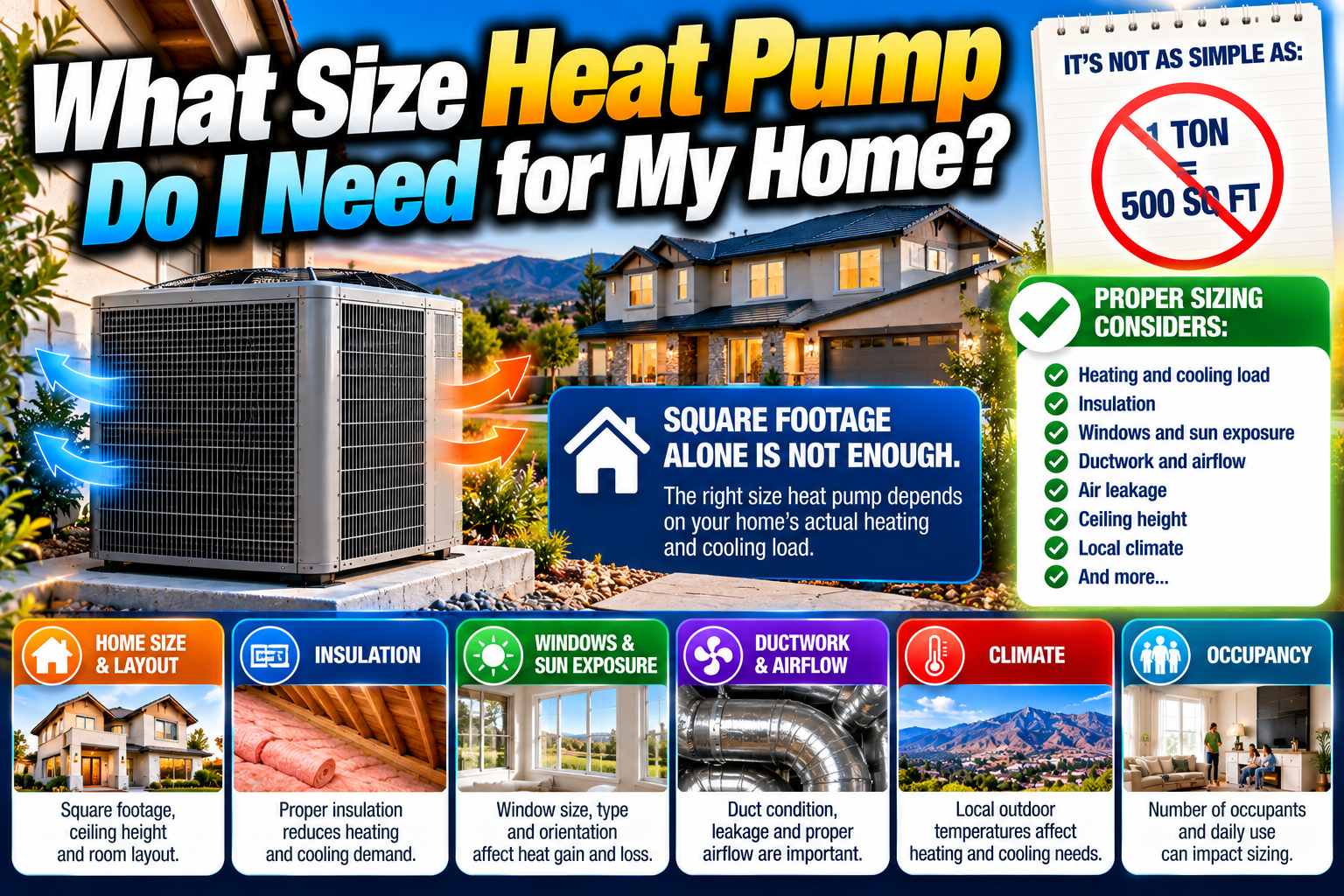
The correct heat-pump size depends on the actual heating and cooling load of the home, not square footage alone.
That includes:
- Insulation
- windows
- ceiling height
- air leakage
- sun exposure
- orientation
- ductwork
- number of occupants
- local climate
- and many other factors.
That’s why proper heat-pump sizing should consider more than square footage.
Key Takeaways
- Heat pumps should not be sized by square footage alone.
- Proper sizing should consider both heating and cooling requirements.
- A load calculation helps estimate how much heating and cooling the home actually needs.
- Oversized equipment can create comfort, cycling and humidity problems.
- Undersized equipment may run continuously and struggle during extreme weather.
- Existing equipment size should not automatically be copied.
- Variable-speed technology can provide flexibility, but it does not eliminate the need for proper sizing.
- Ductwork and airflow must support the selected equipment.
- Heat-pump heating capacity can change as outdoor temperature changes.
- The best system is not necessarily the biggest one.
What Does Heat-Pump Size Mean?
Heat-pump capacity is commonly expressed in:
BTUs per hour
or
tons.
One ton of HVAC capacity equals approximately:
12,000 BTU per hour.
So:
- 2 tons = approximately 24,000 BTU/h
- 3 tons = approximately 36,000 BTU/h
- 4 tons = approximately 48,000 BTU/h
- 5 tons = approximately 60,000 BTU/h
But this does not mean every 2,000-square-foot home needs the same tonnage.
The capacity your house needs depends on how quickly it gains and loses heat.
Why Square Footage Alone Doesn’t Work
Imagine two 2,000-square-foot homes.
Home A
- newer construction
- good attic insulation
- modern windows
- sealed ductwork
- limited west-facing glass
- relatively tight building envelope.
Home B
- older construction
- poor attic insulation
- leaky windows
- large west-facing windows
- leaky attic ducts
- substantial air leakage.
They are both:
2,000 square feet.
But they may have very different heating and cooling loads.
That is why a rule such as:
“One ton for every 500 square feet”
is not a reliable way to select HVAC equipment.
Recent homeowners asking online about heat-pump sizing are being told the same thing: room size alone is insufficient because building orientation, heat loss, solar gain, air leakage and humidity load also matter.
What Is a Load Calculation?
A load calculation estimates how much heating and cooling a building requires under specific design conditions.
For residential HVAC, you may hear the term:
A load calculation considers characteristics such as:
- Square footage
- ceiling height
- insulation
- window size and type
- window orientation
- door area
- air leakage
- wall construction
- roof characteristics
- occupancy
- and local weather conditions.
The purpose is to estimate how many BTUs the house needs during both:
Summer cooling
and
Winter heating.
Why Do Heat Pumps Need Both Heating and Cooling Calculations?
Because a heat pump does both jobs.
A conventional AC system is primarily selected around cooling requirements.
A furnace is primarily selected around heating requirements.
A heat pump needs to satisfy:
Cooling load in summer
AND
Heating load in winter.
Those numbers may not be the same.
In some climates:
Cooling load is larger.
In others:
Heating load is larger.
A recent California homeowner discussion raised exactly this issue—sizing correctly for heating could potentially leave a system oversized for cooling, which is one reason variable-speed equipment can be valuable.
Why Is Heat-Pump Heating Capacity Different From Furnace Capacity?
A gas furnace can generally deliver roughly the same rated output regardless of outdoor temperature, assuming proper operation.
Heat pumps behave differently.
Their heating capacity can change as outdoor temperature changes.
That means you shouldn’t simply look at:
“This is a 36,000-BTU heat pump.”
You also want to know:
How much heating capacity does it produce at the outdoor temperatures expected where you live?
Equipment performance tables matter.
Does a 3-Ton Heat Pump Always Produce 36,000 BTUs of Heat?
Not necessarily under every condition.
The nominal tonnage is useful for identifying equipment class, but actual heating or cooling capacity can vary with:
- Outdoor temperature
- indoor conditions
- compressor speed
- and equipment design.
Modern inverter-driven systems can also modulate capacity significantly.
That’s why proper equipment selection goes beyond the large number printed on the model description.
Why Does Temecula Climate Matter?
The Temecula Valley has:
Hot summers
and
comparatively mild winters.
That means a heat pump needs to be selected carefully for both:
High summer cooling demand
and
Winter heating demand.
Homeowners in Temecula, Murrieta, Menifee, Winchester, Lake Elsinore and surrounding communities often have homes where summer cooling can be a major sizing factor.
The goal is to choose equipment that handles peak conditions without becoming excessively oversized during the majority of the year.
Can My Old HVAC Size Tell Me What I Need?
It can provide information.
But it should not automatically determine the new equipment size.
Suppose your old system is:
5 tons.
That doesn’t prove the house needs 5 tons.
The original contractor may have oversized it.
Or the home may have changed since installation.
Maybe you’ve added:
- New windows
- attic insulation
- air sealing
- new ductwork
- or removed an addition.
Those changes can alter the load.
New equipment should be sized to the actual home rather than simply copying the old equipment nameplate.
What Happens If My Heat Pump Is Too Small?
An undersized heat pump may:
- Run for very long periods
- struggle during very hot weather
- struggle during colder weather
- fail to reach the thermostat setting
- or rely more heavily on backup heat if the system includes it.
Long runtime alone isn’t proof of undersizing, but a system that runs continuously and cannot maintain indoor temperature deserves investigation.
What Happens If My Heat Pump Is Too Large?
Homeowners often assume:
“Bigger is safer.”
But oversized equipment can create its own problems.
Possible issues include:
- Short cycling
- uneven temperatures
- reduced humidity control during cooling
- more frequent starts and stops
- and poor comfort.
A properly selected heat pump avoids both extremes: both oversized and undersized systems can hurt comfort, efficiency and equipment life.
Why Can Oversizing Hurt Humidity Control?
Air conditioners and heat pumps remove moisture from indoor air while cooling.
That process takes time.
If an oversized system cools the house extremely quickly and shuts off repeatedly, it may not operate long enough to remove as much moisture as a properly sized system.
This is especially relevant in climates or homes where humidity is a concern.
One homeowner recently debating a 12,000-BTU versus 18,000-BTU heat pump specifically raised humidity removal as part of the sizing decision.
Doesn’t Variable Speed Fix Oversizing?
It helps.
But it does not mean:
Sizing no longer matters.
Variable-speed heat pumps can reduce output during lower-demand conditions.
That’s valuable.
But every inverter system has:
A minimum capacity
and
A maximum capacity.
If the equipment is dramatically oversized, even its minimum output may be too high during mild conditions.
A recent homeowner with an oversized inverter heat pump described exactly that issue: even after the system reduced output, it still short-cycled because minimum capacity remained too high for the home’s load.
What Is Minimum Capacity?
A variable-speed heat pump can often operate below its full rated capacity.
For example, instead of always producing maximum output, it may reduce compressor speed and provide only the heating or cooling needed at that moment.
But it cannot turn down infinitely.
There is still a minimum amount of output it can produce while running.
This is called:
Minimum capacity.
That’s an important number when comparing variable-speed equipment.
Why Is Minimum Capacity Important in Southern California?
Because much of the year is not:
110°F
or
Freezing cold.
We spend many hours in mild conditions.
A heat pump that can modulate down well may operate quietly and efficiently during these lower-load periods.
That makes:
Operating range
almost as important as maximum capacity.
What Is Maximum Heating Capacity?
Maximum heating capacity tells you how much heat the system can deliver under specified conditions.
When selecting a heat pump, especially for heating-dominant climates, contractors should compare the home’s calculated heating load with the equipment’s actual output at relevant outdoor temperatures.
For Southern California, the winter design temperature isn’t remotely the same as northern states.
That climate difference should influence system selection.
How Does Insulation Affect Heat-Pump Size?
Insulation slows heat transfer.
During winter, it helps keep heat inside.
During summer, it helps keep outdoor heat from entering.
A well-insulated home may require less heating and cooling capacity than a similar-sized poorly insulated house.
This is one reason two identical floorplans can require different equipment.
How Do Windows Affect Heat-Pump Size?
Windows can contribute significantly to heating and cooling loads.
Important characteristics include:
- Window area
- glass type
- orientation
- shading
- and condition.
Large west-facing windows can produce significant afternoon cooling load.
Poor older windows may also increase winter heat loss.
Does Ceiling Height Matter?
Yes.
Square-footage rules typically ignore volume.
A house with:
8-foot ceilings
does not contain the same amount of conditioned air as the same footprint with:
12-foot vaulted ceilings.
A 2026 homeowner specifically asked whether a lower-than-standard ceiling should affect heat-pump sizing because the room volume was lower than typical square-footage sizing charts assumed.
That’s exactly why simple charts are unreliable.
Does Sun Exposure Matter?
Absolutely.
A room receiving intense afternoon sun may have a much higher cooling load than a shaded room on the opposite side of the house.
That can contribute to:
- Hot bedrooms
- uneven temperatures
- and higher cooling demand.
Load calculations account for orientation and solar gain instead of treating every wall and window identically.
Does My Roof Matter?
It can.
Roof characteristics can affect attic and indoor heat gain.
Relevant factors may include:
- Roof color
- roof material
- attic ventilation
- radiant exposure
- insulation
- and whether ductwork is located in the attic.
Again, the house is a system.
Does Air Leakage Affect Heat-Pump Size?
Yes.
Outdoor air leaking into the house increases heating and cooling demand.
Common leakage areas include:
- Doors
- windows
- attic penetrations
- recessed lights
- plumbing penetrations
- and other gaps in the building envelope.
A tighter home generally loses less conditioned air.
What About Duct Leakage?
Duct leakage is especially important.
If a portion of your conditioned air leaks into the attic, the equipment has to work harder to maintain indoor comfort.
This is why heat-pump sizing and duct evaluation shouldn’t be treated as completely separate topics.
Does Return-Air Size Affect Equipment Selection?
The duct system must be able to support the airflow required by the selected heat pump.
If you install equipment requiring more airflow than the return system can provide, the home may end up with:
- High static pressure
- noise
- weak airflow
- or equipment performance problems.
Equipment sizing and duct design need to agree.
Why Isn’t “One Ton Per 500 Square Feet” Good Enough?
Because it ignores nearly everything that determines actual heating and cooling demand.
It doesn’t properly account for:
- Climate
- windows
- insulation
- orientation
- air leakage
- ceiling height
- duct losses
- or building construction.
It may occasionally land near the correct answer by accident.
That doesn’t make it good design.
Why Do Different Contractors Recommend Different Sizes?
This happens frequently.
One contractor may simply copy the existing equipment.
Another may use a square-foot rule.
Another may perform a proper load calculation.
Another may intentionally oversize “just to be safe.”
That’s how one homeowner can receive proposals for dramatically different equipment sizes.
A homeowner recently described quotes ranging from 9,000 BTU to 30,000 BTU for the same space, illustrating exactly how much contractor methodology can vary.
If quotes differ substantially, ask each contractor:
How did you determine the size?
That’s an excellent question.
Should I Ask for a Manual J?
For a full residential system replacement or new installation, a proper heating and cooling load calculation can provide valuable information.
Advanced’s current AC installation approach sizes residential systems to the home using a proper load calculation.
That’s exactly the approach homeowners should want.
Is Manual J Perfect?
A load calculation is only as good as the information entered.
Incorrect assumptions about:
- Insulation
- window type
- air leakage
- duct losses
- or building dimensions
can change the result.
So the purpose isn’t merely to say:
“We did a Manual J.”
The inputs should reasonably represent the actual home.
Should My Heat Pump Be Sized for the Hottest Day Ever?
Generally, HVAC design uses recognized outdoor design conditions rather than the most extreme temperature ever recorded.
If equipment were sized around record-breaking conditions, it could become excessively oversized for the overwhelming majority of the year.
During exceptionally extreme weather, longer runtime can be normal.
Should My Heat Pump Be Sized for Heating or Cooling?
Both should be evaluated.
The contractor should compare:
Calculated cooling load
and
Calculated heating load
with the proposed equipment’s actual performance.
This is especially important with heat pumps because heating output changes with outdoor conditions.
Does a Heat Pump Need to Be Bigger Than an AC?
Not automatically.
This depends on the relationship between the home’s heating and cooling loads and the equipment’s performance.
Some houses may have a larger cooling requirement.
Others may have a larger heating requirement.
You cannot answer that from square footage alone.
Can Backup Heat Affect Heat-Pump Sizing?
Yes.
If a system includes supplemental heat, designers may consider when and how that backup source operates.
However, backup heat should not simply be used as an excuse to undersize the primary heat pump without a reasoned design.
Likewise, oversized primary equipment isn’t automatically better merely because you want to minimize backup operation.
What About Dual Fuel?
Dual fuel combines:
Heat pump
Gas furnace.
In that setup, equipment sizing and controls determine when the heat pump provides heating and when the furnace takes over.
Can Solar Change the Size Heat Pump I Need?
Solar affects how you may think about operating cost.
It generally does not reduce the actual heating or cooling load of the house.
The building still gains and loses the same amount of heat.
Solar panels may help supply electricity, but they do not replace correct HVAC sizing.
Does an EV Affect Heat-Pump Size?
No.
An EV can affect your home’s:
Electrical load
and possibly panel/service requirements.
But it does not change the building’s heating or cooling load.
This is a separate issue from HVAC capacity.
Can I Use Online Heat-Pump Sizing Calculators?
They may provide a rough educational estimate.
But be cautious.
Simple calculators based only on:
Square footage + ZIP code
may miss important building characteristics.
More detailed tools are better, but a professional load calculation is preferable before spending thousands on permanent HVAC equipment.
How Do I Know if My Current System Is Oversized?
Possible clues can include:
- Very short cycles
- large temperature swings
- poor summer humidity control
- noisy airflow
- or a system that rapidly satisfies the thermostat even during demanding weather.
But those symptoms can also have other causes.
Don’t diagnose equipment size from runtime alone.
How Do I Know if My Current System Is Undersized?
Possible signs include:
- Continuous operation during moderate weather
- inability to reach thermostat settings
- poor comfort
- and heavy reliance on supplemental heat.
But again:
- Dirty filters
- duct leakage
- refrigerant problems
- and other faults can mimic undersizing.
The system should be evaluated before assuming capacity is the problem.
Should I Size Up “Just in Case”?
Generally, you should select equipment appropriate for the calculated load and desired design strategy rather than adding large amounts of capacity simply for reassurance.
Variable-speed heat pumps may allow some flexibility.
But intentional oversizing should still have a technical reason behind it.
Bigger is not automatically better.
What Questions Should I Ask My Contractor?
Before buying a heat pump, ask:
- How did you determine the equipment size?
- Did you calculate both heating and cooling load?
- Are you using my existing equipment size as the recommendation?
- What is the proposed heat pump’s heating capacity at our winter design temperature?
- What is its minimum capacity?
- What is its maximum capacity?
- Can my existing ductwork support the required airflow?
- Did you check return-air capacity?
- Will auxiliary heat be required?
- How does this system perform during Temecula summer temperatures?
Those questions tell you far more than simply asking:
“Is this a 4-ton?”
Frequently Asked Questions
What size heat pump do I need for a 2,000-square-foot house?
There isn’t a reliable answer based only on square footage. Insulation, windows, climate, air leakage, ductwork, ceiling height and other factors should be considered.
Is 3 tons enough for 2,000 square feet?
Maybe. It could also be too large or too small depending on the house. A load calculation is the better way to determine capacity.
Is a bigger heat pump better?
No. Oversized systems can create cycling, comfort and humidity problems.
What happens if a heat pump is too small?
It may operate for extended periods and struggle to maintain temperature during high-demand conditions.
Should I replace my old 4-ton system with another 4-ton?
Not automatically. The home should be reevaluated rather than assuming the old equipment was correctly sized.
Do variable-speed heat pumps need exact sizing?
Proper sizing still matters. Variable-speed technology provides a wider operating range but does not eliminate the consequences of severe oversizing or undersizing.
Does insulation affect heat-pump size?
Yes. Better insulation can reduce the home’s heating and cooling load.
Do windows affect heat-pump sizing?
Yes. Window size, type, direction and shading can significantly affect load.
Does ductwork determine heat-pump size?
Ductwork does not determine the building load, but the duct system must be capable of delivering the airflow required by the selected equipment.
Should I get a Manual J before installing a heat pump?
A professional heating and cooling load calculation is one of the best ways to support proper equipment selection.
Why did two contractors recommend different sizes?
They may be using different sizing methods or assumptions. Ask each contractor to explain the calculations behind the recommendation.
Should heat pumps be sized differently from air conditioners?
They require consideration of both heating and cooling performance, including how heating capacity changes with outdoor temperature.
Don’t Buy a Heat Pump Based on Square Footage Alone
This is the main takeaway.
Your home is more than:
2,000 square feet.
It has:
- Windows.
- Insulation.
- Sun exposure.
- Ductwork.
- Air leakage.
- Ceiling height.
- Occupants.
- Heating load.
- Cooling load.
A properly selected heat pump should reflect the actual house.
Not simply:
“This size usually works around here.”
And not:
“That’s what you already have.”
Measure the home.
Calculate the load.
Evaluate the ducts.
Then select the equipment.
Heat Pump Installation in the Temecula Valley
Advanced Heating & Air Conditioning installs heat-pump systems throughout Temecula, Murrieta, Menifee, Winchester, Wildomar, French Valley, Canyon Lake, Lake Elsinore, Hemet and surrounding communities.
Advanced’s current heat-pump installation process evaluates the property’s layout, insulation, windows, ductwork, airflow, electrical access and actual heating and cooling needs before selecting equipment.
Advanced Heating & Air Conditioning
951-609-9881
California Contractor License #916901
REAL PEOPLE. REAL SERVICE. REAL COMFORT.