


Central Heat Pump vs. Mini Split: Which Is Better?
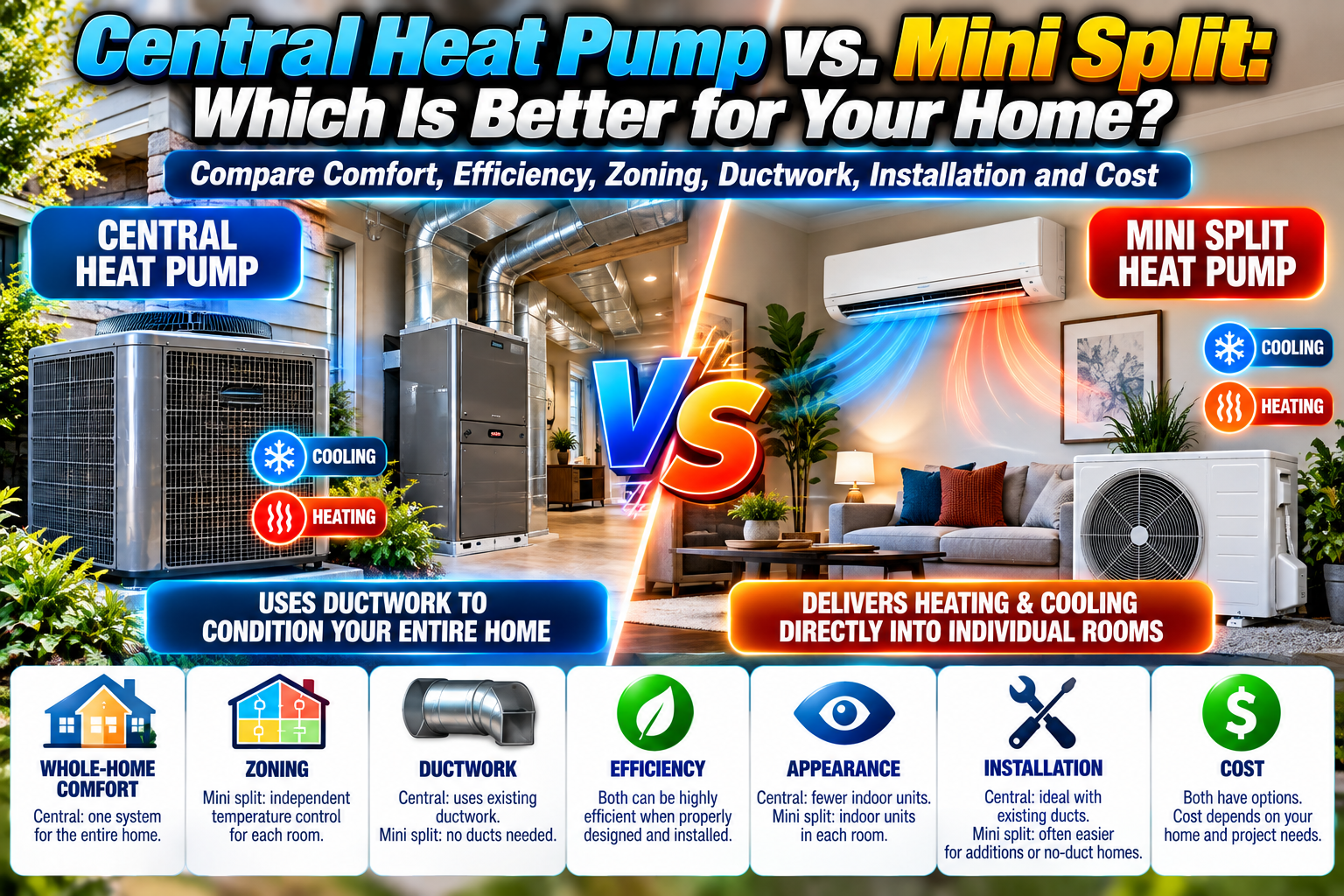
Central Heat Pump vs. Mini Split: Which Is Better for Your Home?
When homeowners decide to switch to heat-pump heating and cooling, they often discover that there is more than one way to do it.
You may be offered:
A central ducted heat pump
or
One or more ductless mini splits.
Then comes the question:
Which is better?
The answer depends on the house.
If your home already has properly sized ductwork in good condition, a central heat pump may provide an excellent whole-home solution.
If your house has:
- No ducts
- An addition
- A garage conversion
- Problem rooms
- or you want independent room-by-room control,
mini splits can be extremely attractive.
And there is one important thing to understand immediately:
A mini split is usually a heat pump too.
The difference is primarily how the heating and cooling gets distributed through the house.
Key Takeaways
- Both central heat pumps and ductless mini splits can provide heating and cooling.
- Most modern mini splits are heat pumps.
- Central heat pumps use ductwork to distribute conditioned air.
- Mini splits deliver conditioned air directly into individual rooms or zones.
- Existing good ductwork can make a central heat pump an excellent replacement option.
- Homes without ductwork may be easier and less disruptive to serve with mini splits.
- Mini splits can provide excellent zoning.
- Central systems provide a clean whole-home appearance with fewer visible indoor units.
- Duct leakage can reduce central-system efficiency.
- Mini splits eliminate most traditional duct losses.
- Multiple mini-split heads still require correct sizing and placement.
- Neither option is automatically more efficient or more comfortable in every house.
- Some homes benefit from both a central heat pump and one or two mini splits.
First: Is a Mini Split Actually a Heat Pump?
Usually, yes.
This terminology confuses homeowners constantly.
A heat pump describes the technology.
A mini split describes a type of HVAC system configuration.
Most modern ductless mini splits are:
Air-source heat pumps.
They provide:
Cooling in summer
and
Heating in winter.
So when someone asks:
“Heat pump or mini split?”
the more accurate comparison is usually:
Central ducted heat pump
versus
Ductless mini-split heat pump.
A 2026 homeowner discussion made this exact distinction when people were asked whether they preferred a heat pump or mini splits; commenters pointed out that mini splits themselves are heat pumps.
What Is a Central Heat Pump?
A central heat pump typically consists of:
- Outdoor heat-pump unit
- Indoor air handler or compatible furnace
- Duct system
- Supply registers and return grilles.
The system conditions air centrally and then distributes it throughout the building using ductwork.
It looks and operates much like a traditional:
Central AC + furnace system
except the heat pump can provide both cooling and heating.
What Is a Mini Split?
A ductless mini split usually consists of:
Outdoor heat-pump unit
connected to
One or more indoor units.
Instead of pushing air through ducts, the indoor unit conditions the room directly.
Indoor units may be:
- Wall mounted
- Ceiling cassette
- Floor mounted
- or other configurations depending on the manufacturer and application.
Advanced Heating & Air Conditioning installs single-zone and multi-zone ductless systems for rooms, additions, garages and properties where extending traditional ductwork may not make sense.
What Is a Single-Zone Mini Split?
A single-zone system typically has:
One outdoor unit
connected to
One indoor unit.
This can be ideal for:
- Garage conversion
- Home addition
- Detached office
- Bedroom
- Bonus room
- or another individual area.
What Is a Multi-Zone Mini Split?
A multi-zone system uses one outdoor unit connected to multiple indoor units.
For example:
- Living room
- Bedroom 1
- Bedroom 2
- Home office
can each have an indoor unit.
Each zone can often be controlled independently.
That is one of the major attractions of mini splits.
Which Is Better If I Already Have Ductwork?
If your existing ductwork is:
- Properly sized
- Reasonably sealed
- Well insulated
- and in good condition,
a central heat pump can be an excellent option.
You can often continue using the existing supply registers and return-air system while upgrading the heating and cooling equipment.
One 2026 homeowner chose a central heat pump over mini splits for exactly this reason: the home already had usable ductwork, and the homeowner preferred consistent temperatures throughout bedrooms and shared spaces without multiple visible wall-mounted units.
Should I Automatically Reuse Existing Ductwork?
No.
Before reuse, ductwork should be evaluated for:
- Size
- airflow
- static pressure
- leakage
- insulation
- damage
- and overall distribution.
Existing does not automatically mean correct.
What If My Ductwork Is Bad?
Now the comparison becomes more interesting.
Suppose you need:
New heat pump
and
Major duct replacement.
At that point, it may be worth comparing:
New central heat pump + duct repairs/replacement
against
Ductless mini splits.
Depending on the house, mini splits may avoid some expensive duct reconstruction.
But they introduce different considerations such as:
- Indoor-unit placement
- refrigerant-line routing
- condensate drainage
- and aesthetics.
What If My House Has No Ductwork?
Mini splits become very attractive.
Installing an entirely new central duct system can require:
- Attic access
- Ceiling work
- wall chases
- soffits
- or significant construction.
Ductless systems can often provide heating and cooling without installing traditional whole-home ductwork.
That can make them particularly useful in:
- Older homes
- homes with radiant heat
- homes with wall furnaces
- additions
- or properties that were never built for central air.
A recent homeowner discussion specifically noted that mini splits can solve many installation and cost problems where good existing ductwork is not available.
Which System Is Better for an Older Home?
It depends heavily on the construction.
An older home might have:
- No ducts
- Poorly retrofitted ducts
- Closed-off rooms
- Plaster walls
- Limited attic space
- or unusual floorplans.
Mini splits can provide individual-zone control without rebuilding the entire house.
But if the home already has good central ductwork, a central heat pump may provide a cleaner whole-home solution.
One 2026 homeowner with an older, compartmentalized house asked exactly this question while deciding between a central heat pump and several mini splits.
Which Is Better for a Newer Home?
A modern home with properly designed central ductwork is often well suited to a central heat pump.
You already have:
- Supply ducts
- Returns
- register locations
- and space for indoor equipment.
Replacing the existing HVAC system with a central heat pump can therefore be relatively straightforward compared with installing multiple wall units throughout the house.
Which Gives Better Zoning?
Generally:
Mini splits.
Individual indoor units can often be controlled separately.
For example:
- Master bedroom = 70°F
- Office = 74°F
- Guest room = reduced conditioning when unused.
That allows room-by-room control.
Central systems can also be zoned, but proper ducted zoning requires:
- Motorized dampers
- Zone controls
- thermostats or sensors
- and careful airflow management.
Is Mini-Split Zoning More Efficient?
It can be.
One of the advantages is that you may reduce conditioning in spaces you are not using.
For example:
Why cool a guest bedroom aggressively all afternoon if nobody is using it?
But zoning savings depend on:
- House layout
- occupancy
- doors
- heat transfer between rooms
- and how homeowners actually operate the system.
Zoning does not eliminate the building’s heating and cooling load.
Can One Mini Split Cool Several Rooms?
Sometimes—but be careful.
A single indoor head works best when air can move freely through the area.
An open:
Living room + kitchen + dining area
may be well suited to one appropriately sized zone.
But expecting one wall unit in a hallway to condition:
Three closed bedrooms
is very different.
Air does not reliably move around corners and through closed doors simply because the equipment has enough BTUs.
The number of indoor units depends on room layout and whether air can move effectively between connected spaces.
Can I Put One Big Mini Split in the Living Room?
You can, but bigger capacity does not solve poor air distribution.
A large indoor unit may make the living room extremely comfortable while bedrooms behind closed doors remain warm or cold.
This is why:
Load calculation + layout
matter just as much as total BTUs.
Which System Looks Better?
This is subjective.
A central heat pump generally uses existing:
- Ceiling
- wall
- or floor registers.
The main equipment is largely out of sight.
Mini splits use visible indoor units unless you choose less obvious styles such as concealed ducted units or certain ceiling cassettes.
Some homeowners do not mind wall-mounted heads at all.
Others strongly prefer the appearance of central HVAC.
That personal preference matters because you will look at the equipment every day.
Are Mini Splits Ugly?
That is entirely subjective.
Modern indoor units are generally designed to blend into residential spaces better than older equipment.
But wall-mounted units are still visible.
If aesthetics matter strongly, consider:
- Ceiling cassettes
- floor consoles
- concealed ducted mini-split units
- or a central system.
Which System Is Quieter?
Both can be extremely quiet when properly selected and installed.
Mini splits can be especially quiet indoors at low fan speeds.
Modern variable-speed central heat pumps can also operate very quietly.
Actual sound depends on:
- Equipment model
- fan speed
- compressor speed
- duct design
- register design
- and installation.
Do not choose based only on the word:
“mini split”
or
“central.”
Compare actual equipment sound ratings.
Which Has Better Air Distribution?
Central ductwork can provide very good whole-home distribution when designed properly.
This is especially useful for homes with many:
- Bedrooms
- bathrooms
- hallways
- and closed spaces.
Mini splits excel at direct conditioning of individual zones.
Neither method is automatically superior.
It depends on floorplan.
Which Is Better for a Two-Story House?
Either can work.
A central heat pump might use:
One properly designed duct system
or
Multiple zones.
Mini splits could use separate indoor units upstairs and downstairs.
The right decision depends on:
- Existing ductwork
- floorplan
- sun exposure
- room loads
- and homeowner comfort preferences.
Which Is Better for an Addition?
Mini splits are often excellent for additions.
Suppose you add:
500 square feet
to a home.
Extending the existing central duct system may reduce airflow to the rest of the house or require substantial redesign.
A dedicated mini split allows the addition to have its own heating and cooling.
That is one of the applications Advanced currently identifies for ductless systems.
Which Is Better for a Garage?
For a converted or conditioned garage, a mini split is often attractive because it can condition that area independently without connecting the garage to the home’s central duct system.
The appropriate solution still depends on:
- Garage insulation
- door type
- windows
- sun exposure
- and intended use.
Which Is Better for a Home Office?
Again, mini splits can be excellent.
A home office may need cooling during daytime hours even while much of the house is unused.
Independent control can be valuable.
But if the central system already serves the office comfortably and efficiently, installing another system may not be necessary.
Which Is More Efficient?
There is no universal winner.
Mini splits can avoid traditional duct losses.
That is a real advantage.
If a central system has ducts running through a hot attic and those ducts leak or have poor insulation, energy can be lost before conditioned air reaches the rooms.
A ductless system avoids most of that distribution loss.
But a modern central heat pump connected to:
- Tight
- properly insulated
- correctly sized ductwork
can also be highly efficient.
Are Duct Losses Really Important?
They can be.
Imagine producing cold air during a Temecula summer.
Then the ductwork running through a very hot attic:
- Leaks some air
- and absorbs additional heat.
The equipment did the cooling work.
But some of that benefit never reaches the rooms.
This is why duct condition should be part of any central-system evaluation.
Does That Mean Mini Splits Are Always More Efficient?
No.
Mini-split efficiency also depends on:
- Equipment selection
- Sizing
- Refrigerant-line installation
- Indoor-unit placement
- Maintenance
- and homeowner usage.
A badly oversized mini split can perform poorly.
A poorly located indoor unit can create comfort problems.
Installation still matters.
Can Mini Splits Be Oversized?
Absolutely.
This is important because people sometimes think:
“Just install a bigger head.”
But mini splits also have:
Minimum capacity
and
maximum capacity.
A significantly oversized unit may cycle rather than modulate properly during mild conditions.
That can reduce comfort and efficiency.
How Are Mini Splits Sized?
Each zone should be evaluated based on factors such as:
- Room dimensions
- Insulation
- windows
- sun exposure
- ceiling height
- occupancy
- and climate.
Advanced’s mini-split installation process evaluates the space, layout, insulation, windows, sun exposure and equipment location before recommending capacity.
How Is a Central Heat Pump Sized?
The entire home’s heating and cooling loads are considered.
A central heat pump should not simply be sized based on:
Square footage
or
the size of the old equipment.
Which Is Better for Variable-Speed Technology?
Both central and ductless systems can use inverter-driven variable-capacity technology.
Mini splits have used inverter compressors for years.
Many newer central heat pumps now use similar technology.
This means the compressor can:
Ramp down when demand is low
and
Ramp up when demand increases.
Does a Mini Split Run All the Time?
It may run for very long periods at low capacity.
That can be normal.
Many inverter mini splits are designed to:
Maintain temperature steadily
rather than repeatedly shut completely off.
The same can be true of variable-speed central heat pumps.
Runtime alone is not a reliable measure of efficiency.
Which One Uses Less Electricity?
It depends.
Factors include:
- Equipment efficiency
- House load
- Number of zones
- Thermostat settings
- Duct losses
- Outdoor conditions
- and homeowner behavior.
A homeowner who conditions only occupied rooms with mini splits may use less energy than one maintaining the entire house at one temperature.
But another house with excellent central ductwork and efficient variable equipment may perform extremely well centrally.
There is no universal answer.
Which Is Better If I Have Solar?
Either can pair with solar because both use electricity.
Solar changes the financial side of electric HVAC operation.
It does not determine which air-distribution system fits your house better.
Still evaluate:
- Layout
- ductwork
- comfort
- electrical capacity
- and equipment sizing.
Which Is Easier to Install?
For a single room:
Mini split, generally.
For a whole house with existing good ductwork:
Central heat pump may actually be simpler and cleaner.
Whole-home multi-zone mini splits can become complex because you may need:
- Several indoor units
- Multiple refrigerant lines
- Condensate drains
- Electrical connections
- and careful outdoor-unit placement.
So do not assume:
Ductless = always simpler.
Can a Whole House Use Mini Splits?
Yes.
Many homes use mini splits as their primary heating and cooling system.
But the house should be designed zone by zone.
You need to consider:
- Closed bedrooms
- Bathrooms
- Hallways
- Large open areas
- and air movement.
Some customers use mini splits as their primary system while others use them to supplement central HVAC.
Can I Combine Central Heat Pump and Mini Splits?
Absolutely.
This can be an excellent solution.
For example:
Central heat pump serves the main house
while
Mini split serves an addition or difficult bedroom.
Or:
Central system handles most rooms
while
A garage or detached office gets its own mini split.
A homeowner discussion described exactly this type of future plan: central heat pump for the main home plus mini splits for additions that existing ductwork did not serve well.
Is a Hybrid Approach Wasteful?
Not necessarily.
Sometimes trying to force one central system to solve every comfort problem creates more expense and complexity than using a dedicated mini split for one difficult area.
The right solution is whatever serves the home efficiently and comfortably.
Which Requires More Maintenance?
Central systems require attention to:
- Filters
- Indoor coil
- Outdoor coil
- Blower
- Ductwork
- Drainage
- Electrical system
- and controls.
Mini splits require maintenance of:
- Indoor-unit filters
- Indoor coils
- Blower wheels
- Outdoor coil
- Drain system
- and refrigeration components.
A ductless system is not maintenance-free simply because there are no traditional ducts.
Are Mini-Split Filters Different?
Usually, yes.
Many ductless indoor units use washable or reusable mesh filters designed primarily to protect the equipment.
They may not provide the same filtration strategy as a properly designed central HVAC filter system.
If indoor air quality is a major priority, discuss filtration options before choosing the system.
Which Is Better for Indoor Air Quality?
A central system can integrate more easily with some whole-home IAQ equipment such as:
- Larger media filters
- Air purification
- UV systems
- and other duct-mounted solutions.
Mini splits may use their own built-in filtration and treatment technologies depending on the equipment.
The best option depends on the homeowner’s actual IAQ goals.
Can Mini Splits Control Humidity?
They can remove moisture during cooling.
Variable operation can support good comfort when properly sized.
But performance depends on:
- Sizing
- runtime
- mode
- and local humidity conditions.
Oversizing can still create short-cycle problems.
Which System Is Easier to Hide?
Usually:
Central HVAC.
Registers can be relatively unobtrusive.
Mini splits require visible indoor components unless concealed or cassette-style equipment is used.
Again, this is a personal preference.
What About Refrigerant Lines?
A central system typically has one main refrigerant line set connecting indoor and outdoor equipment.
Multi-zone mini splits can involve several refrigerant runs.
Those lines must be:
- Properly sized
- supported
- insulated
- and routed.
Exterior line-hide covers are often used to create a cleaner appearance.
Do Mini Splits Need Condensate Drains?
Yes.
During cooling, indoor units remove moisture from the air.
That water needs to drain somewhere.
Depending on unit location, drainage may use:
- Gravity
- or a condensate pump.
Drain design is an important part of installation.
Do Central Heat Pumps Need Condensate Drains?
Yes.
The indoor coil produces condensate during cooling.
The system needs:
- Proper drain piping
- and often safety measures to protect against overflow.
Both technologies require proper moisture management.
Which Is More Reliable?
There is no simple central-vs-mini-split answer.
Reliability depends on:
- Manufacturer
- equipment design
- installation
- maintenance
- electrical conditions
- and usage.
One advantage of several independent single-zone mini splits is redundancy:
If one system fails, other rooms may still have heating or cooling.
A central system provides one coordinated whole-house system but can affect the entire home if that system fails.
What About Multi-Zone Mini Splits?
A multi-zone outdoor unit can serve several indoor heads.
That reduces the number of outdoor units.
But those zones share one outdoor system.
If the outdoor unit has a major failure, multiple rooms can be affected.
There are tradeoffs either way.
Is One Multi-Zone System Better Than Several Single-Zone Systems?
Not universally.
Single-zone systems may offer:
- Independent operation
- Redundancy
- and sometimes stronger individual-zone performance.
Multi-zone systems can reduce:
- Outdoor equipment count
- and visual clutter.
The correct choice depends on the property.
Which One Is Better for Resale?
Homebuyer preferences vary.
Some buyers prefer the familiar appearance and whole-home integration of:
Central heating and air.
Others value:
- Ductless zoning
- and efficiency.
A 2026 homeowner poll asking prospective buyers this exact question produced preferences for both, with several commenters specifically preferring central heat and air because of its integrated whole-home feel.
Resale should be considered, but it should not be the only factor.
Does Central HVAC Increase Home Value More?
There is no universal dollar amount.
Real-estate value depends on:
- Local market
- Home condition
- System quality
- Buyer preference
- and installation quality.
A professionally installed modern HVAC system can be attractive either way.
Avoid making a major HVAC decision based solely on a generic resale-value claim.
What About Cost?
The answer varies enormously.
A central heat-pump project may involve:
- Outdoor unit
- Indoor equipment
- Duct modifications
- Electrical work
- thermostat
- and removal of existing equipment.
A mini-split project may involve:
- One or several indoor units
- Outdoor equipment
- Refrigerant lines
- line covers
- drainage
- electrical work
- and wall or ceiling access.
One mini split can be relatively simple.
Five zones are a very different project.
That’s why you should compare complete installed proposals.
Which Is Cheaper If I Already Have Good Ductwork?
A central heat pump may be very competitive because much of the distribution system already exists.
Installing several mini-split heads may not necessarily save money.
This is why the house must be evaluated before assuming ductless is cheaper.
Which Is Cheaper If I Have No Ductwork?
Mini splits can avoid the substantial cost and disruption of installing a complete duct system.
That can make them extremely attractive.
But compare the actual number of zones required.
A large multi-room home may need numerous indoor units.
What If Only One Room Is Uncomfortable?
Don’t replace your entire central HVAC system automatically.
First determine why that room is uncomfortable.
Possible causes include:
- Duct issue
- Return-air issue
- Insulation
- Windows
- Solar gain
- or building design.
If correcting those problems isn’t practical, a mini split may be an excellent supplemental solution.
Are Mini Splits Good for Temecula?
They can be.
Mini splits provide both:
- Cooling for hot summer weather
- and heating for cooler winter conditions.
Their zoning ability can work particularly well for:
- Additions
- Garages
- Home offices
- Guest houses
- and spaces where traditional ductwork is difficult.
Are Central Heat Pumps Good for Temecula?
Absolutely.
Central heat pumps are especially attractive for homes that already have good duct systems because one system can provide:
- Whole-home cooling
- and whole-home heating.
Advanced’s heat-pump installation positions heat pumps as a year-round solution for Temecula’s hot summers and cooler seasonal temperatures.
Does a Central Heat Pump Need Backup Heat?
Possibly, depending on:
- Equipment
- Heating load
- Electrical configuration
- and homeowner preferences.
Options may include:
- Electric supplemental heat
- or dual fuel with a gas furnace.
Do Mini Splits Need Backup Heat?
Not automatically.
Many modern mini-split heat pumps provide substantial heating capacity.
Whether backup heating is needed depends on:
- Equipment specifications
- Climate
- Room load
- and system design.
In Southern California’s relatively mild climate, this can be much different from a house located in a very cold northern climate.
What Questions Should I Ask Before Choosing?
Before deciding between central heat pump and mini splits, ask:
- Is my existing ductwork worth keeping?
- Have you measured or evaluated the duct system?
- How many mini-split zones would my home actually need?
- Where would the indoor units be installed?
- Where would the refrigerant lines run?
- How would condensate drain?
- What is the heating and cooling load of each area?
- Will bedrooms stay comfortable with doors closed?
- What equipment capacity are you recommending?
- What is the minimum capacity of the equipment?
- What are the electrical requirements?
- What maintenance does each option require?
- What will the finished installation look like?
Those questions lead to a much better decision than simply asking:
“Which is more efficient?”
Frequently Asked Questions
Is a mini split the same thing as a heat pump?
Most modern mini splits are heat pumps. “Mini split” refers to the system configuration, while “heat pump” refers to the heating and cooling technology.
Is a central heat pump better than mini splits?
Not universally. Central heat pumps can be excellent for homes with good ductwork, while mini splits can be better for properties without ducts or for individual-zone control.
Are mini splits more efficient than central heat pumps?
They can avoid duct losses, which may improve overall efficiency. But actual performance depends on equipment, sizing, installation and how the home is operated.
Should I keep my ducts or switch to mini splits?
If the ducts are properly sized, sealed, insulated and in good condition, keeping them may make excellent sense. Poor ductwork may change the comparison.
Can mini splits heat an entire house?
Yes, if the system is properly designed with enough capacity and appropriate indoor-unit locations.
Can one mini split heat several bedrooms?
Possibly in an open layout, but closed bedrooms may need their own conditioning because air does not move easily through closed doors.
Are mini splits good for additions?
Yes. Additions and spaces poorly served by existing ductwork are common mini-split applications.
Can I use a central heat pump and mini splits together?
Yes. A hybrid approach can work very well when the central system handles the main house and mini splits serve difficult or separate areas.
Which system looks better?
Central systems are generally less visible because they use registers. Mini splits have visible indoor units unless concealed or cassette-style equipment is selected.
Which is quieter?
Both can be very quiet. Actual noise depends on the equipment model, compressor capacity, fan speed and installation.
Which costs less?
It depends on the house. Existing good ductwork can make central installation attractive, while a house without ducts may be less expensive to serve with ductless equipment.
Which is better for zoning?
Mini splits naturally provide individual-zone control. Central systems can also use zoning when properly designed.
Do mini splits need maintenance?
Yes. Filters, indoor coils, blower wheels, drains and outdoor equipment need regular attention.
Can mini splits replace my furnace and AC?
Potentially, yes, if they are designed to meet the home’s complete heating and cooling load.
The Best Answer Depends on the House You Already Own
The mistake is starting with:
“Mini splits are better.”
or
“Central HVAC is better.”
Start with the building.
If your home has:
- Excellent ducts
- Good airflow
- Several bedrooms
- and you want a clean whole-home solution,
a central heat pump may make excellent sense.
If your home has:
- No ducts
- Problem additions
- Individual comfort zones
- or spaces you use at very different times,
mini splits may be the better fit.
And sometimes:
The best solution is both.
Use central HVAC where central HVAC works well.
Use ductless where ductless solves a specific problem better.
That’s a much smarter approach than forcing every house into the same system design.
Heat Pump & Mini-Split Installation in the Temecula Valley
Advanced Heating & Air Conditioning installs both central heat pumps and ductless mini-split heat pumps, allowing homeowners to compare options based on the actual property rather than being pushed toward one technology.
For central systems, Advanced evaluates factors including property layout, insulation, windows, ductwork, airflow, electrical access and heating/cooling demand before recommending equipment.
For ductless projects, Advanced evaluates room dimensions, layout, insulation, windows, sun exposure, drainage, electrical access and potential indoor-unit locations before recommending equipment.
Advanced serves Temecula, Murrieta, Menifee, Winchester, Wildomar, French Valley, Canyon Lake, Lake Elsinore, Hemet and surrounding communities.
Advanced Heating & Air Conditioning
951-609-9881
California Contractor License #916901
REAL PEOPLE. REAL SERVICE. REAL COMFORT.