


How Cold Is Too Cold for a Heat Pump?
How Cold Is Too Cold for a Heat Pump?
One of the most common questions homeowners ask when considering a heat pump is:
“What happens when it gets really cold outside?”
It’s a reasonable question.
A heat pump heats your home by transferring heat from the outdoor air into the house.
So homeowners naturally wonder:
If the air outside is cold, where does the heat come from?
And eventually:
Does it become too cold for the heat pump to work?
The answer is:
It depends on the heat pump.
There is no universal outdoor temperature where every heat pump suddenly stops working.
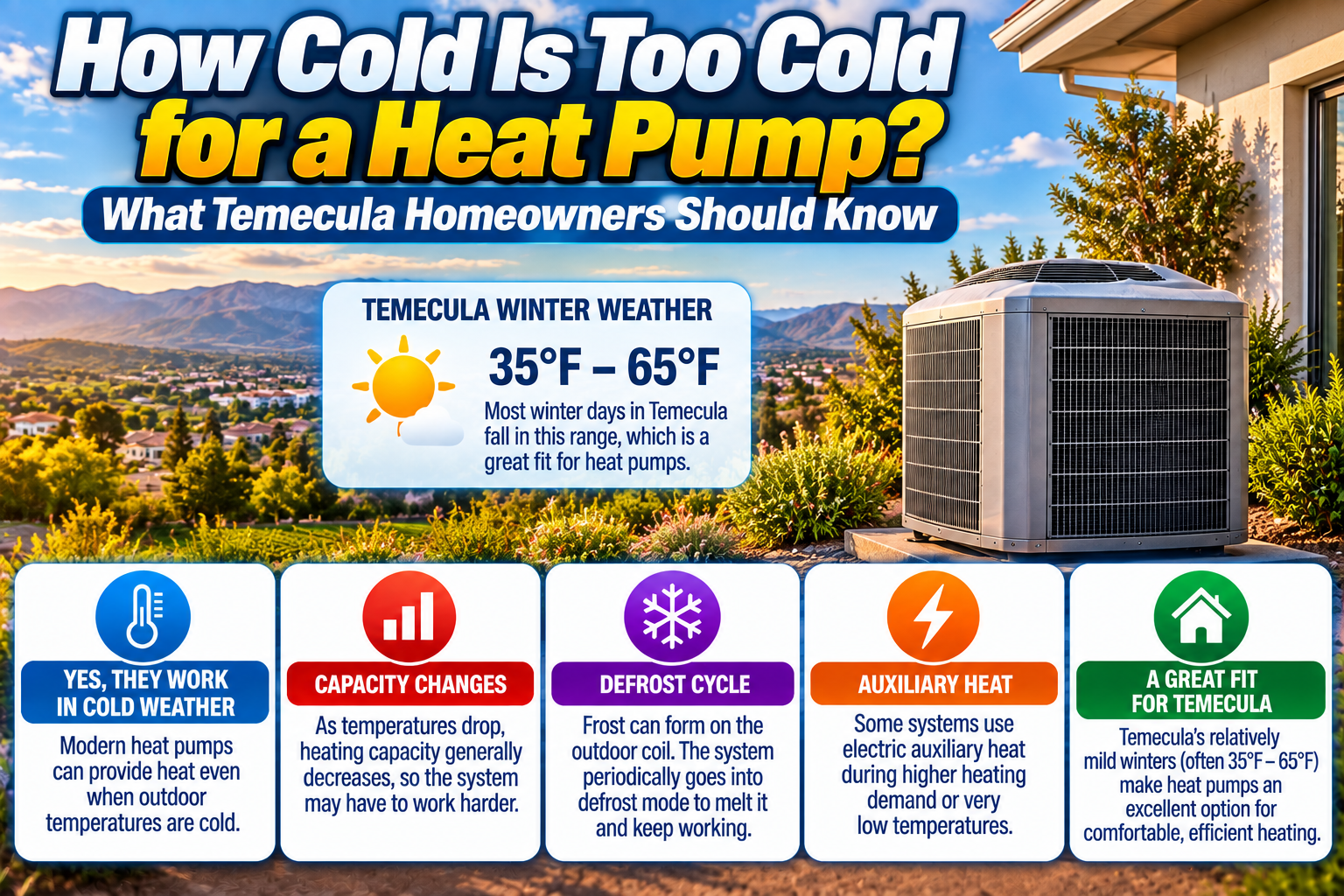
Modern heat pumps can operate at temperatures far below what many homeowners expect. But as outdoor temperatures fall, two important things can change:
- Heating capacity
- and efficiency.
Understanding those two concepts makes heat-pump cold-weather performance much easier to understand.
Key Takeaways
- Heat pumps can provide heat when outdoor temperatures are cold.
- There is no universal temperature where every heat pump stops working.
- Different heat pumps have different low-temperature capabilities.
- Heating capacity generally changes as outdoor temperature falls.
- Efficiency also changes with outdoor temperature.
- A heat pump can still operate even when backup heat becomes more economical.
- Equipment sizing matters tremendously.
- The home’s insulation, windows, ductwork and air leakage affect whether the system can keep up.
- Electric auxiliary heat can supplement a heat pump.
- A dual-fuel system can pair a heat pump with a gas furnace.
- Southern California’s relatively mild winters can make heat pumps particularly attractive.
- The correct heat pump should be selected using actual equipment performance data and the home’s heating load—not a rule of thumb.
Do Heat Pumps Actually Work in Cold Weather?
Yes.
This is one of the biggest misconceptions about heat pumps.
A heat pump does not need the outdoor air to feel:
Warm.
Even cold outdoor air contains thermal energy.
The refrigeration system absorbs some of that energy and transfers it indoors.
That’s why a heat pump can continue producing heat when the temperature outside is much lower than the temperature inside your house.
Why Do People Think Heat Pumps Don’t Work Below 40°F?
A lot of this comes from older equipment and older HVAC rules of thumb.
Historically, some heat pumps lost substantial heating capacity as outdoor temperatures dropped.
That led to statements such as:
“Heat pumps don’t work below freezing.”
or
“You need a furnace anytime it gets below 40 degrees.”
Those statements are too broad for modern equipment.
Today’s heat pumps include:
- Single-stage systems
- Two-stage systems
- Variable-capacity systems
- Inverter-driven systems
- and equipment specifically designed for colder climates.
They do not all perform the same way.
What Happens to a Heat Pump as It Gets Colder Outside?
Two things become increasingly important.
1. Your House Needs More Heat
As outdoor temperature falls, your home generally loses heat faster.
The temperature difference between:
- Inside
- and outside
gets larger.
So your home’s heating load increases.
2. The Heat Pump’s Performance Changes
At the same time, the heat pump’s:
- Capacity
- and efficiency
can change with outdoor temperature.
This creates an important relationship.
Your house is asking for:
More heat
while the heat pump’s available performance is changing.
At some point, those two lines may meet.
What Is Heat-Pump Heating Capacity?
Heating capacity is the amount of heat the equipment can deliver under specific conditions.
It is commonly expressed in:
BTU per hour.
Suppose a heat pump can provide a certain amount of heating at:
47°F outdoors.
That does not necessarily mean it produces exactly the same heating capacity at:
32°F
or
17°F.
The manufacturer’s performance data shows how that particular system behaves at different outdoor temperatures.
Why Is the 47°F Rating Not Enough?
Heat pumps are commonly listed with heating performance information at standardized test conditions.
But homeowners don’t live at one outdoor temperature all winter.
If you’re comparing heat pumps, you want to know:
How much heat does this equipment produce when I actually need it?
That means looking beyond the headline rating.
What Is the Balance Point of a Heat Pump?
This is an important concept.
The thermal balance point is roughly the outdoor temperature where:
The heat pump’s available heating capacity
matches
The home’s heating requirement.
Above that temperature:
The heat pump may be able to handle the heating load by itself.
Below it:
The house may require additional heating capacity.
That additional heat could come from:
- Electric auxiliary heat
- or a gas furnace in a dual-fuel system.
Does the Balance Point Mean the Heat Pump Stops Working?
No.
This is a critical distinction.
The heat pump may still be operating and producing useful heat.
It simply may not be able to provide all the heat the house needs by itself under those conditions.
That’s different from:
“The heat pump doesn’t work.”
What Is an Economic Balance Point?
There’s another balance point homeowners should understand.
The economic balance point asks:
At what outdoor temperature does another heating source become less expensive to operate?
That is different from the thermal balance point.
A homeowner discussion about heat-pump lockout temperatures made this exact distinction: there’s a temperature based on the equipment’s ability to satisfy the heating load and another based on the economics of electricity versus backup fuel.
That’s an excellent distinction for homeowners.
Can a Heat Pump Still Work Below the Economic Balance Point?
Yes.
It might be perfectly capable of heating the home.
But another heat source could potentially cost less to operate under certain:
- Electric rates
- Gas rates
- Equipment efficiencies
- and outdoor conditions.
This is particularly relevant to dual-fuel systems.
What Is Dual Fuel?
A dual-fuel system combines:
- Electric heat pump
- Gas furnace.
During milder weather:
The heat pump heats the house.
When conditions reach a selected transition point:
The gas furnace can take over.
This gives homeowners two heating technologies in one system.
Does Every Heat Pump Need a Gas Furnace?
No.
Many homes use all-electric heat-pump systems.
Depending on the system, backup heating may be:
- Electric resistance heat
- or the heat pump may be designed and sized to handle the home’s heating needs without conventional backup under most conditions.
The right setup depends on:
- Climate
- house
- equipment
- utility rates
- and homeowner preferences.
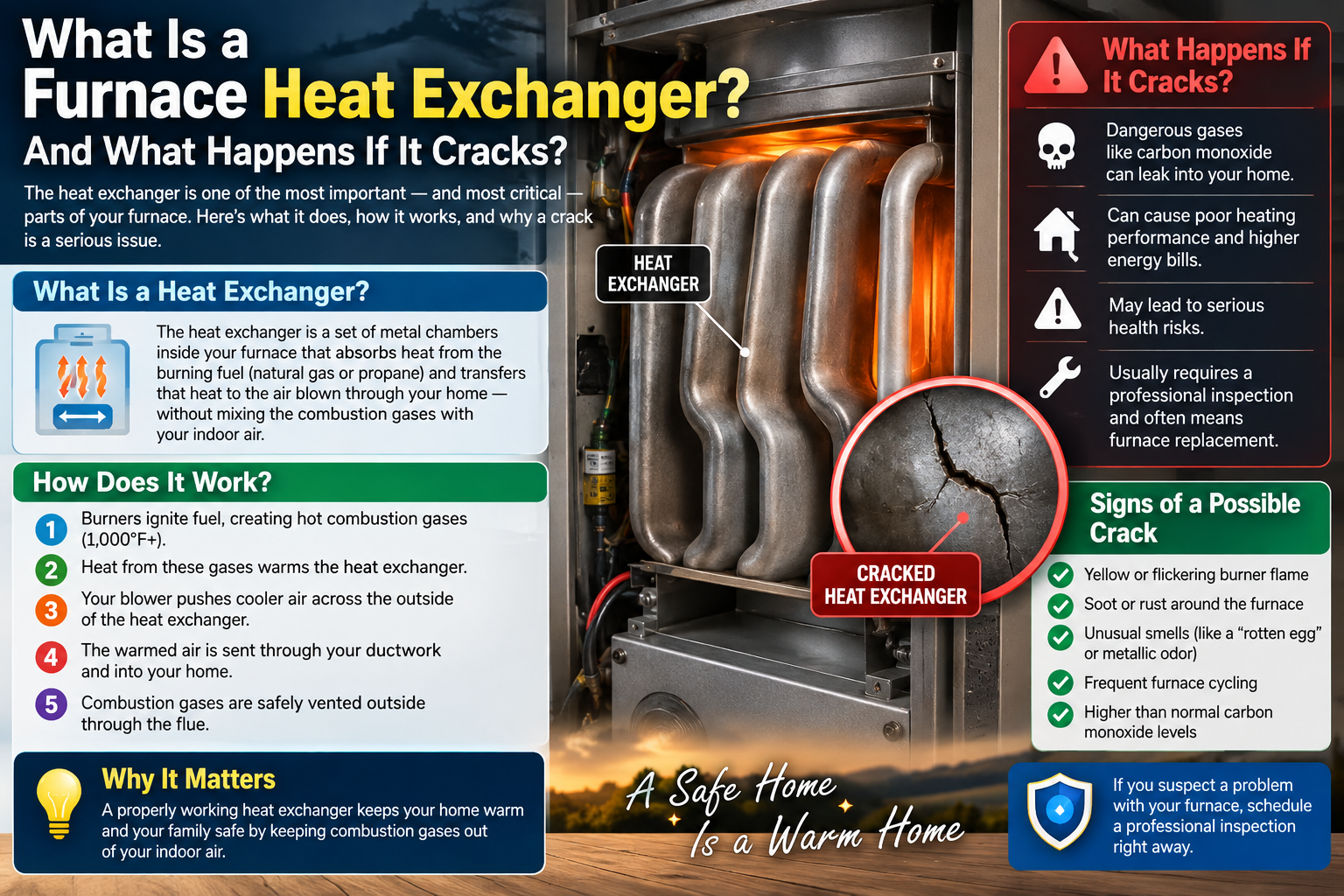
What Is Auxiliary Heat?
Auxiliary heat is supplemental heat that assists the heat pump when additional heating capacity is needed.
In many all-electric systems, this comes from:
Electric resistance heat strips.
The thermostat may display:
AUX HEAT
when this happens.
Does AUX HEAT Mean Something Is Wrong?
Not necessarily.
Auxiliary heat can be part of normal system operation.
For example, it may assist during:
- Very cold conditions
- Large thermostat recovery
- or certain system operating conditions.
The concern is when auxiliary heat operates:
Far more frequently than expected.
That can increase electricity consumption.
Can Cold Weather Cause a High Electric Bill With a Heat Pump?
It can.
A heat pump may:
Run longer
as temperatures fall.
And if electric auxiliary heat operates frequently, electricity consumption can increase further.
One homeowner with a cold-weather heat pump reported very high electricity use during unusually cold weather and discovered that the home’s insulation and auxiliary-heat operation were major parts of the equation.
That illustrates an important lesson:
Don’t evaluate the heat pump without evaluating the house.
Why Does Insulation Matter So Much?
Your HVAC system replaces heat your house loses.
If the house loses heat rapidly through:
- Attic
- Windows
- Doors
- Walls
- Air leaks
- or poorly insulated ducts,
the heating system has to replace that heat continuously.
Improve the building envelope and you reduce the heating load.
That can make a significant difference in how well a heat pump performs during colder weather.
Can a Heat Pump Keep a Poorly Insulated House Warm?
Possibly, if it has enough capacity.
But that does not mean the system will operate efficiently or economically.
A poorly insulated house may require much more heating capacity than an otherwise similar well-insulated home.
That’s why sizing a heat pump by:
Square footage alone
is not enough.
Why Is Proper Heat-Pump Sizing So Important?
Imagine two houses.
Both are:
2,000 square feet.
House A has:
- Good attic insulation
- newer windows
- sealed ducts
- and relatively low air leakage.
House B has:
- Poor insulation
- leaky ducts
- older windows
- and significant air leakage.
Those homes can have very different heating requirements.
That’s why equipment should be selected based on the home’s actual load—not just:
“2,000 square feet = X tons.”
What Is a Manual J Load Calculation?
A Manual J calculation is an established method for estimating residential heating and cooling loads.
It considers factors such as:
- Square footage
- Insulation
- Windows
- Orientation
- Air leakage
- Ceiling height
- Construction
- Climate
- and other characteristics.
For heat-pump installations, proper load calculation is particularly valuable because you’re selecting equipment for:
- Cooling
- and heating.
Should a Heat Pump Be Sized for Heating or Cooling?
This requires proper design.
In a mild climate, cooling demand may drive equipment selection differently than it would in an extremely cold climate.
But the contractor should still verify that the selected system provides adequate:
Heating capacity
at local winter design conditions.
You do not want to discover after installation that the equipment handles summer perfectly but struggles unnecessarily during winter.
Are Heat Pumps a Good Fit for Temecula?
They can be an excellent option.
Temecula and the surrounding Inland Empire experience much milder winters than areas such as:
- Minnesota
- Michigan
- Massachusetts
- or Canada.
That’s important.
A large portion of the national debate about heat pumps focuses on temperatures such as:
- 0°F
- -10°F
- or even colder.
Those are not normal Temecula Valley winter conditions.
That makes many of the scary statements homeowners read online about extreme cold much less relevant to a Southern California installation.
Can a Heat Pump Handle a Temecula Winter?
A properly selected and installed modern heat pump should be evaluated against Temecula’s actual climate and the home’s heating load.
The question shouldn’t be:
“Can heat pumps work in Alaska?”
It should be:
“Will this specific heat pump provide the heating capacity my Temecula home needs at our local winter design conditions?”
That’s a much better HVAC question.
What About Murrieta?
The same principle applies.
Homes in:
and much of Southwest Riverside County experience relatively mild winter conditions compared with cold-climate regions.
Heat pumps can therefore be very attractive in this market.
What About Hemet or Higher-Elevation Areas?
Local conditions matter.
Some surrounding communities can experience colder nighttime temperatures than central Temecula.
Higher elevations can also have different heating requirements.
That doesn’t mean:
Don’t use a heat pump.
It means:
Select the heat pump for the actual property.
What Is a Cold-Climate Heat Pump?
The term generally refers to heat pumps designed to maintain stronger heating performance at lower outdoor temperatures.
Many use:
- Variable-speed inverter compressors
- and sophisticated controls.
These systems can often maintain more capacity as temperatures fall than older conventional heat pumps.
But homeowners should compare actual manufacturer performance data rather than relying only on marketing terminology.
Do I Need a Cold-Climate Heat Pump in Southern California?
Not necessarily.
This is where good system design matters.
Buying equipment designed for extreme cold does not automatically make it the best choice for a Temecula home.
You should compare:
- Heating load
- Cooling load
- Equipment capacity
- Efficiency
- Comfort features
- Cost
- and local climate.
Sometimes a premium variable-capacity heat pump makes sense because of:
- Comfort
- Quiet operation
- Efficiency
- and modulation,
not because Temecula requires extreme-cold capability.
Do Variable-Speed Heat Pumps Perform Better in Cold Weather?
Many modern variable-capacity systems can maintain strong performance over a wide range of outdoor conditions.
An inverter compressor can adjust its operating speed instead of simply being:
100% ON
or
OFF.
That can help provide:
- Longer cycles
- More consistent temperatures
- Quiet operation
- and better capacity matching.
But equipment-specific performance still matters.
Does a Heat Pump Blow Cooler Air Than a Furnace?
Often, yes.
This is another reason homeowners sometimes believe the heat pump isn’t working.
A gas furnace can produce supply air that feels very hot.
A heat pump often provides:
- Warm air for longer periods
- rather than extremely hot air for shorter periods.
The house can still reach the same thermostat temperature.
The heating experience just feels different.
Will My House Feel Cold With a Heat Pump?
It shouldn’t if the system is:
- Properly sized
- Properly installed
- and the house can retain the heat being delivered.
A 2026 homeowner considering a move from gas heat specifically asked whether heat pumps feel cold during winter. Owners responding described remaining comfortable even during much colder conditions than Southern California normally experiences.
Comfort depends on the entire system.
Why Does My Heat Pump Run Longer When It’s Cold?
Because the house needs more heat.
Longer runtime can be completely normal.
Heat pumps—especially variable-speed models—are often designed to:
Run longer at lower capacity.
Is Running Constantly in Cold Weather Bad?
Not necessarily.
A properly operating variable-capacity heat pump may run for very long periods during colder weather.
That can actually provide excellent:
- Temperature stability
- and efficiency.
The better question is:
Is the house maintaining temperature?
What If My Heat Pump Runs Constantly but Can’t Reach the Thermostat Setting?
That deserves investigation.
Possible causes include:
- Insufficient heating capacity
- Air leakage
- Poor insulation
- Duct losses
- Refrigerant problem
- Outdoor-coil issue
- Airflow problem
- Backup heat problem
- or equipment malfunction.
A 2026 homeowner reported a recently installed heat pump that could not maintain indoor temperature during a cold snap, prompting questions about equipment capacity and backup heat.
That is a system-design and diagnostic issue—not proof that all heat pumps fail in cold weather.
Can Ductwork Affect Cold-Weather Performance?
Absolutely.
The heat pump can produce the correct amount of heat at the equipment and still deliver poor comfort if the duct system has:
- Leaks
- Restrictions
- Poor insulation
- Undersized returns
- or bad distribution.
Ducts running through an attic or other unconditioned space can also lose heat before it reaches the rooms.
Does Static Pressure Matter?
Yes.
High static pressure can reduce airflow and make the system work against excessive resistance.
Possible causes include:
- Restrictive filters
- undersized ductwork
- closed registers
- small return ducts
- or restrictive coils.
A good heat-pump installation should evaluate:
Equipment + airflow + ductwork
as a complete system.
Can I Replace My Furnace With a Heat Pump?
In many homes, yes.
But the contractor should evaluate:
- Electrical service
- Existing ductwork
- Heating load
- Cooling load
- Backup heat strategy
- Thermostat/control requirements
- and homeowner goals.
Do not assume a furnace can simply be removed and any heat pump dropped in its place.
Can I Keep My Gas Furnace and Add a Heat Pump?
Yes.
That’s the dual-fuel option.
This can be attractive for homeowners who want:
Heat-pump heating during mild weather
while retaining:
Gas backup heating.
Whether that is economically worthwhile depends on the property and utility costs.
Which Is Better in Temecula: Heat Pump or Gas Furnace?
There is no universal winner.
Compare:
- Installation cost
- Electricity rate
- Gas rate
- Equipment efficiency
- Solar
- Home insulation
- Existing electrical infrastructure
- Comfort preference
- and future plans.
For many Southern California homeowners, a heat pump deserves serious consideration because one system provides both:
- Heating
- and air conditioning.
What If I Have Solar?
Solar can make the economics of an electric heat pump especially interesting.
But solar does not automatically mean:
Heat pump = free heating.
Consider:
- System production
- Electric usage
- Utility rate structure
- Battery storage
- and total household load.
Still, electrifying heating can allow a homeowner to use more of their home’s energy through the electrical system rather than purchasing natural gas.
What Temperature Should I Set My Heat Pump At?
There is no special magic heat-pump thermostat setting.
Choose a comfortable indoor temperature.
But very large temperature setbacks can sometimes trigger:
- Long recovery periods
- or auxiliary heat.
Moderate changes may work better depending on the system.
Should I Turn My Heat Pump Off When It Gets Cold?
Not simply because outdoor temperature reaches some arbitrary number you saw online.
The system should be configured according to:
- Manufacturer performance
- Home heating load
- and backup heating strategy.
A homeowner in a colder climate recently asked whether a heat pump should automatically be shut down below a specific temperature before the furnace takes over. The discussion correctly pointed out that the answer depends on both capacity and economics, not one universal cutoff.
What Is a Heat-Pump Lockout Temperature?
Some systems allow controls to prevent heat-pump operation below a selected outdoor temperature.
This can be useful in certain:
- Dual-fuel
- or backup-heat configurations.
But the lockout should not be chosen randomly.
Setting it too high may prevent you from using efficient heat-pump heating when the equipment could still operate effectively.
Should My Heat Pump Shut Off at 40°F?
Not automatically.
For many modern heat pumps:
40°F is nowhere near their minimum operating temperature.
An arbitrary 40-degree lockout could eliminate a lot of useful heat-pump operation.
Use the actual equipment data.
Should It Shut Off at 32°F?
Again:
Not automatically.
Freezing outdoor temperature does not mean a heat pump suddenly becomes incapable of heating.
Modern equipment can operate below freezing.
What About 20°F?
Same answer.
Some heat pumps can still provide substantial heating capacity at 20°F.
Others may have different performance.
The actual model matters.
What About 0°F?
Now equipment selection becomes much more important.
Some systems are specifically engineered to continue operating at very low temperatures.
Others may require substantial backup heat.
This is exactly why homeowners in colder regions are actively discussing whether cold-climate heat pumps can handle temperatures near or below zero.
For a Temecula homeowner, however, designing around prolonged 0°F weather generally isn’t the central concern it would be in Canada or New England.
Why Does a Heat Pump Need to Defrost?
During heating, the outdoor coil becomes cold.
Moisture from outdoor air can freeze on it.
A small amount of frost can be normal.
The heat pump periodically enters:
Defrost mode
to remove it.
Does Defrost Mean the Heat Pump Can’t Handle Cold Weather?
No.
Defrost is part of normal heat-pump operation.
The problem is when:
- Ice becomes excessive
- Defrost doesn’t work
- or the outdoor coil remains heavily frozen.
What Should I Ask Before Buying a Heat Pump?
Instead of asking only:
“What tonnage is it?”
ask your HVAC contractor:
- What is my home’s heating load?
- What is the heat pump’s heating capacity at our winter design temperature?
- How does capacity change as outdoor temperature drops?
- What is the backup heat strategy?
- Will I have electric auxiliary heat or dual fuel?
- What are the ductwork and airflow requirements?
- Does my electrical system need upgrades?
- Is this single-stage, two-stage or variable capacity?
Those questions tell you much more about how the system will actually perform.
Frequently Asked Questions
How cold is too cold for a heat pump?
There is no universal temperature. The answer depends on the specific heat pump, its low-temperature capacity, the home’s heating load and the backup-heating design.
Do heat pumps work below freezing?
Yes. Many modern heat pumps operate below 32°F.
Do heat pumps stop working at 40°F?
Modern heat pumps do not universally stop working at 40°F. Equipment performance varies by model.
Will a heat pump work in Temecula during winter?
A properly selected and installed heat pump can be an excellent heating option for Temecula’s relatively mild winter climate.
Do I need a furnace with a heat pump?
Not necessarily. Homes may use an all-electric heat pump with electric backup, or a heat pump paired with a gas furnace in a dual-fuel system.
What is the balance point?
It is roughly the outdoor temperature where the heat pump’s available heating capacity equals the home’s heating requirement.
What is the economic balance point?
It is the point where another heating source may become less expensive to operate based on fuel prices and equipment efficiencies.
Does a heat pump get less efficient when it’s colder?
Heat-pump efficiency generally changes as outdoor temperature falls. The amount varies significantly by equipment.
Why does my heat pump run so long when it’s cold?
The house loses heat faster during colder weather, so the system may need longer operating periods.
Does AUX heat mean my heat pump isn’t working?
No. Auxiliary heat can be a normal supplemental heating source.
Can a heat pump work without backup heat?
Some systems and climates allow this, but it depends on equipment capacity and the home’s heating load.
Are variable-speed heat pumps better?
They can provide advantages in capacity control, comfort, noise and efficiency, but proper sizing and installation remain essential.
Are heat pumps good with solar?
They can pair very well with an electrified home and solar system, although actual economics depend on production, consumption and utility rates.
Should I turn my heat pump off below 32°F?
Not simply because the outdoor temperature falls below freezing. Follow the equipment design and control strategy.
Don’t Choose a Heat Pump by One Temperature
This is the biggest takeaway.
Don’t ask only:
“How cold can this heat pump go?”
Ask:
How much heat does it produce at lower temperatures? → How much heat does my house need at those temperatures? → How efficient is the equipment under those conditions? → What happens when the heat pump needs assistance? → What will that cost to operate?
That’s how a heat-pump system should be evaluated.
A heat pump being technically capable of operating at an extremely low temperature is interesting.
But for a homeowner in Temecula or Southwest Riverside County, the much more important question is:
How will this system perform in our climate, in my house, with my ductwork and my utility rates?
That’s the answer that matters.
Heat Pump Installation in the Temecula Valley
Advanced Heating & Air Conditioning installs heat pumps throughout Temecula, Murrieta, Menifee, Winchester, Wildomar, French Valley, Canyon Lake, Lake Elsinore, Hemet and surrounding communities.
When evaluating a heat pump, Advanced can help homeowners consider the complete system—including heating and cooling requirements, equipment capacity, ductwork, airflow, electrical requirements, thermostat controls and backup-heating options.
Advanced Heating & Air Conditioning
951-609-9881
California Contractor License #916901
REAL PEOPLE. REAL SERVICE. REAL COMFORT.