


Heat Pump vs. Air Conditioner in Southern California
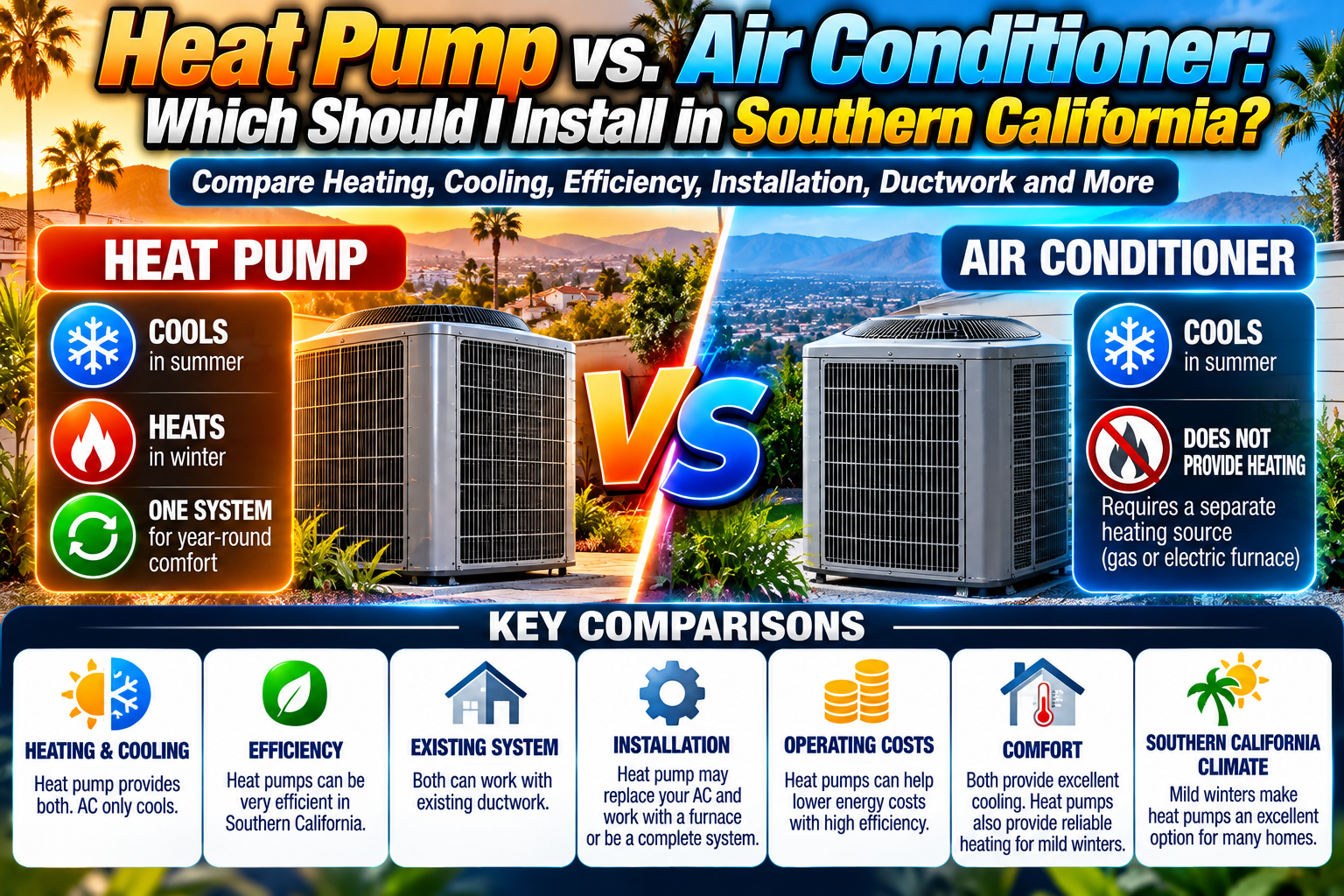
Heat Pump vs. Air Conditioner: Which Should I Install in Southern California?
When it is time to replace an air conditioner, many Southern California homeowners are surprised when their HVAC contractor gives them another option:
Install a heat pump instead.
That immediately creates questions.
- Is a heat pump also an air conditioner?
- Will it cool my house as well as a traditional AC?
- Can I keep my gas furnace?
- Will a heat pump actually heat my home in winter?
- Is it more efficient?
- Is it worth the additional cost?
- Which one makes more sense in Temecula, Murrieta or Menifee?
There isn’t one answer for every house.
But Southern California’s climate makes heat pumps an option homeowners should seriously consider when replacing an HVAC system.
And at Advanced Heating & Air Conditioning, we install a lot of heat pumps because they can be an excellent fit for our climate.
First: Is a Heat Pump an Air Conditioner?
Essentially, yes—with an important difference.
A traditional central air conditioner transfers heat:
From inside your house → outdoors.
That cools the home.
A heat pump does the same thing during summer.
But when you need heating, the heat pump can reverse the refrigeration cycle.
Now it transfers heat:
From outdoors → into your house.
So instead of having equipment that provides only cooling, a heat pump can provide:
Cooling + Heating.
That’s the fundamental difference.
Does a Heat Pump Cool as Well as a Regular Air Conditioner?
Yes, when the equipment is properly selected, sized and installed.
During cooling operation, a central heat pump operates using the same basic refrigeration principles as a central air conditioner.
Both use components such as:
- Compressor
- Outdoor coil
- Indoor coil
- Refrigerant
- Metering device
- and indoor blower.
The heat pump isn’t giving up air-conditioning capability just because it can also heat.
Then Why Would Someone Buy a Regular AC?
Because a conventional AC can still make sense in certain HVAC configurations.
For example, a homeowner may have:
- A relatively new gas furnace
- but an old failed air conditioner.
They may simply want to replace the cooling equipment while keeping their existing heating arrangement.
Another homeowner may be replacing:
The entire HVAC system
and want to consider electrification or have the option of heating with electricity.
That homeowner may find a heat pump much more attractive.
Heat Pump vs. AC: The Biggest Difference
The easiest way to understand the decision is:
Traditional Air Conditioner
Cools the house.
It requires a separate heating source, such as:
- Gas furnace
- or electric furnace.
Heat Pump
Cools the house AND heats the house.
Depending on system design, it can be paired with:
- An air handler
- Electric auxiliary heat
- or even a gas furnace in a dual-fuel system.
That flexibility is one reason we like heat pumps.
Can I Replace My AC With a Heat Pump?
In many homes:
Yes.
But don’t assume that replacing the outdoor condenser is the only thing involved.
The HVAC contractor should evaluate:
- Indoor coil compatibility
- Furnace or air handler
- Refrigerant requirements
- Electrical service
- Thermostat
- Ductwork
- Airflow
- System capacity
- and equipment matching.
The entire system needs to work together.
Can I Keep My Existing Gas Furnace and Add a Heat Pump?
Potentially.
This creates what is commonly called a:
The heat pump can provide heating during appropriate conditions.
The gas furnace can provide another heating source when the controls determine it should take over.
That gives homeowners the ability to use:
- Electric heat-pump heating
- plus gas furnace heating.
Why Are Heat Pumps Especially Interesting in Southern California?
Because our winters are generally much milder than those in many northern climates.
That matters.
Heat pumps transfer heat rather than generating all their heat through electric resistance.
Modern heat pumps can operate across a broad range of outdoor temperatures, and Southern California usually doesn’t experience the prolonged extreme cold seen in northern states.
That makes areas such as:
very interesting markets for heat-pump technology.
Does a Heat Pump Work When It’s Cold Outside?
Yes.
One of the biggest heat-pump myths is:
“There isn’t any heat outside when it’s cold.”
There is.
Even cold outdoor air contains thermal energy.
A heat pump uses the refrigeration cycle to absorb some of that heat and transfer it indoors.
As outdoor temperature drops, however, heating capacity and efficiency can change.
How much depends heavily on the particular heat pump.
Do Heat Pumps Stop Working at 40 Degrees?
No.
That is outdated as a universal rule.
Different heat pumps have different:
- Operating ranges
- Heating capacities
- and low-temperature performance.
Some modern systems are specifically engineered to provide significant heating capacity at temperatures well below freezing.
Homeowners online still ask what outdoor temperature requires backup or emergency heat, but the answer depends on the equipment and the heating load of the house—not one universal temperature.
For Southern California homeowners, the better question is:
How will this specific heat pump perform at our local winter design conditions?
What Is the Difference Between a Heat Pump and an AC Outside Unit?
They can look nearly identical.
Both may have:
- Fan
- Coil
- Compressor
- and similar cabinets.
The important difference is inside the refrigeration system.
A heat pump contains components that allow refrigerant flow to change for heating operation, including a:
Reversing valve.
That is why you usually cannot determine whether something is an AC or heat pump just by looking at the cabinet from across the yard.
Which One Is More Efficient for Cooling?
Don’t assume:
Heat pump = automatically more efficient AC.
Cooling efficiency depends on the actual equipment rating and system.
Compare:
SEER2
and other applicable manufacturer specifications.
A high-efficiency AC can outperform a lower-efficiency heat pump in cooling.
Likewise, a high-efficiency heat pump can outperform a basic AC.
Compare actual equipment—not just equipment categories.
What Is SEER2?
SEER2 is an efficiency metric used for cooling performance.
In simplified terms:
Higher SEER2 = more cooling delivered per amount of electricity consumed under the rating procedure.
But efficiency ratings are only one part of real-world performance.
Actual energy use also depends on:
- Equipment sizing
- Duct leakage
- Airflow
- Thermostat settings
- Insulation
- Outdoor temperature
- Installation quality
- and how much the system runs.
How Is Heat-Pump Heating Efficiency Measured?
Heat pumps also have heating-performance ratings.
Depending on the equipment and rating information, you may see metrics such as:
- HSPF2
- and COP.
These describe heating efficiency in different ways.
The important point for homeowners is:
Don’t evaluate a heat pump only by its cooling SEER2 rating.
If you’re buying it for heating too, look at heating performance.
What Is COP?
COP stands for:
Coefficient of Performance.
It compares heat delivered to electrical energy consumed under specified conditions.
A COP above 1 means the heat pump delivers more heat energy than the electrical energy it consumes because it is:
Moving heat
rather than converting electricity directly into heat through resistance alone.
This is one of the reasons heat pumps can be so attractive.
Is a Heat Pump the Same as Electric Resistance Heat?
No.
This distinction is extremely important.
An electric furnace or heat strip generates heat using electrical resistance.
A heat pump primarily uses electricity to:
Move heat.
Those are very different processes.
Homeowners sometimes hear:
“Heat pumps are electric.”
and assume that means:
“They’re basically giant space heaters.”
They aren’t.
Does a Heat Pump Need Heat Strips?
Not every system is designed the same way.
Some heat-pump systems use electric auxiliary heat.
Others may use a gas furnace as backup.
Some installations and climates may allow the heat pump to carry most or nearly all heating demand.
The correct backup strategy depends on:
- Equipment
- Climate
- Heating load
- Electrical capacity
- and homeowner priorities.
What About Emergency Heat?
Emergency heat is often misunderstood.
It generally allows the backup heating source to operate without relying on normal heat-pump compressor heating.
It is not a setting homeowners should automatically turn on just because the weather gets chilly.
Homeowners continue to ask whether they are supposed to manually switch to emergency heat below a particular outdoor temperature.
Modern controls can manage auxiliary heating based on the system design.
Will a Heat Pump Make My Electric Bill Go Up?
Maybe.
But that question needs context.
If you previously heat with:
Natural gas
and switch some or all heating to:
Electricity,
then naturally your electricity consumption can increase.
But your:
Gas consumption may decrease.
So don’t compare only:
Old electric bill → New electric bill.
Compare total household energy cost.
Is a Heat Pump Always Cheaper Than Gas Heating?
No.
That depends on:
- Electricity rates
- Gas rates
- Heat-pump efficiency
- Outdoor temperature
- Furnace efficiency
- Thermostat strategy
- and the home’s heating load.
This is another reason we should avoid simplistic marketing claims like:
“A heat pump will cut everyone’s heating bill.”
It might.
But it isn’t guaranteed.
Can Solar Make a Heat Pump More Attractive?
Potentially.
A homeowner with solar may be interested in moving more home energy use toward electricity.
That can make heat-pump heating particularly interesting.
But the economics depend on:
- Solar production
- Electric rate plan
- Battery configuration
- Annual heating use
- and other household loads.
Solar doesn’t automatically mean a heat pump will be free to operate.
Can a Battery Run My Heat Pump?
Potentially, depending on the battery system, HVAC equipment, electrical design and startup/current requirements.
This needs to be evaluated as part of the home’s electrical system.
Don’t assume every home battery can automatically power every central HVAC system during an outage.
Which Feels Warmer: Heat Pump or Gas Furnace?
Gas-furnace supply air can often feel hotter.
A heat pump commonly delivers:
- Lower-temperature air
- for longer periods.
That doesn’t necessarily mean the house is less comfortable.
In fact, longer cycles can produce very even temperatures.
But the comfort sensation can be different.
Someone accustomed to the strong burst of hot furnace air may initially notice the change.
Does a Heat Pump Run Longer Than an AC?
During cooling, cycle behavior depends on the equipment and load.
During heating, particularly with:
- Variable-speed
- or inverter-driven equipment,
long operating periods can be normal.
A heat pump may intentionally run:
- Longer
- at lower capacity.
That can improve comfort and reduce large temperature swings.
Does Running Longer Mean It Uses More Electricity?
Not automatically.
Runtime alone does not tell you energy consumption.
For example:
- System A: runs 20 minutes at high power.
- System B: runs 50 minutes at much lower power.
You cannot determine which used more electricity simply from the clock.
You need to know:
Power consumption × runtime.
What About Variable-Speed Heat Pumps?
This is one of the reasons we’re excited about modern heat-pump technology.
Variable-capacity equipment can adjust output based on demand.
Instead of only:
100% ON
or
OFF,
the system may operate across a range of capacities.
That can provide:
- Longer cycles
- More even temperatures
- Quieter operation
- and potentially better efficiency.
Are Variable-Speed Heat Pumps Quieter?
They can be, particularly at lower operating speeds.
The compressor and outdoor fan may not need to operate at full capacity all the time.
But equipment selection and placement still matter.
Can I Use My Existing Ductwork With a Heat Pump?
Often:
Yes.
But existing ductwork should not automatically be assumed to be adequate.
The contractor should evaluate:
- Supply capacity
- Return capacity
- Static pressure
- Duct leakage
- Insulation
- Register sizing
- and airflow requirements.
A brand-new heat pump connected to poor ductwork can still produce:
- Hot rooms
- Cold rooms
- Noise
- High static pressure
- and disappointing comfort.
Does a Heat Pump Need Different Ductwork Than AC?
Not necessarily.
A ducted heat pump uses the home’s supply and return system similarly to central AC.
But heating airflow requirements and equipment combinations still need to be considered.
If the existing ducts are undersized, replacing the outdoor equipment does not fix that.
Can I Use My Existing Furnace Blower?
Potentially, depending on compatibility.
The contractor needs to verify that the furnace or air handler can provide the airflow and control functions required by the new heat pump.
This is especially important when pairing:
- Older indoor equipment
- with newer high-efficiency outdoor equipment.
Do I Need to Replace My Indoor Coil?
Often when replacing outdoor refrigeration equipment, matched indoor equipment matters.
The indoor coil needs to be compatible with:
- Refrigerant
- Capacity
- Efficiency certification
- and manufacturer requirements.
Do not assume an old evaporator coil should automatically remain.
Can I Put a Heat Pump on an Existing Furnace?
Potentially.
That’s one common way to create a dual-fuel system.
But the:
- Coil
- furnace
- blower
- thermostat
- heat pump
- and controls
need to work together correctly.
What About an All-Electric Heat Pump System?
Another option is:
Heat pump + air handler
without a gas furnace.
Depending on the system, electric auxiliary heat may also be included.
This can eliminate combustion heating from the HVAC system.
For some Southern California homes, that’s an attractive option.
Does Going All-Electric Require Electrical Upgrades?
Sometimes.
The contractor should evaluate:
- Electrical panel
- Breaker capacity
- Circuit requirements
- Heat-strip load
- and the outdoor equipment.
This is especially important when converting from gas heating.
Is a Heat Pump Better for Indoor Air Quality?
Not automatically.
Both AC and heat-pump systems can use:
- Good filtration
- Air purification
- Humidity strategies
- and proper ventilation.
Indoor air quality depends more on the entire HVAC design than whether the outdoor unit is technically an AC or heat pump.
Does a Heat Pump Remove Humidity Like an AC?
Yes.
During cooling, a heat pump can remove indoor moisture as air passes over the cold indoor coil.
Proper sizing matters.
An oversized system that cools the home too quickly may have shorter cycles and less dehumidification opportunity.
Is a Heat Pump Better for a Two-Story Home?
It can be an excellent system, but equipment type alone does not solve two-story comfort problems.
Uneven temperatures may involve:
- Duct design
- Return-air pathways
- Insulation
- Solar exposure
- Air leakage
- or zoning.
A heat pump should be part of a properly designed comfort system.
Is a Heat Pump Better for New Construction?
It can be especially attractive.
New construction allows the HVAC system to be designed around:
- Actual heating/cooling loads
- Correct ducts
- Electrical infrastructure
- Equipment location
- and energy-efficiency goals.
That is much easier than trying to correct poor existing infrastructure later.
What If My Current AC Is Still Working?
You do not necessarily need to replace functioning equipment solely because heat pumps are available.
Consider:
- System age
- Repair history
- Efficiency
- Comfort
- Upcoming repair costs
- and future plans.
If your existing equipment is reliable and performing well, continuing to use it can be reasonable.
But when replacement time comes:
Ask for the heat-pump option.
What If My AC Is 15–20 Years Old?
Then replacement planning becomes much more relevant.
An older system may have:
- Lower efficiency
- Older refrigerant technology
- Increasing repair risk
- and aging components.
Rather than automatically replacing:
AC with another AC,
ask the contractor to quote:
- AC option
- and heat-pump option.
Then compare them properly.
Should I Wait Until My AC Completely Dies?
That’s a personal decision.
But planning before failure has advantages.
When the AC fails during a Temecula heat wave, homeowners often care about one thing:
“How fast can you install something?”
Planning ahead gives you more time to evaluate:
- Heat pump vs AC
- Efficiency levels
- Variable-speed equipment
- Dual fuel
- Ductwork
- Financing
- and electrical considerations.
Is a Heat Pump More Expensive to Install?
It can be.
But don’t compare only the outdoor-unit price.
Compare the complete HVAC systems and what each provides.
An AC gives you:
Cooling.
A heat pump provides:
Cooling + heating capability.
Installation price can also change based on:
- Efficiency
- Equipment tier
- Indoor equipment
- Electrical work
- Ductwork
- Thermostat
- and installation complexity.
Are Heat Pumps More Expensive to Repair?
Not necessarily across the board.
Heat pumps share many components with air-conditioning systems.
But because they operate during both:
- Cooling season
- and heating season,
the outdoor equipment may accumulate more annual runtime.
They also include heat-pump-specific components such as the:
- Reversing valve
- and defrost controls.
Does a Heat Pump Last as Long as an AC?
Lifespan varies tremendously.
Factors include:
- Installation quality
- Maintenance
- Runtime
- Climate
- Airflow
- Refrigerant charge
- Equipment quality
- and operating conditions.
Because a heat pump may operate year-round, annual runtime can be greater than cooling-only equipment.
That does not mean heat pumps inherently have short lives.
Which One Is Better for Temecula?
There is no automatic winner for every home.
But heat pumps deserve serious consideration here because they can provide:
- Excellent cooling
- plus efficient electric heating
in a relatively mild winter climate.
For a homeowner replacing an entire HVAC system, we would strongly recommend at least comparing a heat-pump option.
Which One Is Better for Murrieta?
The same principle applies.
Murrieta’s climate is very compatible with evaluating heat-pump heating.
The decision should still account for:
- House load
- Existing furnace
- Electric/gas rates
- Solar
- ductwork
- and homeowner goals.
What About Menifee and Winchester?
Heat pumps can also be excellent options in inland communities.
However, hotter summer conditions make:
- Proper cooling sizing
- Outdoor-unit performance
- Ductwork
- and airflow especially important.
Never choose equipment based only on:
Square footage.
Do Heat Pumps Work in Lake Elsinore?
Yes, properly selected heat pumps can provide both heating and cooling.
Again, equipment should be sized for the actual building load and installation conditions.
What Size Heat Pump Do I Need?
Not:
“My neighbor has a 4-ton, so I need a 4-ton.”
Proper sizing considers:
- Square footage
- Windows
- Insulation
- Orientation
- Ceiling height
- Air leakage
- Occupancy
- Ductwork
- and local design conditions.
Is Bigger Better?
No.
An oversized heat pump can create:
- Short cycling
- Temperature swings
- Noise
- and weaker humidity control.
What Should I Ask My HVAC Contractor?
Before deciding between an AC and heat pump, ask:
- What are my actual heating and cooling loads?
- Can my existing ductwork handle the required airflow?
- What is the static pressure?
- Can I keep my furnace?
- Would dual fuel make sense?
- What would an all-electric system require?
- What SEER2 and heating efficiency am I getting?
- Is the equipment single-stage, two-stage or variable capacity?
- What thermostat/control does it require?
- What electrical upgrades are needed?
- What warranties apply?
Those questions create a much better buying decision than simply asking:
“How many tons?”
Frequently Asked Questions
Is a heat pump better than an air conditioner?
Neither is automatically better. Both can provide excellent cooling, but a heat pump can also provide heating.
Does a heat pump cool as well as central AC?
Yes. Properly sized and installed heat pumps can provide excellent central air conditioning.
Can a heat pump replace my air conditioner?
Often, yes, although indoor equipment, controls, refrigerant compatibility, electrical requirements and ductwork need to be evaluated.
Can I keep my gas furnace with a heat pump?
Potentially. This is commonly called a dual-fuel system.
Do I need a furnace if I install a heat pump?
Not necessarily. Some homes use a heat pump with an air handler and electric backup rather than a gas furnace.
Are heat pumps good in Southern California?
They can be an excellent fit because Southern California generally has mild winters while still requiring substantial summer cooling.
Do heat pumps work below 40°F?
Yes. Modern heat pumps can operate below 40°F. Actual capacity and efficiency depend on the specific equipment.
Is a heat pump just electric heat?
No. A heat pump transfers heat through a refrigeration cycle rather than producing all heating through electric resistance.
Does a heat pump use more electricity than AC?
During cooling, consumption depends on equipment efficiency and operating conditions. A heat pump also uses electricity for heating, so annual electric use needs to be considered alongside reduced use of other heating fuels.
Are variable-speed heat pumps worth considering?
Yes. They can provide excellent comfort, quieter low-capacity operation and efficient performance when properly sized and installed.
Can I use my existing ducts?
Often, but the ducts should be evaluated for sizing, leakage, insulation, airflow and static pressure.
Can solar make a heat pump a better choice?
Potentially. Solar can make electrification attractive, but actual economics depend on production, rate plan and household energy use.
Should I replace a working AC with a heat pump?
Not automatically. But when replacement becomes necessary, a heat pump should be one of the options you compare.
AC Replacement Time Is the Perfect Time to Ask About a Heat Pump
This is the biggest takeaway.
If your existing air conditioner fails, don’t automatically say:
“Put another AC exactly where the old one was.”
Ask:
What would a heat pump look like for my house?
Then compare:
- Traditional AC + furnace
- versus heat pump + furnace
- versus heat pump + air handler.
Look at:
- Installation cost
- Heating and cooling performance
- Efficiency
- Utility costs
- Comfort
- Equipment staging
- Electrical requirements
- Ductwork
- and long-term plans for the home.
For many Southern California homeowners, a heat pump can be an excellent solution.
And because Advanced Heating & Air Conditioning already installs both conventional HVAC systems and heat pumps, the conversation doesn’t need to start with:
“Which product do we want to sell?”
It should start with:
“Which system makes the most sense for this home?”
Heat Pump Installation in the Temecula Valley
Advanced Heating & Air Conditioning installs heat pumps and complete HVAC systems throughout Temecula, Murrieta, Menifee, Winchester, Wildomar, French Valley, Canyon Lake, Lake Elsinore, Hemet and surrounding communities.
When evaluating a heat pump, the system should be considered as a whole—including equipment sizing, airflow, ductwork, static pressure, thermostat/control compatibility, electrical requirements and the homeowner’s heating and cooling goals.
Advanced Heating & Air Conditioning
951-609-9881
California Contractor License #916901
REAL PEOPLE. REAL SERVICE. REAL COMFORT.